Background Information
How often does meditation go wrong? Earlier posts on this site have looked at the kinds of difficult experiences practice can bring. These range from
depersonalization
Depersonalization is a dissociative experience characterized by feelings of detachment from one’s self, body, or mental processes. Individuals experiencing depersonalization may feel like an outside observer of their thoughts, feelings, or body, or they may feel as if they’re in a dream. It can occur as a temporary response to stress, as a symptom of psychiatric disorders, or as a feature of certain meditation experiences.
More on Wikipedia
View in glossary
(feeling detached from one’s own thoughts, body or sense of self) to the 59 types of challenges that Lindahl and colleagues catalogued in interviews with practitioners and teachers. What those studies could not say is how common such experiences are.
Estimates so far have varied widely. A 2020 systematic review put the overall rate of adverse events at 8.3%, but at 3.7% in experimental studies and 33.2% in observational ones. Part of the problem is how researchers ask. Many trials record only serious events, or none at all.
Simon Goldberg and colleagues, including Willoughby Britton (a co-author of the Lindahl study) and Richard Davidson, set out to estimate how common
meditation-related adverse effects
Meditation-related adverse effects are unpleasant experiences that a person attributes to meditation practice, ranging from mild and brief to severe and lasting. Examples include anxiety, re-living traumatic memories, trouble sleeping and feeling disconnected from oneself or the world. Researchers usually record how long each effect lasted and whether it interfered with daily functioning.
View in glossary
are among ordinary Americans who have tried meditation. The team defined adverse effects as side effects that feel unpleasant, from mild to severe.
What They Did
The researchers recruited adults through Prolific, an online research platform, using quotas for age, gender and race based on US Census data. Of 953 people who completed a screening survey, 470 said they had tried
mindfulness
Mindfulness is the psychological process of purposely bringing one’s attention to experiences occurring in the present moment without judgment. It involves maintaining awareness of thoughts, feelings, bodily sensations, and surrounding environment with an attitude of curiosity and acceptance. In meditation contexts, mindfulness practices typically involve focusing attention on the breath or body sensations as anchors to the present moment while acknowledging and releasing distracting thoughts.
More on Wikipedia
View in glossary
, mantra or spiritual meditation at least once. Of those, 434 (92%) completed a longer follow-up questionnaire.
Participants answered two kinds of questions about adverse effects. The first was a single general question: had meditation ever led to challenging, difficult or distressing experiences? The second was a checklist of 10 specific effects, such as anxiety, trouble sleeping and feeling disconnected from everything, each with how long it had lasted. Participants also rated whether any effect had interfered with their daily functioning, and for how long.
The survey also covered lifetime hours of practice, retreat attendance, current depression and anxiety, and
adverse childhood experiences
Adverse childhood experiences are potentially traumatic events that happen before age 18, such as abuse, neglect, or growing up with household substance use or violence. Researchers usually measure them with a short yes/no questionnaire and add up the total. Higher ACE scores are associated with poorer physical and mental health in adulthood, and in meditation research they have been linked to a higher chance of meditation-related adverse effects.
More on Wikipedia
View in glossary
(difficult events before age 18, such as abuse or household dysfunction). Most participants were light practitioners. About 60% reported 100 lifetime hours or fewer, and fewer than 7% had attended a residential retreat.
One Big Result: Half Reported an Adverse Effect, but Few Were Impaired
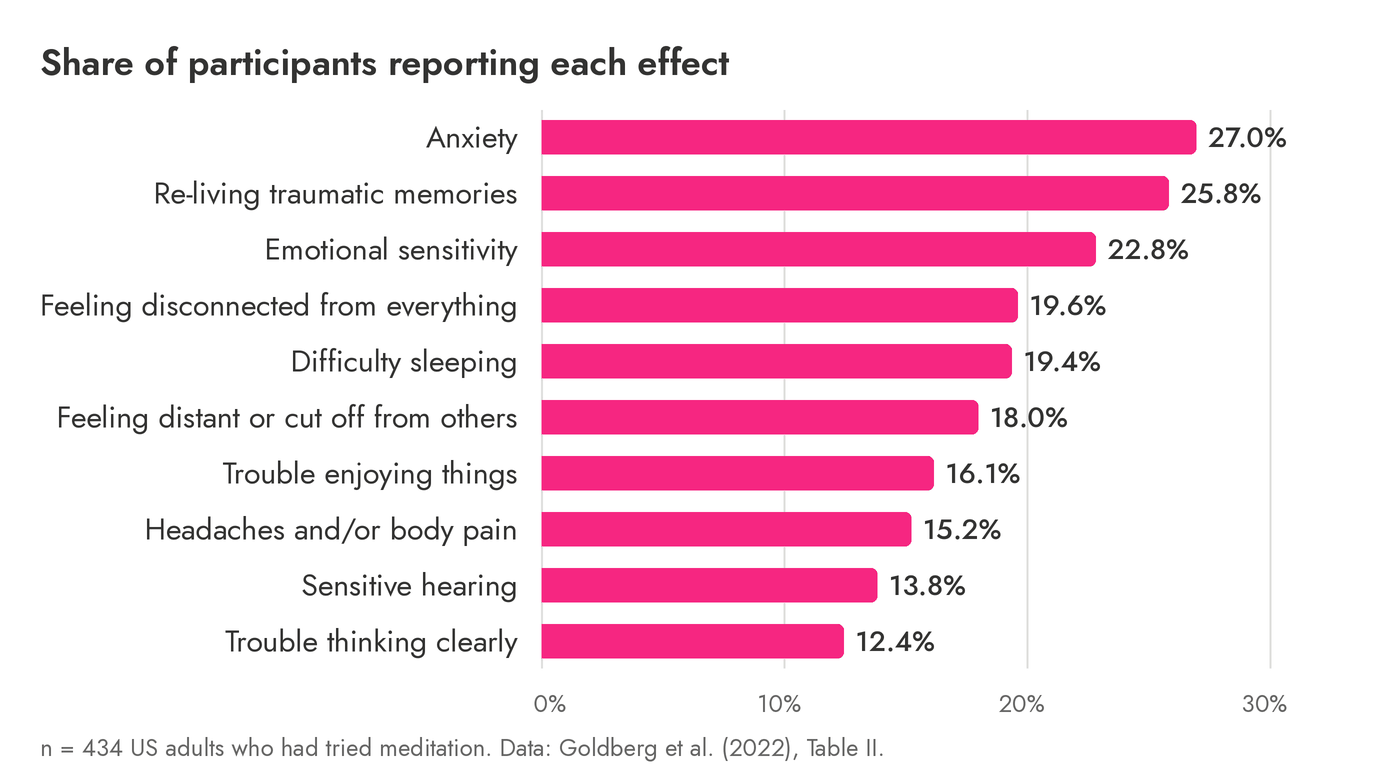
Asked the general question, 32.3% of participants said meditation had at some point led to a challenging or distressing experience. With the specific checklist, that figure rose to 50%. The most common effects were anxiety (27%), re-living traumatic memories (26%) and heightened emotional sensitivity (23%).
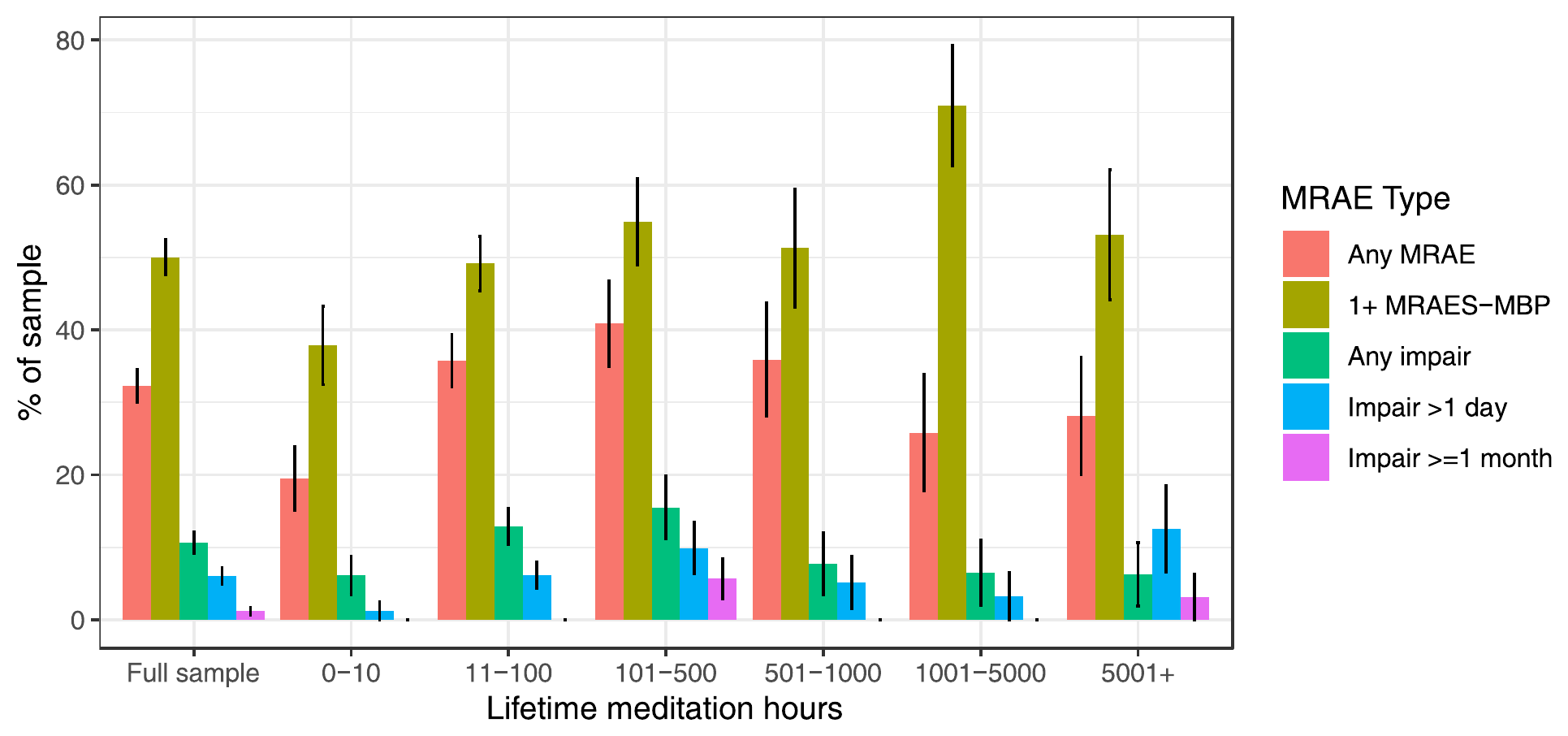
Most of these effects were short-lived. For 30% of participants, the longest-lasting effect passed within a week. About 1 in 10 (10.4%) had an effect that lasted a month or more.
Effects that disrupted daily life were less common. In total, 10.6% reported some impact on their functioning, and most of it was mild: 7.1% said “somewhat,” 2.3% “moderately” and 0.2% “severely.” Impairment lasting a month or longer was reported by 1.2% of the sample.
Miscellaneous Interesting Takeaways
How You Ask Changes the Answer
The jump from 32% to 50% came from the same people answering different questions. A broad question about “difficult experiences” may not bring to mind a week of poor sleep or unusual emotional sensitivity, while a specific checklist does. The authors note that prevalence estimates may shift with the measure used, and that comparing meditation with other treatments will be difficult until similar data exist for them.
Childhood Adversity Was Linked to More Adverse Effects
One of the team’s four preregistered hypotheses was that people with more adverse childhood experiences would report more adverse effects. They did, though the link was modest (a correlation of r = .19, a small
effect size
Effect size is a statistical concept that quantifies the magnitude or strength of a relationship, difference, or intervention outcome. Unlike p-values which only indicate statistical significance, effect sizes measure how meaningful a result is in practical terms. Common measures include Cohen’s d (standardized mean difference), correlation coefficients (r), and odds ratios. In meditation research, effect sizes help quantify the practical impact of different meditation practices on psychological or physiological outcomes.
More on Wikipedia
View in glossary
, where 0 means no relationship and 1 a perfect one). Childhood adversity was also linked to impairment (r = .15).
In exploratory analyses, current depression and anxiety, and more lifetime hours of practice, were also associated with more adverse effects. Practice hours were not linked to any impairment, and retreat attendance showed no reliable link. Because everything was measured at once, these associations can’t show which came first.
Nearly 9 in 10 Were Glad They Practiced
Overall, 88.7% of participants said they were glad to have practiced meditation. That figure was almost the same among those who reported an adverse effect (about 88%). How glad people felt was essentially unrelated to whether they had experienced adverse effects.
Final Reflection
Taken together, the findings suggest that unpleasant experiences may be a fairly common part of meditation for everyday practitioners, while lasting disruption to daily life appeared uncommon in this sample. “Rare” doesn’t fit effects that half the participants reported. “Dangerous” doesn’t fit effects that most people described as brief and still considered worth it.
Because this was a one-time survey of mostly light practitioners, it can’t show that meditation caused these effects, or say what happens during intensive retreats. What it does suggest is that the questions matter. Teachers and researchers may learn more by asking specifically than by waiting to be told.
Citation
Goldberg, S. B., Lam, S. U., Britton, W. B., & Davidson, R. J. (2022). Prevalence of meditation-related adverse effects in a population-based sample in the United States. Psychotherapy Research, 32(3), 291–305. 10.1080/10503307.2021.1933646