
Background Information
Our minds can only take in so much at once. One of the clearest demonstrations of this limit is called the
attentional blink
The attentional blink is a brief gap in awareness that follows spotting something. When people watch a rapid stream of items for two targets, they often miss the second one if it appears within about half a second of the first, as if attention had blinked while the brain was still taking in the first target. It is thought to arise because the two targets compete for limited attention.
More on Wikipedia
View in glossary
. Imagine watching letters flash in the middle of a screen, about a dozen a second, while you look out for numbers. You spot the first number easily. But if a second number appears a few hundred milliseconds later, there is a good chance you won’t see it at all. For a moment after the first target, it is as if attention has blinked. The authors put it this way:
When the second of two target stimuli is presented within a half second of the first one in a rapid sequence of events, it is often not detected.
The leading explanation is that the two targets compete for limited attention. Taking in the first one and holding it in memory takes time and effort, and if the brain devotes too much to it, too little is left for the second. The blink isn’t fixed, though. Most people catch the second target at least some of the time, which suggests that the way attention is shared out can vary, and perhaps be trained.
By 2007, studies had found differences in attention between expert meditators and novices, including this research group’s own finding that long-term practitioners produce unusually strong gamma waves. But comparing experts with beginners at a single moment can’t show that meditation caused the differences. The researchers wanted to follow the same people over time. They also wanted to know whether purely mental training could improve performance on a new task that involves no meditation at all but calls on the skills meditation trains. Earlier research had shown this kind of transfer for intensive action video game play.
They studied
Vipassana
Vipassana is a form of Buddhist meditation focused on the cultivation of insight through moment-to-moment awareness of bodily sensations, thoughts, and emotions. It emphasizes non-reactivity and equanimity, helping practitioners observe mental and physical phenomena without attachment.
More on Wikipedia
View in glossary
, which they describe as starting with concentration on an object such as the breath and then widening into a “non-reactive form of sensory awareness” in which one ideally doesn’t get caught up in judgments and emotional reactions. Their reasoning was that someone trained to notice things without getting caught up in them might also get less caught up in the first target. So they predicted that after three months of intensive practice, the first target would capture less attention, leaving the blink smaller.
What They Did
The practitioner group was 17 people (7 men, median age 41) recruited before the start of a three-month meditation retreat at the Insight Meditation Society in Barre, Massachusetts, where they meditated 10 to 12 hours a day. They were trained in Vipassana and also in metta, a loving-kindness and compassion meditation. They chose to go on the retreat, and all had meditated before, in a wide range of styles and traditions and for very different amounts of time.
The comparison group was 23 people (9 men, median age 41) with no meditation experience, recruited through newspaper ads aimed at people interested in learning about meditation. They did not go on a retreat. Instead, they received a one-hour meditation class, taught by one of the authors, and were asked to meditate for 20 minutes a day for the week before each of their two test sessions. The paper doesn’t say what kind of meditation the class taught, how much the novices actually practiced, or exactly how far apart their two sessions were. Nobody was randomly assigned to a group.
Everyone did the same task at two sessions; for the practitioners, these were at the beginning and end of the retreat. On each trial, 15 to 19 items flashed one after another in the middle of a screen, each shown for 50 milliseconds and followed by a 34-millisecond blank. Most items were letters, but one or two were numbers, and at the end of the trial participants typed the numbers they had seen. The second number came either 336 milliseconds after the first, inside the usual window of the blink, or 672 milliseconds after it, outside the window. Some trials had no second number at all. Each session included 408 trials, and no one meditated during the task.
Throughout the task, the researchers recorded brain activity with a 64-electrode
EEG
An electroencephalogram (EEG) is a recording of brain activity. During this painless test, small sensors are attached to the scalp to pick up the electrical signals produced by the brain.
More on Wikipedia
View in glossary
. They focused on the
P3b
The P3b is a positive brain wave, recorded with EEG, that peaks over the top and back of the head roughly 300 to 600 milliseconds after a person notices a target they were looking for. It is one part of the P300 response. Researchers use its size as a rough index of how much attention or processing the brain devotes to that target.
More on Wikipedia
View in glossary
, a brain response that appears roughly a third to two-thirds of a second after a person notices a target. Its size is taken as a rough index of how much of the brain’s processing goes to that target. The prediction was that after the retreat, the P3b to the first number would be smaller, meaning fewer resources spent on it and more left over for the second.
One Big Result: After the Retreat, Practitioners Caught the Second Number More Often
At the first session, both groups showed a typical attentional blink: they were less likely to report the second number when it came soon after the first than when it came later. At the second session, every one of the 17 practitioners caught the second number more often on the short-interval trials, compared with 16 of the 23 novices, a difference unlikely to be due to chance (p = 0.029).
Statistically, the practitioners’ blink shrank significantly more than the novices’ did (p = 0.040). Looking at each group alone, only the practitioners’ blink was significantly smaller at the second session (p = 0.001). The improvement was specific to the blink window. On short-interval trials the practitioners improved more than the novices, while on long-interval trials, when the second number came well after the first, the difference between the groups was not significant.
The paper gives average accuracy figures only for the 22 people whose brain recordings were analyzed in full (10 practitioners and 12 novices). In that subset, the practitioners caught the second number on 61% of short-interval trials at the first session and 80% at the second, while the novices went from 60% to 69%.
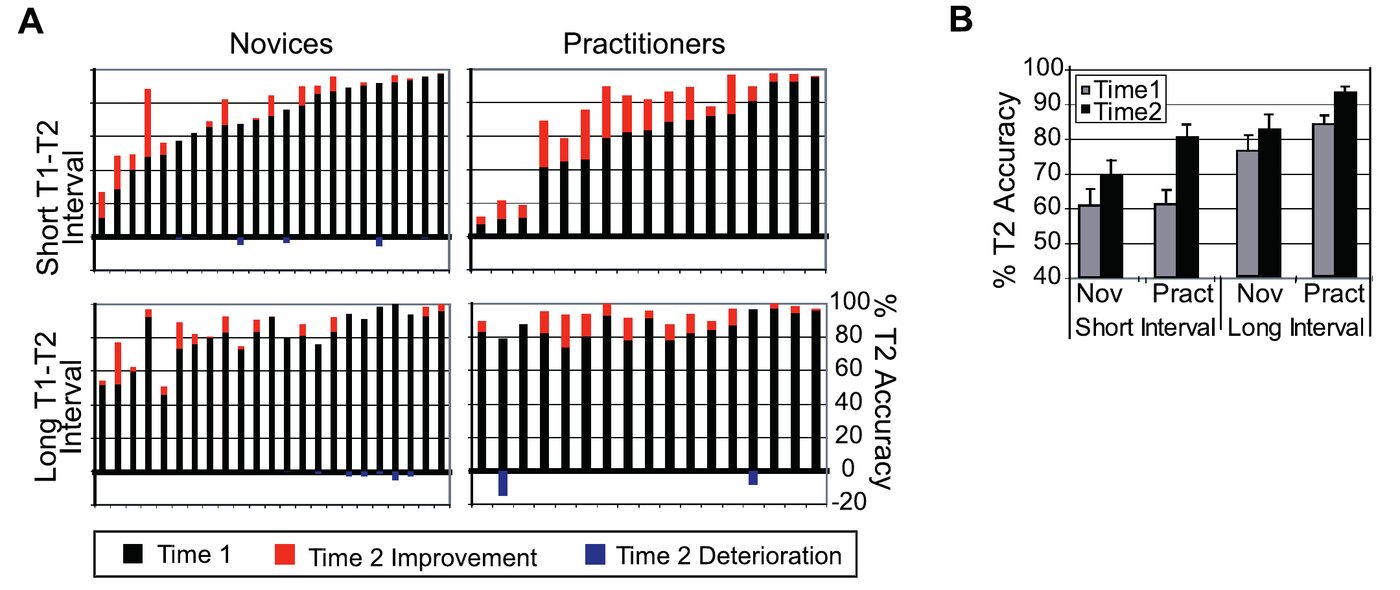
Two checks support the result. Three practitioners and one novice performed at or near chance at both sessions, and the result held whether or not they were included. People who start out worse also have more room to improve, so the researchers reran the analysis taking into account each person’s accuracy at the first session. The practitioners’ larger improvement remained (p = 0.029).
Miscellaneous Interesting Takeaways
The Practitioners’ Brains Spent Less on the First Number
The EEG results matched the prediction. After the retreat, the practitioners’ P3b to the first number was smaller on trials where they went on to catch the second one. The novices showed no such reduction. The result held up in a larger analysis of 34 people (14 practitioners and 20 novices) who had enough clean trials. Because the brain’s responses to two numbers a third of a second apart overlap, the team also looked at trials where the second number came late or not at all. There, too, the practitioners showed a smaller P3b around 400 milliseconds after the first number, though the effect was weaker, and on trials with no second number the change did not differ significantly from the novices’. Outside the window of the P3b to the first number, including the P3b to the second, the groups didn’t change differently, though the authors think the retreat may also have affected some early processing of the second number.
The most striking finding linked the brain and behavior. Across the 22 people in the main brain analysis, those whose P3b to the first number shrank the most tended to show the biggest gains in catching the second (r = −0.68, p = 0.001). The link was weaker but still significant in the larger group of 34 (r = −0.42, p = 0.014). The authors read this as direct support for the idea that the blink comes from how attention is shared between the two targets, and go a step further:
Beyond this, the current study indicates that through mental training, people may gain some control (which need not be voluntary) over the amount of attentional resources devoted to the processing of the first item.
The correlation pooled practitioners and novices, though, and the practitioners as a group changed more on both measures. The paper doesn’t report whether the same link holds within the practitioners alone.
Catching the Second Number Didn’t Cost the First
If the practitioners had simply started ignoring the first number, they would have missed it more often. They didn’t. Accuracy on the first number was similar in the two groups and rose slightly in both: on short-interval trials, from 78% to 83% in the practitioners and from 79% to 82% in the novices.
Both Groups Got a Little Better With Practice
Both groups were somewhat better at the second session on both short- and long-interval trials, probably because the task itself had become familiar. The authors point out that this kind of general practice effect can’t explain why only the practitioners improved selectively on the short-interval trials, inside the blink.
What the Design Can’t Rule Out
This was not a randomized trial. The practitioners chose to spend three months on retreat and had all meditated before; the novices were beginners who had only expressed an interest. And the two groups’ experiences between sessions could hardly have been more different: months of meditating 10 to 12 hours a day in a retreat setting versus a one-hour class and a request to meditate 20 minutes a day for a week before each session. That makes the novices a check on simply repeating the task, not a matched alternative. Anything else that came with the retreat, such as time away from daily life, the setting, or the practitioners’ expectations and motivation, could in principle have contributed. The authors argue that motivation is an unlikely explanation, citing earlier work in which paying people according to their performance didn’t change the size of their blink.
The samples were also small, and the brain analyses relied on subsets of participants with enough clean recordings. The brain results come from testing many time points and electrodes, counting an effect only if it lasted at least 31 milliseconds at four or more neighboring electrodes, rather than from a single planned test. The paper’s abstract says the training “resulted in” a smaller blink, which is stronger causal language than a non-randomized design can fully support. Finally, the practitioners were tested at the end of the retreat, so the study can’t say how long the change lasted; the authors call for longitudinal studies of exactly that.
Final Reflection
This study followed the same meditators over time and found a change on a standard laboratory task that has nothing to do with meditation. Three months of intensive practice was followed by a smaller attentional blink, and the brain recordings suggested why: the practitioners seemed to spend less on the first target, leaving more for the second. The authors’ summary of the result:
These findings demonstrate that meditative training can improve performance on a novel task that requires the trained attentional abilities.
The finding sits well with other work on this site. A three-month concentration retreat strengthened deliberate, controlled attention in a randomized comparison with people waiting for a later retreat, and a five-day trial of integrative body–mind training found gains in resolving conflicting cues after much less practice.
Taken alone, though, this was a small study comparing experienced meditators who chose an intensive retreat with beginners who were asked to do very little practice. It shows that the practitioners’ attention changed during the retreat in a way the novices’ did not, and offers a plausible brain mechanism. Randomized trials with comparison groups doing a similar amount of some other demanding activity would be needed to show that meditation itself was the cause.
Citation
Slagter, H. A., Lutz, A., Greischar, L. L., Francis, A. D., Nieuwenhuis, S., Davis, J. M., & Davidson, R. J. (2007). Mental training affects distribution of limited brain resources. PLoS Biology, 5(6), e138. 10.1371/journal.pbio.0050138
Get the next summary by email
One or two new paper summaries every couple of weeks, sent to your inbox when they go up.
No spam, and you can unsubscribe at any time. Prefer a feed reader? Use the RSS feed.