Background Information
Can eight weeks of meditation change the physical structure of your brain? For more than a decade, many people have assumed so. Small studies from the early 2010s reported that people who completed
MBSR
Mindfulness-Based Stress Reduction (MBSR) is a program designed to help individuals cope with stress, pain, and illness. Developed by Jon Kabat-Zinn in the 1970s, it combines meditation and yoga to promote awareness and stress management. The eight-week program teaches participants to focus on the present moment non-judgmentally, enhancing their ability to manage difficulties.
More on Wikipedia
View in glossary
, the eight-week course originally developed by Jon Kabat-Zinn, showed more
gray matter
Gray matter is brain tissue made up mostly of nerve cell bodies and their connections. It forms the brain’s outer layer (the cortex) and several deeper structures. Structural MRI can estimate gray matter volume (how big a region is), density (how concentrated the tissue is), and cortical thickness (how deep the outer layer is).
More on Wikipedia
View in glossary
(the brain tissue that holds most nerve cell bodies) in regions such as the hippocampus and the posterior cingulate cortex, a hub of the default mode network (
DMN
The default mode network (DMN) is a system of connected brain areas that show increased activity when a person is not focused on what is happening around them. such as during daydreaming and mind-wandering. It can also be active when the individual is thinking about others or themselves, remembering the past, and planning for the future.
More on Wikipedia
View in glossary
). Those studies have been cited more than 3,200 times.
The idea was plausible.
Neuroplasticity
Neuroplasticity is the brain’s ability to change its structure and function in response to experience. Changes can include new connections between neurons and shifts in the size of brain regions. Researchers have looked for structural neuroplasticity after meditation training, much as it has been found after exercise or learning new skills.
More on Wikipedia
View in glossary
, the brain’s capacity to change with experience, is well documented, and aerobic exercise and balance training have both been linked to measurable structural change.
But the earlier MBSR studies had real weaknesses. Groups had 20 or fewer people, participants weren’t randomly assigned, and there was no
active control group
An active control group is a comparison group that takes part in a different program designed to be just as engaging as the one being tested. In meditation research, it might involve exercise, music, or education classes with the same time commitment, teachers, and expectations of benefit. Comparing against an active control helps separate the effects of meditation itself from the general effects of joining a course.
More on Wikipedia
View in glossary
(a comparison group doing a different but equally engaging program). Without one, it’s hard to tell whether a change comes from meditation itself or from simply taking a class. A team led by Tammi Kral at Richard Davidson’s Center for Healthy Minds set out to test the claim more rigorously.
What They Did
The researchers combined two
randomized controlled trials
A Randomized Controlled Trial is a scientific study design that randomly assigns participants to either an experimental group receiving an intervention or a control group, allowing researchers to measure the true effect of the intervention while minimizing bias.
More on Wikipedia
View in glossary
run about five years apart in Madison, Wisconsin, with the same design. Everyone was a healthy adult with no meditation experience. People who had a psychiatric diagnosis in the past year, or who took psychiatric medication, were excluded.
After a baseline brain scan, participants were randomly assigned to one of three groups:
- MBSR: an eight-week course of mindfulness meditation, yoga, and body awareness, taught by certified instructors
- Health Enhancement Program (HEP): a matched eight-week course of exercise, music therapy, and nutrition education
- Waitlist: no training during the study
Both courses asked for daily home practice, which participants logged. After the eight weeks, everyone was scanned again; 218 people completed both scans.
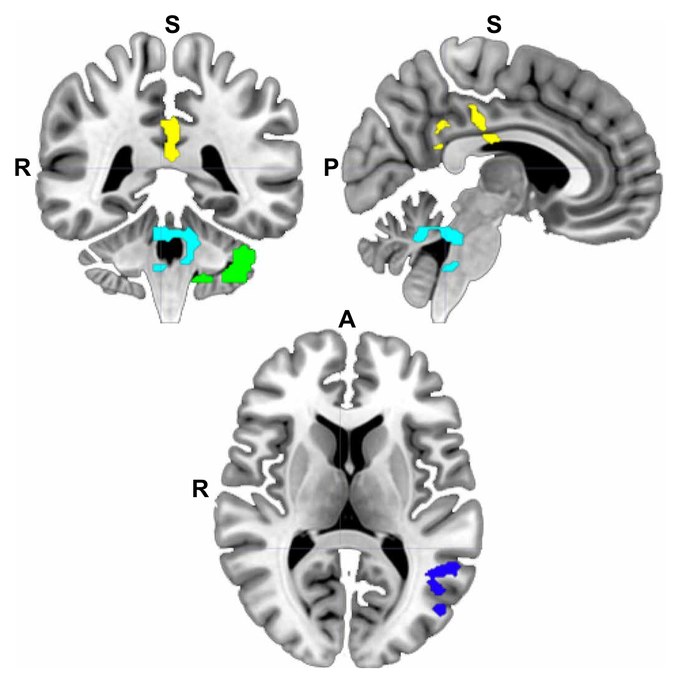
The team used structural MRI (scans that capture the size and shape of brain tissue rather than its activity) to measure gray matter volume, gray matter density, and cortical thickness (the depth of the brain’s outer layer). They looked across the whole brain and in 12 specific regions, including those where earlier studies had reported growth. They then re-ran the analysis with different software to check that the result didn’t depend on one method.
One Big Result: No Structural Changes Compared With Either Control Group
Compared with either the active control or the waitlist, MBSR produced no significant change in gray matter volume, density, or cortical thickness. That held across the whole brain and in every one of the 12 regions examined. It also held with different analysis software, with and without outlying data points, and after accounting for the time between scans.
The differences weren’t just statistically insignificant; they were tiny. For the left hippocampus, one of the regions highlighted in earlier work, the
effect size
Effect size is a statistical concept that quantifies the magnitude or strength of a relationship, difference, or intervention outcome. Unlike p-values which only indicate statistical significance, effect sizes measure how meaningful a result is in practical terms. Common measures include Cohen’s d (standardized mean difference), correlation coefficients (r), and odds ratios. In meditation research, effect sizes help quantify the practical impact of different meditation practices on psychological or physiological outcomes.
More on Wikipedia
View in glossary
for MBSR versus the active control was a partial η² of 0.01. That means group membership accounted for only about 1% of the variation in change. With more than three times as many MBSR participants as the earlier studies, the authors concluded:
“MBSR does not differentially affect brain structure.”
That conclusion is about eight weeks of MBSR in healthy adults. It doesn’t speak directly to longer or more intensive practice.
Miscellaneous Interesting Takeaways
The Training Still Had Effects, but Not All of Them Were Specific to Mindfulness
The lack of structural change doesn’t seem to come from people skipping practice. On average, the MBSR participants attended 8 of 9 possible classes and logged 32 hours of home practice (range 2–85), compared with about 23 hours in the earlier research. Earlier analyses of these same trials also found changes in brain function, such as reduced
amygdala
The amygdala is a pair of almond-shaped structures deep in the brain’s temporal lobes. It plays a central role in processing emotion, especially threat and fear. Meditation studies often look at how strongly the amygdala responds to emotional images, and sometimes at its size.
More on Wikipedia
View in glossary
reactivity to emotional images.
Self-reported
mindfulness
Mindfulness is the psychological process of purposely bringing one’s attention to experiences occurring in the present moment without judgment. It involves maintaining awareness of thoughts, feelings, bodily sensations, and surrounding environment with an attitude of curiosity and acceptance. In meditation contexts, mindfulness practices typically involve focusing attention on the breath or body sensations as anchors to the present moment while acknowledging and releasing distracting thoughts.
More on Wikipedia
View in glossary
rose after MBSR, but it rose after HEP too, and the two groups didn’t differ significantly. The authors suggest that some gains may come from what such courses share, like expert teachers, a group, and attention to well-being, rather than from meditation specifically. The mindfulness gain over the waitlist was also moderate (Cohen’s d of 0.39 to 0.43), well below the large effects (0.77 to 1.48) reported in the earlier small studies.
A Possible Practice Effect in the Amygdala Did Not Hold Up
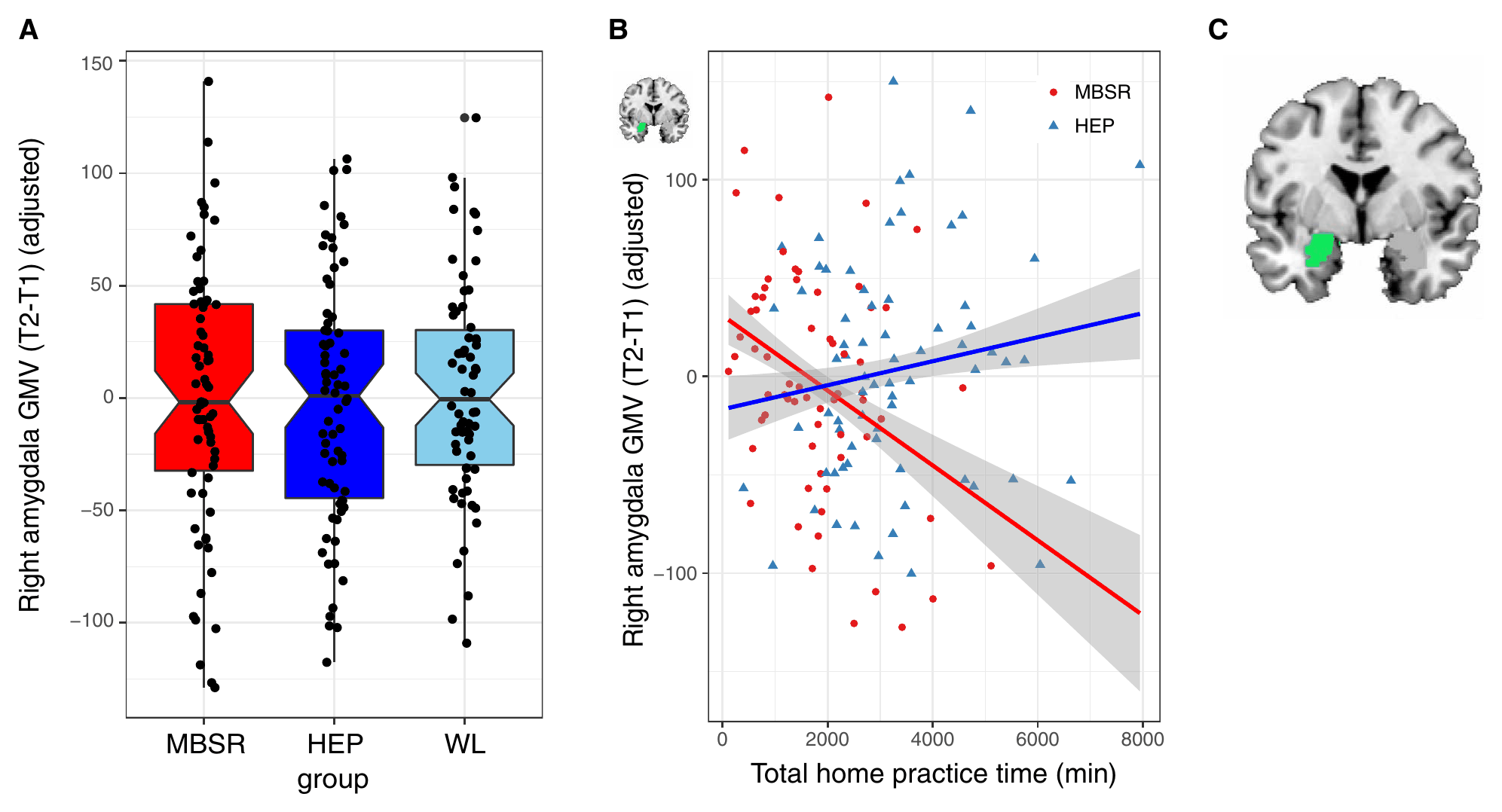
One result hinted at a dose effect. Among MBSR participants, more home practice was associated with a larger reduction in the volume of the right amygdala (an almond-shaped region involved in emotion and threat), compared with the same amount of HEP practice. Participants with less than about 27 hours of practice showed no change, and the authors estimate that fewer than about 22 minutes a day is unlikely to change amygdala structure.
However, the effect was small and didn’t survive the team’s checks with alternative analysis methods. The authors say it should be treated with caution until it is replicated.
Who Signs Up May Matter
The earlier studies recruited people who had chosen to take an MBSR course, and some selected participants for high stress. This study advertised a study of “health and well-being,” assigned people at random, and ended up with unusually healthy volunteers who had very low baseline anxiety. They may simply have had less room to improve.
The authors acknowledge a trade-off: tighter experimental control can cost some realism, and the act of choosing to enroll may itself be linked to greater benefit. They also note that MBSR mixes many practices, so any structural change might be spread out and hard to detect. Longer training, or training focused on a single practice, may be needed to produce measurable change.
Final Reflection
For anyone who has read that a few weeks of mindfulness will “grow” their brain, this study is a useful corrective. In a large, carefully controlled trial, eight weeks of MBSR changed brain structure no more than a matched wellness course or no course at all.
That isn’t the same as showing meditation does nothing to the brain. The study can’t speak to years of practice or intensive retreats, and the same participants showed other changes. What it does suggest is that the benefits of a short course probably don’t show up as measurable changes in gray matter, and that striking results from small studies deserve a second look.
Citation
Kral, T. R. A., Davis, K., Korponay, C., Hirshberg, M. J., Hoel, R., Tello, L. Y., Goldman, R. I., Rosenkranz, M. A., Lutz, A., & Davidson, R. J. (2022). Absence of structural brain changes from mindfulness-based stress reduction: Two combined randomized controlled trials. Science Advances, 8(20), eabk3316. 10.1126/sciadv.abk3316