
Background Information
If a busy, circling mind is part of what keeps people awake, could training that mind help them sleep?
Poor sleep is common and costly. The authors cite estimates that sleep disturbance affects 10–25% of the general population, and accumulated sleep loss is linked to mood and anxiety disorders, cognitive problems, heart disease, and obesity. Sleep medications remain the usual first-line treatment, but they carry risks of misuse, drug interactions, and side effects.
Cognitive behavioral therapy for insomnia
Cognitive behavioral therapy for insomnia (CBT-I) is a structured, usually short-term talk therapy for chronic sleeplessness. It combines changes to sleep habits and schedules, such as limiting time in bed, with work on unhelpful thoughts about sleep. It is widely recommended as a first-line treatment for insomnia.
More on Wikipedia
View in glossary
(CBT-I), a structured talk therapy that reshapes sleep habits and unhelpful thoughts about sleep, works well but can be expensive and hard to find.
Mindfulness
Mindfulness is the psychological process of purposely bringing one’s attention to experiences occurring in the present moment without judgment. It involves maintaining awareness of thoughts, feelings, bodily sensations, and surrounding environment with an attitude of curiosity and acceptance. In meditation contexts, mindfulness practices typically involve focusing attention on the breath or body sensations as anchors to the present moment while acknowledging and releasing distracting thoughts.
More on Wikipedia
View in glossary
offers another possible route. Often described as paying attention on purpose, in the present moment, and without judgment, it has been shown to reduce rumination (repetitive, stuck thinking) and emotional reactivity, both of which can feed sleeplessness.
Earlier
meta-analyses
A meta-analysis statistically combines the results of many earlier studies on the same question. Pooling the data can estimate an overall effect more precisely than any single study and show whether results agree across studies. Its conclusions are only as good as the studies it includes and how similar they are.
More on Wikipedia
View in glossary
, studies that statistically combine the results of many trials, disagreed, with findings ranging from no effect to a moderate benefit. Some included non-randomized studies. Others lumped waitlist groups together with active comparison programs, which made it hard to separate meditation’s own contribution from the general boost of attention, support, and expectation that comes with joining any program.
What They Did
The team, based at the U.S. National Institutes of Health, searched four research databases for studies published through May 2018. From 3,303 records, they kept 18
randomized controlled trials
A Randomized Controlled Trial is a scientific study design that randomly assigns participants to either an experimental group receiving an intervention or a control group, allowing researchers to measure the true effect of the intervention while minimizing bias.
More on Wikipedia
View in glossary
published between 2010 and 2018, with 1,654 adult participants in total. Every trial enrolled people with clinically significant sleep problems and taught an in-person, multi-session mindfulness program. One of them was the older-adults trial covered here in Black et al., 2015.
Half the programs were
MBSR
Mindfulness-Based Stress Reduction (MBSR) is a program designed to help individuals cope with stress, pain, and illness. Developed by Jon Kabat-Zinn in the 1970s, it combines meditation and yoga to promote awareness and stress management. The eight-week program teaches participants to focus on the present moment non-judgmentally, enhancing their ability to manage difficulties.
More on Wikipedia
View in glossary
(9 trials), followed by mindfulness-based cognitive therapy (MBCT, which blends mindfulness with cognitive therapy; 3 trials) and mind–body bridging (3 trials). Weekly classes ran 1–2.5 hours for 2–16 weeks, and all trials encouraged home practice.
The key design choice was to leave out waitlist and usual-care comparisons, keeping only trials with an
active control group
An active control group is a comparison group that takes part in a different program designed to be just as engaging as the one being tested. In meditation research, it might involve exercise, music, or education classes with the same time commitment, teachers, and expectations of benefit. Comparing against an active control helps separate the effects of meditation itself from the general effects of joining a course.
More on Wikipedia
View in glossary
, and to split those by what the comparison group did:
- Established sleep treatments (7 trials): treatments already known to help sleep, such as CBT-I, sleep medication, exercise, or progressive muscle relaxation.
- Matched programs (11 trials): classes matched for time and attention but not built to treat sleep, such as health education or sleep hygiene classes.
Because trials used different questionnaires, mainly the
Pittsburgh Sleep Quality Index
The Pittsburgh Sleep Quality Index (PSQI) is a widely used questionnaire about how well a person has slept over the past month. It covers time to fall asleep, sleep duration, disturbances and daytime effects, and combines them into a score from 0 to 21, where higher means worse sleep. Scores above 5 are commonly taken to indicate poor sleep.
More on Wikipedia
View in glossary
(PSQI), the team converted results to a standardized
effect size
Effect size is a statistical concept that quantifies the magnitude or strength of a relationship, difference, or intervention outcome. Unlike p-values which only indicate statistical significance, effect sizes measure how meaningful a result is in practical terms. Common measures include Cohen’s d (standardized mean difference), correlation coefficients (r), and odds ratios. In meditation research, effect sizes help quantify the practical impact of different meditation practices on psychological or physiological outcomes.
More on Wikipedia
View in glossary
(Hedges’ g), which expresses the difference between groups in standard-deviation units. They also graded how much confidence the evidence deserved.
One Big Result: Mindfulness Outperformed Matched Programs, and the Gap Held at Follow-Up
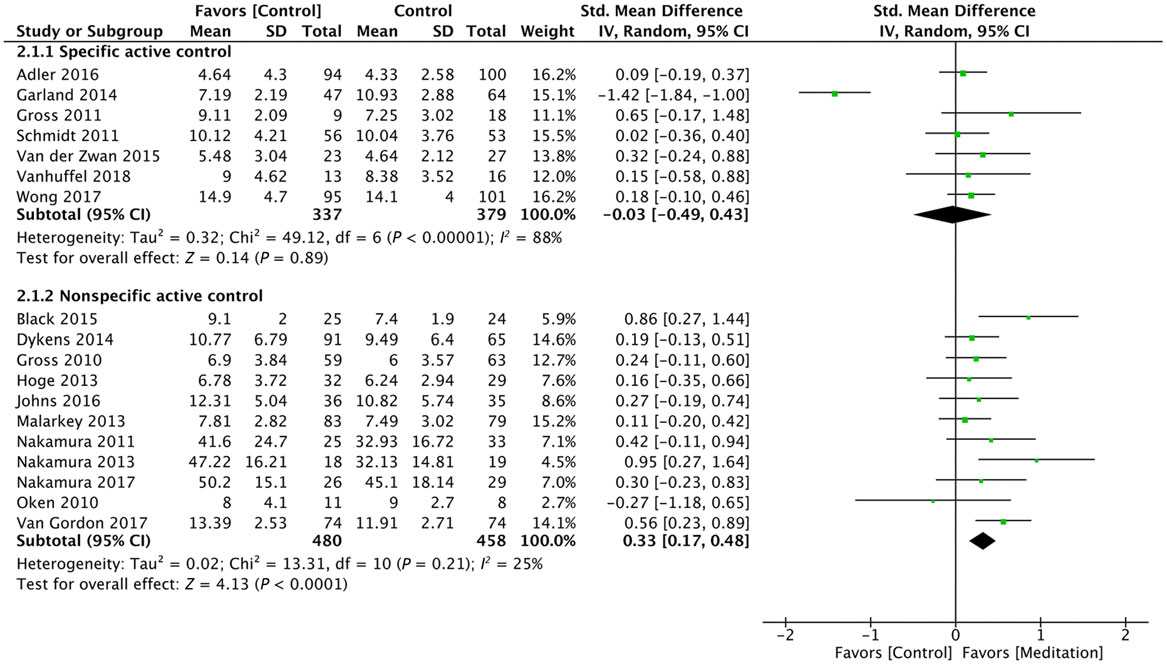
Across the 11 trials with time- and attention-matched comparison programs, mindfulness improved sleep quality more than the comparison did. Right after the programs ended, the effect size was 0.33 (95% confidence interval 0.17 to 0.48), conventionally considered small. Put another way, the mindfulness groups improved by about a third of a standard deviation more than the comparison groups.
Three of these trials also checked in 5–12 months later. There the effect size was 0.54 (95% confidence interval 0.24 to 0.84), in the medium range. The trials largely agreed with one another, and the team rated this body of evidence as moderate in strength.
This comparison matters because the control programs offered the same class time, group contact, and instructor attention. A benefit beyond them suggests that something about the mindfulness practice itself, and not only the experience of joining a program, may help. The authors call the long-term numbers “preliminary evidence for a long-term effect,” a fair caution given that only three trials contributed.
Miscellaneous Interesting Takeaways
No Clear Difference From Established Sleep Treatments
Against treatments already known to help sleep, mindfulness showed no meaningful difference either way: an effect size of −0.03 after treatment and −0.14 at follow-up, with wide confidence intervals that crossed zero. The team rated this evidence as low in strength, partly because the trials disagreed sharply.
Much of that disagreement came from one trial comparing MBSR with CBT-I in people with cancer and insomnia, where CBT-I came out well ahead and half the MBSR group dropped out. With that trial set aside, the results became consistent and tilted slightly toward mindfulness (0.15 after treatment), though not significantly. “No difference found” is not the same as “proven equal,” so this comparison remains open.
More Class Hours Didn’t Predict Better Sleep
Total class time ranged from 3 to 42 hours, yet the amount showed essentially no relationship with how much sleep improved (Spearman’s r = 0.1, p = 0.70). Home practice told a mixed story: of six trials that checked, three found more practice went with better sleep and three found no link. The authors note that dose is hard to measure in meditation, since minutes on the cushion don’t reveal how much of that time was spent attending rather than
mind wandering
Mind wandering is the spontaneous shift of attention away from a current task or external environment to internally generated thoughts, memories, or fantasies. This common cognitive process is associated with default mode network activation and has been extensively studied in relation to meditation practices, which often aim to reduce mind wandering.
More on Wikipedia
View in glossary
.
Few Signs of Harm, but Thin Reporting
Only 10 of the 18 trials reported on adverse events, and those that did showed no sign of increased risk. In two trials, sleep worsened for 3% and 7% of meditators, compared with 24% and 12% of people in the comparison groups. The authors still caution that difficult emotions can surface as awareness sharpens, especially early on, and that people with trauma histories may need extra support, a theme explored in Meditators Described 59 Kinds of Difficult Experiences.
Final Reflection
Taken together, these trials suggest that mindfulness training may offer people with disturbed sleep a modest benefit beyond the support and attention of any structured program, and that the benefit may last for months. How it compares with established treatments like CBT-I is still unclear.
The evidence has real limits. Sleep was almost always self-reported, the populations and programs varied widely, and the long-term picture rests on a handful of trials. Whether mindfulness changes how people sleep, or mainly how they experience their nights, remains an open question.
Citation
Rusch, H. L., Rosario, M., Levison, L. M., Olivera, A., Livingston, W. S., Wu, T., & Gill, J. M. (2019). The effect of mindfulness meditation on sleep quality: A systematic review and meta-analysis of randomized controlled trials. Annals of the New York Academy of Sciences, 1445(1), 5–16. 10.1111/nyas.13996
Get the next summary by email
One or two new paper summaries every couple of weeks, sent to your inbox when they go up.
No spam, and you can unsubscribe at any time. Prefer a feed reader? Use the RSS feed.