
Background Information
Psychological stress can set off
inflammation
Inflammation is a biological response of the immune system to injury, infection, or stress, characterized by the release of signaling molecules called cytokines. Chronic inflammation is linked to impaired cognitive function, increased risk of disease, and accelerated aging.
More on Wikipedia
View in glossary
, and people with chronic inflammatory conditions often say stress makes their symptoms worse. Skin conditions are a clear example: the paper lists psoriasis, atopic dermatitis, eczema, alopecia and urticaria (hives) among the diseases in which stress-related immune changes have been documented.
The skin is wired for this. It is packed with nerve endings, and under stress, sensory nerves release small signaling molecules (neuropeptides such as substance P and CGRP). Working together with norepinephrine from the nerves of the body’s fight-or-flight system, these molecules act on blood vessels and immune cells in the skin to produce what is called
neurogenic inflammation
Neurogenic inflammation is inflammation driven by nerves rather than by infection or injury alone. When sensory nerve endings are activated, they release signaling molecules called neuropeptides, such as substance P and CGRP, that widen blood vessels, make them leakier and activate local immune cells. It is thought to help explain why stress can worsen skin conditions such as psoriasis and eczema.
More on Wikipedia
View in glossary
, inflammation driven by nerves. If a mental practice could dampen the stress response, it might also dampen this kind of inflammation.
Mindfulness-Based Stress Reduction (MBSR)
Mindfulness-Based Stress Reduction (MBSR) is a program designed to help individuals cope with stress, pain, and illness. Developed by Jon Kabat-Zinn in the 1970s, it combines meditation and yoga to promote awareness and stress management. The eight-week program teaches participants to focus on the present moment non-judgmentally, enhancing their ability to manage difficulties.
More on Wikipedia
View in glossary
was by then the dominant form of meditation training in American healthcare, and an earlier randomized trial from the same lab had found that an MBSR course boosted employees’ antibody response to a flu vaccine. But the authors point out a weakness shared by most MBSR studies: they compare people who took the course with people who did nothing or sat on a wait-list. That shows the course helps, but not whether mindfulness is the active ingredient, rather than the class, the teacher, the group or the expectation of benefit. This study set out to answer that question for stress and inflammation.
What They Did
The researchers recruited 49 healthy volunteers (10 men) aged 19 to 59, with an average age of about 46, through newspaper advertisements. People were excluded if they had significant experience with meditation or other mind–body practices such as tai chi, exercised very frequently, smoked, took psychiatric or steroid drugs, or had conditions affecting circulation. The experiment was part of a larger set of studies in the same people, which also looked at attention and emotion regulation.
After a first laboratory visit, participants were randomly assigned to one of two 8-week courses. In this
randomized controlled trial
A Randomized Controlled Trial is a scientific study design that randomly assigns participants to either an experimental group receiving an intervention or a control group, allowing researchers to measure the true effect of the intervention while minimizing bias.
More on Wikipedia
View in glossary
, one group took MBSR, taught by two experienced, certified instructors: continuous attention to the breath, body sensations and mental content while sitting, walking and doing yoga. The other group took the Health Enhancement Program (HEP), an
active control
An active control group is a comparison group that takes part in a different program designed to be just as engaging as the one being tested. In meditation research, it might involve exercise, music, or education classes with the same time commitment, teachers, and expectations of benefit. Comparing against an active control helps separate the effects of meditation itself from the general effects of joining a course.
More on Wikipedia
View in glossary
built to match MBSR in everything except mindfulness:
In order to isolate mindfulness as the agent of change, we designed an active comparison intervention to control for the aspects of MBSR that are known to promote positive outcomes, but are not specific to mindfulness such as a supportive group atmosphere, expert instruction, and engaging in activities that are believed to provide benefit.
HEP had four parts, each meant to mirror a benefit MBSR might deliver for reasons other than mindfulness: physical activity such as walking (to match walking meditation), balance, agility and core strength (to match the yoga), nutrition education, and music therapy. An expert in each area taught it. Both courses met for eight weekly 2.5-hour sessions plus one full day, and both assigned 45 to 60 minutes of practice at home each day.
Everyone came to the lab three times: within 4 weeks before the course, within 4 weeks after it, and 4 months after it ended. Each visit combined two challenges.
A stress test. The
Trier Social Stress Test
The Trier Social Stress Test (TSST) is a standard laboratory stressor. After a few minutes to prepare, a person gives a short speech, often a mock job interview, and then does mental arithmetic aloud, in front of a panel of unsmiling judges and often a camera. The mix of public evaluation and lack of control reliably raises stress hormones such as cortisol, so researchers use it to compare how strongly people react to stress.
More on Wikipedia
View in glossary
(TSST) is a standard way to stress people in a lab. Here, participants had 3 minutes to prepare a speech on a topic they had just been given, then gave it for 5 minutes without notes, standing at a microphone in front of two judges and a video camera, and then did 5 minutes of mental arithmetic. The topics and arithmetic changed at each visit.
A small, controlled skin inflammation. Suction was applied to the inside of the forearm through a template with eight holes, raising eight small blisters. Fluid was drawn from four of them, and
capsaicin
Capsaicin is the compound that makes chili peppers hot. It activates a receptor (TRPV1) on pain-sensing nerve fibers, producing a burning sensation. In the skin, it also makes those nerves release signaling molecules that widen nearby blood vessels, causing a spreading red flare, so researchers apply capsaicin cream to provoke a small, harmless, nerve-driven inflammation.
More on Wikipedia
View in glossary
cream, the compound that makes chili peppers hot, was spread around the other four. Capsaicin activates pain-sensing nerve fibers. The signal also travels back down branches of the same nerves, which then release neuropeptides that widen blood vessels and activate immune cells. The visible result is a flare: a patch of redness that spreads beyond the cream. Because it depends on the nerves, the flare is considered a fairly pure measure of neurogenic inflammation.
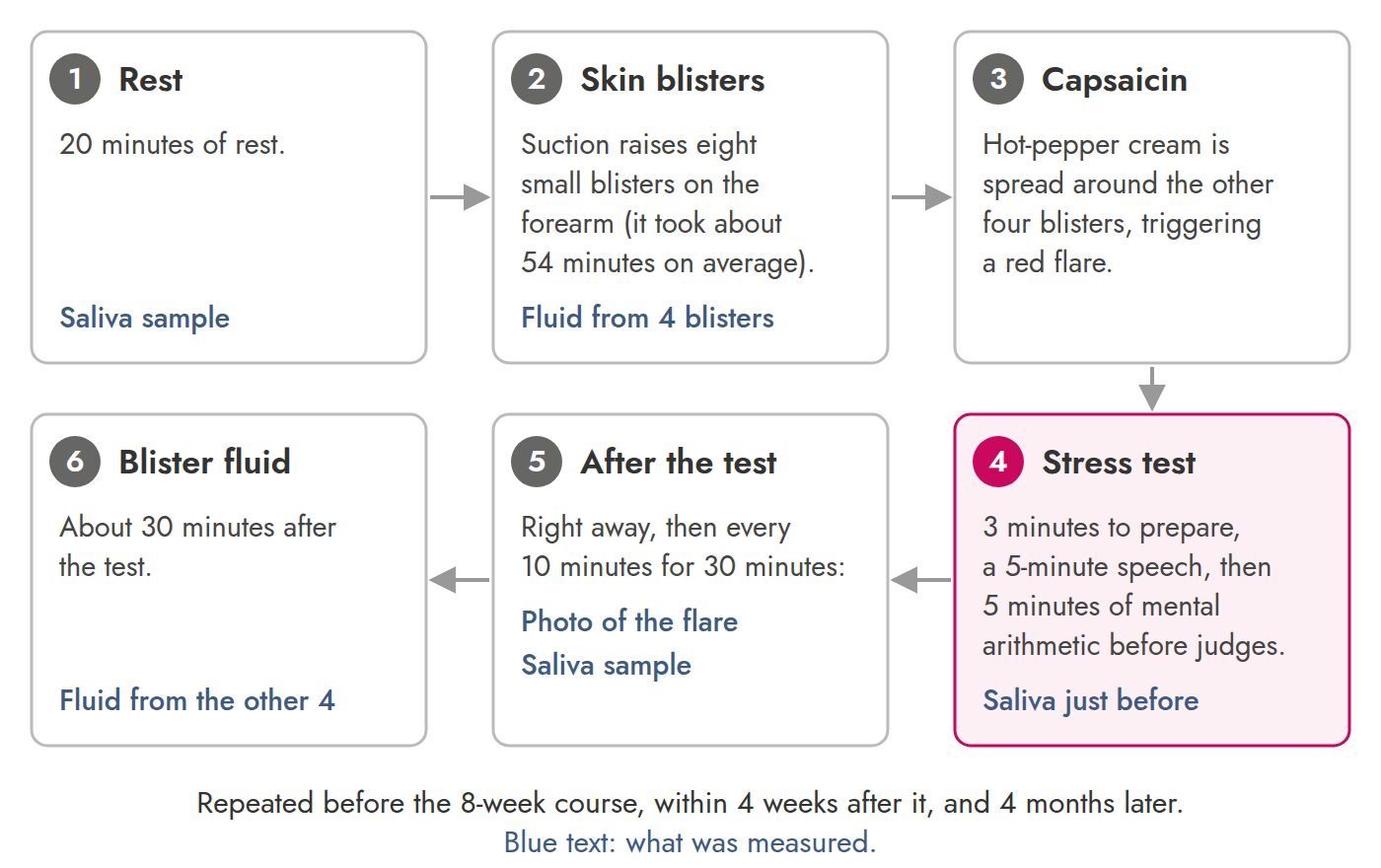
The researchers measured three things around the stress test:
- Flare size. The flare was photographed right after the stress test and every 10 minutes for half an hour. People who didn’t know which group a participant was in traced its outline, and a sticker of fixed size beside it corrected for differences in camera distance. The flare’s growth over the half hour was summarized as a single number.
- Inflammatory proteins in the skin. Blister fluid taken before the capsaicin and again about 30 minutes after the stress test was tested for two cytokines,
TNF-α
Tumor necrosis factor alpha (TNF-α) is a signaling protein (a cytokine) that immune cells release early in inflammation. It helps fight infection and repair tissue, but high or persistent levels contribute to inflammatory diseases such as rheumatoid arthritis, psoriasis and inflammatory bowel disease.
More on Wikipedia
View in glossary and IL-8 Interleukin-8 (IL-8) is a signaling protein (a cytokine) that draws white blood cells, especially neutrophils, to a site of infection or injury. Its levels rise in inflamed tissue, so researchers measure it as a marker of local inflammation.
More on Wikipedia
View in glossary , signaling proteins that immune cells release during inflammation. - The stress hormone
cortisol
Cortisol is a hormone released by the adrenal glands, especially in response to stress. It mobilizes energy and helps regulate the immune system. Because it can be measured in saliva, researchers often use it to gauge how strongly someone reacts to a stressful task, such as timed mental arithmetic. Levels also follow a daily rhythm, so studies try to test everyone at the same time of day.
More on Wikipedia
View in glossary , in six saliva samples per visit. Participants also collected saliva at home five times a day for three days, to track how their cortisol rose and fell over the day.
At each visit, participants also filled in questionnaires on psychological distress, anxiety, depression and hostility (the Symptom Checklist-90-R) and on troublesome physical symptoms over the past month (the Medical Symptoms Checklist).
The challenges worked. At every visit, both cytokines in the blister fluid rose after the capsaicin and stress test (TNF-α by 19% at the first visit and 22% at the second; IL-8 by 13% and 15%), and so did cortisol (by 168% and 84%).
One Big Result: After Training, the Skin Flare Grew Less in the MBSR Group Than in the Health Program Group
Before the courses, the two groups’ flares were the same size (p = .69). By the second visit, flares had grown larger in both groups, but not by the same amount. In the HEP group the flare grew significantly (p < .001), while in the MBSR group it grew only slightly, an increase that fell short of significance (p = .09). After the courses, the MBSR group’s flares were significantly smaller than the HEP group’s (p = .005), and the difference in how much the two groups changed was also significant (group-by-time interaction, F(1, 27) = 10.07, p = .004).
So MBSR did not shrink the flare. Rather, the flare grew in both groups and grew less after MBSR. The authors had predicted the opposite pattern, a smaller response after MBSR and no change after HEP, and looked for an explanation after the fact. They found one in the weather: dry winter air makes skin more irritable, and the first visits took place at an average temperature of 66°F, the second at 36°F. Colder days went with bigger flares, with temperature accounting for 8% of the variation in flare size. On their reading, the HEP group’s growing flares partly reflect the season, and the MBSR group resisted that seasonal rise. That is plausible, but it is an interpretation added after seeing the data, not a planned test.
Why would mindfulness affect the flare? The authors suggest that MBSR may have reduced the stress-related surge of the fight-or-flight (sympathetic) nervous system, whose norepinephrine helps the flare spread. But they didn’t measure that system, as they acknowledge:
Unfortunately, we did not measure local release of NE or other indices of SNS activation, which strongly limits the conclusions that can be drawn about the mechanism of relative flare attenuation.
Two more details matter. First, judging from the statistics reported, the flare comparison across the first two visits included 29 people, 14 in MBSR and 15 in HEP, well short of the 49 enrolled. Second, the paper’s abstract describes a “significantly smaller post-stress inflammatory response” after MBSR. That is true of the flare. The blister-fluid cytokines, the study’s molecular measures of inflammation, showed no difference between the groups (more on that below).
Miscellaneous Interesting Takeaways
Stress Hormones and How People Felt Changed the Same Way in Both Groups
On the measures most studies of MBSR rely on, the active control did just as well. The cortisol response to the stress test was smaller at the second visit than at the first, in both groups alike (no group difference, p = .20; no difference in change, p = .86). The authors can’t tell how much of that decline reflects people getting used to the test. They note that another study found a drop of about 15% when the TSST was repeated a week apart, while here the peak fell by about 31% over 8 to 12 weeks, so they suggest both courses may have added to it.
Self-reports followed the same pattern. Overall psychological distress, anxiety and physical symptoms all fell from before to after the courses, with no difference between MBSR and HEP. Depression and hostility didn’t change significantly in either group. On these measures, a well-run health course gave people the same benefits as MBSR.
The Inflammatory Proteins Didn’t Differ Between Groups
TNF-α and IL-8 in the blister fluid rose after the challenge at each visit, and TNF-α was higher overall at the second visit than at the first, but there were no differences between the groups. The authors suggest the difference might have been too subtle to detect amid the strong inflammatory cascade capsaicin sets off, or that cytokines build more slowly than the flare and the 30-minute window was too short.
One analysis hinted at something. Both groups practiced similar amounts during the course (about 236 minutes a week for MBSR and 212 for HEP). Among MBSR participants, more practice tended to go with a bigger drop in TNF-α from before to after the course; among HEP participants, more practice tended to go with a rise. The two patterns differed significantly (p = .028), but neither correlation was significant within its own group (MBSR: r = −.28, p = .16; HEP: r = .42, p = .12), and the same comparison for IL-8 was not significant (p = .33). It is a lead for future work rather than a finding.
A Steeper Daily Cortisol Rhythm After MBSR, Clearer at Four Months
Cortisol normally peaks in the morning and falls through the day, and a steeper fall has been linked to better health, while a flatter one is associated with depression, chronic stress and heart disease. After the courses, the daily decline tended to get steeper in the MBSR group and flatter in the HEP group, though at the second visit this was only a trend (p = .12). By four months it was significant (p = .03). The authors admit they don’t know why the rhythm would flatten after HEP, given that both groups felt better.
The MBSR group also made less cortisol over the day overall, but that was true at every visit, including before the course began, so it isn’t an effect of training. Across both groups, people who practiced more had bigger drops in daily cortisol output (p = .006), a benefit of practice that didn’t depend on which course they took.
Four Months Later, the Flare Difference Was Gone
At the 4-month follow-up, flares were still larger than at the first visit, but the groups no longer differed in how much they had grown (p = .29). Cortisol responses to the stress test and both cytokines were lower than at the first visit, again in both groups alike, and the drops in distress, anxiety and physical symptoms held in both, joined by a drop in hostility. Weekly practice had fallen by nearly half (to about 123 minutes in MBSR and 162 in HEP). The authors suggest the group meetings and teacher support may have been important for keeping the physical benefits of mindfulness going.
What the Design Can’t Tell Us
The authors list several limits. To keep the burden on participants down, every visit combined the stress test with the capsaicin, with no visit testing either alone. So the study can’t show whether MBSR changed how stress affects the skin, or simply how the skin reacts to capsaicin. The participants were healthy and weren’t selected for stress or inflammation, so the results may not carry over to people with skin disease. There were no measures of fight-or-flight activity, and no ratings of how stressful participants found the test, so cortisol was the only check that the stress test worked.
A few further points are worth adding. The study measured many outcomes at two follow-ups, and the paper doesn’t describe any correction for multiple comparisons, which makes a single positive result less certain. The group sizes aren’t reported, and some analyses report degrees of freedom that imply more participants than the 49 described, so it’s unclear exactly who was included in each analysis. And the authors’ closing summary is more cautious than their abstract:
Nonetheless, the results of this study emphasize that the difference in the stress-buffering abilities between mindfulness training and other well-being promoting activities is subtle.
Final Reflection
This study is a good illustration of what happens when meditation is compared with a strong control. Against a wait-list, MBSR would have looked effective on almost everything measured here: lower distress, less anxiety, fewer physical symptoms and a smaller cortisol response to stress. Against a health course matched in time, teaching quality and home practice, all of those benefits turned out to be shared. What remained specific to MBSR was narrower: a smaller rise in a nerve-driven skin flare right after the course, and a steeper daily cortisol rhythm that emerged by four months.
Those are interesting leads, especially for stress-sensitive skin conditions, where the authors point to an earlier study in which adding mindfulness practice to psoriasis treatment sped the clearing of skin lesions. But the flare result came from 29 people, sat alongside null results for the molecular measures, depended partly on an after-the-fact explanation involving the weather, and had faded by four months.
Other randomized trials on this site have also pitted mindfulness against a carefully matched alternative, with similarly specific results: a three-day mindfulness retreat was followed by a drop in the inflammation marker IL-6 that a relaxation retreat didn’t produce, and five days of integrative body–mind training was linked to a smaller cortisol rise than relaxation training. Together they suggest that if mindfulness has effects on the body beyond those of other healthy activities, they are real but modest, and finding them takes a control group as good as this one.
Citation
Rosenkranz, M. A., Davidson, R. J., MacCoon, D. G., Sheridan, J. F., Kalin, N. H., & Lutz, A. (2013). A comparison of mindfulness-based stress reduction and an active control in modulation of neurogenic inflammation. Brain, Behavior, and Immunity, 27, 174–184. 10.1016/j.bbi.2012.10.013
Get the next summary by email
One or two new paper summaries every couple of weeks, sent to your inbox when they go up.
No spam, and you can unsubscribe at any time. Prefer a feed reader? Use the RSS feed.