
Background Information
What happens in the brain when meditation seems to benefit the body? Earlier randomized trials had linked mindfulness training to lower markers of
inflammation
Inflammation is a biological response of the immune system to injury, infection, or stress, characterized by the release of signaling molecules called cytokines. Chronic inflammation is linked to impaired cognitive function, increased risk of disease, and accelerated aging.
More on Wikipedia
View in glossary
in stressed people. How that training might get “under the skin,” though, was largely unknown. As the authors put it:
Little is known about how behavioral interventions, such as mindfulness meditation training, can impact the brain and physical health.
One candidate lies in how brain networks talk to each other at rest. The default mode network (
DMN
The default mode network (DMN) is a system of connected brain areas that show increased activity when a person is not focused on what is happening around them. such as during daydreaming and mind-wandering. It can also be active when the individual is thinking about others or themselves, remembering the past, and planning for the future.
More on Wikipedia
View in glossary
) is a set of regions that is most active when attention drifts inward, toward thoughts about oneself, the past and the future, and it is closely tied to
mind wandering
Mind wandering is the spontaneous shift of attention away from a current task or external environment to internally generated thoughts, memories, or fantasies. This common cognitive process is associated with default mode network activation and has been extensively studied in relation to meditation practices, which often aim to reduce mind wandering.
More on Wikipedia
View in glossary
. A key hub of the DMN is the
posterior cingulate cortex (PCC)
The posterior cingulate cortex (PCC) is a region toward the back of the brain’s midline. It is a central hub of the default mode network and tends to be active during self-related thought and mind-wandering. Many meditation studies track PCC activity or connectivity as a window onto the DMN.
More on Wikipedia
View in glossary
, toward the back of the brain. Near the front sits the
dorsolateral prefrontal cortex (dlPFC)
The dorsolateral prefrontal cortex (dlPFC) is a region on the upper outer sides of the frontal lobes. It is a core part of the brain’s executive control network, supporting working memory, directing attention and regulating emotion. Stronger dlPFC activity and connectivity have been associated with lower pain, negative emotion and stress.
More on Wikipedia
View in glossary
, part of a network that supports top-down executive control, such as steering attention and regulating emotion.
An earlier cross-sectional study had found that experienced meditators showed stronger resting-state
functional connectivity
Functional connectivity is the degree to which activity in different brain regions rises and falls together over time. It is usually measured with fMRI as the correlation between regions’ signals. It shows coordinated activity, not physical wiring. Researchers use it to see how brain networks such as the DMN communicate in different mental states.
More on Wikipedia
View in glossary
between the PCC and executive control regions. Functional connectivity is the degree to which two regions’ activity rises and falls together; “resting state” means it is measured while a person lies still and does no particular task. But comparing experts with novices can’t show that meditation produced the difference.
The body side of the story centers on
interleukin-6 (IL-6)
Interleukin-6 (IL-6) is a signaling protein (a cytokine) that immune cells release to coordinate inflammation. It is measured from a blood sample, usually in picograms per milliliter. Persistently elevated IL-6 is associated with chronic stress, aging and a higher risk of cardiovascular disease, which makes it a common marker in studies of whether meditation affects health.
More on Wikipedia
View in glossary
, a signaling protein released by immune cells. Circulating IL-6 tends to run higher in chronically stressed people and is associated with greater risk of cardiovascular disease and death. Unemployment, a well-known chronic stressor, is itself associated with elevated inflammation.
What They Did
In this
randomized controlled trial
A Randomized Controlled Trial is a scientific study design that randomly assigns participants to either an experimental group receiving an intervention or a control group, allowing researchers to measure the true effect of the intervention while minimizing bias.
More on Wikipedia
View in glossary
, the team recruited 35 right-handed adults who were unemployed, looking for work and reporting moderate to high job-search stress. Each first had a 5-minute resting-state
fMRI
An fMRI (functional Magnetic Resonance Imaging) measures changes in blood flow related to neural activity in the brain, offering insights into brain function and activity patterns.
More on Wikipedia
View in glossary
scan, lying still while looking at a fixation cross, and gave a blood sample. They were then randomly assigned to one of two three-day residential retreats, held in separate wings of the same retreat center.
The mindfulness program drew on Mindfulness-Based Stress Reduction (
MBSR
Mindfulness-Based Stress Reduction (MBSR) is a program designed to help individuals cope with stress, pain, and illness. Developed by Jon Kabat-Zinn in the 1970s, it combines meditation and yoga to promote awareness and stress management. The eight-week program teaches participants to focus on the present moment non-judgmentally, enhancing their ability to manage difficulties.
More on Wikipedia
View in glossary
): body scans, sitting and walking meditation, mindful eating, mindful stretching and group discussion. The comparison program matched its structure, with walking, stretching and teaching sessions, but invited participants to do these things restfully rather than mindfully. This
active control
An active control group is a comparison group that takes part in a different program designed to be just as engaging as the one being tested. In meditation research, it might involve exercise, music, or education classes with the same time commitment, teachers, and expectations of benefit. Comparing against an active control helps separate the effects of meditation itself from the general effects of joining a course.
More on Wikipedia
View in glossary
was meant to hold constant things like expectations, group support, teacher attention and physical activity, so that any difference could more plausibly be traced to mindfulness itself.
Participants were scanned again within two weeks of the retreat and gave a second blood sample four months later. The staff who ran the follow-up scans, processed the brain data and handled the blood samples did not know who had been in which group.
One Big Result: A Strengthened Brain Link Accounted for About 30% of the Drop in Inflammation
After the mindfulness retreat, but not the relaxation retreat, resting-state connectivity between the PCC and a region of the left dlPFC increased. At baseline, neither group showed meaningful coupling between the two regions. After training, the mindfulness group’s activity in these areas tended to rise and fall together, while the relaxation group’s did not.
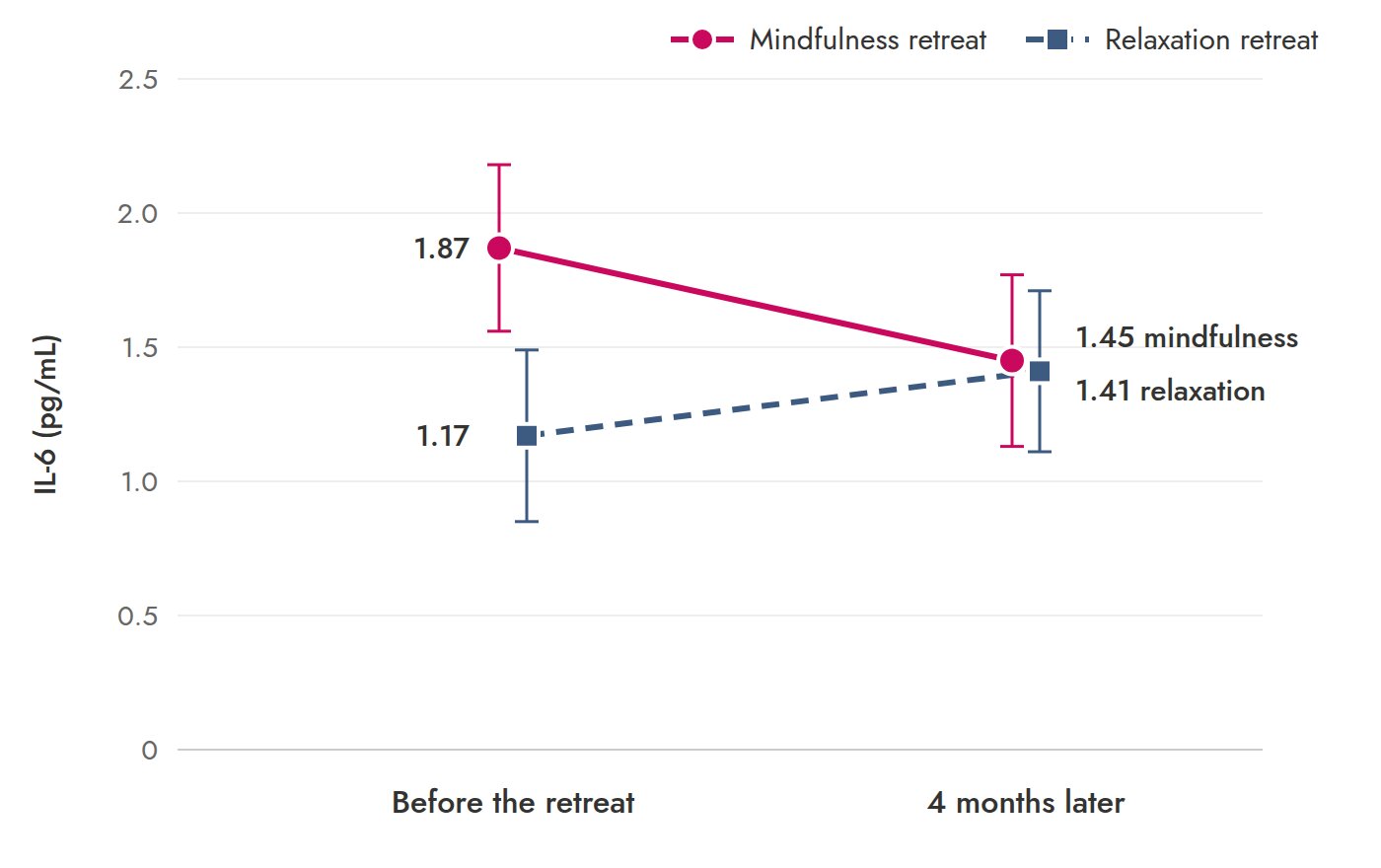
Four months later, the mindfulness group’s IL-6 had fallen while the relaxation group’s had risen. Adjusted for age, average levels went from 1.87 to 1.45 picograms per milliliter in the mindfulness group, and from 1.17 to 1.41 in the relaxation group: shifts of roughly a fifth in opposite directions. The difference between groups corresponded to a medium-to-large
effect size
Effect size is a statistical concept that quantifies the magnitude or strength of a relationship, difference, or intervention outcome. Unlike p-values which only indicate statistical significance, effect sizes measure how meaningful a result is in practical terms. Common measures include Cohen’s d (standardized mean difference), correlation coefficients (r), and odds ratios. In meditation research, effect sizes help quantify the practical impact of different meditation practices on psychological or physiological outcomes.
More on Wikipedia
View in glossary
(d = 0.71), though at p = .05 it sat right on the conventional threshold for statistical significance.
The team then asked whether the brain change could account for the IL-6 change, using a
mediation analysis
Mediation analysis is a statistical method that tests whether a third variable helps explain the link between a cause and an effect, for example whether a brain change helps explain why a training program altered a health marker. It estimates how much of the overall effect runs through that variable. A significant result is consistent with a causal pathway but does not prove one on its own.
More on Wikipedia
View in glossary
(a statistical test of whether one variable helps explain the link between a treatment and an outcome). Greater increases in PCC–dlPFC connectivity went with larger IL-6 reductions, and once connectivity was added to the model, the group difference in IL-6 was no longer significant.
Specifically, these alterations in rsFC statistically explained 30% of the overall mindfulness meditation training effects on IL-6 at follow-up.
A similar connectivity increase on the right side, which did not survive correction for multiple comparisons, accounted for about 25%.
Miscellaneous Interesting Takeaways
The Relaxation Retreat Was Just as Convincing
At the end of the retreats, both groups rated how much they expected their program to help with stress, and the ratings did not differ significantly. Four months on, both groups were about equally likely to recommend their program to others (4.15 vs. 4.12 on a 5-point scale). This suggests that the differences between groups are unlikely to come down simply to the mindfulness participants believing more in their treatment.
Finding Work Didn’t Explain the Inflammation Change
Getting a job could plausibly lower stress and inflammation, so the team checked re-employment. By the four-month follow-up, 48% of participants in each group had found work, so re-employment can’t account for the difference in IL-6. The authors are frank about the limits of this part of the study:
…we note this was a small sample and this IL-6 finding should be treated with some caution.
Not Every Predicted Brain Change Appeared
The team had also expected stronger coupling between the PCC and the dorsal anterior cingulate cortex (dACC), another region linked to attention and control, as seen in the earlier study of experienced meditators. That change did not appear, and connections within the DMN itself did not weaken either. The authors suggest the difference may come from method: in the earlier study, rest scans followed meditation periods, so some meditation-related activity may have carried over into them.
Final Reflection
This study is a small but carefully controlled step toward explaining how mindfulness training might relate to physical health. It suggests that even a brief, intensive retreat may change how a mind-wandering hub communicates with a region involved in self-regulation, and that this change is associated with lower levels of an inflammation marker months later, even though participants did little formal practice once they got home (about once a week, on average). The authors describe the possible pathway, in which the dlPFC helps dampen the stress responses that drive inflammation, as speculation.
It fits with an older finding on this site, in which an eight-week MBSR course shifted brain activity and strengthened the immune response to a flu vaccine, though that study measured different things in brain and body.
With 35 participants, an IL-6 result right at the significance threshold, and a statistical rather than demonstrated causal link between brain and body, the findings are best read as a promising lead for larger trials to test, not a settled account of how meditation affects health.
Citation
Creswell, J. D., Taren, A. A., Lindsay, E. K., Greco, C. M., Gianaros, P. J., Fairgrieve, A., Marsland, A. L., Brown, K. W., Way, B. M., Rosen, R. K., & Ferris, J. L. (2016). Alterations in resting-state functional connectivity link mindfulness meditation with reduced interleukin-6: A randomized controlled trial. Biological Psychiatry, 80(1), 53–61. 10.1016/j.biopsych.2016.01.008
Get the next summary by email
One or two new paper summaries every couple of weeks, sent to your inbox when they go up.
No spam, and you can unsubscribe at any time. Prefer a feed reader? Use the RSS feed.