
Background Information
What happens in the brain when a meditator moves through the deepest states of concentration? In the Theravada Buddhist tradition, these states are called the
jhanas
Jhana refers to states of deep concentration or meditative absorption in Buddhist practice, achieved through intense focus and mindfulness. These states represent progressive levels of mental and emotional calm, clarity, and bliss, cultivated through the practice of meditation, leading to profound insight and enlightenment.
More on Wikipedia
View in glossary
: a sequence of eight absorptions reached through sustained, focused attention.
The first four, the “form” jhanas, are traditionally described as moving from bliss toward contentment and then equanimity. The last four, the “formless” jhanas, leave sensory objects behind, and experience takes on qualities such as boundless space, with a growing sense of the self falling away.
Neuroscience has barely looked at these states. The authors count only three earlier neuroimaging studies of jhana, including a 2013 study of a single meditator already covered on this site. Part of the challenge is that reports of inner experience can be unreliable. So the team used
neurophenomenology
Neurophenomenology is a research approach that pairs detailed first-person reports of experience with measurements of brain activity, using each to help interpret the other. Proposed by neuroscientist Francisco Varela in the 1990s, it depends on participants who can observe and describe their experience precisely, which makes experienced meditators natural collaborators.
More on Wikipedia
View in glossary
, an approach that pairs careful first-person descriptions of experience with brain measurements and uses each to help interpret the other.
The study tested a specific idea. Some current theories picture the brain as a hierarchy: high-level networks such as the default mode network (
DMN
The default mode network (DMN) is a system of connected brain areas that show increased activity when a person is not focused on what is happening around them. such as during daydreaming and mind-wandering. It can also be active when the individual is thinking about others or themselves, remembering the past, and planning for the future.
More on Wikipedia
View in glossary
), active during self-referential thought and mind-wandering, and the frontoparietal network, involved in cognitive control, send predictions down to sensory areas. Focused-attention meditation is thought to loosen this top-down control. If so, jhana might show up as a flattening of that hierarchy.
What They Did
The participant was a 52-year-old meditation teacher with more than 25 years of practice in several traditions, including
Vipassana
Vipassana is a form of Buddhist meditation focused on the cultivation of insight through moment-to-moment awareness of bodily sensations, thoughts, and emotions. It emphasizes non-reactivity and equanimity, helping practitioners observe mental and physical phenomena without attachment.
More on Wikipedia
View in glossary
and jhana. Rather than recruit a group, the researchers studied one expert intensively: five days of
fMRI
An fMRI (functional Magnetic Resonance Imaging) measures changes in blood flow related to neural activity in the brain, offering insights into brain function and activity patterns.
More on Wikipedia
View in glossary
in an ultra-high-field 7-tesla scanner and five separate days of
EEG
An electroencephalogram (EEG) is a recording of brain activity. During this painless test, small sensors are attached to the scalp to pick up the electrical signals produced by the brain.
More on Wikipedia
View in glossary
, with up to three or four hours of recording each day.
They recorded 27 jhana runs in the scanner and 29 with EEG. In each run, which lasted about 14 minutes on average, the meditator moved through all eight jhanas in sequence, pressing a button at each transition up to the sixth. He didn’t mark the seventh and eighth, because pressing a button would have pulled him out of those states. The authors describe how the sequence unfolded:
In general, the participant intended/inclined their mind to begin a progression through the ACAM-J and the mind did as intended in its own time.
(ACAM-J, short for “advanced concentrative absorption meditation – jhanas,” is the authors’ term for these states.)
Because an expert may drift into meditation during ordinary rest, the team built two control tasks instead: silently counting backward from 10,000 in steps of five, and quietly recalling events from the past two weeks. Each lasted eight minutes with eyes closed. After every run, the meditator rated his experience on scales developed with his input, covering bliss, equanimity, the stability and width of attention, and “grades of formlessness.”
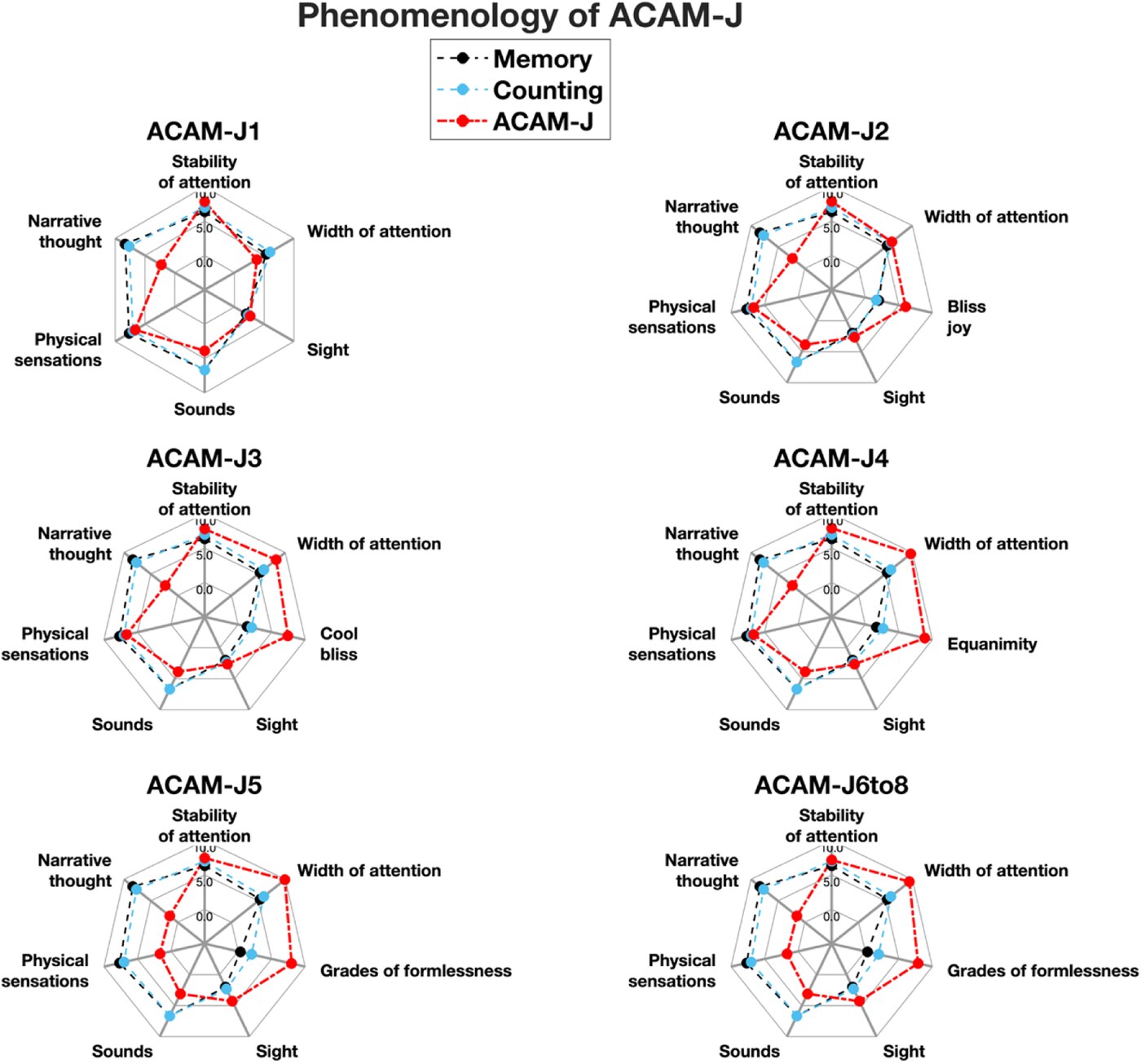
One Big Result: Jhana Was Linked to Less Segregated, More Interconnected Brain Networks
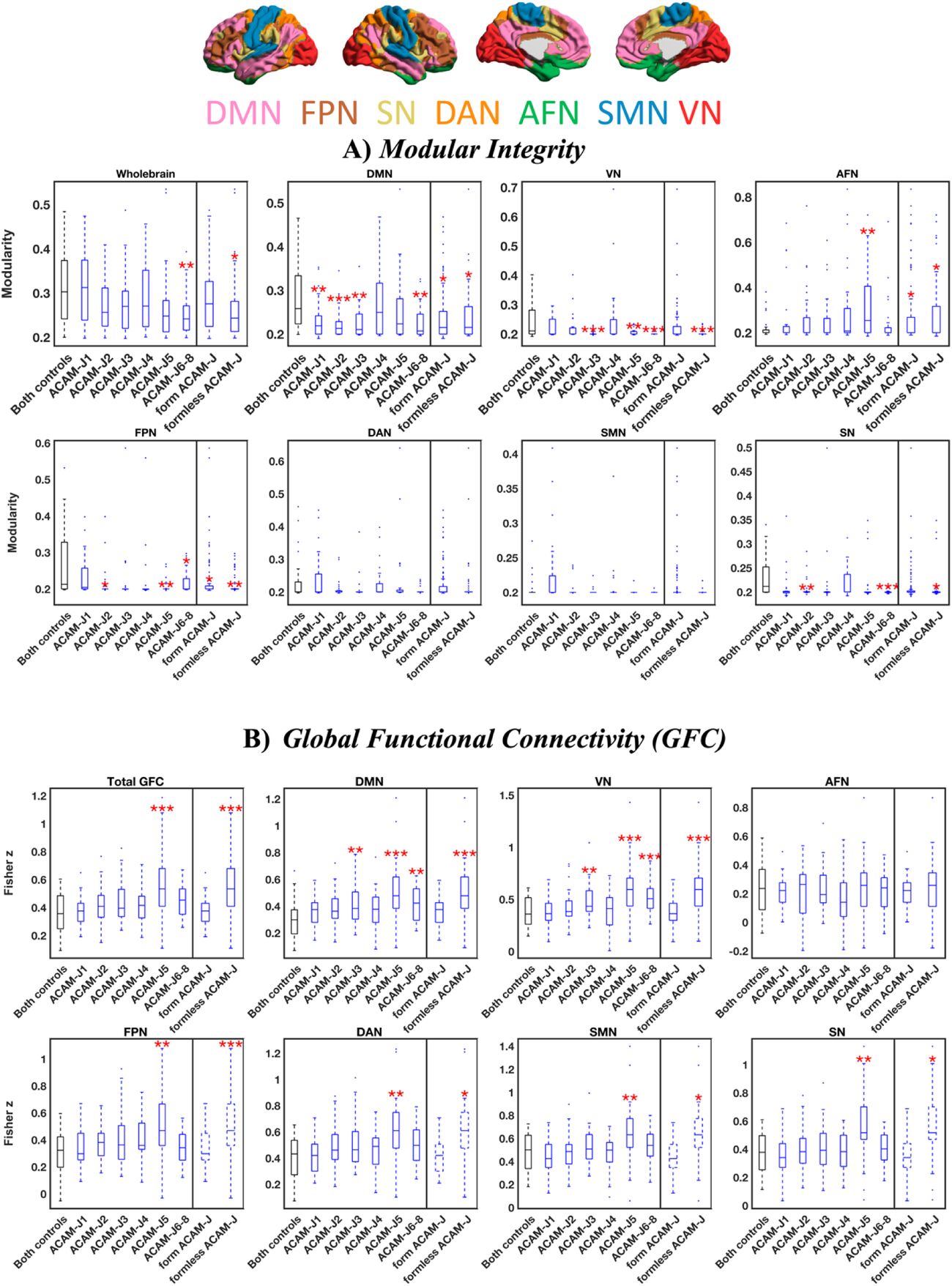
The team looked at two fMRI measures. Modularity describes how much a network splits into tight clusters that mostly talk among themselves, a sign of hierarchical organization. Global functional connectivity describes how closely a region’s activity rises and falls with the rest of the brain (see
functional connectivity
Functional connectivity is the degree to which activity in different brain regions rises and falls together over time. It is usually measured with fMRI as the correlation between regions’ signals. It shows coordinated activity, not physical wiring. Researchers use it to see how brain networks such as the DMN communicate in different mental states.
More on Wikipedia
View in glossary
).
Compared with the two control tasks combined, modularity was lower during jhana in four of seven large-scale networks: the DMN, frontoparietal, visual and salience networks. Global connectivity was higher in six of the seven (all but the affective network) and across the brain as a whole. The changes were strongest in the formless jhanas, and the DMN in particular became more connected with other networks. The authors read this as support for the hierarchy idea:
Our results show that advanced meditation practices markedly dysregulate high-level brain systems via practices of enhanced attention to sensations, corroborating recent neurocognitive theories of meditation as the deconstruction of the brain’s cortical hierarchy.
The EEG recordings told a compatible story. During jhana, rhythmic electrical activity was weaker across much of the scalp, most clearly in the slower delta, theta and
alpha
Alpha waves are rhythmic electrical brain activity at roughly 8–13 cycles per second, recorded with EEG. They are often strongest when the eyes are closed and the mind is relaxed, and are thought to help filter out or hold back information as part of top-down control. Meditation studies have reported both increases and decreases in alpha, depending on the practice.
More on Wikipedia
View in glossary
frequency bands. At the same time, brain signals became more varied, as measured by
Lempel-Ziv Complexity
Lempel-Ziv complexity is a measure of how varied, or unpredictable, a signal is. Applied to EEG, it counts how many distinct patterns appear in a recording: a repetitive signal scores low, and a richly varied one scores high. It is often used as a rough index of brain “entropy” and has been found to rise in psychedelic states.
More on Wikipedia
View in glossary
, a count of how many distinct patterns a signal contains.
Miscellaneous Interesting Takeaways
Bliss Had Its Own Neural Signature
The second jhana is traditionally marked by intense, pleasant bodily bliss. Run by run, higher bliss ratings in this jhana went with higher DMN connectivity and lower DMN modularity. On the EEG, bliss went with weaker
beta
Beta brain waves are a type of brainwave pattern that oscillate between approximately 12 to 30 Hz. Beta waves are typically associated with active thinking, focus, alertness, and engagement with the external world. They are prominent during conscious, goal-directed activity and are linked to cognitive tasks such as problem-solving, decision-making, and sustained attention.
More on Wikipedia
View in glossary
and
gamma
Gamma brain waves are a type of brainwave pattern that oscillate at approximately 25 to 100 Hz. Gamma waves are associated with states of heightened perception, problem-solving, and consciousness. Gamma waves play a crucial role in cognitive functioning, including memory, and information processing, and are thought to integrate thoughts and information from different parts of the brain.
More on Wikipedia
View in glossary
activity, rhythms the authors link to the brain’s predictions and active thinking, and with a modest drop in signal complexity, the opposite of the overall trend.
This suggests that during ACAM-J2, the brain experiences a state of relaxation and “letting go”, which may be related to the pleasant subjective experience of bliss/joy.
Stable Attention and Wide Attention Looked Different in the Brain
The meditator rated two qualities of attention separately: how steady it was and how wide it was. Steadier attention went with more alpha and theta power, while wider attention went with less alpha power and more complex signals. The authors take this as a sign that stability and width are distinct, both in experience and in the brain. In the formless jhanas, stronger formlessness ratings also went with more alpha power.
The Choice of Control Task Mattered
Many fMRI differences were clear against the counting task but weaker against memory recall, where increased connectivity appeared only in the DMN and visual network during the formless jhanas. The EEG results, by contrast, held up against both tasks. The ratings also suggest that some jhana-like experience crept into the first control runs, a reminder of how hard it is to find a truly “neutral” comparison for an expert meditator.
Final Reflection
This study offers an unusually detailed look at the jhanas, with dozens of runs and the meditator’s own ratings tied to each one. In this practitioner, the jhanas were reliably accompanied by a loosening of the brain’s usual network divisions, and specific experiences, especially bliss, tracked specific brain measures.
The findings fit the idea that deep concentration relaxes the brain’s top-down hierarchy, but they can’t establish it. They come from one person, moving through the states in a fixed order, compared with only a few control runs recorded at different times. Whether other practitioners show the same patterns is the obvious next question, and one the authors themselves raise.
Citation
Chowdhury, A., Bianciardi, M., Chapdelaine, E., Riaz, O. S., Timmermann, C., van Lutterveld, R., Sparby, T., & Sacchet, M. D. (2025). Multimodal neurophenomenology of advanced concentration absorption meditation: An intensively sampled case study of Jhana. NeuroImage, 305, 120973. 10.1016/j.neuroimage.2024.120973
Get the next summary by email
One or two new paper summaries every couple of weeks, sent to your inbox when they go up.
No spam, and you can unsubscribe at any time. Prefer a feed reader? Use the RSS feed.