
Background Information
Can the parts of the brain we use to understand other people be trained, the way practice shapes the regions involved in movement or memory? There is plenty of evidence for
neuroplasticity
Neuroplasticity is the brain’s ability to change its structure and function in response to experience. Changes can include new connections between neurons and shifts in the size of brain regions. Researchers have looked for structural neuroplasticity after meditation training, much as it has been found after exercise or learning new skills.
More on Wikipedia
View in glossary
in sensory, motor and memory systems. Much less is known about social skills.
Earlier studies of meditation and brain structure had real limits. Most were
cross-sectional
A cross-sectional study measures a group of people at a single point in time. It can show which things tend to go together, but not which came first or whether one causes the other.
More on Wikipedia
View in glossary
, comparing long-term meditators with non-meditators, so they couldn’t show what the practice itself did. The few training studies had their own problems, as the authors note:
Notably, samples in these studies were relatively small, and studies often lacked active control groups; furthermore, testing intervals were short, providing neither generalizable and robust estimates of brain change nor information about the effects of different types of mental practices on plasticity
Social neuroscience also suggests there are at least two routes to understanding others. The socio-affective route covers empathy (sharing another person’s feelings) and compassion (concern for their suffering plus a wish to help). It leans on regions such as the
insula
The insula is a region of cortex folded deep inside each side of the brain. It helps represent the body’s internal state (interoception) and is involved in emotion, empathy and compassion. Its front part, the anterior insula, comes up often in meditation research.
More on Wikipedia
View in glossary
and the anterior cingulate cortex. The socio-cognitive route is
theory of mind
Theory of mind is the ability to work out what another person thinks, believes or intends. It is also called mentalizing or cognitive perspective-taking. It is usually distinguished from empathy, which involves sharing another person’s feelings rather than reasoning about their thoughts.
More on Wikipedia
View in glossary
: working out what someone else thinks, believes or intends. It relies more on the medial prefrontal cortex, the temporoparietal junction (TPJ) and parts of the temporal lobe.
Sofie Valk, Tania Singer and colleagues at the Max Planck Institute in Leipzig asked whether training each route separately would leave different marks on
cortical thickness
Cortical thickness is the depth of the cerebral cortex, the brain’s folded outer layer of gray matter. It is estimated from MRI scans as the distance between the cortex’s outer surface and the white matter underneath. Researchers track it over time to look for training-related change, though it can’t show what changed at the level of cells.
More on Wikipedia
View in glossary
, the depth of the brain’s outer layer of
gray matter
Gray matter is brain tissue made up mostly of nerve cell bodies and their connections. It forms the brain’s outer layer (the cortex) and several deeper structures. Structural MRI can estimate gray matter volume (how big a region is), density (how concentrated the tissue is), and cortical thickness (how deep the outer layer is).
More on Wikipedia
View in glossary
.
What They Did
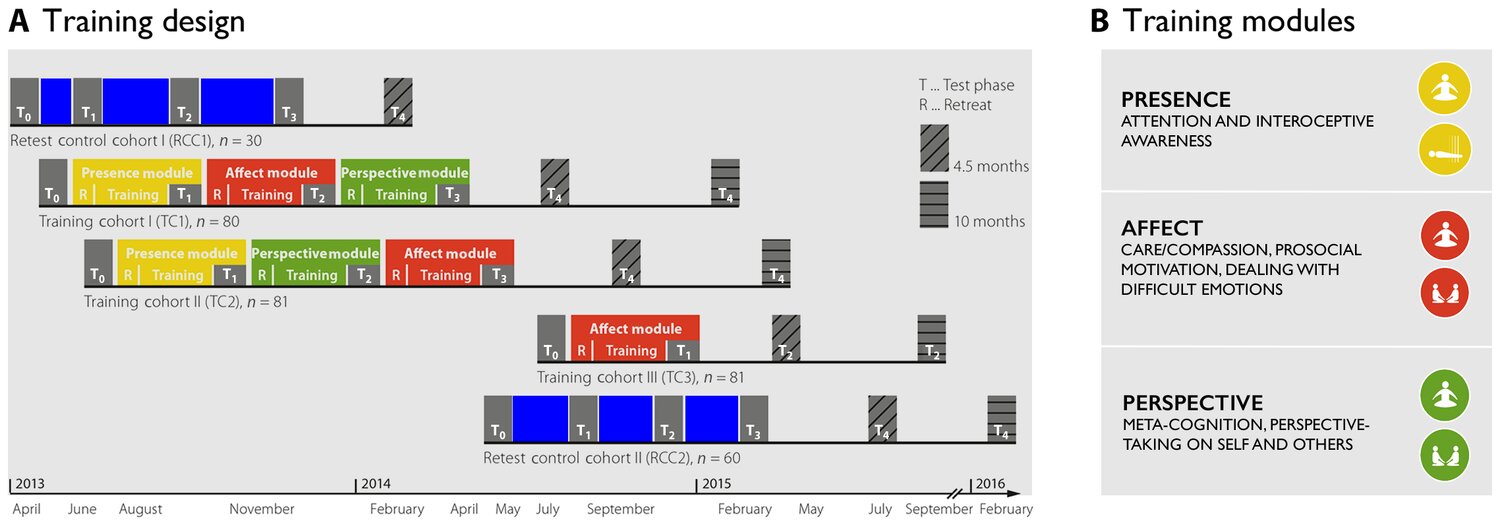
The study was part of the ReSource Project, a secular nine-month training program. It had three 13-week modules. Each opened with a 3-day retreat, followed by eight weeks of weekly 2-hour group sessions with teachers, then five weeks of consolidation, with daily practice supported by a smartphone app throughout.
- Presence built attention and body awareness through breathing meditation and body scans, much like familiar programs such as
MBSR
Mindfulness-Based Stress Reduction (MBSR) is a program designed to help individuals cope with stress, pain, and illness. Developed by Jon Kabat-Zinn in the 1970s, it combines meditation and yoga to promote awareness and stress management. The eight-week program teaches participants to focus on the present moment non-judgmentally, enhancing their ability to manage difficulties.
More on Wikipedia
View in glossary . - Affect used
loving-kindness meditation
Brahma Vihara meditation, also known as the Four Immeasurables, involves cultivating four qualities: loving-kindness (metta), compassion (karuna), empathetic joy (mudita), and equanimity (upekkha). It aims to develop a state of unconditional love, compassion towards suffering, joy in the happiness of others, and a balanced mind in all situations.
More on Wikipedia
View in glossary and a daily 10-minute partner exercise. One partner described a situation from the past day that felt difficult and one they felt grateful for, while the other listened without responding. - Perspective used a meditation on observing thoughts as passing events, plus a partner exercise. The speaker described their day from the viewpoint of one of their “inner parts” (recurring patterns of thought and feeling), and the listener tried to work out which part was speaking.
Two training cohorts both began with Presence and then did Affect and Perspective in opposite orders, so each served as an
active control
An active control group is a comparison group that takes part in a different program designed to be just as engaging as the one being tested. In meditation research, it might involve exercise, music, or education classes with the same time commitment, teachers, and expectations of benefit. Comparing against an active control helps separate the effects of meditation itself from the general effects of joining a course.
More on Wikipedia
View in glossary
for the other. A third cohort did Affect alone for three months, so it could be compared directly with Presence. A retest group did no training but was scanned on the same schedule. Participants trained in Berlin or Leipzig and were all scanned in Leipzig, and fewer than 8% dropped out.
One Big Result: Each Practice Was Linked to Its Own Pattern of Cortical Thickening
When each module was compared with the average of the other two, the three kinds of training were associated with thickening in largely separate regions:
- Presence (attention and body awareness): the right prefrontal cortex extending into the anterior cingulate, along with regions at the back of the brain (occipital and inferior temporal cortex).
- Affect (compassion and difficult emotions): a cluster running from the right supramarginal gyrus into the insula and the dorsolateral prefrontal cortex, regions tied to empathy and emotion regulation, plus parts of the cingulate.
- Perspective (theory of mind): the left ventrolateral prefrontal cortex and the right middle temporal gyrus, a region reliably linked to understanding others’ minds.
These patterns held in both training cohorts and at both sites. The untrained retest group, by contrast, showed only thinning in lateral frontal regions over the nine months, which fits with normal age-related change.

The changes were small. Averaged over the regions that changed, they amount to at most a few hundredths of a millimeter over three months. The authors sum up the main message this way:
In conclusion, our findings of structural plasticity in healthy adults in faculties relevant to social intelligence and social interactions suggest that the type of mental training matters.
Miscellaneous Interesting Takeaways
Brain Changes Tracked Individual Gains in Skill
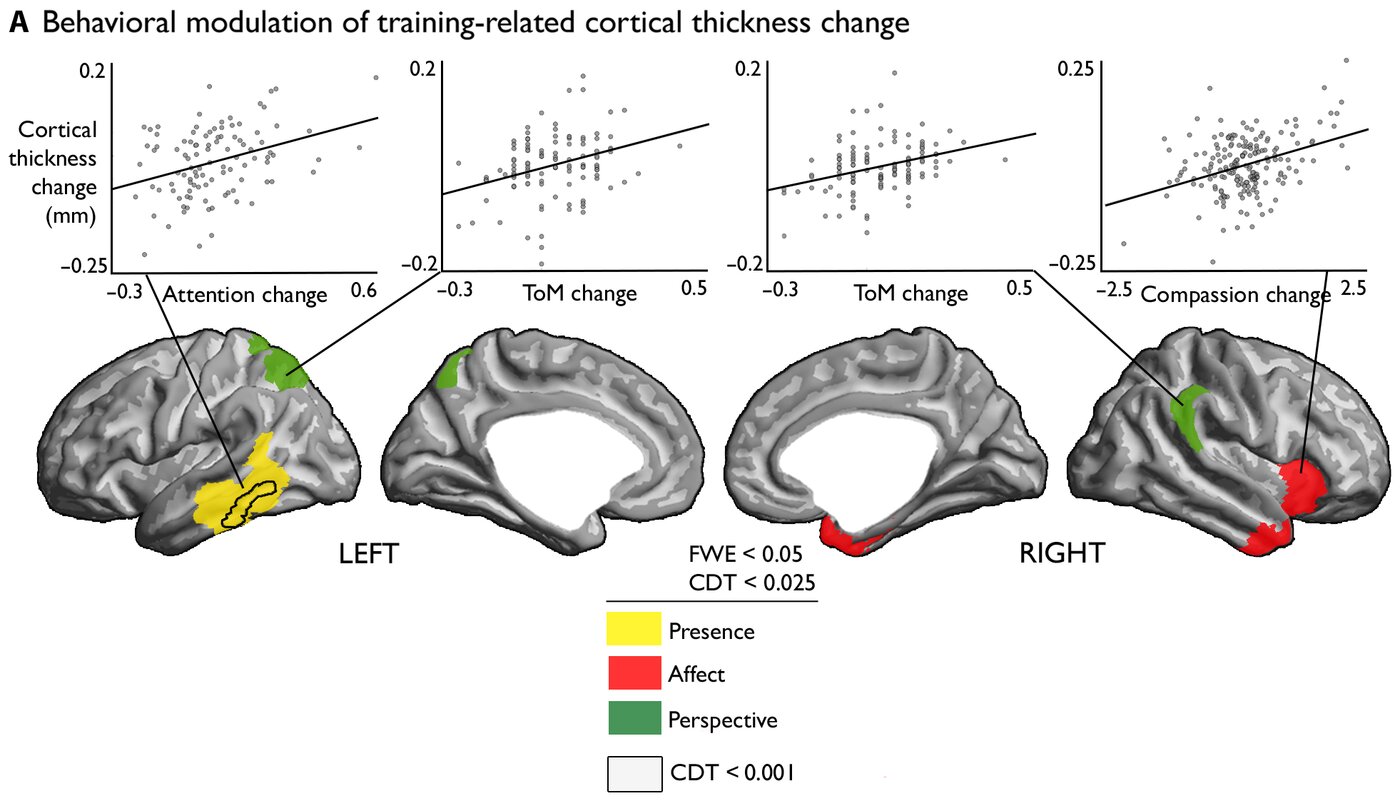
The people who improved most also tended to show the most thickening. After Affect training, larger gains in compassion ratings went with more thickening in the right insula, extending toward the temporal pole. This held in all three cohorts that did Affect (correlations of r = 0.28 to 0.37). After Perspective, gains in theory-of-mind accuracy tracked thickening in the TPJ and left parietal cortex (r = 0.24 to 0.44).
These are moderate correlations. They show that brain and behavior changed together, not that one caused the other.
Attention Results Didn’t Land Where Expected
Attention, measured with a cued
flanker task
The flanker test is a cognitive task used to measure interference control—the ability to focus attention on relevant stimuli while suppressing responses to irrelevant distractions. Participants respond to a central target stimulus surrounded by distracting ‘flanker’ stimuli. Performance on this task reflects the efficiency of controlled and automatic attentional processes.
More on Wikipedia
View in glossary
, improved after Presence. But the thickening linked to that improvement was in the left middle temporal cortex, not the frontal attention network the team had predicted. It also didn’t overlap with the areas active during the attention task in baseline
fMRI
An fMRI (functional Magnetic Resonance Imaging) measures changes in blood flow related to neural activity in the brain, offering insights into brain function and activity patterns.
More on Wikipedia
View in glossary
scans. The compassion and theory-of-mind changes, by contrast, did overlap with the regions active during those tasks. The authors suggest the flanker task may not have captured everything Presence trained, such as body awareness and noticing one’s own mind.
Compassion Training Without a Mindfulness Foundation
Many contemplative traditions teach attention first and compassion later. The cohort that did Affect alone, with no Presence training first, still showed thickening in the supramarginal gyrus and sensorimotor regions extending into the insula. The authors see this as a hint that socio-affective skills might be trained without first learning to stabilize the mind, but they flag it as a question for future work.
A Different Result From a Shorter, Broader Course
A randomized trial of the eight-week
MBSR
Mindfulness-Based Stress Reduction (MBSR) is a program designed to help individuals cope with stress, pain, and illness. Developed by Jon Kabat-Zinn in the 1970s, it combines meditation and yoga to promote awareness and stress management. The eight-week program teaches participants to focus on the present moment non-judgmentally, enhancing their ability to manage difficulties.
More on Wikipedia
View in glossary
course found no structural brain changes compared with a matched health program. Its authors point to this study, whose training ran about 50% longer, as a possible reason for the difference: longer training, or training that focuses on one kind of practice at a time, may be needed before changes in brain structure show up.
Final Reflection
This study suggests that what people practice may shape where change shows up in the brain. Attention, compassion and perspective-taking each appeared to leave a different structural footprint, even with short daily practice in healthy adults.
The usual cautions apply. Cortical thickness is an indirect measure, the brain–skill links are correlations, and the Perspective module was always taken after Presence, never on its own. The authors are also frank about how little an MRI scan can say about what actually changed:
Because plasticity research based on this high-level mental training can only be conducted in living humans with noninvasive neuroimaging, we can merely speculate about the neurobiological mechanisms driving the observed structural changes.
Still, with its large sample, active comparison modules and untrained retest group, this is one of the stronger pieces of evidence that different contemplative practices may not be interchangeable.
Citation
Valk, S. L., Bernhardt, B. C., Trautwein, F.-M., Böckler, A., Kanske, P., Guizard, N., Collins, D. L., & Singer, T. (2017). Structural plasticity of the social brain: Differential change after socio-affective and cognitive mental training. Science Advances, 3(10), e1700489. 10.1126/sciadv.1700489
Get the next summary by email
One or two new paper summaries every couple of weeks, sent to your inbox when they go up.
No spam, and you can unsubscribe at any time. Prefer a feed reader? Use the RSS feed.