
Background Information
Sleep tends to get worse with age, and poor sleep is linked to heart disease, cognitive decline and earlier death. The standard non-drug treatment,
CBT-I
Cognitive behavioral therapy for insomnia (CBT-I) is a structured, usually short-term talk therapy for chronic sleeplessness. It combines changes to sleep habits and schedules, such as limiting time in bed, with work on unhelpful thoughts about sleep. It is widely recommended as a first-line treatment for insomnia.
More on Wikipedia
Read more in the glossary
, works well for many people, but the authors note that up to 40% don’t respond to it. That has made researchers look for alternatives.
One candidate is Mindfulness-Based Therapy for Insomnia (MBTI), an eight-week group program that weaves
mindfulness
Mindfulness is the psychological process of purposely bringing one’s attention to experiences occurring in the present moment without judgment. It involves maintaining awareness of thoughts, feelings, bodily sensations, and surrounding environment with an attitude of curiosity and acceptance. In meditation contexts, mindfulness practices typically involve focusing attention on the breath or body sensations as anchors to the present moment while acknowledging and releasing distracting thoughts.
More on Wikipedia
Read more in the glossary
practice together with behavioral techniques borrowed from CBT-I, such as sleep restriction and stimulus control. Instead of challenging unhelpful thoughts about sleep head-on, as CBT-I does, mindfulness aims to change how people relate to those thoughts and to calm the mental arousal that keeps them awake. In an earlier pilot trial in adults with chronic insomnia, MBTI reduced symptoms more than simply tracking sleep, and by six months had outdone a general mindfulness program (Ong et al., 2014). Jason C. Ong, first author of that pilot and author of the MBTI manual the instructors followed, is a co-author of this paper.
The authors wanted to address three weaknesses in earlier research on mindfulness and sleep: mindfulness programs that weren’t designed for sleep, a reliance on questionnaires rather than objective sleep measures, and comparisons with no-treatment groups rather than an
active control
An active control group is a comparison group that takes part in a different program designed to be just as engaging as the one being tested. In meditation research, it might involve exercise, music, or education classes with the same time commitment, teachers, and expectations of benefit. Comparing against an active control helps separate the effects of meditation itself from the general effects of joining a course.
More on Wikipedia
Read more in the glossary
that gives people the same time and attention.
What They Did
The team recruited adults aged 50 to 80 in Singapore through advertisements, a meditation center, sleep clinics and word of mouth. To qualify, people needed a score of at least 5 on the
Pittsburgh Sleep Quality Index (PSQI)
The Pittsburgh Sleep Quality Index (PSQI) is a widely used questionnaire about how well a person has slept over the past month. It covers time to fall asleep, sleep duration, disturbances and daytime effects, and combines them into a score from 0 to 21, where higher means worse sleep. Scores above 5 are commonly taken to indicate poor sleep.
More on Wikipedia
Read more in the glossary
, a questionnaire on which higher scores mean worse sleep, plus at least one specific complaint: usually taking more than 30 minutes to fall asleep, lying awake for more than 30 minutes during the night, or sleeping less than six and a half hours. A clinical diagnosis of insomnia wasn’t required. People with major neurological or psychiatric conditions, cognitive impairment or long-term use of sleep medication were excluded, and none had taken a mindfulness course before.
In this
Randomized Controlled Trial
A Randomized Controlled Trial is a scientific study design that randomly assigns participants to either an experimental group receiving an intervention or a control group, allowing researchers to measure the true effect of the intervention while minimizing bias.
More on Wikipedia
Read more in the glossary
, 127 people (average age 61, 58% women, 95% Chinese) were randomly assigned to one of two eight-week courses, each meeting once a week for two hours in groups of 6 to 15:
- MBTI (65 people), taught by certified mindfulness instructors with about 2,000 hours of personal practice on average. Each class after the first opened with a formal practice such as sitting meditation, a
body scan
The body scan is a meditation practice in which attention is moved slowly through the body, part by part, noticing whatever sensations are present without trying to change them. It is a core exercise in mindfulness programs such as MBSR.
More on Wikipedia
Read more in the glossary , mindful eating or mindful movement, followed by discussion of how the week’s practice applied to people’s sleep. Sleep hygiene Sleep hygiene is a set of everyday habits and conditions thought to support good sleep, such as keeping regular sleep and wake times, limiting caffeine, alcohol and screens before bed, and keeping the bedroom dark, quiet and cool. Sleep hygiene advice is a common part of insomnia treatment, but on its own it usually helps less than structured therapies such as CBT-I.
More on Wikipedia
Read more in the glossary was introduced in week 2, and two behavioral techniques from week 3: sleep restriction, which limits time in bed, and stimulus control, which strengthens the link between bed and sleep. Home practice started at 20–30 minutes a day and built up to 45. - SHEEP (62 people), a Sleep Hygiene, Education, and Exercise Program developed by psychologists at Singapore General Hospital and taught by instructors with at least a master’s degree in clinical psychology. It covered sleep biology, tracking one’s own sleep, and changes to habits and the bedroom, and taught
diaphragmatic breathing
Diaphragmatic breathing, also called belly or abdominal breathing, is breathing driven mainly by the diaphragm, the dome-shaped muscle under the lungs. As it contracts, the belly rather than the chest rises, and breaths become deeper and slower. It is taught in yoga, tai chi and many relaxation and meditation practices, and is often used as a way to calm the body.
More on Wikipedia
Read more in the glossary , morning and evening stretches and progressive muscle relaxation Progressive muscle relaxation (PMR) is a relaxation technique in which a person tenses and then releases groups of muscles in turn, noticing the contrast between tension and relaxation. With practice, fewer and larger muscle groups are used, until relaxation can be brought on by recall alone. It was developed by the physician Edmund Jacobson in the early 20th century and is often used as a comparison treatment in meditation trials.
More on Wikipedia
Read more in the glossary . Class time and homework time were matched to MBTI’s.
The two main questionnaires were the Insomnia Severity Index (ISI), a seven-item scale covering daytime and nighttime insomnia symptoms, and the PSQI. For objective measures, participants wore a movement-sensing wrist device (
actigraphy
Actigraphy estimates sleep and wake from movement, recorded by a small device worn on the wrist like a watch for days or weeks. Because people move much less when asleep, the record gives an objective estimate of when and how long someone sleeps in everyday life. It is less detailed than a sleep-lab recording with polysomnography, and can mistake lying still while awake for sleep.
More on Wikipedia
Read more in the glossary
) for at least five nights and had one night of
polysomnography
Polysomnography is an overnight sleep study, usually done in a sleep lab. Sensors record brain activity (EEG), eye movements, muscle activity, heart rhythm and breathing, so that each stretch of the night can be scored as wake, light sleep, deep sleep or REM sleep, and sleep disorders such as apnea can be detected.
More on Wikipedia
Read more in the glossary
at home, which records brain activity to score sleep and wake. From these the researchers took
sleep onset latency
Sleep onset latency is how long it takes to fall asleep, counted from lights out or the start of trying to sleep. It can be reported by the sleeper, estimated from movement with a wrist-worn device, or measured from brain activity in a sleep recording. Regularly taking more than about 30 minutes to fall asleep is a common sign of insomnia.
More on Wikipedia
Read more in the glossary
(how long it took to fall asleep) and
wake after sleep onset
Wake after sleep onset (WASO) is the total time spent awake during the night after first falling asleep, added up across all the awakenings until the final one in the morning. It is a standard measure of how broken a night’s sleep is, and can be estimated from sleep diaries, wrist-worn devices or a full sleep recording. Lying awake for more than about 30 minutes a night is a common sign of insomnia.
More on Wikipedia
Read more in the glossary
(WASO, total time awake after first falling asleep). That made six primary outcomes. Everything was measured before and after the course; the PSQI and a pre-sleep arousal questionnaire were also given at week 4 and, by phone, six months later.
Participants knew which course they were taking, though both were presented as credible sleep treatments. The researchers who collected data were blind to group, and sleep recordings were shuffled before scoring so that scorers didn’t know whose they were or when they were made. The main analysis was by
intention to treat
An intention-to-treat analysis counts every randomized participant in the group they were assigned to, whether or not they completed or even started the treatment. It keeps the benefit of randomization, since dropping people who didn’t follow their plan can leave groups that differ in other ways, and it estimates what happens when a treatment is offered in practice rather than when it is taken exactly as intended.
More on Wikipedia
Read more in the glossary
, filling in missing data statistically so that everyone randomized was counted. To allow for testing several primary outcomes, a difference between the groups had to reach p < 0.0125 to count.
One Big Result: Insomnia Severity Fell More With Mindfulness, but Sleep Quality Improved Equally
Of the 127 people randomized, 113 completed the course, attending 7.4 of the 8 classes on average.
On the Insomnia Severity Index, the MBTI group improved significantly more than the SHEEP group (p = 0.010). MBTI participants’ average score fell from 14.9 to 10.0, a large
effect size
Effect size is a statistical concept that quantifies the magnitude or strength of a relationship, difference, or intervention outcome. Unlike p-values which only indicate statistical significance, effect sizes measure how meaningful a result is in practical terms. Common measures include Cohen’s d (standardized mean difference), correlation coefficients (r), and odds ratios. In meditation research, effect sizes help quantify the practical impact of different meditation practices on psychological or physiological outcomes.
More on Wikipedia
Read more in the glossary
(d = −1.27), while the SHEEP group’s fell from 14.2 to 11.2 (d = −0.69). On the sleep quality questionnaire, though, the two groups moved together. Both improved by week 4 and further by the end of the course, MBTI from 11.0 to 7.3 (d = −1.19) and SHEEP from 10.9 to 7.6 (d = −1.02), and both kept their gains six months later.
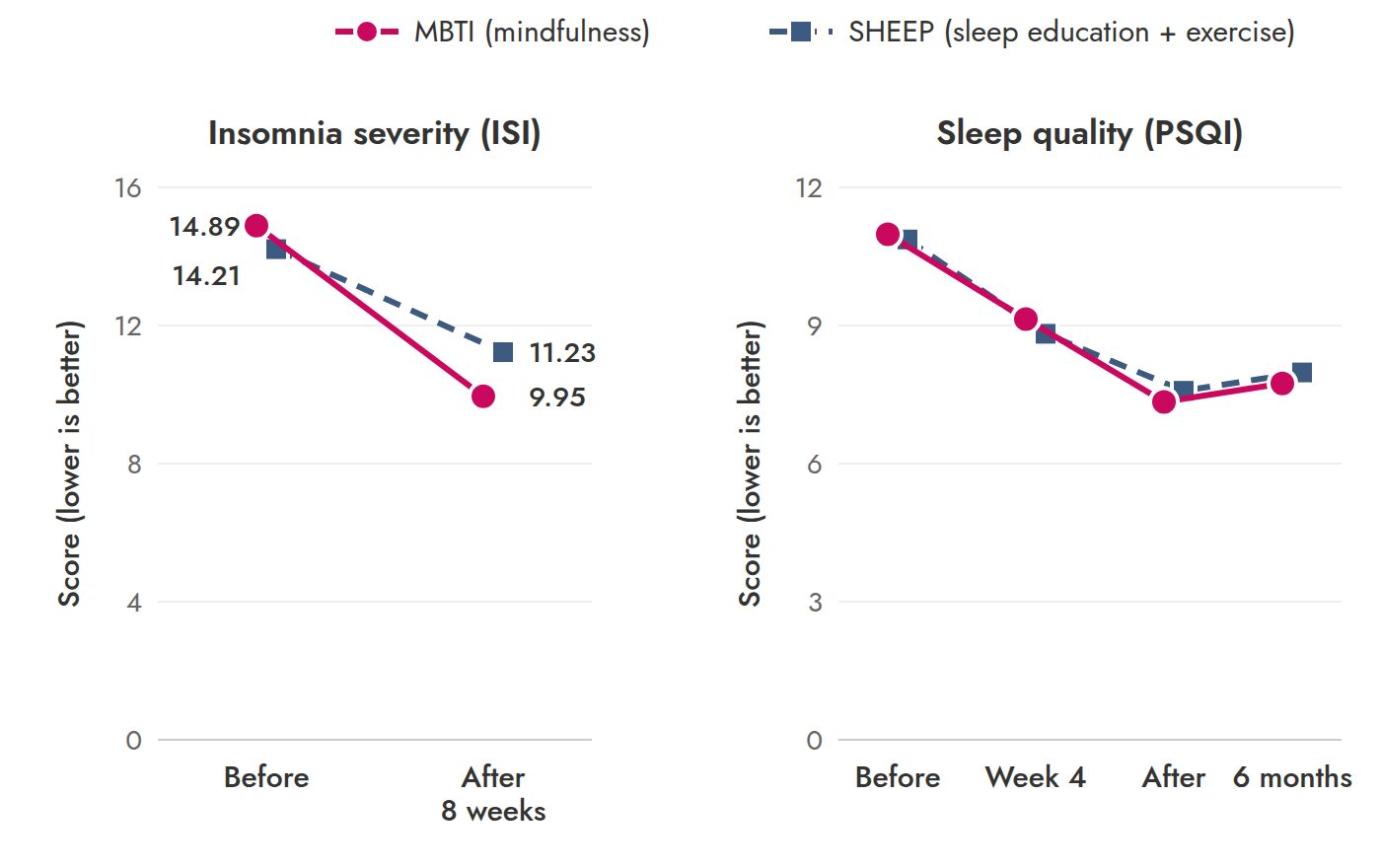
Why would the groups differ on one questionnaire and not the other? The authors point out that the ISI gives more weight to how people feel and function during the day, and offer a tentative explanation:
Given the large and equal improvements in PSQI scores between the groups, the result on the ISI suggests that MBTI participants may have been more accepting of sensations of sleepiness or fatigue on nights with poor-quality sleep.
The study didn’t test this idea directly.
Miscellaneous Interesting Takeaways
Objective Sleep Changed a Little, and Not Clearly More With Mindfulness
None of the four objective primary outcomes improved significantly more in the MBTI group than in the SHEEP group. Time awake at night measured by the wrist device came closest (p = 0.019), but that fell short of the stricter threshold the authors set for multiple outcomes.
Looking within each group, the MBTI group showed small improvements in three of the four measures. On the wrist device, its time awake at night fell from 75 to 65 minutes (d = −0.30) and its time to fall asleep from 23 to 17 minutes (d = −0.25). On the home sleep recording, its time awake at night fell from 95 to 80 minutes (d = −0.26). The SHEEP group’s changes on these measures weren’t significant. Time to fall asleep on the sleep recording didn’t change in either group.
The MBTI group also started with more time awake at night than the SHEEP group on both devices. The paper’s text says the groups did not differ at baseline on clinical measures, but its Table 2 lists p = 0.01 for the difference in time awake on the sleep recording (95 vs. 72 minutes).
Some objective gains were shared. On the home recording, both groups slept longer after the course (MBTI from 348 to 373 minutes, SHEEP from 344 to 376) and spent a larger share of their time in bed asleep (
sleep efficiency
Sleep efficiency is the share of time in bed actually spent asleep: total sleep time divided by time in bed, given as a percentage. It can be measured in a sleep lab or estimated from sleep diaries or wrist-worn devices. Taking a long time to fall asleep or lying awake during the night lowers it, and values below about 85–90% are often taken as a sign of disturbed sleep.
More on Wikipedia
Read more in the glossary
). On the wrist device, the MBTI group’s sleep efficiency rose slightly as its time in bed fell, while total sleep time didn’t change in either group.
The Control Program Was Unusually Effective
SHEEP was not a token comparison. Its participants improved about as much on sleep quality as the MBTI group did, a bigger change than earlier studies of sleep hygiene programs have found. The authors think its extra ingredients explain why:
A likely explanation for this difference was that SHEEP contained many active components (e.g. exercise, breathing training, and relaxation) compared with typical sleep hygiene courses.
A strong control group makes any advantage for mindfulness more convincing, but also harder to find. The authors sum up the comparison plainly: “The incremental benefit of MBTI over active control was, as such, limited to only a few outcomes, with insomnia severity being the most notable.”
Racing Thoughts at Bedtime Calmed in Both Groups
Both groups reported less mental arousal before sleep by week 4, more by the end of the course and more again at six months, with no difference between them. Physical arousal before sleep didn’t fall significantly during the course in either group, but was lower at the six-month follow-up. Unhelpful beliefs about sleep also eased equally in both groups.
Mindfulness Scores Didn’t Rise, but Tracked Improvement in the MBTI Group
Neither group scored significantly higher on the
Five Facet Mindfulness Questionnaire
The Five Facet Mindfulness Questionnaire (FFMQ) is a widely used 39-item self-report questionnaire that measures mindfulness as an everyday tendency. It gives scores for five facets: observing experiences, describing them in words, acting with awareness rather than on autopilot, not judging one’s inner experience, and not reacting to it. Because it relies on self-report, scores can reflect how people see themselves, and can shift with what they have learned about mindfulness.
More on Wikipedia
Read more in the glossary
after the course. The authors suggest a ceiling effect, since older adults tend to score high to begin with, and note that many mindfulness trials find no change on such questionnaires. Still, in an exploratory analysis, MBTI participants whose mindfulness scores rose the most tended to improve most in sleep quality (r = −0.59) and insomnia severity (r = −0.38), and no such link appeared in the SHEEP group. The authors take this as a hint that the two courses worked through different routes, though a
correlation
A correlation measures how closely two things rise and fall together across people or over time. Pearson’s r runs from −1 to +1: values near +1 mean that people high on one measure tend to be high on the other, values near −1 mean the reverse, and values near 0 mean no straight-line relationship. A correlation alone can’t show that one thing causes the other.
More on Wikipedia
Read more in the glossary
can’t show that one change caused the other.
No Harms Reported
No adverse events related to the courses or the study visits were reported, and nobody withdrew because of adverse effects. Satisfaction with the courses and instructors didn’t differ between the groups. Of the people who dropped out of MBTI, one said it was because they were unhappy with the course content, as did two in SHEEP.
Who Was Studied
The authors describe their sample as older and mostly Han Chinese, with much broader sleep complaints than the earlier pilot, which recruited only people with diagnosed primary insomnia. Because people were recruited through advertisements, the sample did not represent Singapore’s population, and results may not apply to younger adults. Sessions weren’t recorded, out of concern that recording would make participants less willing to share, so there was no independent check on how faithfully instructors followed each program. Objective sleep was measured only before and after the course, not at six months.
Final Reflection
This is a careful trial: a sleep-specific mindfulness program, a well-matched active comparison, blinded scoring and both questionnaire and objective sleep measures. Its results are more modest than the paper’s abstract suggests, which concludes that MBTI “is effective at improving subjective and objective sleep quality in older adults.” Both groups improved substantially, and the paper’s own discussion is more measured:
In summary, of our six primary comparisons, only one (ISI) showed a significant time × group interaction.
That one difference matters, though. MBTI reduced insomnia severity with a large effect, by more than a demanding control program did, and the authors note that the size of that drop is comparable to what CBT-I studies report, although this trial didn’t compare the two directly. They suggest MBTI could suit people who haven’t responded to CBT-I or can’t get it, and that it can be taught in community groups of up to 15. They also call for the trials that would settle that question: a head-to-head comparison with CBT-I, or a trial in people for whom CBT-I has failed. For older adults with everyday sleep troubles, this study suggests a structured sleep course with relaxation and exercise may improve how they rate their sleep about as much as mindfulness does, with mindfulness offering an extra edge on how much insomnia bothers them.
Citation
Perini, F., Wong, K. F., Lin, J., Hassirim, Z., Ong, J. L., Lo, J., Ong, J. C., Doshi, K., & Lim, J. (2023). Mindfulness-based therapy for insomnia for older adults with sleep difficulties: a randomized clinical trial. Psychological Medicine, 53(3), 1038–1048. 10.1017/S0033291721002476
Get the next summary by email
One or two new paper summaries every couple of weeks, sent to your inbox when they go up.
No spam, and you can unsubscribe at any time. Prefer a feed reader? Use the RSS feed.