
Background Information
Some meditation traditions have long held that practice can cut the need for sleep, with stories of yogis who sleep only a couple of hours a night. The authors of this 2010 paper, researchers at the University of Kentucky, noted that
EEG
An electroencephalogram (EEG) is a recording of brain activity. During this painless test, small sensors are attached to the scalp to pick up the electrical signals produced by the brain.
More on Wikipedia
Read more in the glossary
studies of meditation had rarely touched the question:
Surprisingly, given the number of EEG studies on meditation, essentially no one has addressed whether meditation might provide a restorative function similar to non-REM sleep despite centuries of anecdotal claims by certain practitioners and followers that meditation does reduce the need for sleep…
Their reasoning started from brain waves. During meditation, synchronized
alpha waves
Alpha waves are rhythmic electrical brain activity at roughly 8–13 cycles per second, recorded with EEG. They are often strongest when the eyes are closed and the mind is relaxed, and are thought to help filter out or hold back information as part of top-down control. Meditation studies have reported both increases and decreases in alpha, depending on the practice.
More on Wikipedia
Read more in the glossary
dominate much of the cortex, more strongly than in ordinary eyes-closed rest. That bears a superficial resemblance to deep
NREM Sleep
Non-rapid eye movement (NREM) sleep makes up most of a night’s sleep. It runs from light sleep (stages N1 and N2) to deep, slow-wave sleep (N3), alternating with REM sleep in cycles of about 90 minutes. During NREM sleep, brain activity is dominated by slow waves and the brain responds much less to the outside world.
More on Wikipedia
Read more in the glossary
, when even slower, synchronized
delta waves
Delta waves are the slowest rhythmic electrical brain activity recorded with EEG, at roughly 0.5–4 cycles per second. They dominate deep (slow-wave) sleep and also appear under general anesthesia, so more delta while awake can be a sign of drowsiness. Smaller amounts are present in waking EEG, where they have also been linked to attention and internal processing.
More on Wikipedia
Read more in the glossary
take over. The two rhythms come from very different brain systems, but both reflect many neurons firing together, and the authors wondered whether that might give the brain a chance to reset.
There’s no direct measure of how much sleep a person needs, so the team used an indirect one: the
psychomotor vigilance task (PVT)
The psychomotor vigilance task (PVT) is a simple reaction-time test of sustained alertness. For about ten minutes, a person watches a small display and presses a button as fast as possible whenever a counter starts, at random intervals. Well-rested people respond in roughly 200–300 milliseconds and rarely miss; with sleep loss, responses slow and lapses become more common, which makes the PVT a standard measure of the effects of sleep deprivation.
More on Wikipedia
Read more in the glossary
. For ten minutes, a person watches a small display and presses a button as fast as possible whenever a counter starts, at random intervals. Well-rested people typically respond in about 180 to 300 milliseconds and almost never miss. As sleep debt builds up, responses slow down and lapses become more common.
What They Did
The paper reports two studies.
Study 1: Beginners. Ten University of Kentucky students (7 men and 3 women, aged 19 to 23) with no previous meditation experience were screened for medical, psychiatric and sleep problems. They kept a regular sleep schedule, checked with a wrist activity monitor (
actigraphy
Actigraphy estimates sleep and wake from movement, recorded by a small device worn on the wrist like a watch for days or weeks. Because people move much less when asleep, the record gives an objective estimate of when and how long someone sleeps in everyday life. It is less detailed than a sleep-lab recording with polysomnography, and can mistake lying still while awake for sleep.
More on Wikipedia
Read more in the glossary
), and averaged about 7.5 hours of sleep before each test day. On test days they avoided caffeine, nicotine, alcohol and other drugs.
Each student had two one-hour lessons, in pairs, in a simple eyes-closed meditation focused on the breath, a form of
concentrative meditation
Focused attention is a style of meditation in which you keep your attention on one chosen object, such as the breath or a point in front of you, notice when the mind has wandered, and bring it back. It trains steady concentration, and Buddhist shamatha practice is a well-known example. Researchers often contrast it with open monitoring meditation.
Read more in the glossary
. They knelt on a meditation bench and breathed from the abdomen, keeping their attention on its movement.
In this
within-subject design
In a within-subject (or repeated-measures) design, every participant takes part in all of a study’s conditions, and their results under one condition are compared with their own results under the others. Because each person serves as their own comparison, it needs fewer participants than comparing separate groups. But the order of conditions can matter, through practice, fatigue or carry-over, so researchers vary the order across participants, and people may guess what is being compared.
More on Wikipedia
Read more in the glossary
, every student then went through three conditions, twice each, on six separate days. Each day’s activity was assigned at random, and the students didn’t know it in advance:
- Meditation: 40 minutes of the breath-focused practice.
- Nap: 40 minutes lying in bed, trying to sleep.
- Control: 40 minutes in a desk chair with soft music, light reading or conversation, eyes open.
The session ran from 3:10 to 3:50 pm. The students took the 10-minute PVT at 3:00, again at 4:00 (ten minutes after the session) and a third time at 4:50, after 40 minutes of the control activities.
Later, each student stayed up through a weekend night. After about 32 hours without sleep, they took the PVT, meditated for 40 minutes and took it again. There was no sleep-deprived nap or control session for comparison.
Study 2: Long-term meditators. Seven experienced meditators in the Delhi region of India (3 women and 4 men, aged 24 to 48) had practiced for at least three years, two hours or more on most days, in traditional yogic styles focused on the breath. For 15 to 30 days they kept sleep journals, and for 15 to 22 days they wore activity monitors, pressing a marker button each time they began to meditate. Smaller subsets had an EEG (3 people), or took the PVT and a
Multiple Sleep Latency Test (MSLT)
The Multiple Sleep Latency Test (MSLT) measures daytime sleepiness. Over one day, a person is given four or five chances, about two hours apart, to nap in a quiet, dark room, and the time it takes to fall asleep (the sleep latency) is recorded with EEG. Falling asleep within a few minutes on average points to excessive sleepiness or sleep debt, while taking much longer suggests normal alertness.
More on Wikipedia
Read more in the glossary
, a standard measure of daytime sleepiness (4 people). Their average sleep was compared with that of 23 non-meditators in India matched for age and sex.
One Big Result: Every Student Reacted Faster After Meditating, While Most Got Slower After a Nap
In all ten students, reaction times on the PVT were faster after 40 minutes of meditation than before it. Averaged across the ten students in the paper’s Table 1, responses went from about 253 to 237 milliseconds, roughly 17 milliseconds quicker, which the authors describe as about a 7% improvement. The direction and size of the change matched on both meditation days for 9 of the 10 students.
The nap went the other way. Reaction times slowed for 9 of 10 students, from about 263 to 296 milliseconds on average. The authors put this down to
sleep inertia
Sleep inertia is the grogginess and slowed thinking that follow waking up. Reaction times, memory and decision-making are worse for a while after waking, usually from a few minutes to about half an hour, and the effect is stronger when someone wakes from deep slow-wave sleep or after sleep deprivation. It is why a long nap can leave people feeling worse at first.
More on Wikipedia
Read more in the glossary
, the grogginess that follows waking. Most students seemed to fall asleep within ten minutes, so they had about half an hour of sleep, probably enough for some to reach deep sleep, which makes waking up harder.
Perhaps more surprising, the control activity also left people slower, from about 250 to 266 milliseconds; 9 of 10 slowed and one was essentially unchanged. The authors suggest the mid-afternoon dip in alertness, the students’ missing their usual afternoon caffeine, or flagging motivation. Whatever the cause, it changes how the meditation result reads:
In light of the results following naps and control activities, the improvement post-meditation appears even greater, since the improvement occurs against the normal decline.
Measured against the control days rather than the pre-test, the authors estimate the meditation advantage at closer to 14%. In their statistical comparison, the two meditation conditions differed significantly from the nap and control conditions, while the nap and control conditions didn’t differ significantly from each other.
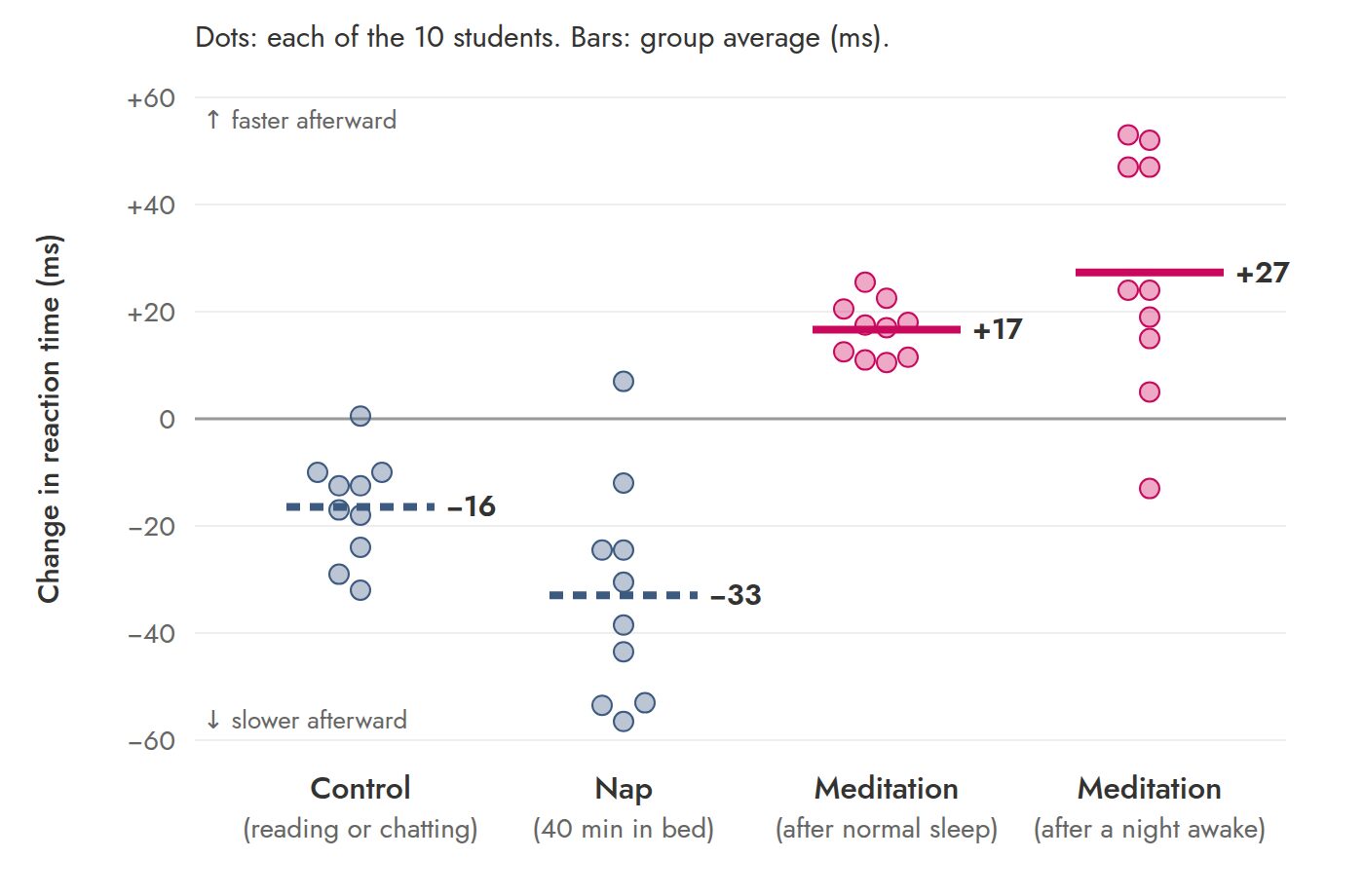
The boost didn’t last long. An hour later, many students were back to their baseline, with no significant difference from the control days, though the paper doesn’t show these data.
Miscellaneous Interesting Takeaways
Meditation Helped Even After a Sleepless Night
After about 32 hours awake, the students started slower, at 289 milliseconds against 255 on rested days. Meditation still sped them up significantly: 9 of the 10 were faster afterward, by about 27 milliseconds on average, though this wasn’t significantly different from the gain on rested days. Lapses, responses slower than half a second or errors, showed up after the sleepless night (they were extremely rare on other days), and they dropped after meditation. Without a sleep-deprived day spent napping or doing the control activity, though, there’s no way to tell how much of this change was due to meditation itself.
Yogis Slept About Two and a Half Hours Less
The seven long-term meditators slept an average of 5.2 hours a day, against 7.8 hours for the 23 non-meditators, a statistically significant difference, and also less than published norms. Each of the seven slept between four and six hours, and, as the authors note, their daily meditation, between 1.5 and 3.5 hours, was roughly equal to the “lost” sleep. (The paper describes the meditators as practicing two hours or more on most days; in the paper’s Table 2, two of them average 1.5 and 1.75 hours a day.)
They didn’t seem short of sleep. In the four who took the MSLT, it took an average of 18.25 minutes to fall asleep during the day, which the authors describe as above population norms, a sign of little daytime sleepiness. Their PVT scores showed no sign of sleepiness either, though those data aren’t shown. In some of them, EEG, video and direct observation during meditation found very little sleep and no head-nodding, so the yogis weren’t simply napping while they meditated.
That led the authors to suggest meditation might replace some sleep, roughly hour for hour. They also offer an alternative: meditators might sleep more deeply, getting sleep’s benefits in less time. And they found a clear limit:
When we challenged Yogis with a total night of sleep deprivation, they were generally too tired to meditate successfully, further discounting the idea that extensive meditation could totally or largely replace sleep.
This part of the study is a one-time comparison of seven people with a separate group, so it can’t show that meditation caused the shorter sleep. It can’t rule out, for example, that people who need less sleep are the ones drawn to hours of daily practice, or that the groups differ in other ways. The paper also doesn’t say how the comparison group’s sleep was measured. A later study on this site found a smaller gap: in one night in a sleep lab, long-term meditators slept about 36 minutes less than non-meditators.
What the Design Can and Can’t Rule Out
The authors acknowledge that ten participants is “admittedly quite small,” and that results from college students new to meditation may not apply to anyone else. Students knew whether they were meditating or napping, so expectations could have played a part (see
demand characteristics
Demand characteristics are cues in an experiment that hint at what the researchers expect, which can lead participants to behave the way they think they are supposed to rather than how they normally would. Researchers reduce them by disguising the study’s purpose, measuring behavior unobtrusively, or using comparison conditions that seem just as plausible.
More on Wikipedia
Read more in the glossary
). The authors think this unlikely: several students said they expected the nap to help too, yet they got worse after it, and the PVT is a simple test with no learning curve that would be hard to underperform on purpose.
The three conditions also differed in more than the activity. Meditating, the students knelt with eyes closed and attention on the breath; in the control condition they sat in a chair with eyes open, reading, talking or listening to music. So the results can’t separate meditation from simply resting quietly with eyes closed, a possibility the authors raise themselves when they ask whether “meditation (or even simple eyes-closed resting)” might pay off sleep debt.
Not the Same as a Short Nap
The authors suggest that brief meditation could give a quick lift without the grogginess that follows a longer nap. They also speculate that “power naps” of 10 to 15 minutes, which often involve no actual sleep, may work more like meditation than like sleep. That idea wasn’t tested here.
Final Reflection
This small, early study made a neat point with a simple test. Forty minutes of breath-focused meditation, practiced by people with just two lessons, left all of them responding faster on a basic alertness task, while a 40-minute nap left nearly all of them slower. Because performance fell in the control condition, meditation seemed to work against the afternoon slump rather than just adding a small gain.
It’s also a reminder for studies that test beginners right after a session: part of any gain may come from the session just finished rather than from the training. Here, the lift had largely faded within an hour.
The bolder claim in the title, that meditation “may decrease sleep need,” rests on seven yogis compared with a separate group, and the authors frame it carefully as preliminary. It’s an intriguing observation, not evidence that meditation can stand in for sleep, and their own sleep-deprivation test suggests it can’t replace much of it. Larger studies with sleep measured the same way in both groups, and tracking people before and after they take up long daily practice, would be needed to tell.
Citation
Kaul, P., Passafiume, J., Sargent, R. C., & O’Hara, B. F. (2010). Meditation acutely improves psychomotor vigilance, and may decrease sleep need. Behavioral and Brain Functions, 6(1), 47. 10.1186/1744-9081-6-47
Get the next summary by email
One or two new paper summaries every couple of weeks, sent to your inbox when they go up.
No spam, and you can unsubscribe at any time. Prefer a feed reader? Use the RSS feed.