
Background Information
When experienced meditators practice, their brains can produce distinctive rhythms. Earlier work from the same Wisconsin research group found that long-term Buddhist practitioners generated unusually strong gamma waves during compassion meditation.
gamma
Gamma brain waves are a type of brainwave pattern that oscillate at approximately 25 to 100 Hz. Gamma waves are associated with states of heightened perception, problem-solving, and consciousness. Gamma waves play a crucial role in cognitive functioning, including memory, and information processing, and are thought to integrate thoughts and information from different parts of the brain.
More on Wikipedia
View in glossary
waves are fast electrical rhythms linked to attention, perception and memory.
That raises a question researchers call “state versus trait.” Is a meditator’s brain different only while meditating (a state), or has practice changed it in a lasting way that shows up all the time (a trait)? Answering this is harder than it sounds. Ask an expert meditator to rest quietly in the lab, and they may slip into a meditative state without meaning to.
Sleep gets around that problem. A sleeping brain isn’t following instructions or deliberately paying attention, so its activity reflects how its circuits work on their own. As the authors put it:
In this regard, sleep provides an exquisite window to explore the spontaneous brain activity as well as the function of neural circuits at rest.
What They Did
The researchers recruited 29 right-handed long-term meditators and 29 people with no meditation experience, matched for age and sex. Every meditator had practiced daily for at least three years and attended at least three week-long retreats. On average they had practiced for nearly 16 years, and their estimated lifetime practice ranged from about 1,500 to more than 32,000 hours. Most trained in the Theravada Buddhist tradition, combining focused-attention practices such as breath awareness, open-monitoring practices such as
Vipassana
Vipassana is a form of Buddhist meditation focused on the cultivation of insight through moment-to-moment awareness of bodily sensations, thoughts, and emotions. It emphasizes non-reactivity and equanimity, helping practitioners observe mental and physical phenomena without attachment.
More on Wikipedia
View in glossary
, and loving-kindness meditation.
Everyone spent one night in a sleep lab, wired for full
polysomnography
Polysomnography is an overnight sleep study, usually done in a sleep lab. Sensors record brain activity (EEG), eye movements, muscle activity, heart rhythm and breathing, so that each stretch of the night can be scored as wake, light sleep, deep sleep or REM sleep, and sleep disorders such as apnea can be detected.
More on Wikipedia
View in glossary
plus a high-density
EEG
An electroencephalogram (EEG) is a recording of brain activity. During this painless test, small sensors are attached to the scalp to pick up the electrical signals produced by the brain.
More on Wikipedia
View in glossary
cap with 256 electrodes, which shows where on the scalp activity is concentrated. Screening that night found sleep disorders in three meditators, so they and their matched partners were dropped, leaving 26 people in each group. The technician who scored the sleep recordings didn’t know who was in which group.
The team split each person’s brain activity into six frequency bands, from slow delta waves to fast gamma (25–40 Hz), and compared the groups across the scalp during
NREM sleep
Non-rapid eye movement (NREM) sleep makes up most of a night’s sleep. It runs from light sleep (stages N1 and N2) to deep, slow-wave sleep (N3), alternating with REM sleep in cycles of about 90 minutes. During NREM sleep, brain activity is dominated by slow waves and the brain responds much less to the outside world.
More on Wikipedia
View in glossary
(non-rapid eye movement sleep) and
REM sleep
Rapid Eye Movement (REM) sleep is a sleep stage marked by vivid dreaming, rapid eye movements, and heightened brain activity similar to wakefulness. REM sleep supports emotional regulation, memory consolidation, and neuroplasticity. It typically increases in the later part of the night.
More on Wikipedia
View in glossary
.
One Big Result: Meditators Had About 35% More Gamma Activity at the Back of the Head During Non-REM Sleep
Overall brain activity during sleep was similar in the two groups. The difference was specific. In a cluster of 39 electrodes over the parietal and occipital regions at the back of the head, meditators had higher gamma activity during non-REM sleep than non-meditators. This held after correcting for the 18 comparisons the team made across frequency bands and sleep phases. None of the other five frequency bands differed.
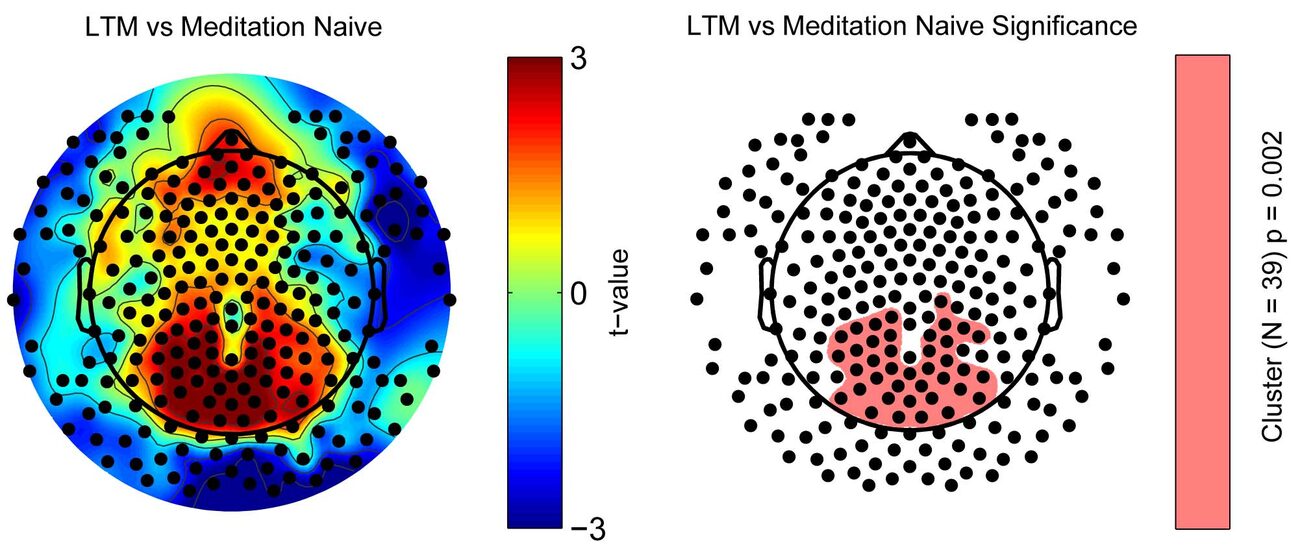
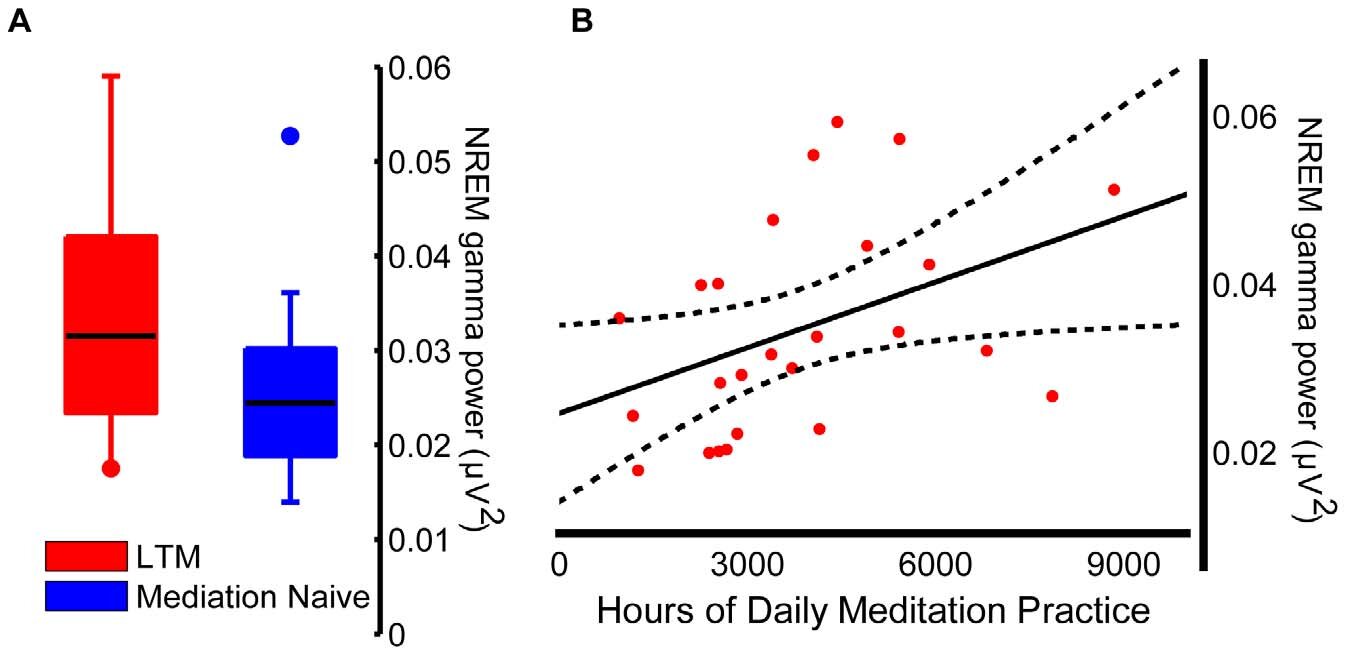
Averaged over that cluster, meditators’ gamma power was about 35% higher, a large
effect size
Effect size is a statistical concept that quantifies the magnitude or strength of a relationship, difference, or intervention outcome. Unlike p-values which only indicate statistical significance, effect sizes measure how meaningful a result is in practical terms. Common measures include Cohen’s d (standardized mean difference), correlation coefficients (r), and odds ratios. In meditation research, effect sizes help quantify the practical impact of different meditation practices on psychological or physiological outcomes.
More on Wikipedia
View in glossary
(Cohen’s d = 0.8). The pattern appeared across the first three sleep cycles of the night, though it was weaker early in the night and in deep sleep, when gamma activity is low for everyone.
Fast activity on an EEG can come from muscle tension or eye movements rather than the brain. To check, the team compared gamma in the neck-muscle and eye-movement recordings and found no difference between the groups, which makes muscle artifacts an unlikely explanation.
Miscellaneous Interesting Takeaways
Daily Practice, Not Retreat Time, Tracked the Difference
Among the meditators, those with more hours of daily practice had more gamma during non-REM sleep (a moderate correlation, rho = 0.48). Time spent on retreats showed no relationship at all. The authors found this striking:
The differential effect of the amount of daily practice and of retreat time on localized NREM gamma activity is to our knowledge the first indication of a specific effect of constant meditation daily practice, but not of intensive retreat practice, on brain neuroplasticity.
One wrinkle: gamma also rose with age among the meditators. The authors found no such link among the non-meditators, which argues against age alone, but in a group this size age and years of practice are hard to fully separate.
No Difference in REM Sleep
During REM sleep, the stage most associated with vivid dreaming, meditators showed only a slight, non-significant gamma increase in the same region. The authors offer a speculative explanation. Gamma activity normally drops during non-REM sleep, along with the brain’s ability to process information. Meditators may keep a little more of that capacity, and perhaps some awareness, through non-REM sleep, an advantage that would matter less in REM, when brain activity rebounds for everyone.
Meditators Slept Less, but Not Worse in Other Ways
On their night in the lab, the meditators slept about 36 minutes less than the non-meditators (around 6 hours 9 minutes versus 6 hours 45 minutes) and spent about half an hour longer awake after first falling asleep. Otherwise their sleep looked the same: they fell asleep just as quickly and spent the same share of the night in each sleep stage, including deep sleep. Neither difference was linked to how much they practiced.
That differs from a study of Vipassana practitioners, which found meditators had more deep and REM sleep than non-meditators. The authors note that results on meditators’ sleep structure have been mixed, and that nobody here had an adaptation night to get used to sleeping in the lab, which may explain why everyone slept less than seven hours.
Final Reflection
This study took an inventive approach to an old question. By looking at the brain during sleep, when a meditator can’t be meditating on purpose, it found a difference in gamma activity that looks more like a lasting trait than a passing state. Its link to daily practice fits the idea that regular meditation gradually reshapes how certain brain circuits behave.
The authors are careful about what they found. They call their design “a correlative and not a causal approach,” and argue that the extra gamma is not a sign of poor sleep:
Instead, we speculate here the specific gamma increase is not pathological, but reflects the lasting, plastic effect on specific neuronal circuits of long-term meditation practice.
People who stick with years of daily meditation may differ from others in many ways, and this was one night in a sleep lab. Longitudinal studies that record the same people’s sleep before and after meditation training would be needed to show that practice causes the change.
Citation
Ferrarelli, F., Smith, R., Dentico, D., Riedner, B. A., Zennig, C., Benca, R. M., Lutz, A., Davidson, R. J., & Tononi, G. (2013). Experienced mindfulness meditators exhibit higher parietal-occipital EEG gamma activity during NREM sleep. PLoS ONE, 8(8), e73417. 10.1371/journal.pone.0073417
Get the next summary by email
One or two new paper summaries every couple of weeks, sent to your inbox when they go up.
No spam, and you can unsubscribe at any time. Prefer a feed reader? Use the RSS feed.