
Background Information
Earlier brain imaging studies had found a set of regions that are more active when people rest than when they do almost any demanding task. This
DMN
The default mode network (DMN) is a system of connected brain areas that show increased activity when a person is not focused on what is happening around them, such as during daydreaming and mind-wandering. It can also be active when the individual is thinking about others or themselves, remembering the past, and planning for the future.
More on Wikipedia
Read more in the glossary
includes areas along the brain’s midline and the
angular gyrus
The angular gyrus is a region in the back of the parietal lobe, part of the inferior parietal lobule, where information from vision, hearing and touch comes together. It is involved in language, attention, memory and in taking perspectives, including switching between seeing a situation from one’s own point of view and from the outside.
More on Wikipedia
Read more in the glossary
, and it has been linked to the stream of thoughts, memories and associations that runs on its own whenever we aren’t busy, the raw material of
mind wandering
Mind wandering is the spontaneous shift of attention away from a current task or external environment to internally generated thoughts, memories, or fantasies. This common cognitive process is associated with default mode network activation and has been extensively studied in relation to meditation practices, which often aim to reduce mind wandering.
More on Wikipedia
Read more in the glossary
.
That stream is exactly what many forms of meditation work with.
Zen
Zen is a school of Mahayana Buddhism that developed in China (as Chan) and spread to Japan, Korea and Vietnam. Its central practice is seated meditation (zazen), such as shikantaza, “just sitting” in open awareness without a particular object, or working with koans, paradoxical questions meant to cut through ordinary conceptual thinking.
More on Wikipedia
Read more in the glossary
meditation in particular aims at a state of full awareness with little conceptual content, while staying alert, eyes open, rather than withdrawing into a dreamy calm. The authors quote the classic instructions for zazen (seated meditation) by Dōgen, the patriarch of the Japanese Sōto Zen school:
Think of neither good nor evil and judge not right or wrong. Stop the operation of the mind, and consciousness; bring to an end all desires, all concepts and judgments […] After the bodily position is in order, regulate your breathing. If a thought arises, take note of it and then dismiss it.
The researchers wanted to see the “take note of it and then dismiss it” part in the brain. Their idea was that years of noticing distracting thoughts and returning to the breath should make meditators better at cutting short the cascade of associations that a single word sets off. If so, the default mode network’s response to a meaningful word should be shorter in meditators than in people who had never meditated.
What They Did
The study compared 12 Zen meditators, each with more than 3 years of daily practice and recruited from the local community and meditation centers, with 12 people who had never meditated. The groups were matched for sex (10 and 9 men), age (averages of 37.3 and 35.3 years) and education (17.8 and 17.6 years of schooling on average). All were native English speakers. The paper gives no further detail of the meditators’ practice, such as total hours.
Everyone, meditator or not, did the same thing in the scanner: lie still for about 20 minutes, look at a cross on the screen, attend to their breathing and return to it whenever thoughts, memories or sensations pulled them away. Giving the non-meditators the same simplified meditation, rather than letting them simply rest, was meant to make the two groups’ tasks as similar as possible.
At random moments, a string of letters appeared on the screen. Participants pressed one button if it was a real English word and another if it wasn’t, then went straight back to their breath. This
lexical decision task
A lexical decision task is a standard psychology test in which a person sees a string of letters and decides, usually by pressing a button, whether it is a real word or a made-up one that could be pronounced but means nothing. Researchers use it to study how words and their meanings are recognized: comparing the responses to real words and to nonwords isolates what the meaning adds.
More on Wikipedia
Read more in the glossary
used 50 real words and 50 nonwords: strings of letters that could be pronounced but meant nothing, matched to the words for sound and spelling. The gaps between them varied from 1.4 to 72.9 seconds with a median of 8.2 seconds.
The trick lies in the comparison. Both kinds of letter strings interrupt the meditation, need to be read and need a button press. Only real words carry meaning, and recognizing a word automatically calls up associations with it, even though the task never asked anyone to think about the meaning. The authors chose this to mimic spontaneous, unbidden thoughts, using the words as “seeds” that set off a small cascade of associations at moments the researchers controlled. Subtracting the brain’s response to nonwords from its response to words should leave the part due to meaning, which the authors call conceptual processing.
The analysis had two steps. First, pooling both groups, the researchers found the brain areas that responded more to words than to nonwords in the
fMRI
An fMRI (functional Magnetic Resonance Imaging) measures changes in blood flow related to neural activity in the brain, offering insights into brain function and activity patterns.
More on Wikipedia
Read more in the glossary
scans. Then, within those areas, they traced how the response to meaning unfolded over the 14 seconds after each word. fMRI tracks blood flow, which rises and falls a few seconds behind the neurons (the
hemodynamic response
The hemodynamic response is the change in blood flow and oxygen in a brain area after its neurons become active, and it is what fMRI actually measures (as the BOLD, or blood-oxygen-level-dependent, signal). It is slow: after a brief event the signal rises over a few seconds, peaks and takes several more seconds to settle. Researchers often model it with a standard curve, which can miss responses that last longer than usual.
More on Wikipedia
Read more in the glossary
), so a lingering train of thought should show up as a long tail. Their main test added up the response to meaning from 6 to 14 seconds after the word, after the point where a standard, brief response would have peaked, and compared the groups.
One Big Result: In Meditators, the Brain’s Response to a Word’s Meaning Faded Sooner
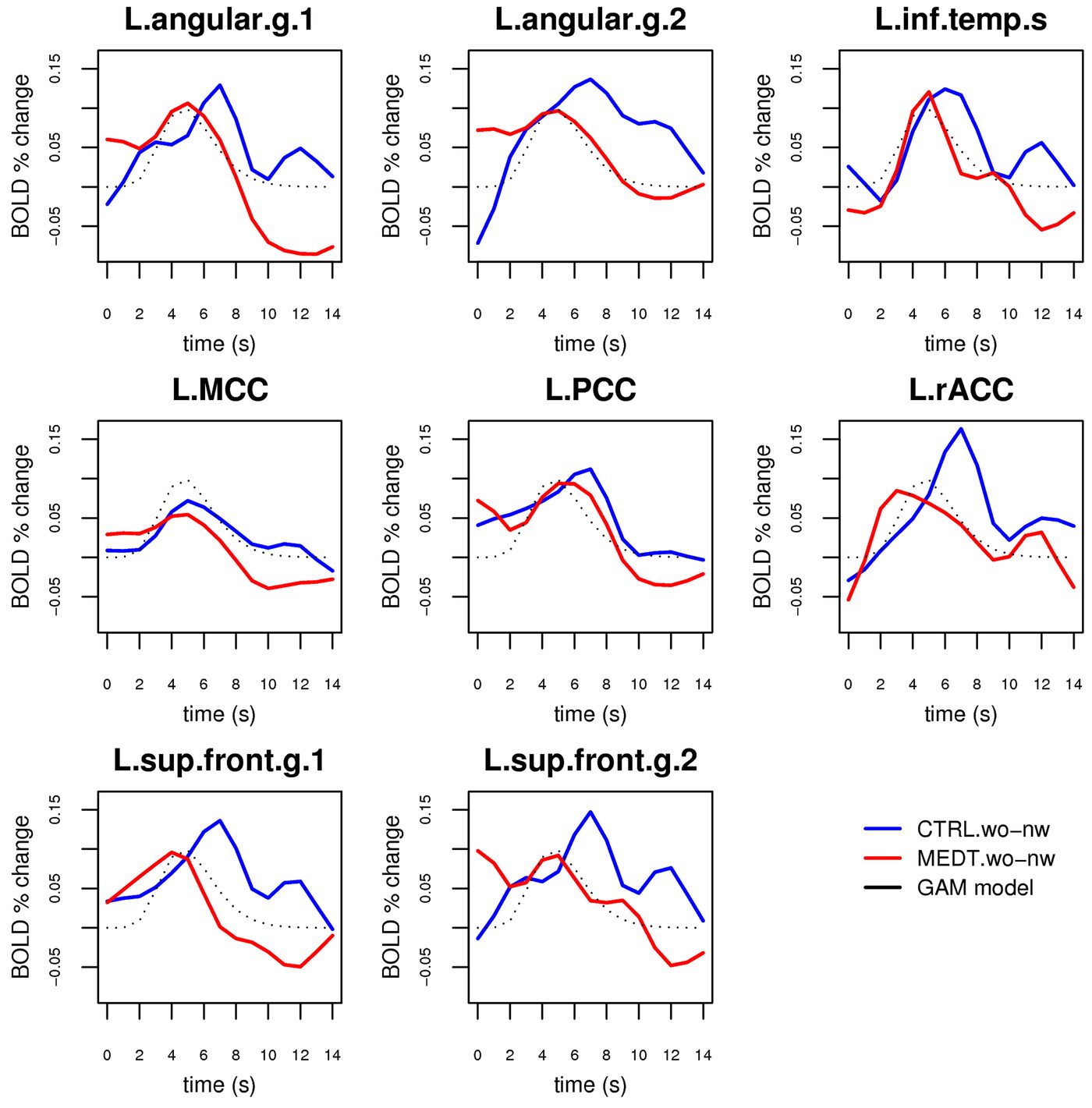
Eight clusters responded more to words than to nonwords, all in the left hemisphere, as expected for a language task, and they largely overlapped with the default mode network. They included two parts of the angular gyrus, two parts of the superior frontal gyrus, the
posterior cingulate cortex
The posterior cingulate cortex (PCC) is a region toward the back of the brain’s midline. It is a central hub of the default mode network and tends to be active during self-related thought and mind-wandering. Many meditation studies track PCC activity or connectivity as a window onto the DMN.
More on Wikipedia
Read more in the glossary
, the rostral
anterior cingulate
The anterior cingulate cortex (ACC) is a strip of cortex on the inner surface of each frontal lobe, curving around the front of the corpus callosum. It is involved in monitoring conflicts and errors, regulating attention and emotion, and processing pain, and it often turns up in brain-imaging studies of meditation.
More on Wikipedia
Read more in the glossary
, part of the inferior temporal lobe and the middle cingulate cortex.
In these regions, the response to meaning lasted longer in the non-meditators. Summed from 6 to 14 seconds after the word, it was larger in non-meditators than in meditators across the eight regions (F(1,22) = 12.3, p = 0.002), and the size of the group difference didn’t differ significantly from region to region. Tested one by one, with a correction for
multiple comparisons
The multiple comparisons problem arises when researchers run many statistical tests at once. Each test has a small chance of a false positive, so across thousands of tests, such as one for every point in a brain scan, some “significant” results will turn up by chance alone. Corrections raise the bar for significance to keep the overall false-positive rate down, at the cost of making small real effects harder to detect.
More on Wikipedia
Read more in the glossary
, six of the eight regions showed the difference. The two that didn’t were the middle cingulate cortex, which the authors note isn’t usually counted as part of the default mode network, and the posterior cingulate cortex. The difference was clearest in the left angular gyrus and the left superior frontal gyrus.
In the authors’ words:
In regions of the default network, meditators displayed a BOLD response related to semantic processing that was characterized by a reduced post-stimulus tail compared to control subjects.
The authors’ suggested explanation is that the meditators were better at the task they had both been given: once they had answered, they returned to the breath more effectively, cutting short the chain of associations the word had started. They suggest that meditation training may build the ability to regulate the flow of spontaneous thought, and that this line of research could be relevant to conditions marked by excessive rumination, such as depression, anxiety disorders and obsessive-compulsive disorder. The study tested only the brain response, though, not participants’ thoughts or any clinical outcome.
Miscellaneous Interesting Takeaways
Meditators Were No Quicker or More Accurate
The two groups answered equally fast. Both took longer for nonwords than words, but the group difference was far from significant (p = 0.62). Non-meditators averaged 988 milliseconds for words and 1,094 for nonwords; meditators, 969 and 1,008. Errors and missed answers were rare in both groups, about one of each per 50 items. The authors had thought meditators might respond faster, and suggest that switching from inward attention on the breath to an outside stimulus took time for everyone. Whatever the reason, the brain difference wasn’t accompanied by a difference in behavior.
A Standard Analysis Found No Group Difference
The finding depended on how the brain response was modeled. Standard fMRI analyses assume the response to a brief event has a fixed, short shape. Analyzed that way, the words-minus-nonwords response did not differ between meditators and non-meditators in any region, and neither did a search across the whole brain. The authors explain that the standard shape catches the first rise in the signal but only partly fits a response that lasts longer, which was what their hypothesis was about. So they modeled the response more flexibly and found the difference in how long it lasted, rather than in how strong it was at first.
The Difference Wasn’t About Difficulty
Nonwords took longer to judge than words, so the words-minus-nonwords difference could, in principle, reflect how hard the items were rather than their meaning. The authors checked: across participants, the brain difference in each region was unrelated to the difference in response times (median
correlation
A correlation measures how closely two things rise and fall together across people or over time. Pearson’s r runs from −1 to +1: values near +1 mean that people high on one measure tend to be high on the other, values near −1 mean the reverse, and values near 0 mean no straight-line relationship. A correlation alone can’t show that one thing causes the other.
More on Wikipedia
Read more in the glossary
r = 0.04, none significant).
Every Interruption Quieted These Regions
Both words and nonwords generally lowered activity in these regions compared with the meditation baseline, in both groups. The authors suggest two reasons: the meditation itself likely involves some spontaneous thinking that registers in these regions, and every letter string forced a switch from inward attention to reading and pressing a button. Words simply lowered it less than nonwords did, and that difference is the response to meaning measured above.
In Meditators, Activity Dipped Below the Baseline
In a few regions, especially part of the left angular gyrus, a region the authors call central to elaborating concepts, the meditators’ response to meaning dropped below the baseline after the word. The authors suggest that refocusing on the breath was so effective in meditators that conceptual processing briefly fell below its usual level during meditation. This is their interpretation of the curves, not something the study tested directly.
What the Design Can’t Show
The authors are candid about the limits:
the employed cross-sectional experimental design cannot rule out the possibility of a selection bias where the observed effect is not due to the difference in meditative experience between the two groups but to some pre-existing hidden variable
They add that the study had no behavioral measure of what people were thinking after each word, so the shorter tail is inferred from the brain signal alone, and that a larger sample would help. Two further points follow from the setup. The meditation in the scanner was a simplified breath focus done lying down, chosen so the non-meditators could do it too, not seated zazen with its posture and open awareness. And the conceptual processing was triggered by single words, chosen to mimic spontaneous thoughts; the authors suggest emotional words and full sentences as a next step.
Final Reflection
The paper’s title captures its approach: rather than ask meditators to stop thinking, the researchers planted a thought and watched how long its trace lasted. In 12 Zen meditators, the default mode network’s response to a word’s meaning ended sooner than in 12 people who had never meditated, while both groups judged the words equally well.
The result fits with later work on this site showing lower default mode activity in experienced meditators during meditation than during an active task, and with
EEG
An electroencephalogram (EEG) is a recording of brain activity. During this painless test, small sensors are attached to the scalp to pick up the electrical signals produced by the brain.
More on Wikipedia
Read more in the glossary
studies of meditators aiming for a mind empty of thought. It adds a twist: the difference here was not in how strongly the brain responded to a word, but in how quickly the response passed.
Still, this was a small, one-time comparison, and the difference appeared only when the response was modeled in detail. It can’t show that Zen practice caused the shorter response, and it didn’t measure thoughts directly. It is best read as an early, inventive demonstration of a way to study letting go of thoughts in the brain, one that needed larger, longitudinal studies to confirm.
Citation
Pagnoni, G., Cekic, M., & Guo, Y. (2008). “Thinking about not-thinking”: Neural correlates of conceptual processing during Zen meditation. PLoS ONE, 3(9), e3083. 10.1371/journal.pone.0003083
Get the next summary by email
One or two new paper summaries every couple of weeks, sent to your inbox when they go up.
No spam, and you can unsubscribe at any time. Prefer a feed reader? Use the RSS feed.