
Background Information
Many brain studies of meditation look for what the brain does more of. Concentrating on an object, for example, has been linked to stronger fast rhythms, and compassion meditation in long-term practitioners to unusually strong gamma waves. Some traditions, though, aim for something closer to the opposite: a state in which thinking stops, memories and plans fall away, and the meditator stays fully awake. It is sometimes described as “pure being” or linked to
nondual awareness
Nondual awareness is a style of meditation, found in Tibetan Buddhism and other contemplative traditions, that does not focus on any particular object or experience. Instead the meditator rests in awareness itself, without splitting experience into an observing subject and the things observed, or into inner and outer. It is usually described as effortless, in contrast with practices that deliberately direct attention.
More on Wikipedia
Read more in the glossary
.
This German–Japanese team, led by Thilo Hinterberger at the University Medical Center Regensburg, called it “thoughtless emptiness” (TE). They describe what it asks of the meditator this way:
It requires refraining from using thoughts, memories, emotions, associations, perceptions while consciousness is maintained.
If such a state exists, it raises a puzzle. Many theories tie consciousness to busy, high-level information processing in the brain. A state that is conscious but nearly empty of content should look different. Its brain activity should also differ from ordinary rest, when the mind tends to wander, and from drowsiness and the drift into sleep, which on an
EEG
An electroencephalogram (EEG) is a recording of brain activity. During this painless test, small sensors are attached to the scalp to pick up the electrical signals produced by the brain.
More on Wikipedia
Read more in the glossary
show up as more slow
theta
Theta waves are rhythmic electrical brain activity at roughly 4–8 cycles per second, recorded with EEG. While awake, they are linked to memory, focused attention and drowsiness, and meditation studies often report more theta over the front of the head during practice. In sleep, theta is common in light non-REM sleep and in REM sleep.
More on Wikipedia
Read more in the glossary
and
delta
Delta waves are the slowest rhythmic electrical brain activity recorded with EEG, at roughly 0.5–4 cycles per second. They dominate deep (slow-wave) sleep and also appear under general anesthesia, so more delta while awake can be a sign of drowsiness. Smaller amounts are present in waking EEG, where they have also been linked to attention and internal processing.
More on Wikipedia
Read more in the glossary
waves.
What They Did
The researchers recorded 50 people aged 22 to 68. Forty-two were meditators with at least two years of regular practice in a wide range of traditions: Zen Buddhism (11, including six Zen monks in Japan), Sahaja Yoga (8), Western contemplative methods (7), spiritist or mediumistic practice (5), Qigong (4), Tibetan Buddhism (4), and spiritual healing or shamanism (3). Eight people of similar age had never meditated. Most of the Buddhist and Qigong practitioners were recorded in Japan, and the sessions took place in various locations, mostly meditation rooms or people’s homes.
Lifetime practice ranged from zero to over 21,000 hours. For the main analysis the team kept the 30 most seasoned meditators, those with at least five years or more than 1,000 hours of practice. On average they had meditated for 20 years and about 6,500 hours.
Each person wore a 64-electrode EEG cap through a session of about two and a half to three hours:
- Baseline (15 minutes): five minutes each of resting with eyes open, resting with eyes closed, and reading, all without meditating.
- Their own meditation (20–30 minutes), done in their usual way. The non-meditators got a short introduction to breath meditation.
- Four guided tasks of 2 minutes each, eyes closed, after a short break:
- Presence/monitoring: “Try to be in a state of high presence at the place you are in this room at each moment of time.”
- Thoughtless emptiness: “Try to maintain the state of emptiness from all thought as well as possible.”
- Focused attention on a spot in the middle of the forehead, sometimes called the “third eye.”
- Spatial connectedness: first visualizing, then just perceiving, an “energy stream” running along the body’s axis down to the earth and up to the sky.
Afterwards everyone was asked how well they had managed each task, and all the meditators said they had succeeded.
The team split the EEG into seven frequency bands, from slow delta through theta,
alpha
Alpha waves are rhythmic electrical brain activity at roughly 8–13 cycles per second, recorded with EEG. They are often strongest when the eyes are closed and the mind is relaxed, and are thought to help filter out or hold back information as part of top-down control. Meditation studies have reported both increases and decreases in alpha, depending on the practice.
More on Wikipedia
Read more in the glossary
and two
beta
Beta brain waves are a type of brainwave pattern that oscillate between approximately 12 to 30 Hz. Beta waves are typically associated with active thinking, focus, alertness, and engagement with the external world. They are prominent during conscious, goal-directed activity and are linked to cognitive tasks such as problem-solving, decision-making, and sustained attention.
More on Wikipedia
Read more in the glossary
bands to two
gamma
Gamma brain waves are a type of brainwave pattern that oscillate at approximately 25 to 100 Hz. Gamma waves are associated with states of heightened perception, problem-solving, and consciousness. Gamma waves play a crucial role in cognitive functioning, including memory, and information processing, and are thought to integrate thoughts and information from different parts of the brain.
More on Wikipedia
Read more in the glossary
bands, and set the edges of the slower bands from each person’s own alpha rhythm. They grouped the electrodes into 13 brain regions and made eight planned comparisons between conditions. That added up to 728 statistical tests, so they used a
false discovery rate
The false discovery rate (FDR) is the expected share of false positives among the results a study declares significant. FDR corrections, such as the Benjamini–Hochberg method, are a common way to handle multiple comparisons. They are less strict than corrections that try to avoid even a single false positive (such as Bonferroni), so they miss fewer real effects, while accepting that a small fraction of the reported findings may be due to chance.
More on Wikipedia
Read more in the glossary
correction across bands, regions and comparisons to limit chance findings.
One Big Result: Thoughtless Emptiness Came With Less Brain-Wave Power, Especially Fewer Slow Waves
Across all frequencies and electrodes together, the 30 experienced meditators’ EEG power was lower during thoughtless emptiness than during eyes-closed rest, and lower than during the presence exercise. Each comparison picked out a different set of rhythms:
- Compared with rest: less delta in every brain region and less theta in every region but the very front, plus less beta, mainly over the front and center of the head and along the midline. In sleepiness and the drift into sleep, these slow rhythms rise.
- Compared with present-moment awareness: less alpha in every region, less beta in most, and less gamma in a few areas. The presence exercise was the only state with more alpha than emptiness.
- Compared with focused attention: less gamma over the center and back of the head.
- Compared with spatial connectedness: no differences that survived correction. These two very different-sounding instructions produced almost the same brain activity.
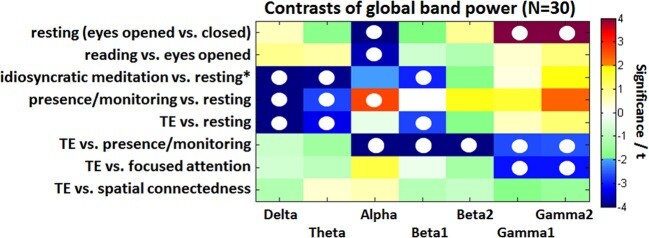
The authors read the pattern as a state that is quieter than ordinary rest without being sleepy. Fewer slow waves argue against drowsiness, and less alpha, beta and gamma than in the other meditations suggests less of the processing that goes with attending, judging and representing mental content. They go further, arguing against the long-standing idea that consciousness must always be of something:
Our data suggest that this might not be the case: even in a state of reduced cognitive processing clear consciousness seems to be possible in experienced meditators.
That is a big claim for this evidence to carry. Whether people were in fact empty of thought, and awake, rests on their own reports afterwards and on the absence of sleep-like slow waves. Nothing in the session measured awareness directly.
Miscellaneous Interesting Takeaways
Every Meditation Had Fewer Slow Waves Than Rest
Lower delta and theta weren’t unique to emptiness. The meditators’ own 20–30-minute meditations and the presence exercise showed the same drop compared with rest. That runs against a common finding: many earlier studies linked meditation and meditation experience to more theta. The authors note that theta has also been tied to arousal and attention, and that the right comparison depends on what “rest” means. For seasoned meditators it may not mean much, since some may slip into meditation even when told to rest.
Their usual meditations looked a lot like thoughtless emptiness, perhaps because a third of these 30 meditators named something like emptiness as the aim of their own practice. Not everything went down, either. Compared with rest, both their own meditation and the emptiness task showed more gamma over the right temple. The authors could not explain that for emptiness. Temporal areas are also where tension in the facial muscles tends to show up in fast EEG rhythms, the authors note in their discussion of artifacts, and no muscle activity was recorded.
The Order of the Session Is a Real Caveat
Rest was recorded at the start. The four guided tasks came after a 20–30-minute meditation and only a few minutes’ break, so the meditators may not have returned to baseline. The authors flag this themselves:
Therefore, comparisons of the instructed meditative tasks from the third session with resting from the first recording session have to be handled with caution.
The comparisons among the four guided tasks are less affected, since all four were recorded together. Even so, each lasted only two minutes, which is a short time to settle into what the authors describe as an advanced state.
Experience Seemed to Matter, but the Evidence Is Indirect
The team also split all 50 participants into thirds by lifetime practice and compared the top and bottom thirds. The 17 most experienced had at least 3,800 hours (about 9,700 hours and 27 years on average). The 17 least experienced, which included the non-meditators, had less than 500 hours. After correction, several of the condition differences held up among the most experienced, but none among the least experienced, whose rest, presence and emptiness looked statistically alike.
The authors conclude that beginners probably couldn’t reach the states. But a difference that is significant in one group and not in another isn’t the same as a significant difference between groups, and the paper doesn’t report a direct test of that. When they instead related lifetime practice hours to brain activity across all 50 people, the links were mostly weak, and correction for multiple tests removed almost all of them. The two groups’ individual alpha rhythms didn’t differ.
Not the Same Signature as a Similar Case Study
A later single-case study recorded an expert meditator who reported awareness without thoughts, senses or self. Compared with rest, that state came with more theta and much less alpha. Here, emptiness came with less theta than rest. The designs differ in many ways (one person, in the last minutes of a 30-minute meditation, versus a group doing a 2-minute task), so the contrast is a reminder that “contentless” states may not share a single EEG signature, or that rest is a slippery baseline. A separate study in which an experienced meditator dissolved his sense of a boundary between self and world found that beta waves faded, which fits the drop in beta seen here.
Final Reflection
This study asked a question that most meditation research skips. What does the brain look like when a meditator tries to do less? In 30 experienced practitioners from many traditions, the answer was broadly quieter rhythms, with fewer slow waves rather than the extra ones that come with drowsiness, plus a clear difference from focused attention and from present-moment awareness. It’s an interesting counterpoint to the many studies that report heightened gamma or theta during meditation.
The design limits how far it can go. Each emptiness period lasted two minutes and came after a long meditation; the state was judged only by the meditators’ reports; recordings were made in many different places; and the comparison between beginners and experts rests on one group reaching significance and the other not. The paper’s title says the decreased activity “represents” the conscious state of emptiness, but the data show an association in a single session. Longer recordings, a fresh rest period alongside the tasks, muscle monitoring and a direct test between experienced and novice meditators would show whether this quieter signature holds up.
Citation
Hinterberger, T., Schmidt, S., Kamei, T., & Walach, H. (2014). Decreased electrophysiological activity represents the conscious state of emptiness in meditation. Frontiers in Psychology, 5, 99. 10.3389/fpsyg.2014.00099
Get the next summary by email
One or two new paper summaries every couple of weeks, sent to your inbox when they go up.
No spam, and you can unsubscribe at any time. Prefer a feed reader? Use the RSS feed.