
Background Information
Most of the time we don’t notice it, but our experience is split in two: there is “me,” here, and there is the world, out there. Philosophers and neuroscientists call the processes that draw this line “self-specific.” They are different from thinking about yourself (your personality, your appearance, your plans), which much brain research has linked to the
default mode network
The default mode network (DMN) is a system of connected brain areas that show increased activity when a person is not focused on what is happening around them, such as during daydreaming and mind-wandering. It can also be active when the individual is thinking about others or themselves, remembering the past, and planning for the future.
More on Wikipedia
Read more in the glossary
. Self-specific processes are more basic. They make an experience feel like yours in the first place, happening to a body that is located somewhere and acting in the world.
These processes are hard to study because they rarely change. Brain researchers have mostly disturbed them from the outside, with tasks and illusions that alter people’s sense of agency, of owning their body, or of where they are located. According to the authors, no brain-imaging study had yet looked at someone deliberately turning these processes down. Some contemplative traditions, though, aim to loosen the sense of self from the inside, and experienced meditators describe states in which the line between self and world softens or disappears.
This study, from a team in Israel, took those descriptions seriously as data. It uses an approach called
neurophenomenology
Neurophenomenology is a research approach that pairs detailed first-person reports of experience with measurements of brain activity, using each to help interpret the other. Proposed by neuroscientist Francisco Varela in the 1990s, it depends on participants who can observe and describe their experience precisely, which makes experienced meditators natural collaborators.
More on Wikipedia
Read more in the glossary
: careful first-person reports guide how brain recordings are designed and analyzed. The question was whether the sense of boundaries is all-or-nothing or can be dialed down in steps, and what happens in the brain as it is.
What They Did
The main participant, called S in the paper, was a 64-year-old man who had practiced
mindfulness
Mindfulness is the psychological process of purposely bringing one’s attention to experiences occurring in the present moment without judgment. It involves maintaining awareness of thoughts, feelings, bodily sensations, and surrounding environment with an attitude of curiosity and acceptance. In meditation contexts, mindfulness practices typically involve focusing attention on the breath or body sensations as anchors to the present moment while acknowledging and releasing distracting thoughts.
More on Wikipedia
Read more in the glossary
in the Satipatthana and Theravada
Vipassana
Vipassana is a form of Buddhist meditation focused on the cultivation of insight through moment-to-moment awareness of bodily sensations, thoughts, and emotions. It emphasizes non-reactivity and equanimity, helping practitioners observe mental and physical phenomena without attachment.
More on Wikipedia
Read more in the glossary
traditions for about 40 years, with over 20,000 hours of practice. He had worked with neuroscientists for a decade and had shown in five earlier interviews that he could produce unusual states on demand and describe them in detail. He is also the paper’s third author, though the authors note that he took no part in forming the hypotheses, analyzing the data or interpreting the results.
Before any recording, S was interviewed in depth, lying in the
MEG
Magnetoencephalography (MEG) records the tiny magnetic fields produced by electrical activity in the brain, using very sensitive sensors in a helmet-shaped device. Like EEG, it tracks brain activity millisecond by millisecond, but because magnetic fields pass through the skull with little distortion, it can usually locate where in the brain the activity comes from more accurately.
More on Wikipedia
Read more in the glossary
scanner with his eyes closed, about three states he could produce on cue:
- SB1: his ordinary sense of boundaries
- SB2: a state in which the sense of boundaries began to dissolve
- SB3: a state in which it disappeared
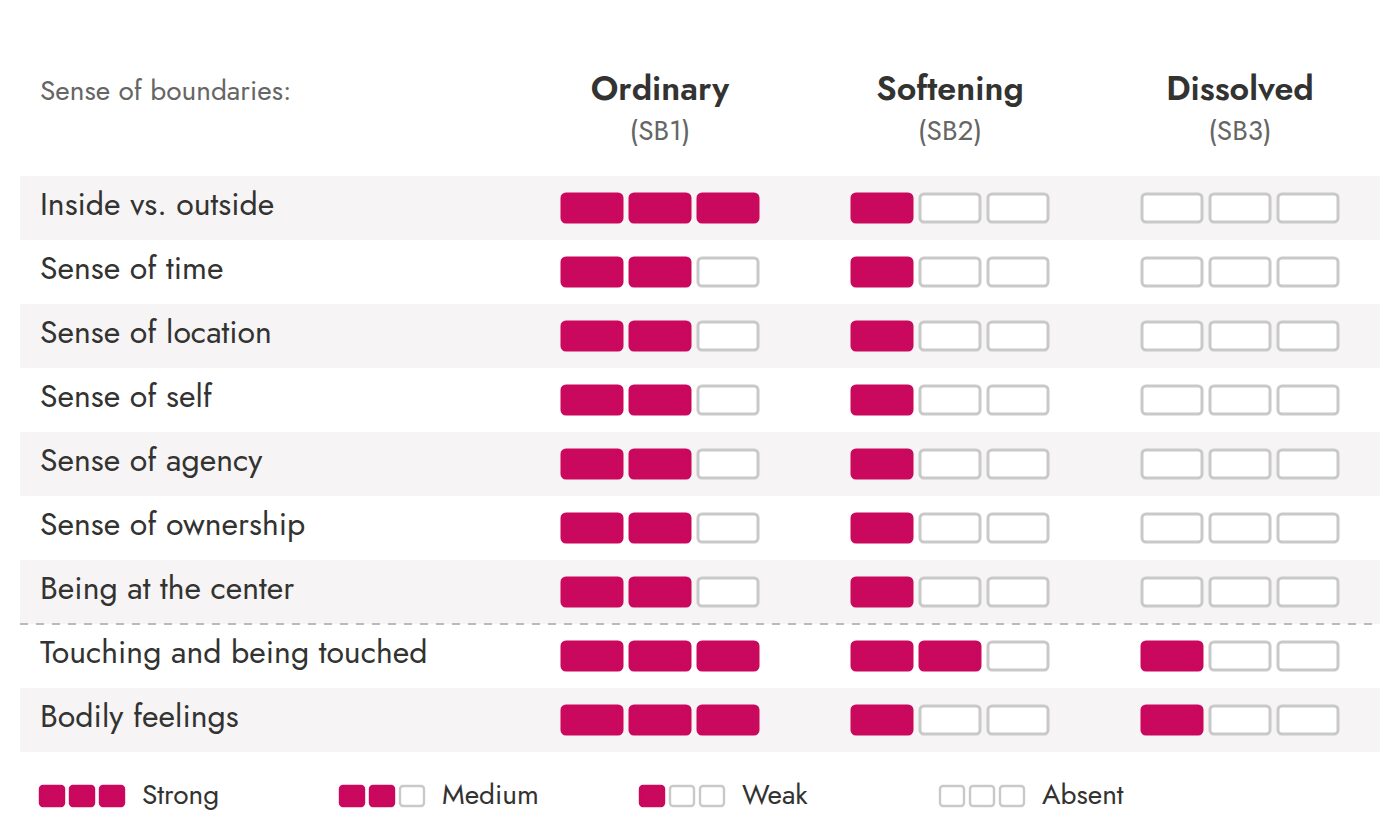
The interviews, analyzed in a companion paper (Ataria et al., 2015), identified nine aspects of experience that weakened from one state to the next, such as the sense of time, of location, of agency and of being at the center of experience.
During MEG recording, a recorded voice cued S through the three states, one minute each, in four blocks with a minute’s rest between blocks. Because shifting between such states at random would have been very hard, the order was always the same: SB1, then SB2, then SB3. The team then looked for brain rhythms whose strength rose or fell in step across the three states.
To see whether what they found in S held up in other people, the team reanalyzed recordings from the team’s earlier MEG study of long-term mindfulness meditators. The original group of 12 had practiced for over 16 years on average. S had been part of it, but his data were left out, and one more recording couldn’t be used, which left 10 meditators. They had produced three related states, 30 seconds at a time: a “narrative” mode (thinking about what characterizes you), a “minimal” mode (experiencing what is happening to you right now), and a “selfless” mode (experiencing the present moment “when you are not in the center”).
One Big Result: As the Sense of Boundaries Dissolved, Beta Brain Waves Weakened in Parietal Regions Tied to Self and Body
In S’s recordings, only one kind of brain rhythm tracked the three states:
beta
Beta brain waves are a type of brainwave pattern that oscillate between approximately 12 to 30 Hz. Beta waves are typically associated with active thinking, focus, alertness, and engagement with the external world. They are prominent during conscious, goal-directed activity and are linked to cognitive tasks such as problem-solving, decision-making, and sustained attention.
More on Wikipedia
Read more in the glossary
waves, peaking at 27 Hz. Their power fell step by step from SB1 to SB2 to SB3. No frequency band grew stronger as the boundaries dissolved. When the team traced where the falling beta activity came from, they found a large cluster over the parietal lobes, more extensive on the right side of the brain. It had two main parts:
- On the outer surface, the
temporoparietal junction
The temporoparietal junction (TPJ) is the area where the brain’s temporal and parietal lobes meet, toward the back and side of the head. It helps combine signals from the body and senses into a sense of where the self is, and it is central to theory of mind: working out what other people think and intend.
More on Wikipedia
Read more in the glossary , a region that combines signals from the body and senses into a sense of where the self is. Damage or stimulation here, especially on the right, can produce out-of-body experiences. - On the inner surface, the
precuneus
The precuneus is a region on the inner surface of the parietal lobe, toward the back of the brain’s midline, next to the posterior cingulate cortex. Together they form a core hub of the default mode network, and the precuneus is often active during self-related thinking, memory recall and imagining one’s own point of view.
More on Wikipedia
Read more in the glossary and the middle and posterior cingulate cortex, part of the brain’s core self-related network.
The effect also reached sensory and motor areas and the
insula
The insula is a region of cortex folded deep inside each side of the brain. It helps represent the body’s internal state (interoception) and is involved in emotion, empathy and compassion. Its front part, the anterior insula, comes up often in meditation research.
More on Wikipedia
Read more in the glossary
.
The 10 other meditators showed a similar pattern. Of six frequency bands, only beta weakened as they moved from narrative to minimal to selfless awareness, and it survived a correction for testing several bands. Their beta peaked at 21 Hz, and its estimated source was a cluster in the right hemisphere, centered on the temporoparietal junction, with smaller effects in the cingulate cortex and precuneus. This confirmation is narrower than it may sound: the group’s source analysis was limited to the brain regions already found in S, and the effect covered a much smaller area than his.
The authors read the two regions as two parts of one process. Turning down the inner parietal hub may loosen awareness from its habitual identification with a self. Turning down the temporoparietal junction may loosen the felt unity of self and body, so that awareness is no longer anchored to one location and perspective.
Miscellaneous Interesting Takeaways
The Interviews Shaped the Experiment
The first-person reports did more than describe the states. Because S described the dissolving of boundaries as gradual, the team searched for brain signals that changed in step across all three states, rather than simply comparing two. The reports also suggested that the sense of boundaries is better described by how flexible it is than by where it lies. As it loosened, S’s sense of self first expanded and then disappeared, and the distinction between inside and outside faded along with the sense of time and location.
Even in the dissolved state, though, something bodily remained: a faint sense of touching and being touched, and a minimal feel of the body’s position and movement. The authors suggest these may be more basic than the self.
Why Beta?
One theory holds that beta rhythms signal the brain’s intention to keep its current state, the “status quo,” while a drop in beta signals that the current state is about to be disrupted. The authors suggest that the ordinary sense of boundaries is so deep-rooted that deliberately dissolving it is exactly such a disruption.
The frequencies that tracked S’s states (22–33 Hz) spill a little into what is often called the
gamma
Gamma brain waves are a type of brainwave pattern that oscillate at approximately 25 to 100 Hz. Gamma waves are associated with states of heightened perception, problem-solving, and consciousness. Gamma waves play a crucial role in cognitive functioning, including memory, and information processing, and are thought to integrate thoughts and information from different parts of the brain.
More on Wikipedia
Read more in the glossary
range. The authors argue this is better read as beta: the effect fell off sharply above its peak and stayed low through the gamma range, and in the group only the standard beta band showed it.
The Same Order Every Time
Because S always went from SB1 to SB2 to SB3, a steady drift over each block could in principle mimic a “dissolving boundaries” effect. The team ran checks, reported in their supplement, which they say rule out an explanation by order alone. In the group, two other sets of three states with the same fixed-order design, about the sense of time and of space, showed no beta effect. These checks help, but they are not the same as randomizing the order, which the authors list as a drawback.
Possible Clinical Relevance
The authors point to
Depersonalization
Depersonalization is a dissociative experience characterized by feelings of detachment from one’s self, body, or mental processes. Individuals experiencing depersonalization may feel like an outside observer of their thoughts, feelings, or body, or they may feel as if they’re in a dream. It can occur as a temporary response to stress, as a symptom of psychiatric disorders, or as a feature of certain meditation experiences.
More on Wikipedia
Read more in the glossary
disorder, in which people feel unreal or detached from themselves, which has been linked to overactivity in the temporoparietal junction. They suggest that knowing the frequency and location of these signals might one day help guide neurofeedback treatments. This is a speculative idea, not something the study tested. They are also careful to distinguish meditation-induced loss of self from loss of self in mental illness. Elsewhere on this site, Castillo (1990) explores why depersonalization in meditators can feel calm rather than distressing.
Final Reflection
This is an inventive study. Rather than trying to disturb the sense of self from the outside, it worked with a meditator who could take it apart from the inside, on cue and in steps, and let his descriptions guide the analysis. The result is a specific, testable link between a subtle aspect of experience and a measurable brain rhythm in regions already known to matter for the sense of self and body. It fits with other single-meditator studies on this site, such as jhana absorption states, in which deep meditation is linked to changes in self-related brain networks.
The authors draw a big conclusion from it:
The graded nature of SSPs and its trainability leading to the loss of the distinction between “self” and “world” point to a self which is constructed and continuously remade by particular and transient neural processes.
That is in keeping with Buddhist teaching, but this study can only support part of it. It showed that these states can be graded, at least in experts. It did not test trainability: no one was followed before and after training, and no non-meditators were recorded. The statistics for S compared many 2-second slices of one man’s recording, so they show that the pattern was reliable within his brain, not how common it is. The authors themselves are frank about this:
A further drawback is that the prior neural hypothesis is based on a single subject. While this drawback was partly overcome by corroborating the results in a larger group, the degree to which the results can be generalized to wider, non-meditative populations is uncertain. As such, the study is preliminary.
They also note that the design can’t show that weaker beta causes the boundaries to dissolve; it might be a by-product of other processes. As a proof of concept, though, it shows that even something as subtle as the felt line between self and world can be brought into the lab, if the right person is willing to describe it.
Citation
Dor-Ziderman, Y., Ataria, Y., Fulder, S., Goldstein, A., & Berkovich-Ohana, A. (2016). Self-specific processing in the meditating brain: A MEG neurophenomenology study. Neuroscience of Consciousness, 2016(1), niw019. 10.1093/nc/niw019
Get the next summary by email
One or two new paper summaries every couple of weeks, sent to your inbox when they go up.
No spam, and you can unsubscribe at any time. Prefer a feed reader? Use the RSS feed.