
Background Information
Philosophers and neuroscientists often split the everyday sense of self into two layers. The narrative self is the story of who you are: your memories, plans, traits and opinions of yourself, held together by language and stretching across time. The minimal self is more basic. It is the pre-reflective, moment-to-moment sense that I am the one having this experience, which carries a sense of ownership (these are my sensations) and agency (I am doing this).
Buddhist practice aims at something beyond both: a “selfless” way of experiencing in which, as the authors put it, identification with a fixed sense of self “is replaced by identification with the phenomenon of experiencing itself.” Much of what science knows about losing the sense of ownership and agency comes from illness, such as schizophrenia or brain injury. The authors argue that long-term meditators offer a rare chance to study it in healthy brains, produced on purpose.
The narrative self is fairly well mapped. Brain imaging studies consistently link thinking about oneself to the
mPFC
The medial prefrontal cortex (mPFC) is the part of the frontal lobes along the brain’s midline, just behind the forehead. It is a core part of the default mode network and is consistently active when people think about themselves, judge their own traits, or recall and plan events in their own lives.
More on Wikipedia
Read more in the glossary
, a hub of the default mode network (
DMN
The default mode network (DMN) is a system of connected brain areas that show increased activity when a person is not focused on what is happening around them, such as during daydreaming and mind-wandering. It can also be active when the individual is thinking about others or themselves, remembering the past, and planning for the future.
More on Wikipedia
Read more in the glossary
), the system active during self-related thought and mind-wandering. A study of experienced Insight meditators found this network quieter during meditation. The minimal self is much less understood, and a “selfless” state had barely been studied at all.
This study used
MEG
Magnetoencephalography (MEG) records the tiny magnetic fields produced by electrical activity in the brain, using very sensitive sensors in a helmet-shaped device. Like EEG, it tracks brain activity millisecond by millisecond, but because magnetic fields pass through the skull with little distortion, it can usually locate where in the brain the activity comes from more accurately.
More on Wikipedia
Read more in the glossary
, which tracks brain activity millisecond by millisecond and can split it into frequency bands, such as fast
gamma
Gamma brain waves are a type of brainwave pattern that oscillate at approximately 25 to 100 Hz. Gamma waves are associated with states of heightened perception, problem-solving, and consciousness. Gamma waves play a crucial role in cognitive functioning, including memory, and information processing, and are thought to integrate thoughts and information from different parts of the brain.
More on Wikipedia
Read more in the glossary
and slower
beta
Beta brain waves are a type of brainwave pattern that oscillate between approximately 12 to 30 Hz. Beta waves are typically associated with active thinking, focus, alertness, and engagement with the external world. They are prominent during conscious, goal-directed activity and are linked to cognitive tasks such as problem-solving, decision-making, and sustained attention.
More on Wikipedia
Read more in the glossary
rhythms. The question was not only where different modes of self show up in the brain but at what frequency.
What They Did
The researchers, at Bar-Ilan University in Israel, recruited 16 experienced meditators. Two were dropped because of tiredness and back pain, and two more because they practiced Zen and non-dual meditation, leaving 12 people who all practiced similar forms of
Vipassana
Vipassana is a form of Buddhist meditation focused on the cultivation of insight through moment-to-moment awareness of bodily sensations, thoughts, and emotions. It emphasizes non-reactivity and equanimity, helping practitioners observe mental and physical phenomena without attachment.
More on Wikipedia
Read more in the glossary
from or inspired by the Theravada Buddhist tradition. The 9 men and 3 women were aged 31 to 66 and had meditated for an average of 16.5 years (9 to 34) and an estimated 11,225 hours (from about 1,300 to over 29,000). There was no comparison group of non-meditators.
Before recording, the team spent about 45 minutes explaining the tasks with slides, so that everyone understood the states they would be asked to produce. Then, lying in the MEG scanner with eyes closed, each participant was asked to enter three states in turn, each held for three 30-second periods:
- Narrative self: “Try to think what characterizes you.”
- Minimal self: “Try to experience what is happening to you at the present moment.”
- Selfless: “Try to experience what is happening at the present moment, when you are not in the center.”
The first 4 seconds of each period were dropped to give people time to settle into the state. This was one of seven sessions in a 2- to 3-hour visit. Afterwards, over an intercom, participants rated how successfully and how steadily they had held each state, described their emotions, and described their selfless experience freely, in their own words.
The analysis made two comparisons within the same people. Narrative versus minimal self asked what changes when self-related thinking quiets down. Minimal self versus selfless asked what changes when the sense of being the subject of experience drops away. The team first checked seven frequency bands across all 248 sensors (correcting for the number of bands tested), then estimated which brain regions produced the differences.
This is where the
neurophenomenology
Neurophenomenology is a research approach that pairs detailed first-person reports of experience with measurements of brain activity, using each to help interpret the other. Proposed by neuroscientist Francisco Varela in the 1990s, it depends on participants who can observe and describe their experience precisely, which makes experienced meditators natural collaborators.
More on Wikipedia
Read more in the glossary
came in: participants’ own reports were used to guide the brain analysis, not just to confirm it. Reading the descriptions of the selfless state, the authors found three distinct kinds of experience, and they then asked whether people in each group showed different brain activity.
One Big Result: Letting Go of the Sense of Self Went With Less Beta Activity in Self-Related Regions
Moving from the minimal self to the selfless state changed only one frequency band: beta (13–25 Hz). Averaged over all sensors, beta power was about 10% lower in the selfless state, and the source analysis placed the drop in six clusters. The largest was in the front of the brain, including the lower part of the mPFC and the
anterior cingulate
The anterior cingulate cortex (ACC) is a strip of cortex on the inner surface of each frontal lobe, curving around the front of the corpus callosum. It is involved in monitoring conflicts and errors, regulating attention and emotion, and processing pain, and it often turns up in brain-imaging studies of meditation.
More on Wikipedia
Read more in the glossary
. Others were in the posterior cingulate cortex (
PCC
The posterior cingulate cortex (PCC) is a region toward the back of the brain’s midline. It is a central hub of the default mode network and tends to be active during self-related thought and mind-wandering. Many meditation studies track PCC activity or connectivity as a window onto the DMN.
More on Wikipedia
Read more in the glossary
) and precuneus at the back of the midline, the left thalamus, and the
inferior parietal lobules
The inferior parietal lobule (IPL) is a region on the outer surface of the parietal lobe, toward the back and side of the head. It combines information from the senses and the body and is involved in attention, language, the sense of being the one who causes one’s own actions (agency), and telling oneself apart from others.
More on Wikipedia
Read more in the glossary
on both sides, regions previously tied to the sense of agency and to telling self from other. No high-gamma differences appeared in this comparison.
Quieting the narrative self looked different. Going from thinking about oneself to simply experiencing the present lowered only high-gamma activity (60–80 Hz), by about 5% across sensors, in two large clusters spanning frontal regions including the dorsal and lower mPFC. This fit the authors’ prediction and the fMRI studies tying self-related thinking to the mPFC.
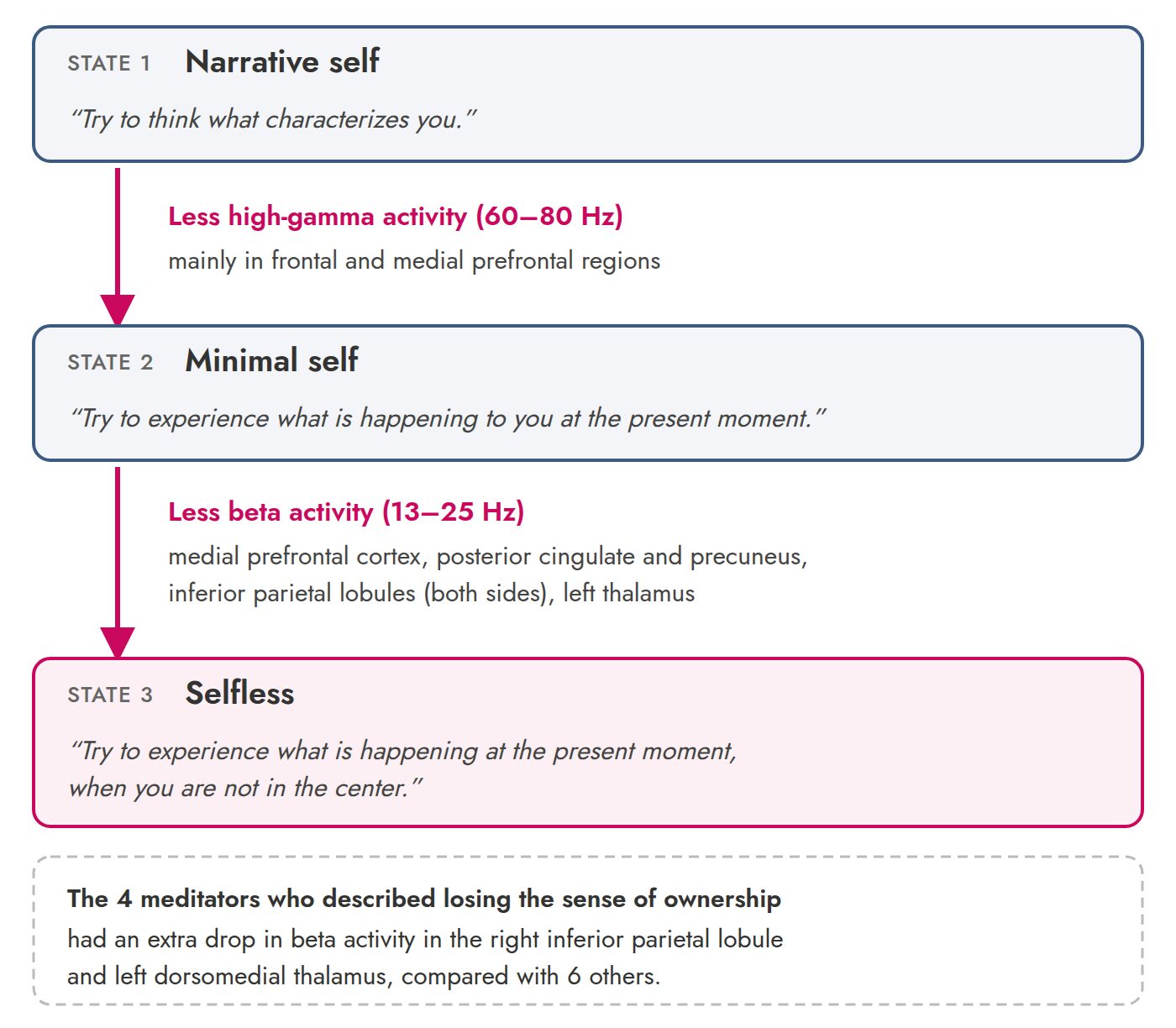
The authors’ central claim is that these two layers of self run on different rhythms: the narrative self on high gamma, centered on the front of the brain, and the minimal self on beta, in a network that adds parietal regions. They suggest beta makes sense because the sense of agency is thought to be built on motor systems, which often work in the beta band. That explanation came after the fact; the authors had predicted the gamma result but said their predictions for the minimal self were “less clear.”
Miscellaneous Interesting Takeaways
Three Different Ways of Being Selfless
The meditators’ descriptions of the selfless state fell into three types. To check this sorting, the authors gave the raw descriptions to 12 independent referees (graduate students and postdoctoral researchers), and dropped the two descriptions that more than one of them sorted differently, leaving 10.
- Lack of ownership: experience carried on, but without a sense of owning or directing it. One participant said:
It was emptiness, as if the self fell out of the picture. There was an experience but it had no address, it was not attached to a center or subject …
- Altered experience: a changed sense of the body, senses or space, such as “as if I took a step back and am looking at myself from the back.”
- Less happening: a general quieting, described as “Very pleasant and relaxed and quiet.”
The four people in the lack-of-ownership group were also the most experienced meditators, a distinct group on a combined measure of years and hours of practice. When the team compared their brain activity with the other six, they showed an extra drop in beta activity in the right inferior parietal lobule and the left dorsomedial thalamus. The other two types showed no distinctive pattern. This is the finding behind the abstract’s claim that selflessness “is linked to” beta in the right inferior parietal lobule, and it rests on four people compared with six. Because the same four were both the most experienced and the ones who described losing ownership, the study can’t tell whether the brain difference reflects the experience, the expertise, or both.
Thinking About Yourself Felt Worse
The emotional reports were striking. While thinking about what characterizes them, 10 of the 12 meditators reported negative (5) or mixed (5) emotions. In the minimal-self and selfless states, only one person did; most felt neutral (9 in the minimal state, 8 in the selfless state) and the rest positive. In keeping with the Buddhist context, the authors counted pride as a negative emotion. They connect this to evidence that a wandering mind is an unhappy mind, suggesting that meeting experience in the present, rather than through one’s self-story, may matter for well-being.
Checking for Effort and Muscle Tension
Two worries could explain the brain differences without any change in the self. One is difficulty: if one state took more effort, attention could drive the result. But participants rated all three states as about equally successful (8.6, 7.8 and 8.0 out of 10) and steady (8.2, 8.0 and 7.6), with no significant differences, and the team found no differences in the alpha and theta rhythms usually linked to concentration in meditation. The other is muscle tension, which can masquerade as high-gamma activity and might ease as people relax out of self-focused thinking. The authors argue the gamma pattern didn’t look like muscle noise, and the meditators who reported little or no emotion while thinking about themselves didn’t show the pattern any less.
Final Reflection
This was an early, inventive attempt to put the Buddhist idea of selflessness in a brain scanner, and to let meditators’ own descriptions shape the analysis. The authors see one result as a finding in itself:
Indeed, a non-trivial outcome of the present study is that long-term mindfulness meditators are actually able, under experimental conditions, to successfully produce and steadily hold a selfless mode of awareness.
That conclusion rests on the meditators’ own ratings, and the descriptions show that the same instruction produced quite different experiences. The authors themselves read this as people reducing the sense of self “through different strategies.”
The design has other limits. There was no group of non-meditators, so we can’t tell whether the brain changes are specific to trained practitioners. The paper doesn’t say that the three states were presented in varying orders, so time in the scanner could play a part. Each state was held for only about a minute and a half in total, and the analyses that tie experience to brain activity involve very small groups. The authors acknowledge this:
Another limitation regards the small sample of participants, especially in the neurophenomenological analysis, which yielded very small groups. Thus, the results reported here warrant replication in a larger group and in other meditative traditions.
Read as a map of possibilities rather than settled facts, the study offers a clear hypothesis: the story-telling self and the bare sense of being the one who experiences may be carried by different brain rhythms, and letting go of the latter may show up as quieter beta activity in parietal regions tied to agency and ownership.
Citation
Dor-Ziderman, Y., Berkovich-Ohana, A., Glicksohn, J., & Goldstein, A. (2013). Mindfulness-induced selflessness: A MEG neurophenomenological study. Frontiers in Human Neuroscience, 7, 582. 10.3389/fnhum.2013.00582
Get the next summary by email
One or two new paper summaries every couple of weeks, sent to your inbox when they go up.
No spam, and you can unsubscribe at any time. Prefer a feed reader? Use the RSS feed.