
Background Information
Medicine usually treats death as a moment: the heart stops, breathing stops, a doctor declares death. Brain research has begun to complicate that picture. The authors point to studies in rats and in people that recorded bursts of brain electrical activity at or shortly after clinical death, and to recent work suggesting the brain’s hearing pathways may still respond to sounds just before death. Many religious traditions have long held that dying takes time.
One of those traditions is Tibetan Buddhism. Tibetan Buddhists believe that at death the mind passes through a stage in which its fundamental nature becomes especially clear, no longer occupied by sensations or thoughts. Everyone is said to pass through it, but only advanced meditators are thought able to recognize it and rest in it. That postmortem meditative state is called
Tukdam
Tukdam (Tibetan thugs dam, also spelled thukdam) is a state that Tibetan Buddhists believe some advanced meditators enter at death, remaining in meditation after breathing has stopped. According to the tradition, the body of someone in tukdam stays fresh, with supple skin and warmth around the heart, and doesn’t begin to decay for days or even weeks. The state is understood to have ended when signs of decomposition appear.
More on Wikipedia
Read more in the glossary
(thugs dam in Tibetan, also spelled thukdam). According to the tradition, it shows on the body:
The visage of those in tukdam is described as radiant, their skin remains supple and elastic, and the area around the heart is said to be warmer than the rest of the body.
Someone in tukdam may remain so for a week or even a month, the tradition holds, without the body beginning to smell or decay. When signs of decomposition appear, the tukdam is understood to have ended.
This study reports the first findings of the Tukdam Project, a long-term collaboration between the Center for Healthy Minds at the University of Wisconsin-Madison and Tibetan institutions in India: Men-Tsee-Khang, Delek Hospital and the Office of the Dalai Lama. It grew out of conversations between Richard Davidson, the study’s senior author, and the Dalai Lama. The researchers hypothesized that some brain activity, perhaps in the brainstem, which helps coordinate the body’s organs, might persist for a while after clinical death in people in tukdam, and might help explain the reported delay in decomposition.
What They Did
Finding cases was hard. Accomplished practitioners tend to be private about their practice, since humility and secrecy are considered part of it, and monasteries in India are often far apart. The Office of the Dalai Lama wrote to 28 nunneries and monasteries asking for help, and the team gave talks and equipment demonstrations in Tibetan communities across India.
When a possible case was reported, one of two doctors on the team did a phone interview to check that the person had no history of neurological disease, that the body showed no odor or other sign of decomposition, and that it had not been preserved in any way. A doctor then checked the body in person or from photographs before the team asked permission to record. The eldest family member or a disciple gave consent, and each family or practitioner received the equivalent of $25 in rupees, an amount chosen as a culturally acceptable offering. Sometimes the team was welcomed to observe but not permitted to record, and in some cases the tukdam had ended by the time the team arrived.
Between 2013 and 2019 the team heard of 27 possible cases and was allowed to record 13. Six of those recordings had too much electrical interference or were incomplete, leaving seven: six monks and one laywoman, aged 43 to 91, who had died of illnesses including cancer, pneumonia and kidney failure.
Recording a body in a monastery room or retreat hut is not like recording in a lab. The team ran everything on batteries, switched off fans, heaters and lights, used a meter to find the spot with the least electrical noise, and moved the body as little as possible. They placed four
EEG
An electroencephalogram (EEG) is a recording of brain activity. During this painless test, small sensors are attached to the scalp to pick up the electrical signals produced by the brain.
More on Wikipedia
Read more in the glossary
electrodes on the scalp, fitted foam earphones, and played two kinds of sound:
- A stream of 2,000 short tones over about 17 minutes, in runs of a repeated pitch broken now and then by a change in pitch. In a living brain, the change triggers the
mismatch negativity
The mismatch negativity (MMN) is a brain response, recorded with EEG, to a sound that breaks a repeating pattern, such as a change in pitch after a run of identical tones. It shows up as a negative dip roughly 100 to 300 milliseconds after the odd sound and arises automatically, even when the person isn’t paying attention, so it is used to test whether the brain still processes sound during sleep, in coma or in a vegetative state.
More on Wikipedia
Read more in the glossary , a small electrical dip about a tenth of a second later that appears even when the person isn’t paying attention. Detecting it would point to some remaining activity in the cortex. - About 4,000 clicks, 20 per second, for 3 minutes and 20 seconds. These trigger the
auditory brainstem response
The auditory brainstem response (ABR) is a series of tiny electrical waves, recorded from the scalp, that the hearing nerve and brainstem produce within about 10 milliseconds of a click. Because it doesn’t depend on attention or awareness, it is used to test hearing in newborns and to check whether the brainstem is still working in people in a deep coma or suspected of brain death.
More on Wikipedia
Read more in the glossary , a set of tiny waves within 10 milliseconds that come from the hearing nerve and brainstem. Detecting it would point to remaining brainstem activity.
Both are event-related potentials : responses too small to see in a single trial, which emerge when many trials are averaged. Both have been used to assess people in comas or vegetative states. The team also recorded 5 to 10 minutes of resting EEG.
The teams repeated recordings twice a day until decomposition began or the tukdam was judged to have ended; the paper reports the session closest to the time of death for each person. That was never soon after death. The earliest recording began 26 hours after clinical death; for the other six it began 3 to 5 days after.
To show that their setup could pick up these responses in the same rough conditions, the team also recorded 14 living practitioners, mostly older monks, in monastery rooms, retreat areas and an elders’ home. They were asked to relax and not to do any particular meditation. Only five recordings were clean enough to use: three monks, a lay practitioner and a nun, aged 61 to 86. The authors stress these are not a control group, only a check that the equipment worked.
One Big Result: None of the Seven Tukdam Recordings Showed a Detectable Brain Response
In the living practitioners, the expected responses appeared. Averaged across them, the mismatch negativity was a clear dip of about 0.71 microvolts at both electrodes analyzed, and the brainstem response showed its usual peak at about 7.5 milliseconds. In the seven people in tukdam, both responses were flat. Their average mismatch response was essentially zero (0.01 and 0.07 microvolts, slightly positive rather than negative), and no brainstem waveform could be made out. The differences between the groups were statistically significant for both measures at both electrodes, though with five and seven people these tests mostly confirm what the flat lines already show.
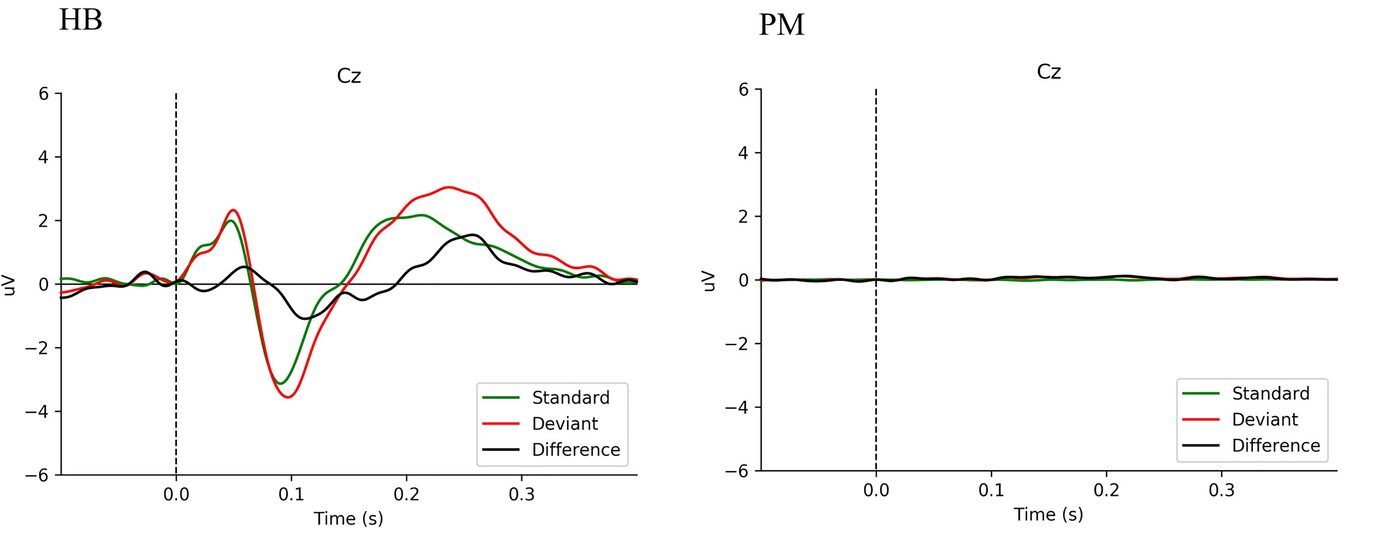
The authors’ conclusion is narrow:
No recognizable EEG waveforms were discernable in any of these tukdam cases, thus we failed to find support for the hypothesis of residual brain activity following the cessation of cardiorespiratory function in tukdam cases recorded beyond 26 h postmortem.
“Any of these tukdam cases” means the seven that could be analyzed; the six unusable recordings can’t speak either way. The paper also collected resting EEG but reports results only for the two sound-evoked responses.
Miscellaneous Interesting Takeaways
What the Null Result Does and Doesn’t Rule Out
The study tested one idea: that brain activity measurable from the scalp lingers in tukdam and might explain the reported slowing of decay. It found no support for that, at least from a day or more after death. The authors are clear about what remains open:
It is important to note that even if tukdam is mediated by residual electrical activity in the brainstem, this activity may generate signals that are too weak to be detected on the scalp surface or not possible to resolve owing to the limitations of our field equipment.
And if the brain isn’t involved, other biological processes might be. The authors suggest collecting blood, saliva and tissue in future cases, which cultural and practical obstacles prevented this time.
They also didn’t set out to test whether any awareness persists in tukdam, as the tradition holds; they say they did not expect to be able to assess that. And they write that the study “was not meant to adjudicate the empirical status of tukdam per se.” In other words, finding no brain signal neither confirms nor refutes tukdam as Tibetan Buddhists understand it.
The Delay in Decomposition Wasn’t Measured
The hypothesis rested on the reported delay in decomposition, which the authors acknowledge has not yet been confirmed through objective measures. This study didn’t measure it either. Cases were included because Tibetan lay, medical and religious specialists recognized them as tukdam and found no smell or visible decay when the team was contacted. The authors list the difficulty of turning the traditional signs, such as smell, rate of decomposition and suppleness of the skin, into research measurements as one of the study’s main limitations.
Why Recording Started So Late
The studies of brain activity around death that motivated this work looked at the immediate window around clinical death. Here the earliest recording came 26 hours after death, and most came 3 to 5 days after. Part of the reason is respect for the tradition: it is customary to observe the deceased for three days before deciding whether they are in tukdam, and some Tibetans believe that touching the body too soon would disturb it. Travel added more delay, since reaching some cases took a day’s journey. The team hopes to get to know practitioners while they are alive so that recording can begin as they are dying, and to record laypeople not expected to enter tukdam for comparison.
One Woman in Each Group
Each group included only one woman: the laywoman among the deceased and the nun among the living practitioners. The authors attribute this to cultural and religious difficulties in recruiting women and say efforts to recruit female practitioners are underway.
Final Reflection
This is a careful report of a negative result from a study that was difficult to run. The team, with Tibetan researchers from Men-Tsee-Khang collecting much of the data, recorded seven people in tukdam in monasteries, hospitals, a home and a retreat hut across India, moved the bodies as little as possible, and showed that the same equipment picked up clear responses in living practitioners. In none of the seven did they find a brain response to sound.
The limits are plain. Seven people is a small number, recording started a day or more after death, four scalp electrodes can only detect so much, and the physical signs that define tukdam were taken from the tradition rather than measured. The authors offer the project as a model for future studies of meditation and dying across cultures, and they are continuing it, aiming to record practitioners earlier and to collect other kinds of biological samples.
For a different angle on long-term Tibetan Buddhist practitioners, researchers from the same center have recorded unusually strong gamma waves in their brains during meditation.
Citation
Lott, D. T., Yeshi, T., Norchung, N., Dolma, S., Tsering, N., Jinpa, N., Woser, T., Dorjee, K., Desel, T., Fitch, D., Finley, A. J., Goldman, R., Bernal, A. M. O., Ragazzi, R., Aroor, K., Koger, J., Francis, A., Perlman, D. M., Wielgosz, J., Bachhuber, D. R. W., Tamdin, T., Sadutshang, T. D., Dunne, J. D., Lutz, A., & Davidson, R. J. (2021). No detectable electroencephalographic activity after clinical declaration of death among Tibetan Buddhist meditators in apparent tukdam, a putative postmortem meditation state. Frontiers in Psychology, 11, 599190. 10.3389/fpsyg.2020.599190
Get the next summary by email
One or two new paper summaries every couple of weeks, sent to your inbox when they go up.
No spam, and you can unsubscribe at any time. Prefer a feed reader? Use the RSS feed.