
Background Information
Tibetan Buddhism has a meditation practice said to generate intense inner heat. It is called
g-tummo
g-Tummo, often written tummo and known in English as “inner fire” or “psychic heat,” is a meditation practice of Tibetan Buddhism and Bön associated with sensations of intense bodily heat. It combines a breath-holding technique with muscle contractions (“vase breathing”) and visualization of flames in the body, and it is traditionally taught in long retreats.
More on Wikipedia
Read more in the glossary
(“inner fire” or “psychic heat”), and the stories told about it are remarkable. Practitioners are said to sit or walk in Himalayan cold wearing almost nothing, drying wet sheets wrapped around their bodies until the sheets steam. At Gebchak nunnery in eastern Tibet, experienced practitioners still do this every year: at dawn, in −25°C to −30°C, they walk slowly around the nunnery for a few hours in short skirts and shoes, with a wet sheet draped over their naked torsos.
Before this study, the only measurements came from Benson and colleagues, in papers published in 1982 and 1990. They reported that three g-tummo meditators raised the temperature of their fingers and toes by up to 8.3°C, raised skin temperature at the navel and lower back by 1.9°C, and showed no rise in rectal temperature. Retellings later inflated those figures, the authors note, perhaps by mixing up Fahrenheit and Celsius, into claims of 15- or 17-degree rises. Finger and toe temperatures can swing widely without any change deep in the body, and the authors point out that the steaming sheets don’t prove much either:
Wet sheets wrapped around a practitioner’s body would steam and dry due to the significant temperature difference between the wet sheets (heated by a human body) and the cold air outside, even if the practitioners simply maintain their normal body temperature.
So two questions were open. Does g-tummo actually raise the body’s core temperature beyond normal? And if it does, is it the meditation that does it, or the physical technique that goes with it? The practice has both. Its physical part is a special breath-hold called “vase breathing”: after inhaling, the practitioner holds the breath and contracts the abdominal and pelvic muscles so that the lower belly bulges like a vase. These are
isometric
An isometric exercise tenses muscles without moving the joints they act on, as in holding a plank or pressing the palms together. The muscles work and produce heat even though the body stays still.
More on Wikipedia
Read more in the glossary
contractions, muscles tensed without moving. Its mental part is visualization: holding vivid images of flames at particular places in the body, along with intense sensations of heat in the spine.
What They Did
The first author, Maria Kozhevnikov of the National University of Singapore, traveled in January to Nangchen in China’s Qinghai province, more than 4,200 meters up. With help from the abbot of Gebchak nunnery, she recruited ten experienced practitioners (seven of them women) from the nunnery and nearby monasteries. They were 25 to 52 years old and had practiced g-tummo for 6 to 32 years. Most were tested in an unheated mud-and-brick house, where the room temperature at that time of year is usually around 0°C.
Practitioners described two forms of the practice, and the study tested both. Forceful Breath uses vigorous vase breathing, with a loud inhalation and a sharp “huh!” on the exhalation, while the practitioner visualizes a flame rising from below the navel to the crown of the head. Its purpose is to raise heat. Gentle Breath uses the same breath-hold without strain, while the practitioner imagines the whole body filling with bliss and heat. Its purpose is to keep the heat up. Because Forceful Breath is too demanding to sustain for long or while walking, the practitioners said, it is Gentle Breath that they use during the wet-sheet ceremony.
Each form was done two ways. In the baseline version, practitioners breathed, contracted their muscles and held their hands and bodies exactly as in the practice, but without any visualization. Baselines were limited to 10 minutes. In the meditation version, they did their usual full practice, breathing plus visualization, for as long as they felt comfortable. Not everyone could do everything. Four people did all four conditions back to back in a fixed order (Forceful baseline, Gentle baseline, Forceful meditation, Gentle meditation). Two did only the Forceful pair, and four did only the Gentle pair. So six people contribute to every Forceful Breath result.
Throughout, small disc thermometers taped under the left armpit and on the left little finger recorded temperature. An armpit reading is a less intrusive stand-in for core body temperature than a rectal or oral one; the authors chose it partly because rectal and mouth readings could be thrown off by the muscle contractions and airflow of vase breathing. A wireless
EEG
An electroencephalogram (EEG) is a recording of brain activity. During this painless test, small sensors are attached to the scalp to pick up the electrical signals produced by the brain.
More on Wikipedia
Read more in the glossary
headset recorded brain activity at nine scalp sites, and a microphone picked up the breathing so that the researchers could time each breath-hold.
A second study, in a yoga studio in New Jersey, asked what the breathing does without the meditation. Eleven Western participants (ten of them women, aged 46 to 70) with an average of 13.6 years of yoga or martial arts practice, but no experience of Tibetan meditation, were taught the Forceful Breath technique without visualization in a 30-minute training session. Then each rested for 15 to 20 minutes, did the breathing for as long as was comfortable, and rested again while their armpit temperature was recorded.
One Big Result: Breathing Raised Body Temperature, and Only the Full Meditation Took It Clearly Past Normal
The practitioners started at an average armpit temperature of 36.49°C, close to the 36.6°C the authors use as normal for the armpit. The breathing-and-muscle technique on its own warmed them: by the end of the Forceful baseline, they averaged 36.9°C, a rise that fell just short of being significantly above normal (p = .053). By the end of the Forceful meditation, which came later in the session, they averaged 37.6°C, clearly above normal (p = .005). The highest reading was 38.3°C, which the authors place in the slight-to-moderate fever zone. One practitioner gained 2.2°C between the start of the session and the end of the Forceful meditation.
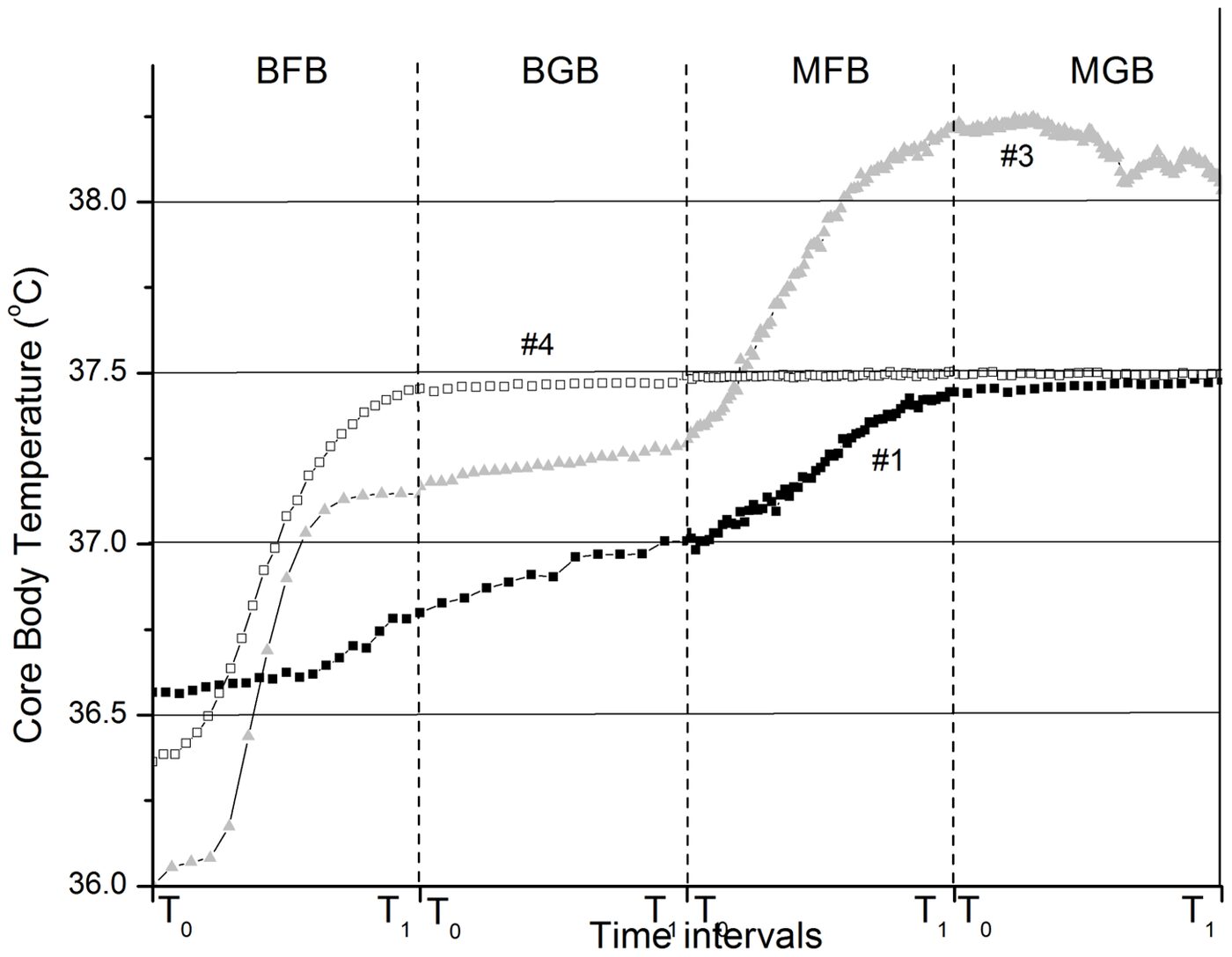
Gentle Breath behaved as the practitioners had said it would. The four people who did only the Gentle pair showed no rise at all (they ended at 36.42°C on average). But in the people who had already warmed up with Forceful Breath, temperature stayed roughly level through Gentle Breath rather than falling back.
The Western group showed that the breathing works without the meditation. Their armpit temperature rose significantly during the Forceful Breath technique, from 36.38°C to 36.99°C on average, but it never exceeded 37.02°C, staying within the normal range. Before and after the breathing alone, their temperatures did not differ significantly from those of the six Tibetan practitioners at the same stage. Only the Tibetans’ temperatures at the end of the full meditation were significantly higher than the Westerners’ (p = .001). And when the Westerners stopped, their temperature drifted back to where it had started within about 20 minutes.
From these patterns and from correlations described below, the authors conclude that the two parts of the practice play different roles:
That is, the FB somatic component (vase breathing) causes thermogenic effects, while the neurocognitive component (meditative visualization) seems to be key for facilitating a sustained increase in body temperature for longer periods, possibly due to mitigating physiological mechanisms leading to heat loss.
In other words, the breath-hold produces heat (
thermogenesis
Thermogenesis is the body’s production of heat. Muscle activity, including shivering and other muscle contractions, is a major source; the body also makes heat by burning fuel in brown fat and through digestion.
More on Wikipedia
Read more in the glossary
), and the visualization may let practitioners keep it rising rather than leveling off. The heat-producing half of that conclusion is well supported, since two different groups showed it. The visualization half is a reasonable reading but a weaker one, for a reason the design builds in: the meditation always came after the breathing-only round. The Forceful meditation began from a temperature the baseline had already raised, it was allowed to run as long as each practitioner liked (19.4 minutes on average, against 5.9 minutes for the capped baseline), and the 37.6°C average is the end point of the whole sequence. Measured within each round, the averages are surprisingly close. By our arithmetic from the paper’s Table 1, temperature rose by about 0.44°C during the breathing-only round and about 0.48°C during the meditation round, though the meditation round took about three times as long. The temperature rose fastest during the breathing alone (0.146°C per minute, against 0.030°C per minute during the meditation).
Miscellaneous Interesting Takeaways
Finger Temperature Followed the Hands, Not the Mind
Finger temperature rose by 1.2°C to 6.8°C during the different conditions, in line with Benson’s earlier reports. But the peaks lined up with changes in hand position, such as tensing the hands or pressing the fists into the crease of the groin, over the large femoral artery. The authors concluded:
This suggests that the peripheral temperature increases are primarily the result of increased peripheral blood flow due to peripheral muscular action (and proximity of the femoral artery) rather than a result of psychological (caused by meditation) or physiological (caused by breathing or isometric techniques) states.
Because the hand movements are part of the practice and couldn’t be removed, the rest of the analysis used only the armpit readings. This undercuts the most dramatic numbers in circulation, which come from the extremities.
Longer Breath-Holds Warmed People Faster
The Tibetan practitioners’ breath-holds averaged 1.58 minutes during the Forceful baseline. Those who held longer warmed faster during the baseline (r = 0.91, among six people). The Westerners held their breath for only about 30 seconds on average (19 to 41 seconds), and in them too, longer holds went with faster warming (r = 0.60, p = .050). Their rate of warming during the breathing, 0.091°C per minute, was in the same range the authors cite for medical hyperthermia treatments that heat the body from outside, 0.02 to 0.17°C per minute.
That difference in breath-holding matters for the comparison between the groups. The Tibetans’ holds were several times as long as the Westerners’, they had decades of practice rather than 30 minutes of training, and they were in a room near freezing rather than a yoga studio. So the Westerners’ lower final temperatures may reflect less skill with the breathing itself, not only the lack of visualization.
Brain Rhythms Changed During the Forceful Meditation
Compared with its breathing-only baseline, the Forceful meditation showed more
alpha
Alpha waves are rhythmic electrical brain activity at roughly 8–13 cycles per second, recorded with EEG. They are often strongest when the eyes are closed and the mind is relaxed, and are thought to help filter out or hold back information as part of top-down control. Meditation studies have reported both increases and decreases in alpha, depending on the practice.
More on Wikipedia
Read more in the glossary
power (strongest over the back of the head) and more
beta
Beta brain waves are a type of brainwave pattern that oscillate between approximately 12 to 30 Hz. Beta waves are typically associated with active thinking, focus, alertness, and engagement with the external world. They are prominent during conscious, goal-directed activity and are linked to cognitive tasks such as problem-solving, decision-making, and sustained attention.
More on Wikipedia
Read more in the glossary
power, with a near-significant rise in
gamma
Gamma brain waves are a type of brainwave pattern that oscillate at approximately 25 to 100 Hz. Gamma waves are associated with states of heightened perception, problem-solving, and consciousness. Gamma waves play a crucial role in cognitive functioning, including memory, and information processing, and are thought to integrate thoughts and information from different parts of the brain.
More on Wikipedia
Read more in the glossary
(p = .06);
theta
Theta waves are rhythmic electrical brain activity at roughly 4–8 cycles per second, recorded with EEG. While awake, they are linked to memory, focused attention and drowsiness, and meditation studies often report more theta over the front of the head during practice. In sleep, theta is common in light non-REM sleep and in REM sleep.
More on Wikipedia
Read more in the glossary
did not change. The Gentle meditation showed only a rise in beta. The authors read the alpha increase as attention turned inward, onto the imagined flames and sensations of heat, with outside input held back.
The most striking correlation was that practitioners whose alpha power rose more during the Forceful meditation also gained more heat during it (R² = 0.82). The alpha rise also went with a longer period of rising temperature before it leveled off (r = 0.94), which is the basis for the authors’ idea that visualization lets the heat keep building. Alpha did not change between the start and end of the breathing-only round. These correlations are intriguing, but they come from six people, and the paper tests several of them without correcting for
multiple comparisons
The multiple comparisons problem arises when researchers run many statistical tests at once. Each test has a small chance of a false positive, so across thousands of tests, such as one for every point in a brain scan, some “significant” results will turn up by chance alone. Corrections raise the bar for significance to keep the overall false-positive rate down, at the cost of making small real effects harder to detect.
More on Wikipedia
Read more in the glossary
. Recording EEG in the cold during forceful breathing and muscle contraction is also hard: on average, about 46% of each person’s one-second segments were discarded as too noisy, and the authors themselves caution that the frontal gamma could be muscle or eye-movement activity.
Two Single Cases Hint at the Same Story
Two more Western volunteers were tested separately. A woman with long hatha yoga experience did the Forceful breathing twice, with a rest in between. Her temperature reached 36.96°C the first time and rose no higher the second, even though she started the second round warmer. A Western woman with seven years of g-tummo practice reached a similar 36.95°C with the breathing alone, then went up to 37.03°C when she added the visualization. The authors describe that as reaching “the zone of slight fever,” but it is a small step above the Western group’s average, and these are two individuals.
The Wet-Sheet Ceremony Uses the Gentle Practice
As the practitioners explained, the ceremony doesn’t use the more heat-producing form, because Forceful Breath is too strenuous to keep up for long or while walking. The study didn’t measure anyone during the ceremony itself. Its results suggest a sequence, though: the forceful practice raises heat, and the gentle one keeps it from falling, which is just what walking for hours in subzero cold would need. The evidence for that second role is indirect: the Westerners cooled down while resting after the breathing, but no one in the Tibetan group was measured resting after the forceful practice for comparison.
Some Questions the Design Leaves Open
The authors acknowledge that their samples were small, because g-tummo practitioners are few, the practice is sacred, and the monasteries are remote. Beyond that, the “above normal” results were tested against a population norm of 36.6°C, not against a matched control group, and an armpit thermometer is a less precise measure of core temperature than an internal one; Benson’s earlier study found no rise in rectal temperature. The conditions always ran in the same order, and the baselines and meditations differed in length. A few details in the paper are also inconsistent: for example, the Forceful Breath group’s average years of practice (12.5) falls below the range given for it (19 to 30 years). None of this erases the main finding that the practitioners warmed up measurably, but it limits how firmly the extra heat can be credited to visualization.
Final Reflection
This study took a legend into the field and measured it. The answer is partly deflating and partly impressive. The famous finger-and-toe figures turn out to reflect hand positions and blood flow, and the steaming sheets need no fever to explain them. But experienced practitioners did raise their armpit temperature during the forceful practice, in six of them to an average of 37.6°C and in one to 38.3°C, in a room near freezing. And a breathing technique that Western volunteers learned in half an hour raised their temperature too, though only within the normal range.
What remains uncertain is the role of the mind. The authors’ account, in which breath-holding generates heat and focused visualization keeps it building, fits their data, including the link between alpha power and longer warming. But with the meditation always following the breathing, lasting longer, and studied in six people, the same data could partly reflect more time doing the breathing, done by more skilled breathers. A study that varied the order, matched the durations and compared visualization with an attention-matched alternative would show how much the imagined flames add.
The authors suggest that for practitioners the heat may be a means rather than the goal, a way to reach “deep meditative states.” For brain science, its value is as a rare, measurable example of a contemplative practice changing a basic body function, with brain rhythms that change during the practice, as in other studies of advanced practitioners.
Citation
Kozhevnikov, M., Elliott, J., Shephard, J., & Gramann, K. (2013). Neurocognitive and somatic components of temperature increases during g-tummo meditation: Legend and reality. PLoS ONE, 8(3), e58244. 10.1371/journal.pone.0058244
Get the next summary by email
One or two new paper summaries every couple of weeks, sent to your inbox when they go up.
No spam, and you can unsubscribe at any time. Prefer a feed reader? Use the RSS feed.