
Background Information
Meditation research mostly measures benefits such as lower stress or better attention. Buddhist texts describe a much wider range of experiences that can come with practice, including unusual changes in perception. Lights and luminosity come up again and again in those texts.
In the Theravada tradition, a light or image called a
Nimitta
In Theravada Buddhist meditation, a nimitta (Pali for “sign”) is a mental image that is said to appear once concentration has developed, often while focusing on the breath. It is commonly described as a light, such as a star, a cluster of gems or the disk of the moon. Teachers treat it as a sign of deepening concentration, and it can become the new object of attention on the way to the jhanas.
More on Wikipedia
Read more in the glossary
is said to appear once concentration on the breath has developed. A fifth-century manual, The Path of Purification, says it may look “as a star or cluster of gems or a cluster of pearls,” or like “the moon’s disk or the sun’s disk.” Buddhist tantric texts describe a sequence of visions, from something “like seeing a mirage” through “flickering fireflies” to “a clear autumn sky pervaded by the light of the full moon.”
Jared Lindahl, Willoughby Britton and colleagues at Brown University point out that, apart from a couple of earlier studies, these experiences had gone undocumented in the scientific literature on meditation. Yet similar lights are well studied elsewhere: in people kept in darkness and silence, in people staring into a featureless visual field, and in people with failing eyesight. The paper sets out to connect these three bodies of knowledge: what today’s meditators report, what Buddhist texts say, and what neuroscience knows about seeing lights that aren’t there.
What They Did
The data came from the early stages of the Varieties of Contemplative Experience study, the project behind the team’s later catalogue of 59 kinds of meditation-related challenges. The researchers recruited 28 meditators (average age 43, 61% men) by word of mouth. All had a regular practice in a Buddhist tradition: 71% in Vipassana or Theravada traditions, 25% Tibetan and 25% Zen (some practiced in more than one). Nearly half were meditation teachers. To take part, each had to have had a meditation-related experience that was significant, unexpected or challenging, or that came with physical or psychological changes.
Interviews were open-ended. Each began with “What was your experience with meditation?” and the interviewers followed up only with general prompts such as “Can you tell me more about that?” Nobody was asked about lights. About 36 hours of recordings were transcribed and split into 6,594 short passages, which pairs of researchers then coded into more than forty categories of experience. “Light experiences” emerged as one sub-category of visual experience. A passage counted if it used the word “light” or described something seen as bright or luminous; purely metaphorical uses of light did not count.
The team then sorted the light experiences into types, compared them with descriptions in Buddhist texts, and set both beside studies of
sensory deprivation
Sensory deprivation is the deliberate reduction of input to the senses, for example by sitting in a dark, silent room, wearing blindfolds and earplugs, or floating in a lightless tank. Even short periods can change perception, including simple visual hallucinations such as spots or flashes of light.
More on Wikipedia
Read more in the glossary
,
perceptual isolation
Perceptual isolation, studied as the Ganzfeld effect, means exposing someone to an unchanging, featureless field of sight or sound, such as an even wash of light over both eyes with steady white noise. The senses still receive input, but the brain habituates and filters it out, and people often begin to see lights, patterns or images that aren’t there.
More on Wikipedia
Read more in the glossary
and visual disorders such as
Charles Bonnet Syndrome
Charles Bonnet syndrome is a condition in which people with poor vision or blindness, most often older adults, see things that aren’t there, from spots, flashes and patterns to faces or scenes. It is not a sign of mental illness, and people usually know the images aren’t real. It is thought to arise when visual areas of the brain, deprived of input, become overactive.
More on Wikipedia
Read more in the glossary
.
One Big Result: Meditators’ Lights Fell Into Two Classes, Both Described in Buddhist Texts and in Sensory-Deprivation Research
Nine of the 28 meditators (32%) described lights or luminous experiences without being asked. Six practiced mainly in Vipassana or Burmese Theravada traditions, two in Zen and one in a Tibetan tradition. Five had their light experiences on retreat and four during daily practice. On average they had been practicing for five years (between two and eight) before the lights appeared. None had been doing a “dark retreat,” a Tibetan practice of meditating in complete darkness.
Their descriptions fell into two classes:
- Discrete lightforms. Four meditators saw small, distinct lights: “blue, purple, red” globes, “jewel lights,” “Christmas tree lights,” white spots or “little stars,” and in one case a white moon-shaped object overhead. Some hung still in space; others moved.
- Patterned and diffuse lights. These had no clear shape or location but changed the whole visual field. One meditator saw “ropes of shimmering” that made space shimmer; another saw reality “pixelating a little bit and becoming very very vivid.” Six described the visual field growing brighter, two with eyes open and four behind closed eyes, such as an “internal curtain of light.” Two felt the light in their bodies: one “was breaking apart into sparkles,” and another felt “rays of light coming out of me.”
One practitioner on a Tibetan concentration (
Shamatha
Shamatha (Pali samatha, “calm abiding”) is a Buddhist family of concentration practices that train attention to settle and stay on a chosen object, such as the sensations of the breath. Practitioners notice when the mind has wandered and bring it back, aiming for attention that is both stable and vivid. It is often paired with vipassana, or insight, practice.
More on Wikipedia
Read more in the glossary
) retreat described the discrete kind:
Sometimes there were, oftentimes just a white spot, sometimes multiple white spots, sometimes the spots, or “little stars” as I called them, would float together in a wave, like a group of birds migrating, but I would just let those things come and go.
Both classes have counterparts in the other two sources. Buddhist texts describe gems, pearls, stars and fireflies, as well as shimmering, “all phenomena as brilliantly colored particles,” and an illuminated sky. Studies of sensory deprivation and failing eyesight describe phosphenes (spots or points of light) and photopsia (flashes of light), along with shimmering, visual snow like television static, and a brightening of the visual field. Researchers class all of these as “simple” visual hallucinations, as opposed to “complex” ones such as faces or scenes. The authors set the three sources side by side:
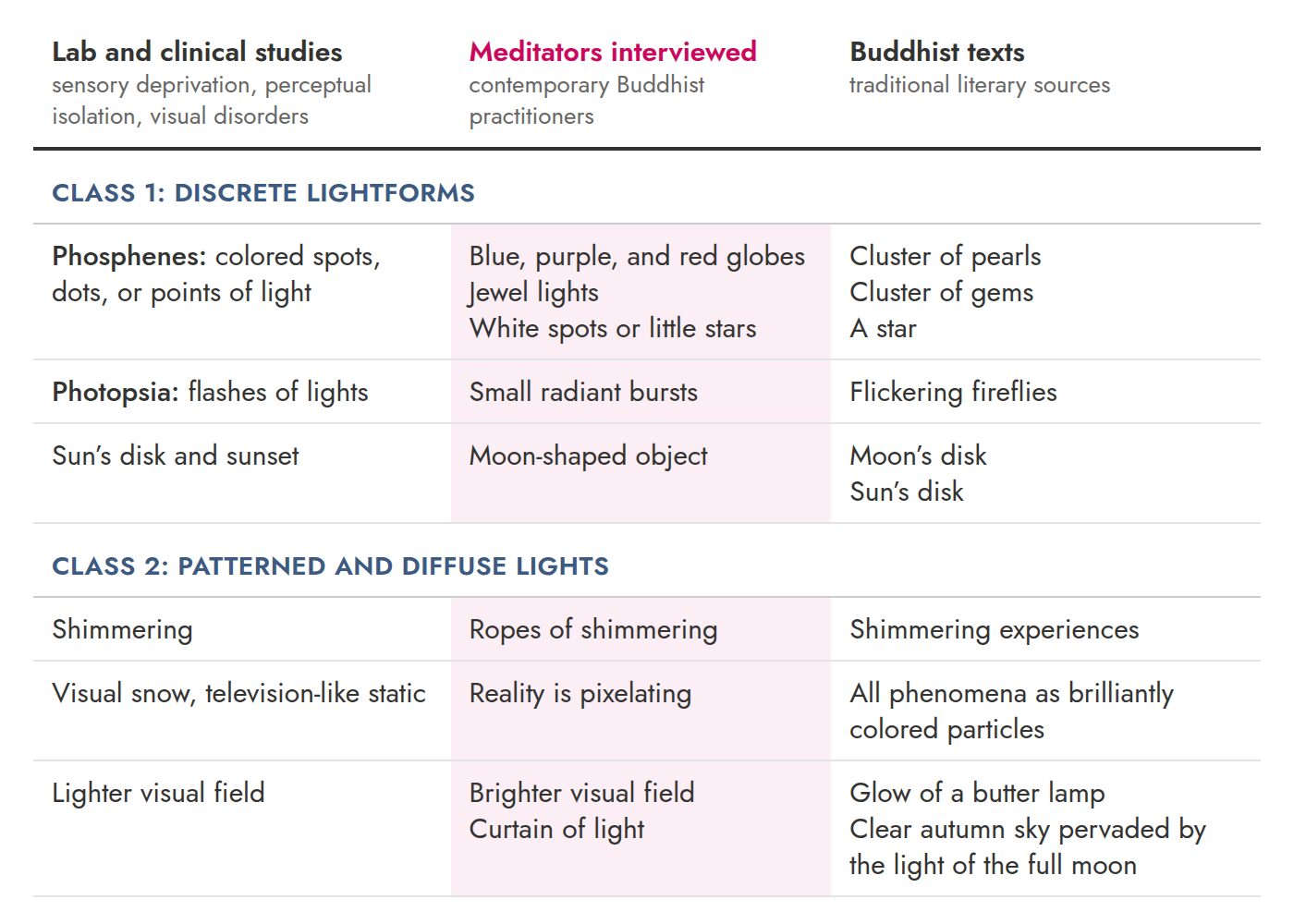
The matching in this table is the authors’ own judgment of which descriptions resemble each other, not a statistical test. It does show how readily ordinary descriptions from today’s meditators map onto both older religious texts and the clinical literature.
Miscellaneous Interesting Takeaways
Buddhist Traditions Don’t Agree on What the Lights Mean
The authors found no single traditional interpretation. In Theravada concentration practice, the nimitta is taken as a sign that an early stage of absorption has been reached, and it can become the new object of attention in place of the breath. Tibetan tantric traditions read the sequence of lights as positive signs that the mind’s clarity is becoming apparent.
Other teachings treat the same lights as distractions. Some Burmese Theravada teachers list “illumination” among ten “imperfections of insight,” a sign of a calm mind but so enticing that it can lead a meditator astray. Tibetan teachings class lights among meditation experiences (nyams) to be left alone. In Zen they belong to makyo, and one Zen teacher advises responding by “paying no attention to them.” In the Dzogchen tradition of Tibetan Buddhism, by contrast, advanced practitioners deliberately stabilize the lights and investigate them, as a way of seeing how the mind builds up its picture of the world.
Lights Usually Came With Concentration
Seven of the nine (78%) linked their lights, unprompted, to periods of heightened concentration, a connection Buddhist texts also make. Lights appeared both on retreat and in everyday practice, and in rooms that were neither deliberately darkened nor brightened.
The Proposal: Meditation as a Form of Sensory Deprivation
Most of the paper’s discussion develops a hypothesis. Darkness, silence and stillness reliably produce simple visual hallucinations, often within a short time. A leading explanation is
homeostatic plasticity
Homeostatic plasticity is a set of feedback mechanisms that keep neurons’ activity near a stable level. If a neuron receives less input, it becomes more excitable, for example by strengthening its connections; if it receives too much, it becomes less excitable. When sensory input drops sharply, this compensation can overshoot and cause spontaneous firing.
More on Wikipedia
Read more in the glossary
: when neurons receive less input, they turn up their own sensitivity to keep activity near its usual level, and sometimes overshoot until they fire spontaneously. That spontaneous firing is experienced as hallucinations, such as lights. Simple hallucinations are linked to activity in the
occipital cortex
The occipital lobe, at the back of the brain, is the brain’s main center for vision. Its outer layer, the occipital or visual cortex, receives signals from the eyes and analyzes features such as edges, color and movement.
More on Wikipedia
Read more in the glossary
, the brain’s main visual area.
The authors argue that meditation shares the ingredients of sensory deprivation. Practice usually happens in quiet places, with little social contact, a still posture, and eyes closed or resting on one spot. Attention also does the filtering: concentrating on the breath means repeatedly setting aside sights, sounds and other sensations. They link this to
alpha
Alpha waves are rhythmic electrical brain activity at roughly 8–13 cycles per second, recorded with EEG. They are often strongest when the eyes are closed and the mind is relaxed, and are thought to help filter out or hold back information as part of top-down control. Meditation studies have reported both increases and decreases in alpha, depending on the practice.
More on Wikipedia
Read more in the glossary
waves, which are thought to help hold back input that isn’t relevant to the task. On this view, practitioners who concentrate on the breath are, in effect, depriving their visual system of attention, and it may respond as it does to darkness.
They point to findings from other studies that fit the idea: experienced meditators who were not using visual objects as their main focus showed lasting improvements in fine visual discrimination after a three-month concentration retreat, and long-term practitioners have shown unexplained extra
gamma
Gamma brain waves are a type of brainwave pattern that oscillate at approximately 25 to 100 Hz. Gamma waves are associated with states of heightened perception, problem-solving, and consciousness. Gamma waves play a crucial role in cognitive functioning, including memory, and information processing, and are thought to integrate thoughts and information from different parts of the brain.
More on Wikipedia
Read more in the glossary
activity over the back of the head, including during non-REM sleep. In perceptual isolation studies, a rise in alpha power, followed by a burst of fast activity at the back of the head, comes just before a hallucination. The authors are clear that the model is unproven:
While still highly speculative, this suggests that the sensory attenuation components of meditation may enhance its neuroplastic potential beyond other forms of skill acquisition.
Their reasoning is that sensory deprivation opens a period of heightened
neuroplasticity
Neuroplasticity is the brain’s ability to change its structure and function in response to experience. Changes can include new connections between neurons and shifts in the size of brain regions. Researchers have looked for structural neuroplasticity after meditation training, much as it has been found after exercise or learning new skills.
More on Wikipedia
Read more in the glossary
, so if meditation works partly the same way, lights might mark a time when the brain is especially open to change. They also suggest lights deserve study as a possible marker of skill in concentration. Researchers currently gauge meditation expertise from hours of practice or self-report questionnaires, both of which have known problems. They add the caveat that any traditional sign of progress can create expectations about what should happen.
Not a Sign of Illness
The authors worry that a clinician unfamiliar with these traditions could mistake a meditator’s lights for a symptom, since seeing things that aren’t there is a known sign of psychosis and of eye disease. Outside traditional settings, without a teacher who knows these experiences, they argue that lights are especially likely to be misread. They write:
It is important, therefore, not to uncritically pathologize these anomalous perceptual experiences. Light-related experiences are likely to be benign, but may cause distress to the practitioner if they are unexpected or accompanied by other psychological changes.
The team went on to study meditation-related difficulties much more widely, in their larger interview study and in an 8-week mindfulness course.
Could It Just Be Drowsiness?
Images at the edge of sleep (
hypnagogia
Hypnagogia is the drowsy state between wakefulness and sleep. Experiences that arise in it, called hypnagogic hallucinations, are very common: dream-like images, sounds, or a sudden feeling of falling as a person drifts off. They are usually harmless.
More on Wikipedia
Read more in the glossary
) are very common, so the authors considered whether the meditators were simply nodding off. They think this unlikely: several meditators had their eyes open, they linked the lights to concentration and never to drowsiness, and hypnagogic images tend to be panoramic and dream-like and to involve several senses at once, unlike the waking hallucinations the meditators’ reports resembled. Still, they call for brain recordings during the experiences to rule it out.
What the Study Can’t Say
The authors note that because nobody was asked about lights directly, they may have missed some. The opposite caution applies too: participants were recruited because they had had unusual experiences, so 9 of 28 says nothing about how often ordinary meditators see lights. The reports were described in retrospect, and nothing was measured in the brain or the eyes. The authors did not control how much light was in the room or whether eyes were open, and changes in the eye itself, such as adjusting to the dark, can also cause brief changes in what people see.
On expectations, the authors argue that lights are rarely described in American Buddhist meditation literature, that only one participant linked their experience to Buddhist ideas about lights, and that participants tended to use everyday words such as “Christmas lights” and “electrical sparks.” That makes it less likely that people saw what they had been told to expect, though it can’t rule out
demand characteristics
Demand characteristics are cues in an experiment that hint at what the researchers expect, which can lead participants to behave the way they think they are supposed to rather than how they normally would. Researchers reduce them by disguising the study’s purpose, measuring behavior unobtrusively, or using comparison conditions that seem just as plausible.
More on Wikipedia
Read more in the glossary
entirely.
Final Reflection
This is a descriptive paper, and its main contribution is a vocabulary. It shows that the lights some meditators see are not random oddities. They fall into recognizable types that Buddhist manuals described centuries ago and that neuroscientists recognize from darkness, monotony and failing eyesight. That alone is useful to meditators who meet them and to clinicians who might otherwise misread them.
The bigger claims, that meditation works partly like sensory deprivation and that lights may herald a window of enhanced neuroplasticity, are interesting hypotheses rather than findings. The study measured nothing in the brain, and its nine reports come from a small, selected group. The authors themselves call the idea “highly speculative” and lay out how to test it: larger samples including secular practitioners, attention tests, and brain recordings taken while the lights are happening.
Citation
Lindahl, J. R., Kaplan, C. T., Winget, E. M., & Britton, W. B. (2014). A phenomenology of meditation-induced light experiences: Traditional Buddhist and neurobiological perspectives. Frontiers in Psychology, 4, 973. 10.3389/fpsyg.2013.00973
Get the next summary by email
One or two new paper summaries every couple of weeks, sent to your inbox when they go up.
No spam, and you can unsubscribe at any time. Prefer a feed reader? Use the RSS feed.