
Background Information
Many contemplative traditions describe a state that sounds almost paradoxical: being aware, but of nothing in particular, except awareness itself. It goes by names like “pure consciousness” or “pure awareness.” The authors define it this way:
It refers to the meditator’s subjective experience of consciousness as such, wherein he or she is non-conceptually aware of being aware.
This paper comes from the Minimal Phenomenal Experience (MPE) project, led by the philosopher Thomas Metzinger, the paper’s second author. The project asks whether there is a simplest possible form of conscious experience and, if so, what the brain needs in order to produce it. Its working hypothesis is that such an experience exists, one that lacks a sense of time, a location in space, a sense of doing anything, and the feeling of being a particular person looking out at the world. Pure awareness during meditation is the project’s way in, because meditators say they experience something like it.
Earlier research on these states was mostly qualitative, built on interviews and written descriptions, which found themes such as an absence of space, time and body, peacefulness and unboundedness. What was missing, the authors argue, was a questionnaire that could measure the experience in many people and find out which of its features go together. The study did not assume that pure awareness is completely empty. It allowed that the experience might come mixed with thoughts, feelings or perceptions, and set out to find out what it is like in practice.
What They Did
Metzinger drew up 92 questions about pure awareness from a review of Eastern and Western writings and pilot studies with advanced practitioners, mostly from the
Vipassana
Vipassana is a form of Buddhist meditation focused on the cultivation of insight through moment-to-moment awareness of bodily sensations, thoughts, and emotions. It emphasizes non-reactivity and equanimity, helping practitioners observe mental and physical phenomena without attachment.
More on Wikipedia
Read more in the glossary
and
Zen
Zen is a school of Mahayana Buddhism that developed in China (as Chan) and spread to Japan, Korea and Vietnam. Its central practice is seated meditation (zazen), such as shikantaza, “just sitting” in open awareness without a particular object, or working with koans, paradoxical questions meant to cut through ordinary conceptual thinking.
More on Wikipedia
Read more in the glossary
traditions. The questions covered how awake people felt, their mood and relaxation, whether thoughts, emotions or perceptions were present, whether there was a sense of self or of time, and many subtler qualities. Examples include “Did you have an experience of ‘now’?”, “Did your experience have a non-visual quality of ‘brightness’?” and “Was there a sense of self?” The questionnaire was written in English and translated into German, French, Italian and Spanish, with each translation checked by translating it back into English.
The survey ran online from January to the start of April 2020. Metzinger first emailed a personal invitation to regular, committed meditators and asked them to pass it on. The call was then spread on social media to meditation organizations and groups around the world. The first 1,000 people to answer every question were offered €50.
The survey opened with a screening question: had they ever had an experience of pure awareness? Those who said yes were asked to pick one particular experience, ideally one “in which the quality of pure awareness was particularly salient and/or one which you can remember particularly clearly,” and to answer every question about that single experience. Each question was answered by dragging a slider along a line from 0 (for example “No”) to 100 (“Very much so”), and the questions appeared in random order.
Of 3,627 responses submitted, 2,466 answered the screening question, and 91.5% of them (2,257) said they had had such an experience. Many didn’t finish the long questionnaire. The final sample was the 1,403 people (39% of all responses) who reported an experience and answered at least 86 of the 92 questions. Their median age was 52 (range 17 to 88), and 48.5% were men and 50.0% women. Most were regular meditators (77%), with a median of 10 years of practice and 30 minutes a session. Vipassana (44%) and Zen (35%) were the most common practices, followed by loving-kindness (28%),
Mahāmudrā
Mahāmudrā (Sanskrit for “great seal”) is a body of teachings and meditation practices in Tibetan Buddhism, central to the Kagyü school. It aims at direct recognition of the nature of the mind itself, often described as open, clear awareness that is not centered on a self.
More on Wikipedia
Read more in the glossary
/Dzogchen,
MBSR
Mindfulness-Based Stress Reduction (MBSR) is a program designed to help individuals cope with stress, pain, and illness. Developed by Jon Kabat-Zinn in the 1970s, it combines meditation and yoga to promote awareness and stress management. The eight-week program teaches participants to focus on the present moment non-judgmentally, enhancing their ability to manage difficulties.
More on Wikipedia
Read more in the glossary
and
Shamatha
Shamatha (Pali samatha, “calm abiding”) is a Buddhist family of concentration practices that train attention to settle and stay on a chosen object, such as the sensations of the breath. Practitioners notice when the mind has wandered and bring it back, aiming for attention that is both stable and vivid. It is often paired with vipassana, or insight, practice.
More on Wikipedia
Read more in the glossary
(about 20% each) and
Transcendental Meditation
Transcendental Meditation (TM) is a trademarked form of mantra meditation taught through a standardized course by certified teachers. Practitioners sit with eyes closed for about 20 minutes twice a day, silently repeating a mantra (a sound or word) in a way meant to be effortless, letting the mind settle rather than holding attention on an object. Researchers usually group it with other mantra-based techniques, separate from mindfulness meditation.
More on Wikipedia
Read more in the glossary
(14%), and many practiced more than one. Nearly two-thirds took the survey in German and 55% lived in Germany, with 57 nationalities in all. The most common religious identity was “spiritual but not religious” (46%).
To make sense of 92 answers per person, the authors used
factor analysis
Factor analysis is a statistical method for finding a smaller number of underlying dimensions, called factors, behind answers to many questions. Questions that people tend to answer in similar ways are grouped onto the same factor. Researchers choose how many factors to keep and name them by the questions that load on each, so the result involves judgment as well as arithmetic.
More on Wikipedia
Read more in the glossary
. This looks for groups of questions that people tend to answer in similar ways. If people who report feeling relaxed also tend to report feeling at peace and at ease, those questions form one factor, a single underlying dimension along which experiences vary. The researchers then checked how well the resulting model fit the data.
One Big Result: The Reports Formed 12 Dimensions, With Peace and Effort Pulling in Opposite Directions
The authors settled on 12 factors. Each is a dimension along which people’s experiences differed, not a feature that every experience had.
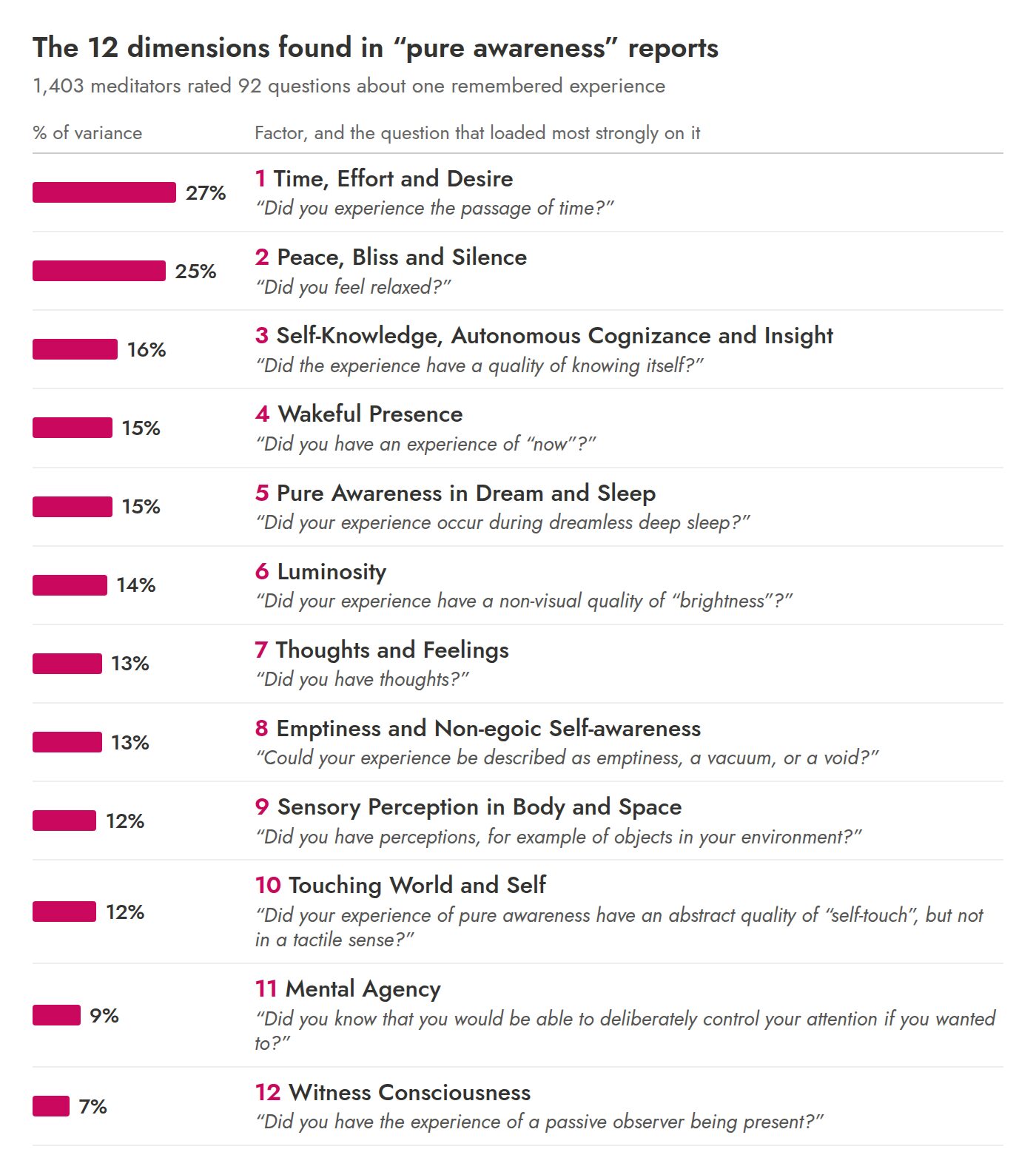
Several factors describe qualities that the contemplative literature has long attributed to pure awareness:
- Peace, Bliss and Silence: feeling relaxed, at peace, at ease and whole, with a subtle positive mood the questionnaire likened to an “invisible smile,” a deep, unbounded silence, and a sense that the state was “the natural state.”
- Wakeful Presence: an experience of “now” and “here,” being in the present moment, alert and awake, and “simply being.”
- Self-Knowledge, Autonomous Cognizance and Insight: an experience that seemed to know itself, a “cognizant” quality and a sense of insight, experienced as arising by itself rather than being something the meditator made.
- Emptiness and Non-egoic Self-awareness: emptiness or a void, “an emptiness that has awoken to itself,” a dissolving boundary between self and surroundings, and, loading negatively, a sense of self. In other words, the more these qualities were present, the less people reported a sense of self.
- Luminosity: non-visual qualities of “brightness” and “radiance,” and also visual brightness with the eyes closed.
- Touching World and Self: an abstract, non-physical sense of self-touch, or of the whole body touching and being touched by the world.
- Witness Consciousness: the experience of a passive, impersonal observer being present.
Others describe what was still going on during some of the reported experiences: a sense of time passing, effort and desire; thoughts, memories, plans and emotions; perceptions and body sensations; and the knowledge that one could still control one’s attention or think on purpose. The authors read the first of these as ordinary, effortful meditation, with “still a meditator and a goal state.” One more factor collected the questions about whether the experience happened in dreamless sleep or in a dream.
The paper’s chart of all 92 questions, sorted by their typical rating, shows what the experiences were usually like. At the top were feeling at ease, at peace, in the present moment, whole and relaxed, and “simply being.” Near the bottom were pain, effort, desire, planning, and the experience happening during sleep or dreams.
The factors also related to each other in a way that makes intuitive sense. Time, Effort and Desire was negatively correlated with Peace, Bliss and Silence (r = −0.40) and with Emptiness and Non-egoic Self-awareness (−0.30), and positively correlated with Thoughts and Feelings (0.31) and Sensory Perception (0.37). Experiences with more sense of effort and time tended to have less peace and emptiness, and more thoughts and perceptions.
How solid is this structure? The authors are open about its limits. Different standard rules for how many factors to keep gave answers ranging from 4 or 5 to 14. The authors chose 12 as a balance: fewer than 6 would blur distinctions they considered important, and 12 still had enough questions supporting each factor. Together the 12 factors explained 44% of the variation in people’s answers, which the authors call moderate, so much of what people reported isn’t captured. The factors’ internal consistency, measured with
Cronbach’s alpha
Cronbach’s alpha is a measure of how consistently a set of questionnaire items measures the same thing, based on how strongly people’s answers to them go together. It runs from 0 to 1; values of about 0.7 or higher are usually considered acceptable for research.
More on Wikipedia
Read more in the glossary
, ranged from 0.52 for the sleep factor to 0.82, and 9 of the 12 reached 0.70. When the authors tested a stricter version of the model, in which each question belongs to only one factor, the fit was poor, which the authors take to mean that many questions relate to more than one dimension. The authors present the 12 factors as a tentative model and describe their own interpretations of them as speculative:
The interpretations and connections we propose are predicated on the assumption that these factors or very similar ones may be reproduced in future studies, which is by no means guaranteed.
Miscellaneous Interesting Takeaways
Almost Everyone Who Answered Said They’d Had the Experience
Of those who answered the screening question, 91.5% said they had experienced pure awareness, and only 3.2% (78 people) said they didn’t understand the concept. Those who said yes were slightly more likely to be longer-term practitioners or German or Spanish speakers, and slightly less likely to be men, but each difference changed the likelihood by only a few percent. A survey about pure awareness, passed among committed meditators, presumably attracted people who felt it applied to them, so this figure says little about how common the experience is among meditators in general.
“The Simplest Kind of Conscious Experience”
One question asked: “Is the experience of pure awareness the simplest kind of conscious experience you know?” The median answer was 80 out of 100. The authors see this as support for the idea that pure awareness is a prime example of minimal experience, while cautioning that people’s sense of simplicity is not an objective measure, and that even simpler forms of experience may yet be found.
A Claim About Selfless Self-Awareness
The authors suggest that the self-knowing and emptiness factors provide “empirical evidence for a non-egoic, homunculus-free form of self-awareness”: awareness that knows itself without any sense of a person doing the knowing. What the data show more strictly is that many meditators describe their experience this way, and that these descriptions hang together statistically. The authors themselves point to a puzzle here: if an experience truly had no self in it, it is unclear how someone could later remember it as something that happened to them.
Luminosity and Touch Went Together
One connection the authors single out as intriguing: the Luminosity factor correlated with Touching World and Self (r = 0.31). They see no obvious reason in the experiences themselves why brightness or radiance should go with an abstract sense of touch, and suggest the two may share something in the brain.
A Built-In Consistency Check
The questionnaire contained two almost identical questions, asked at different points, about a non-visual quality of “radiance.” For about half the participants, the two answers were within 10 points of each other on the 100-point scale. The authors note that the two questions were not worded exactly alike and that people’s idea of the target experience may have shifted as they worked through 92 questions. They excluded no one on this basis.
The Study’s Limits
The authors list many limitations. There’s no guarantee that participants understood “pure awareness” as intended, and regular practitioners may have answered in the language and assumptions of their own tradition or teacher. Asking for an especially clear experience may have tilted the sample toward dramatic ones:
What can be remembered particularly clearly may often be the most impressive states, which may not necessarily be the most paradigmatic instances of “pure awareness.”
The reports were retrospective, sometimes about experiences that may have happened decades earlier, and memory for past mental states is unreliable. Because the survey was anonymous and IP addresses weren’t stored, nobody could verify who answered or rule out duplicate or fraudulent responses. More than 60% of responses were incomplete, a sign of heavy
self-selection bias
Self-selection bias arises when people decide for themselves whether to take part in a study, so those who do may differ from those who don’t in ways that affect the results. A survey advertised as being about the unwanted effects of meditation, for example, may draw more people who have had such effects, making them look more common than they are among meditators in general.
More on Wikipedia
Read more in the glossary
, and the sample, dominated by German speakers, is unlikely to represent meditators worldwide. There was no comparison group and no brain measurement. The participants also wrote 841 usable free-text descriptions of their experiences, which the authors plan to analyze separately.
Final Reflection
This study is one of the first attempts to measure pure awareness with a questionnaire in a large group of meditators, and the picture it paints is richer than a simple blank. The highest-rated features of what people described were peace, ease, wholeness and being fully present. Around them, people varied along dimensions such as self-knowing clarity, luminosity, a fading sense of self, and a sense of being witnessed. Some reports also included ordinary ingredients such as time, effort and thoughts, which suggests that what meditators call pure awareness often comes mixed with everyday experience rather than standing completely on its own.
The statistical model is admittedly rough: it explains less than half of the variation, fits only moderately, and its 12 dimensions were chosen partly on conceptual grounds. It needs testing in other samples before its factors can be trusted as the building blocks of this experience. Still, a map like this is what brain research on these states needs. An EEG and fMRI case study of one expert meditator relied on his own report that his awareness had become content-free, and a brain imaging study of nondual awareness relied on experienced meditators entering that state on request. Questionnaires like the MPE-92M could eventually help researchers check which kind of pure awareness a meditator is actually reporting.
Citation
Gamma, A., & Metzinger, T. (2021). The Minimal Phenomenal Experience questionnaire (MPE-92M): Towards a phenomenological profile of “pure awareness” experiences in meditators. PLoS ONE, 16(7), e0253694. 10.1371/journal.pone.0253694
Get the next summary by email
One or two new paper summaries every couple of weeks, sent to your inbox when they go up.
No spam, and you can unsubscribe at any time. Prefer a feed reader? Use the RSS feed.