
Background Information
Much of the time, attention seems to face one of two ways. Sometimes we are absorbed in the world around us: watching a film, catching a ball, reading a page. At other times we are lost in our own heads, replaying a conversation or planning tomorrow, and the room around us fades. The authors note that we can all relate to both experiences.
Brain imaging suggests the cortex has a similar split. One broad system, which the authors call extrinsic (others call it the
task-positive network
The task-positive network is a set of brain regions, including sensory, attention and parietal areas, that become more active when a person is engaged with an external, attention-demanding task. Its activity tends to rise when the default mode network’s falls, and vice versa, so the two are often described as anticorrelated or competing.
More on Wikipedia
Read more in the glossary
), takes in sensory areas and responds more when we deal with things outside us. The other, the intrinsic system, overlaps with the default mode network (
DMN
The default mode network (DMN) is a system of connected brain areas that show increased activity when a person is not focused on what is happening around them, such as during daydreaming and mind-wandering. It can also be active when the individual is thinking about others or themselves, remembering the past, and planning for the future.
More on Wikipedia
Read more in the glossary
): areas such as the
posterior cingulate cortex
The posterior cingulate cortex (PCC) is a region toward the back of the brain’s midline. It is a central hub of the default mode network and tends to be active during self-related thought and mind-wandering. Many meditation studies track PCC activity or connectivity as a window onto the DMN.
More on Wikipedia
Read more in the glossary
, the
precuneus
The precuneus is a region on the inner surface of the parietal lobe, toward the back of the brain’s midline, next to the posterior cingulate cortex. Together they form a core hub of the default mode network, and the precuneus is often active during self-related thinking, memory recall and imagining one’s own point of view.
More on Wikipedia
Read more in the glossary
, the
inferior parietal lobule
The inferior parietal lobule (IPL) is a region on the outer surface of the parietal lobe, toward the back and side of the head. It combines information from the senses and the body and is involved in attention, language, the sense of being the one who causes one’s own actions (agency), and telling oneself apart from others.
More on Wikipedia
Read more in the glossary
and the
medial prefrontal cortex
The medial prefrontal cortex (mPFC) is the part of the frontal lobes along the brain’s midline, just behind the forehead. It is a core part of the default mode network and is consistently active when people think about themselves, judge their own traits, or recall and plan events in their own lives.
More on Wikipedia
Read more in the glossary
. It responds more when we are not busy with a task, and it lights up when people think about themselves, recall the past or imagine the future. The paper’s abstract describes it as tied to experiences that are “internal and self-related.”
These two systems tend to see-saw. Their activity over time is usually anticorrelated: when one goes up, the other tends to go down, even when a person is lying still and doing nothing, or asleep. Many researchers read this as a kind of competition between the two. That raises the question this study asked: is the competition fixed, or can a person change it by how they hold their mind?
Meditation offered a way to test this. Earlier studies, the authors note, found that focused attention and open monitoring meditation, which direct attention to particular experiences, seemed to sharpen the split between the two systems. A study of Insight meditators is in the same family: default mode activity dropped during meditation. This team wanted to know whether every kind of meditation pushes in the same direction. They chose a contrasting practice,
nondual awareness
Nondual awareness is a style of meditation, found in Tibetan Buddhism and other contemplative traditions, that does not focus on any particular object or experience. Instead the meditator rests in awareness itself, without splitting experience into an observing subject and the things observed, or into inner and outer. It is usually described as effortless, in contrast with practices that deliberately direct attention.
More on Wikipedia
Read more in the glossary
(NDA), from Tibetan Buddhism.
In the paper’s description, focused attention and open monitoring are “constructed” states, built by deploying attention in particular ways and concerned with the content of experience. Nondual awareness is thought not to involve intentional effort. It rests on recognizing a “reflexive” awareness, regarded in the tradition as “unconstructed,” and is concerned with the context of experience rather than its contents. The authors also point out that Asian contemplative traditions have long described experience as split into subject and object, with inner and outer mental processes competing. Nondual practice, in the authors’ words, cultivates awareness “in which external and internal experience is integrated.”
What They Did
The researchers, at New York University, recruited 24 meditators experienced in the Tibetan Buddhist practices of nondual awareness, focused attention or both, chosen on their teachers’ recommendation from Buddhist centers around the US (16 men and 8 women, median age 50). Two fell asleep in the scanner and were dropped. Of the remaining 22, 14 did both meditations, 4 did only nondual awareness and 4 only focused attention, so 18 people contributed to each meditation. They had practiced for 8 to 33 years, an estimated 4,000 to 37,000 hours (average about 13,700), based on their reports of daily practice and an assumed 10 hours a day on retreat. Most had practiced only Tibetan Buddhism; seven also had some experience of other traditions, such as Zen or Taoism. There was no group of non-meditators.
Each person lay in an
fMRI
An fMRI (functional Magnetic Resonance Imaging) measures changes in blood flow related to neural activity in the brain, offering insights into brain function and activity patterns.
More on Wikipedia
Read more in the glossary
scanner with eyes open on a red dot for three eight-minute scans, in an order varied across participants. The instructions were:
- Fixation (no meditation): keep your gaze on the dot, “allow your mind to wander naturally,” and avoid any kind of meditation.
- Focused attention: keep a steady focus on the dot as the object of meditation, letting other thoughts go and gently returning when the mind wanders.
- Nondual awareness:
Rest in reflexive NDA, equally aware of inside and outside of your body, allowing experiences to arise and subside of their own accord.
Nondual meditators were also warned against common pitfalls: fixing attention only on outer or only on inner experience, or trying to keep the mind empty through effortful focus. Participants were given time to settle into each meditation before recording began, so that the scan caught the state itself rather than the effort of getting there.
A fourth scan showed short movie clips of faces, buildings, scenes and objects alternating with a plain gray screen. The team used it to find, in each person’s brain, 8 extrinsic
regions of interest
In brain imaging, a region of interest (ROI) is an area chosen in advance for testing, such as the amygdala or hippocampus, usually because earlier research points to it. Limiting the main test to one region means fewer statistical comparisons, so real effects there are easier to detect. The trade-off is that the test says nothing about the rest of the brain, so ROI studies often add a separate, exploratory whole-brain search.
More on Wikipedia
Read more in the glossary
that responded more to the movies (mostly visual areas, plus the superior parietal lobule) and 7 intrinsic regions that responded less (the posterior cingulate, two parts of the precuneus, the lateral parietal cortex on each side, the medial prefrontal cortex and a region of the right superior frontal gyrus). Because these regions were chosen from a separate scan, the main comparisons weren’t biased by how they were picked.
The main measure was
functional connectivity
Functional connectivity is the degree to which activity in different brain regions rises and falls together over time. It is usually measured with fMRI as the correlation between regions’ signals. It shows coordinated activity, not physical wiring. Researchers use it to see how brain networks such as the DMN communicate in different mental states.
More on Wikipedia
Read more in the glossary
. For each person and condition, the team averaged activity across all the extrinsic regions and across all the intrinsic regions, then asked how closely the two averages rose and fell together over the eight minutes. A correlation near −1 means the two systems move in strict opposition; near 0, they move independently.
One Big Result: Focused Attention Widened the Divide Between the Two Systems, and Nondual Awareness Narrowed It
In all three conditions the two systems were anticorrelated, as expected. But how strongly depended on what the meditators were doing. Compared with simply looking at the dot, the two systems were more opposed during focused attention and less opposed during nondual awareness. Both differences were statistically significant (p < 0.001 by standard tests, and p < 0.005 by a more cautious test that shuffles the timing of the signals).
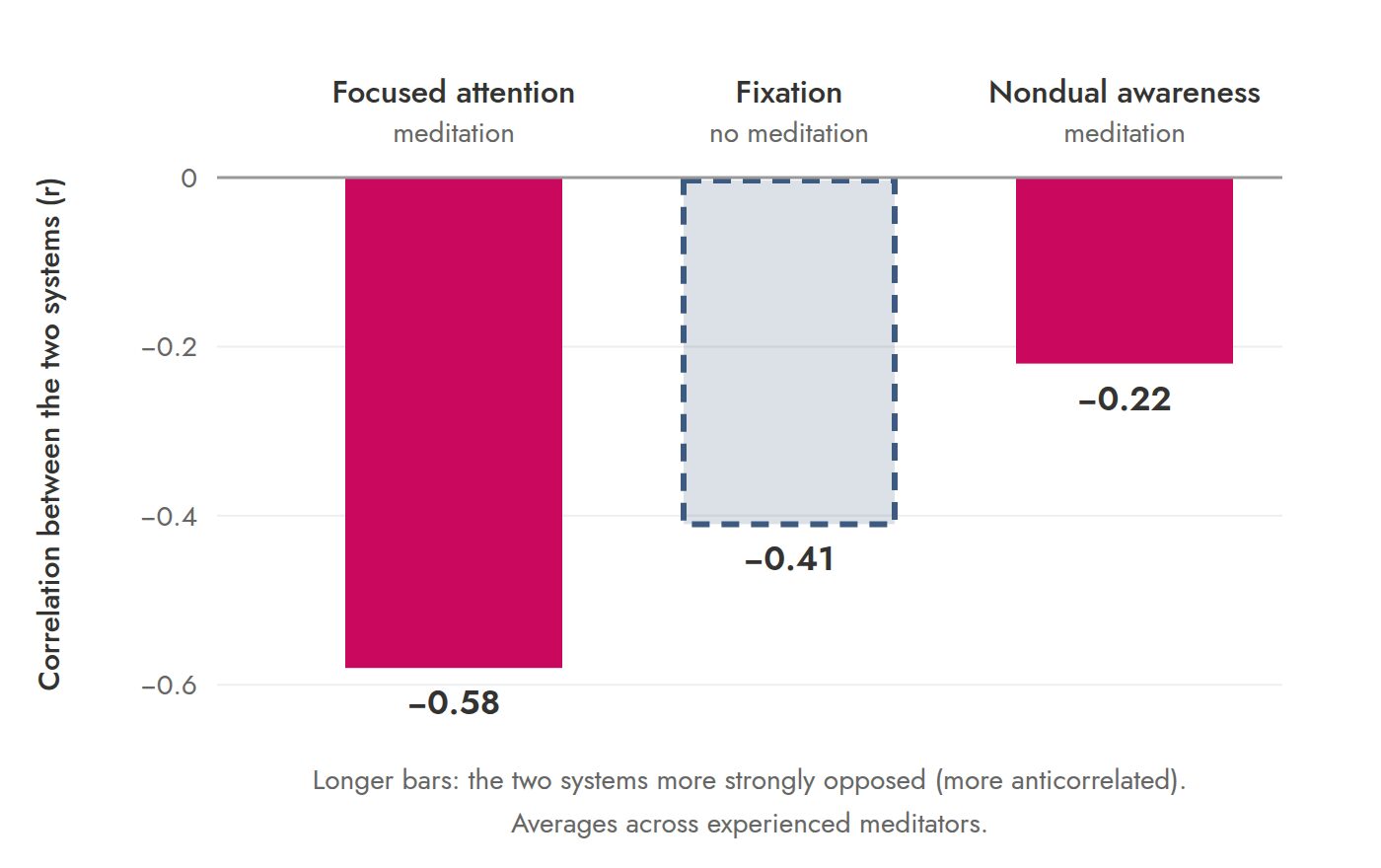
Focused attention replicated earlier reports. The new finding was that nondual awareness pushed the other way: the same meditators, in the same session, could make the two systems compete more or compete less, depending on the practice. The authors offer an interpretation, which they flag as speculation:
It is tempting to speculate that practicing a meditation that either focuses on, or monitors, external or internal experience (FA and OM), actively increases the competition between extrinsic and intrinsic systems, while practicing a meditation that cultivates awareness in which external and internal experience is integrated (NDA) decreases this competition.
The change was specific to how the two systems related to each other. When the team looked at pairs of regions within each system, the outward-facing regions stayed just as correlated with one another across all three conditions, and so did the inward-facing regions. The only hint of a difference was between the two meditations in the intrinsic system, which the authors describe as marginal (p = 0.07 by one test, below 0.05 by the other).
Note that nondual awareness weakened the opposition rather than removing it. At −0.22 on average, the two systems still tended to move in opposite directions.
Miscellaneous Interesting Takeaways
The Systems Didn’t Simply Get Louder or Quieter
A correlation can change because two signals coordinate differently, or because one of them becomes larger or smaller. The team checked how much activity fluctuated in each system and found no difference between the three conditions (all p values between 0.29 and 0.99). Intrinsic regions fluctuated more than extrinsic ones throughout. So the shift seems to be in how the systems interacted, not in how active either one was.
A Debated Processing Step, Applied Evenly
Before analysis, the team removed the brain-wide “global” signal, a common step that strips out fluctuations shared across the whole cortex, such as those caused by breathing, heart rate and head movement. Researchers debate whether this step can itself create some of the anticorrelation between the two systems. The authors acknowledge this and point out that the step was identical in all three conditions, so it can’t explain the differences between them. The global signal itself varied no more in one condition than another (p > 0.25), and it was, if anything, most variable during nondual awareness, where the anticorrelation was weakest. Still, the absolute values in the chart depend partly on this choice and are best read relative to each other.
What “Extrinsic” Meant Here
The extrinsic regions were picked by what responded to movie clips, so most were visual areas plus the superior parietal lobule. The frontal attention and control areas often grouped with the task-positive network, such as the
dorsolateral prefrontal cortex
The dorsolateral prefrontal cortex (dlPFC) is a region on the upper outer sides of the frontal lobes. It is a core part of the brain’s executive control network, supporting working memory, directing attention and regulating emotion. Stronger dlPFC activity and connectivity have been associated with lower pain, negative emotion and stress.
More on Wikipedia
Read more in the glossary
, weren’t among them. Findings about “the extrinsic system” here mostly concern visual and parietal cortex.
Different Practices, Different Brain States
The study adds to a picture, seen elsewhere on this site, in which meditations that sound alike are not alike in the brain. Practices aimed at letting go of the sense of self, such as experiencing the present without being “in the center” or dissolving the felt boundary between self and world, had their own signatures in brain rhythms. In a case study of the deepest absorption states, an expert meditator’s brain networks became less compartmentalized and more interconnected. The present study’s finding, that one practice drove the inward and outward systems apart and another let them work less against each other, points the same way: “meditation” is not one thing.
Final Reflection
This is a neat experiment. By asking the same people to switch between two practices with opposite aims, it shows that the see-saw between the brain’s outward- and inward-facing systems is not fixed. It can be tightened or loosened, in the same brain, within a single scanning session. That is a useful result on its own, whatever one thinks of the contemplative framing.
What it can’t show is just as important. Everyone tested was an experienced meditator, so there is no way to tell whether years of practice made this possible or whether anyone could do it with simple instructions; the authors suggest a follow-up with briefly trained novices. The samples were small (18 per meditation, 14 for the direct comparison of the two). And no one measured what the meditators experienced, beyond whether they stayed awake and said afterward that they could meditate. The authors are frank about this:
Perhaps the biggest challenge in studying the effects of meditation on cortical function is that it is very difficult to objectively determine how and to what extent each participant is meditating
That gap matters for the bigger claims. The discussion describes nondual awareness as a state in which outer and inner experience “are increasingly synergistic rather than competing,” and suggests the brain’s usual anticorrelation might mirror the everyday split between inner and outer experience. The brain data fit that idea, but with no measure of experience in the scanner they can’t confirm it. For the sense of self, the study offers an intriguing hint rather than an answer: in at least one form of practice, the brain systems linked to self-related thought and to the outside world became less opposed.
Citation
Josipovic, Z., Dinstein, I., Weber, J., & Heeger, D. J. (2012). Influence of meditation on anti-correlated networks in the brain. Frontiers in Human Neuroscience, 5, 183. 10.3389/fnhum.2011.00183
Get the next summary by email
One or two new paper summaries every couple of weeks, sent to your inbox when they go up.
No spam, and you can unsubscribe at any time. Prefer a feed reader? Use the RSS feed.