
Background Information
People who have had deep meditative, mystical or psychedelic experiences often say that time stopped or that space lost its edges. Scholars of mysticism have long counted “non-spatial and non-temporal” experience among its core features, and Buddhist and Vedic writings describe the deepest states of meditation as beyond time and space. Such accounts also often mention the body: its boundaries soften or it seems to expand or fade.
These experiences are hard to study, because they can’t be produced on demand in a laboratory. This study, from Bar-Ilan University and the Weizmann Institute in Israel, tried a different approach: ask long-term meditators who already know such states to bring them about deliberately, and record their brains while they do.
The authors had a specific hunch. Because altered time and space so often come with an altered sense of the body, they predicted that the brain activity behind them would show up in regions that handle bodily experience, including the
insula
The insula is a region of cortex folded deep inside each side of the brain. It helps represent the body’s internal state (interoception) and is involved in emotion, empathy and compassion. Its front part, the anterior insula, comes up often in meditation research.
More on Wikipedia
Read more in the glossary
, which represents the body’s internal state (
interoception
Interoception is the sense of the body’s internal state: feeling your heartbeat, breathing, hunger, warmth, tension and other sensations from inside the body. Interoceptive awareness is how much attention a person pays to these signals. Practices such as the body scan, which moves attention through the body part by part, aim to strengthen it.
More on Wikipedia
Read more in the glossary
) and has been linked to the sense of time.
They recorded with
MEG
Magnetoencephalography (MEG) records the tiny magnetic fields produced by electrical activity in the brain, using very sensitive sensors in a helmet-shaped device. Like EEG, it tracks brain activity millisecond by millisecond, but because magnetic fields pass through the skull with little distortion, it can usually locate where in the brain the activity comes from more accurately.
More on Wikipedia
Read more in the glossary
, which tracks brain activity millisecond by millisecond and splits it into frequency bands, and used
neurophenomenology
Neurophenomenology is a research approach that pairs detailed first-person reports of experience with measurements of brain activity, using each to help interpret the other. Proposed by neuroscientist Francisco Varela in the 1990s, it depends on participants who can observe and describe their experience precisely, which makes experienced meditators natural collaborators.
More on Wikipedia
Read more in the glossary
: the meditators’ own descriptions of what they experienced helped guide the brain analysis.
What They Did
The participants are the same people, recorded in the same visit, as a companion study on the sense of self, Dor-Ziderman et al., 2013. Sixteen meditators were recruited. Two were dropped because of severe tiredness and back pain, and two because they practiced other forms of meditation, leaving 12 who practiced mindfulness meditation within the Theravada Buddhist tradition (3 women; aged 31 to 64). The companion paper describes them all as practicing forms of
Vipassana
Vipassana is a form of Buddhist meditation focused on the cultivation of insight through moment-to-moment awareness of bodily sensations, thoughts, and emotions. It emphasizes non-reactivity and equanimity, helping practitioners observe mental and physical phenomena without attachment.
More on Wikipedia
Read more in the glossary
. They had meditated for an average of 16.5 years and an estimated 11,225 hours (about 1,300 to 29,000). There was no comparison group of non-meditators.
The visit involved seven MEG recording sessions, about two hours in the scanner. This paper reports the third and fourth sessions, called “Time” and “Space.” The “Self” session that followed is the one described in the companion paper. In each session the meditators, lying with eyes closed, were cued into three conditions, each held for three 30-second periods:
Time session
- Then (control): “Try to be in the near past (in the same place—the lab)”
- Now (baseline): “Try to be in the present moment”
- Timelessness (target): “Try to be outside time”
Space session
- There (control): “Try to be elsewhere (at the moment, with the experimenters outside the shielded MEG room)”
- Here (baseline): “Try to be here”
- Spacelessness (target): “Try not to be in the center of space”
The control conditions were there to rule out a simpler explanation. Trying to leave time or space might just mean remembering or imagining being somewhere else. If the target states showed the same brain pattern as recalling the recent past or imagining another room, that would be the likely explanation.
Before the sessions, everyone filled in Hood’s Mysticism Scale, a questionnaire about self-transcendent experiences. Their average score on its “timelessness and spacelessness” items was 4.47 out of 5, so all of them had been through such experiences before. Afterwards, over an intercom, they rated how successful and how steady each condition had been and described their experiences. The first author sorted those descriptions into categories, and the categories were accepted when at least three of five judges agreed.
The brain analysis compared each state with its baseline: Timelessness with Now, Spacelessness with Here, and likewise for the controls. The key question was where the two target comparisons overlapped, since a shared pattern would point to something common to leaving both time and space. One participant who described an
out-of-body experience
An out-of-body experience (OBE) is the feeling of being located outside one’s own physical body, often seeing it from above or from across the room. OBEs are reported in deep meditation, near-death experiences, sleep paralysis and some neurological conditions, and can be triggered by stimulating the temporoparietal junction, a region that helps place the sense of self in the body.
More on Wikipedia
Read more in the glossary
was set aside because that experience didn’t fit the others (more on this below), so the brain results come from 11 people.
One Big Result: Stepping Outside Time and Space Both Raised Theta Activity in Body-Related Regions
The present-moment baselines, Now and Here, didn’t differ from each other in any frequency band. Compared with them, both Timelessness and Spacelessness showed changes in only one band: more
theta
Theta waves are rhythmic electrical brain activity at roughly 4–8 cycles per second, recorded with EEG. While awake, they are linked to memory, focused attention and drowsiness, and meditation studies often report more theta over the front of the head during practice. In sleep, theta is common in light non-REM sleep and in REM sleep.
More on Wikipedia
Read more in the glossary
activity (4–8 Hz). This held after correcting for the many sensors tested, though the Timelessness result was only just significant (p = 0.049; for Spacelessness, p = 0.014).
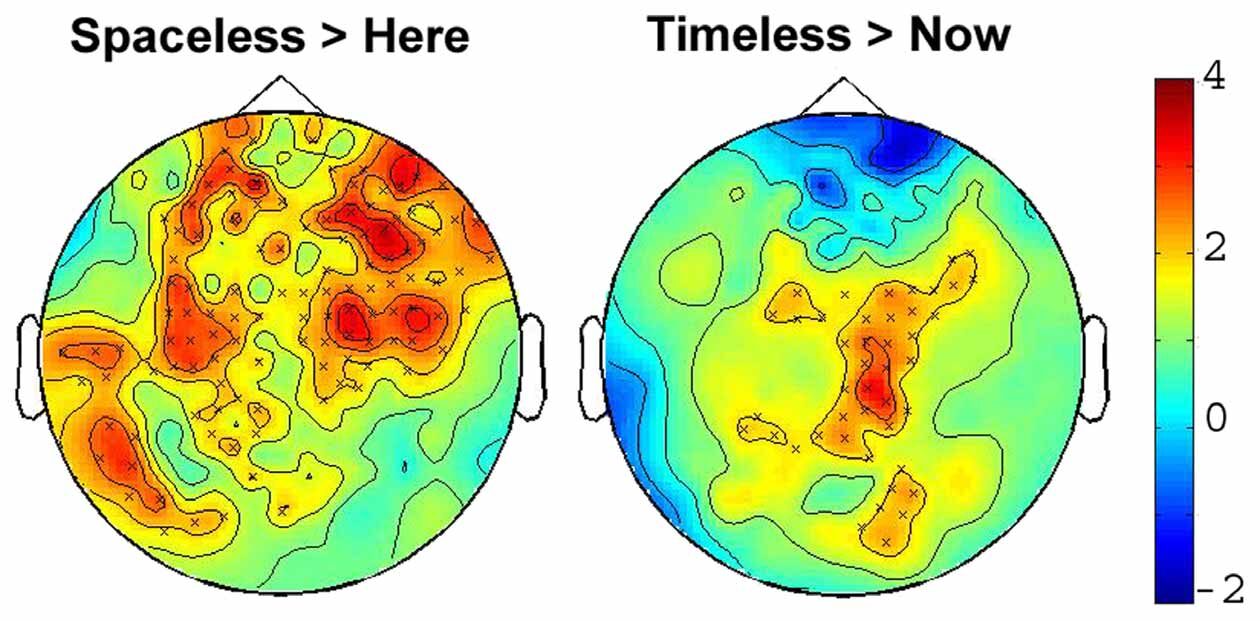
Each state had its own wide pattern. Timelessness drew mostly on the right side of the brain (88% of the active area), in regions earlier research links to timing, such as motor areas, the basal ganglia, thalamus and cerebellum, as well as the right insula. Spacelessness was spread across both sides, in regions tied to spatial processing and balance.
Where the two overlapped, theta was higher in four clusters: the
PCC
The posterior cingulate cortex (PCC) is a region toward the back of the brain’s midline. It is a central hub of the default mode network and tends to be active during self-related thought and mind-wandering. Many meditation studies track PCC activity or connectivity as a window onto the DMN.
More on Wikipedia
Read more in the glossary
and neighboring
precuneus
The precuneus is a region on the inner surface of the parietal lobe, toward the back of the brain’s midline, next to the posterior cingulate cortex. Together they form a core hub of the default mode network, and the precuneus is often active during self-related thinking, memory recall and imagining one’s own point of view.
More on Wikipedia
Read more in the glossary
on both sides of the brain’s midline, the back of the right superior temporal gyrus (part of the
TPJ
The temporoparietal junction (TPJ) is the area where the brain’s temporal and parietal lobes meet, toward the back and side of the head. It helps combine signals from the body and senses into a sense of where the self is, and it is central to theory of mind: working out what other people think and intend.
More on Wikipedia
Read more in the glossary
), and a midline part of the left
cerebellum
The cerebellum (“little brain”) is a densely packed structure at the back of the brain, beneath the main hemispheres. It is best known for coordinating movement and balance, using signals from the inner ear and the body, but it also contributes to timing, attention and other mental functions.
More on Wikipedia
Read more in the glossary
that handles balance signals. The authors argue that all four are involved in the felt sense of the body: the PCC and precuneus in representing the body, the TPJ in body-related self-processing and the first-person perspective (disruptions there are linked to out-of-body experiences), and this part of the cerebellum in balance.
The control states told a different story. Recalling the recent past and being “elsewhere” also raised theta, but their overlap fell in different places: the right posterior parietal lobe, two neighboring right frontal areas (the precentral and middle frontal gyri), and the precuneus, a network the authors link to memory and imagery. Within the precuneus, the control overlap sat higher than the target overlap, in a separate spot. The authors summarize:
To summarize, we show that an altered experience of time and space involves theta activity in regions related to a sense of the body.
This interpretation is reasonable but indirect. The study measured theta activity, not bodily experience; the link to the body comes from what these regions are known to do in other studies. And theta rose in the control states too, so it was the location of the increase, rather than the theta itself, that set the target states apart. The insula, central to the original hunch, showed theta in both target states, but in different spots, so it didn’t appear in the overlap.
Miscellaneous Interesting Takeaways
What the Meditators Described
The interviews are a rich part of the paper. Two broad themes emerged: the sense of time and space, and the sense of the body’s boundaries. Many reports describe the body expanding or fading rather than time or space alone. One participant described the Spacelessness condition like this:
I released the subject-object contrast, and then the center of space became endless, without a reference point in the middle. There was a sense of floating in a sea of being.
Others reported “a sense of spaciousness, boundlessness,” feeling “something wider than the body,” or losing “discrimination between different body parts.” Not everyone got there. Some described no change in the sense of time or of their bodily boundaries, and a few used deliberate strategies, such as “visualizing black” or “imagining that the body is un-real.” The meditators rated both target states as significantly less successful than being here and now.
Deeper Experiences, Different Body-Region Activity
Using the descriptions, the team split the 11 meditators into two groups: 5 who reported changes in both their sense of time and space and their bodily boundaries, and 6 who didn’t. The groups didn’t differ in age, years of practice or Mysticism Scale scores, and their success ratings were similar. Yet their brains differed: the group with the deeper changes had lower theta in the right TPJ cluster and higher theta in the cerebellum cluster.
The team then tested the insula on its own, as an anatomically defined
region of interest
In brain imaging, a region of interest (ROI) is an area chosen in advance for testing, such as the amygdala or hippocampus, usually because earlier research points to it. Limiting the main test to one region means fewer statistical comparisons, so real effects there are easier to detect. The trade-off is that the test says nothing about the rest of the brain, so ROI studies often add a separate, exploratory whole-brain search.
More on Wikipedia
Read more in the glossary
. After excluding two people with unusually high values, the deeper-change group (4 people) had lower insula theta than the others (5 people). These comparisons involve very small groups and are best read as leads for future studies.
The authors note that the ratings and the descriptions didn’t line up: some of the most experienced meditators rated their success lower than less experienced ones did. They suggest this reflects differences in self-criticism and expectations, and conclude that verbal reports are needed alongside numerical ratings.
The Out-of-Body Exception
One meditator had a different experience altogether: “The body stayed in bed but I saw myself from the corner of the room.” The body didn’t dissolve or expand; this meditator felt located outside it. Because this didn’t fit the scale running from ordinary to dissolved bodily boundaries, the authors set it aside. That person’s theta in the PCC and cerebellum clusters was much lower than the two groups’ averages, a pattern the authors find suggestive but which comes from a single case.
Two Meditators Aimed for Something Deeper
Two of the three people who rated their Timelessness success at zero came from the Burmese Mahasi school, whose map of insight stages culminates in “cuts” in consciousness called “fruition.” They had tried to reach that state in 30-second windows and failed. Once the researchers explained they weren’t expecting fruition, these two rated Spacelessness much higher (6 and 8).
A Note on the Mysticism Scores
The meditators’ average Mysticism Scale score (4.30) and timelessness-and-spacelessness score (4.47) were well above those of 191 religious participants in an earlier study (3.58 and 3.42). The authors read this as evidence that meditation practice raises the frequency of such experiences. Comparing this small, hand-picked group with a different study’s sample can’t show that practice caused the difference. People drawn to long-term meditation may differ in many ways.
Final Reflection
This study took on states that neuroscience had barely studied, and did it with care: control conditions for memory and imagination, detailed interviews and a rare group of practitioners who could produce the states on cue. Its main finding is that two different instructions, to leave time and to leave space, converged on more theta activity in a shared set of regions, which the authors argue are tied to the felt sense of the body.
The evidence is limited, and the authors say so plainly:
First, sample size was rather small after exclusion of five of the participants. The 11 remaining participants were further divided into two sub-groups, resulting in very small group sizes. Second, the study design was fixed, as opposed to counterbalanced, between the Time and Space sessions.
The fixed order went further than the two sessions. The paper’s protocol figure shows the conditions in the same order in both sessions, with the “outside” condition always last. Because theta with closed eyes also accompanies deep relaxation and drowsiness, as the authors note, that order makes it harder to rule out that simply coming later in each session played a part. There was no group of non-meditators, the states were held for about a minute and a half each, and whether people reached them rests on their own reports, which varied widely. The authors call all of their results “preliminary.” The paper’s conclusion that these states “do not rely on memory and mental imagery” is also stronger than the design allows; the control conditions show only that the overlap differed from that of recalling and imagining, and some participants described imagery-based strategies.
Read alongside its companion study, where letting go of the sense of self went with less beta activity, the paper sketches a picture in which different aspects of deep meditative experience may run on different brain rhythms. It is an early map, built from a dozen people, of experiences that meditators have described for centuries.
Citation
Berkovich-Ohana, A., Dor-Ziderman, Y., Glicksohn, J., & Goldstein, A. (2013). Alterations in the sense of time, space, and body in the mindfulness-trained brain: A neurophenomenologically-guided MEG study. Frontiers in Psychology, 4, 912. 10.3389/fpsyg.2013.00912
Get the next summary by email
One or two new paper summaries every couple of weeks, sent to your inbox when they go up.
No spam, and you can unsubscribe at any time. Prefer a feed reader? Use the RSS feed.