
Background Information
Most brain research on consciousness compares being conscious with not being conscious: waking versus deep sleep, or before and during general anesthesia. The trouble is that waking experience is always full of something, such as sights, sounds, thoughts, feelings, a sense of being “me.” That makes it hard to separate the brain activity behind being aware at all from the activity behind whatever one happens to be aware of.
Contemplative traditions offer another route. Many describe a meditative state in which awareness remains but its usual contents fall away. The authors call it content-free awareness and define it this way:
A state of ‘content-free awareness’ (CFA) represents a non-pathological, wakeful state of consciousness free of the complexity of normal wakeful states, i.e., the bare state of being aware or consciousness as such.
If such a state exists, and philosophers and neuroscientists still debate whether it does, the brain activity that goes with it might point toward the minimum the brain needs for conscious experience. For questions about the self, it matters for another reason: people who report the state describe the sense of self disappearing along with everything else.
The researchers are running a larger study of meditation states with reduced content in expert and novice meditators. This short report describes one session from it, recorded at the University Medical Center in Freiburg, Germany, in which, unexpectedly, an expert said he had reached the state while being scanned. The authors note that such experiences are rare and can’t be produced on demand, which is why they published a single case.
What They Did
The meditator, identified as TB, was 56 and a former physician. He teaches in the Karma Kagyü tradition of Tibetan Buddhism. He had meditated for 40 years, lived as an ordained monk in a retreat center for 21 of them (teaching there for 17), had meditated up to 12 hours a day for ten years, and had an estimated 50,000-plus hours of formal practice. He is also listed among the paper’s authors, credited with helping the team understand the states of consciousness under study.
He lay in a 3-tesla MRI scanner with his eyes closed while the team recorded brain activity two ways at once: a 256-channel
EEG
An electroencephalogram (EEG) is a recording of brain activity. During this painless test, small sensors are attached to the scalp to pick up the electrical signals produced by the brain.
More on Wikipedia
Read more in the glossary
cap measured the brain’s electrical rhythms, and a very fast form of
fMRI
An fMRI (functional Magnetic Resonance Imaging) measures changes in blood flow related to neural activity in the brain, offering insights into brain function and activity patterns.
More on Wikipedia
Read more in the glossary
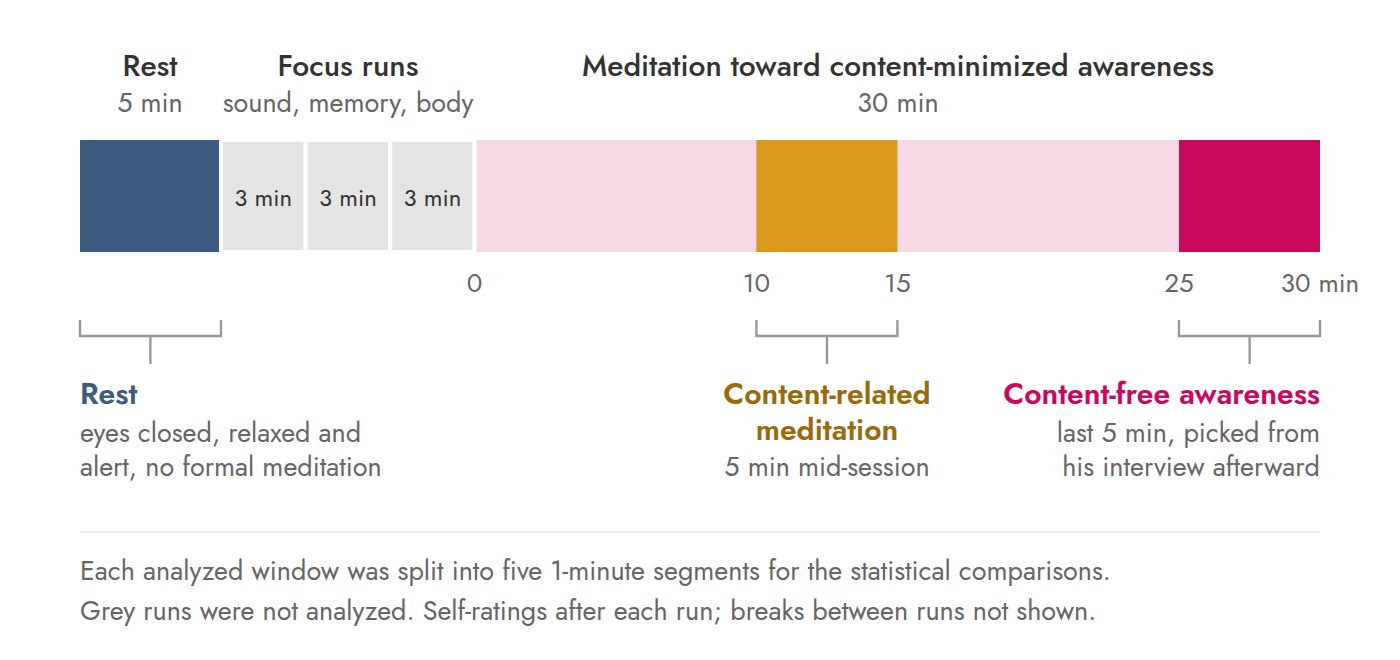
captured a whole-brain image every tenth of a second. Heart and breathing sensors ran throughout. The session had five recording runs:
- Five minutes of rest, relaxed and alert but not meditating.
- Three 3-minute runs focusing on the scanner’s sound, on a memory and on bodily sensations (these weren’t analyzed in this report).
- Thirty minutes of formal meditation aiming for awareness with as little content as possible.
After each part, he rated how much mental content, bodily self-awareness and sense of time and space he had experienced, on a 10-step scale. For the rest period he gave 8, 8 and 9. For the 30-minute meditation as a whole, he gave 2, 2 and 1.
In a detailed interview afterward, he said the meditation deepened gradually and reached its deepest point in the last few minutes. There, he described what tradition calls the “ground state of awakening”:
The former Buddhist monk described his experience as a ‘clear, aware openness’ without any thoughts, physical, or sensory perception and even without any sense of self, time, and space – a state traditionally called the ‘ground state of awakening.’
He reported no awareness even of the loud scanner noise, yet was sure he had stayed awake, and the EEG showed no signs of sleep. He came out feeling deeply refreshed, which he recognized from past experience as a sign of a very deep “non-dual” state, without the usual split between a perceiving subject and its objects. In the terms of his tradition, he described it as basic
mahāmudrā
Mahāmudrā (Sanskrit for “great seal”) is a body of teachings and meditation practices in Tibetan Buddhism, central to the Kagyü school. It aims at direct recognition of the nature of the mind itself, often described as open, clear awareness that is not centered on a self.
More on Wikipedia
Read more in the glossary
.
Based on that account, the team treated the last five minutes of the meditation as content-free awareness. For comparison, they took the five minutes of rest and five minutes from the middle of the earlier meditation (minutes 11 to 15), which they called content-related meditation. Each five-minute window was cut into one-minute segments.
From the EEG, they measured two rhythms often linked to meditation:
theta
Theta waves are rhythmic electrical brain activity at roughly 4–8 cycles per second, recorded with EEG. While awake, they are linked to memory, focused attention and drowsiness, and meditation studies often report more theta over the front of the head during practice. In sleep, theta is common in light non-REM sleep and in REM sleep.
More on Wikipedia
Read more in the glossary
(4–8 Hz) and
alpha
Alpha waves are rhythmic electrical brain activity at roughly 8–13 cycles per second, recorded with EEG. They are often strongest when the eyes are closed and the mind is relaxed, and are thought to help filter out or hold back information as part of top-down control. Meditation studies have reported both increases and decreases in alpha, depending on the practice.
More on Wikipedia
Read more in the glossary
(8–12 Hz). From the fMRI, they measured
functional connectivity
Functional connectivity is the degree to which activity in different brain regions rises and falls together over time. It is usually measured with fMRI as the correlation between regions’ signals. It shows coordinated activity, not physical wiring. Researchers use it to see how brain networks such as the DMN communicate in different mental states.
More on Wikipedia
Read more in the glossary
between the hubs of two networks: the default mode network (
DMN
The default mode network (DMN) is a system of connected brain areas that show increased activity when a person is not focused on what is happening around them, such as during daydreaming and mind-wandering. It can also be active when the individual is thinking about others or themselves, remembering the past, and planning for the future.
More on Wikipedia
Read more in the glossary
), tied to self-related thought and mind wandering, and the
dorsal attention network
The dorsal attention network (DAN) is a set of brain regions toward the top of the parietal lobes (around the intraparietal sulcus) and in the frontal lobes (the frontal eye fields). It directs attention voluntarily toward whatever a person has chosen to focus on, especially in the outside world, and its activity tends to rise and fall in opposition to the default mode network.
More on Wikipedia
Read more in the glossary
, which steers attention toward chosen targets, especially outside the body. They also measured connectivity between the attention network and the primary auditory cortex, the first stop for sound in the brain, to see whether hearing had been “switched off.”
One Big Result: The Final Minutes Showed More Theta and Weaker Links in the Back of the Default Mode Network
Compared with the earlier meditation as well as with rest, the final five minutes stood out for a strong rise in theta and weaker connections within the DMN, along with a further decoupling of attention from hearing (below).
Theta rose sharply. At the three electrodes with the biggest changes from rest, two over the front of the head (F6 and F7) and one at the top-back midline (Pz), theta power was higher during content-free awareness than during rest or the earlier meditation (all significant after correcting for
multiple comparisons
The multiple comparisons problem arises when researchers run many statistical tests at once. Each test has a small chance of a false positive, so across thousands of tests, such as one for every point in a brain scan, some “significant” results will turn up by chance alone. Corrections raise the bar for significance to keep the overall false-positive rate down, at the cost of making small real effects harder to detect.
More on Wikipedia
Read more in the glossary
). The earlier meditation had raised theta only at Pz.
The back of the DMN loosened. Connectivity between the
posterior cingulate cortex
The posterior cingulate cortex (PCC) is a region toward the back of the brain’s midline. It is a central hub of the default mode network and tends to be active during self-related thought and mind-wandering. Many meditation studies track PCC activity or connectivity as a window onto the DMN.
More on Wikipedia
Read more in the glossary
, a central DMN hub, and the
inferior parietal lobule
The inferior parietal lobule (IPL) is a region on the outer surface of the parietal lobe, toward the back and side of the head. It combines information from the senses and the body and is involved in attention, language, the sense of being the one who causes one’s own actions (agency), and telling oneself apart from others.
More on Wikipedia
Read more in the glossary
on each side was lower during content-free awareness than during rest or the earlier meditation. Against the earlier meditation, the DMN’s links to the
medial prefrontal cortex
The medial prefrontal cortex (mPFC) is the part of the frontal lobes along the brain’s midline, just behind the forehead. It is a core part of the default mode network and is consistently active when people think about themselves, judge their own traits, or recall and plan events in their own lives.
More on Wikipedia
Read more in the glossary
and between the left and right parietal lobules also weakened. During the earlier meditation, by contrast, some of these back-of-the-brain DMN links had strengthened compared with rest.
Minute by minute across the rest period and the meditation, the more right-frontal theta rose, the more connectivity in the right side of the back of the DMN fell. The authors connect this to the self:
Taken together, the disconnections inside the posterior part of the DMN, which we found to be negatively correlated with the increase in frontal theta power may be the main neural correlate of the cessation of internal mentation, as well as the dissolution of self-consciousness, and may also contribute to the experienced state of space- and timelessness.
They point out that the interplay between the PCC and the parietal lobules has been linked before to meditative experiences of non-dual awareness and of selflessness, and that psychedelic experiences in which self, space and time dissolve also involve reduced activity and connectivity in the back of the DMN. In another single-expert study on this site, beta rhythms faded mostly in right-side parietal areas as a meditator dissolved the boundary between self and world, though that study used a different technique and measure.
Other changes separated the final minutes from rest but were already partly under way during the earlier meditation:
- Alpha fell dramatically, at a frontal-midline electrode (FCz) and at two over the sides and back of the head (P7 and P8). Most of this drop had already happened by mid-meditation; only the frontal decrease continued significantly into the final minutes.
- The attention network became more tightly connected within itself compared with rest, including links between its parietal and frontal hubs.
- The attention network decoupled from auditory cortex. Its links with auditory cortex, mostly on the left, were weaker than at rest, and its links with auditory cortex on both sides were weaker than during the earlier meditation. That fits his report of not hearing the scanner, and these links also weakened as frontal theta rose.
The authors read the pattern as a deliberate, top-down attentional state that shuts out both incoming senses and inner thinking, a kind of “disconnected consciousness.” They argue that falling alpha has been linked to the mind’s disconnection from the senses in REM sleep and ketamine anesthesia, and that, unlike in those states, content-free awareness lacks inner mental activity too.
Miscellaneous Interesting Takeaways
Several Predictions Didn’t Hold
The team had expected connectivity to decrease within the attention network, the usual opposition between the attention network and the DMN to weaken, and alpha to rise. Instead, attention-network connectivity increased, the relationship between the two networks didn’t change, and alpha fell. Most meditation studies report more alpha, especially over the front of the head. The authors note that decreases have been reported mainly in experienced meditators from Hindu yoga and Tibetan Buddhist traditions, and caution that one person’s specific state can’t simply be compared with averages pooled across many studies.
The jhana case study of another expert also found weaker alpha during deep absorption, but in that meditator theta weakened too, whereas here it rose. The practices, the states and the analyses all differed, so the two cases don’t settle what these rhythms mean.
His Brain Was Unusual Even at Rest
In most people, alpha is strongest over the back of the head. TB’s resting alpha was strongest over the front, with little at the back. The authors suggest this could be a lasting effect of decades of training, though with one person and no comparison group there’s no way to test that here.
Heart Rate Slowed, but Breathing Sped Up
His heart rate fell gradually through the meditation and reached its lowest point in the final minutes. His
heart rate variability
Heart rate variability (HRV) is the natural variation in time between one heartbeat and the next, calculated from an ECG or a pulse sensor. Higher HRV at rest usually reflects a stronger parasympathetic (“rest and digest”) influence on the heart and is generally linked to relaxation, better health and more flexible responses to stress.
More on Wikipedia
Read more in the glossary
, breathing rate and estimated oxygen use all sat below resting levels for much of the meditation, then began climbing after about 20 minutes and ended significantly above rest. A slower heart with more variable beats points to deep physical relaxation; faster breathing and more oxygen use look more like arousal. The authors note that Tibetan Buddhist and tantric yoga traditions emphasize an “awake” quality of mind, and that arousal responses have been found in such meditators before.
A Rare State, Caught by Chance
This wasn’t a planned test of content-free awareness. The meditator was asked to aim for minimal content, and only afterward said he had reached a content-free state. The authors call the data “serendipitous” and argue that exploratory single cases can generate new hypotheses, pointing to how much neuroscience learned from famous neurological patients such as H.M. and Phineas Gage.
Final Reflection
This report offers a rare look at a state that meditation traditions have described for centuries but that science has hardly been able to examine: awareness reported as empty of thoughts, sensations, time, space and self. In one highly experienced practitioner, that state came with rising theta, falling alpha, an attention network pulling tighter while it decoupled from hearing, and a loosening in the back of the default mode network, the network most often tied to self-related thinking.
The limits are substantial, and the authors acknowledge several of them. There was one person, one session and one episode. The content-free period was defined by his account afterward, not by any independent marker, and he is also a co-author. Each condition contributed only five consecutive one-minute segments from the same recording, so the statistics show that those minutes differed from the others, not that the pattern would recur in another sitting or another person. The content-free minutes also came last, after more than 40 minutes in the scanner, so anything that drifts over time could play a part. And only two EEG frequency bands were examined.
The authors are clear that a single case can’t prove anything, but it can suggest where to look. Their proposal, that a self-less, content-free awareness depends on stable top-down attention disconnecting the brain from both the senses and inner thought, is now a hypothesis for group studies to test.
Citation
Winter, U., LeVan, P., Borghardt, T. L., Akin, B., Wittmann, M., Leyens, Y., & Schmidt, S. (2020). Content-free awareness: EEG-fcMRI correlates of consciousness as such in an expert meditator. Frontiers in Psychology, 10, 3064. 10.3389/fpsyg.2019.03064
Get the next summary by email
One or two new paper summaries every couple of weeks, sent to your inbox when they go up.
No spam, and you can unsubscribe at any time. Prefer a feed reader? Use the RSS feed.