
Background Information
Ordinarily, experience has an edge that we rarely notice. There is “me,” here, in this body, and there is the world, out there. Philosophers distinguish this basic, pre-reflective sense of self (being the one who is located somewhere, who acts and who perceives from a point of view) from the reflective self, the “me” you think about when you consider your personality, memories or appearance. The pre-reflective self draws a subtle but constant line between ourselves and everything else, which the authors call the sense of boundaries.
Because that line is always there, it is hard to study. Researchers usually learn about it when it breaks down, in conditions such as
depersonalization
Depersonalization is a dissociative experience characterized by feelings of detachment from one’s self, body, or mental processes. Individuals experiencing depersonalization may feel like an outside observer of their thoughts, feelings, or body, or they may feel as if they’re in a dream. It can occur as a temporary response to stress, as a symptom of psychiatric disorders, or as a feature of certain meditation experiences.
More on Wikipedia
Read more in the glossary
, or by disrupting one piece of it at a time with illusions and lab tasks. Some meditators, though, report being able to dissolve the whole boundary from the inside, on purpose.
This study comes from a team in Israel that has spent about a decade studying such states with
neurophenomenology
Neurophenomenology is a research approach that pairs detailed first-person reports of experience with measurements of brain activity, using each to help interpret the other. Proposed by neuroscientist Francisco Varela in the 1990s, it depends on participants who can observe and describe their experience precisely, which makes experienced meditators natural collaborators.
More on Wikipedia
Read more in the glossary
, which pairs careful first-person reports with brain recordings. In an earlier MEG study, 12 long-term Vipassana meditators produced a “selfless” state on cue. A 2016 follow-up centered on one meditator with about 40 years of practice who dissolved his sense of boundaries in steps. Interviews with him identified aspects of experience, such as the sense of agency, location and time, that faded as the boundary dissolved.
As the authors acknowledge, those detailed descriptions came from a single highly adept practitioner. This paper reports the interviews from a larger project designed to test whether the picture holds up in a bigger group. The project also recorded brain activity with
MEG
Magnetoencephalography (MEG) records the tiny magnetic fields produced by electrical activity in the brain, using very sensitive sensors in a helmet-shaped device. Like EEG, it tracks brain activity millisecond by millisecond, but because magnetic fields pass through the skull with little distortion, it can usually locate where in the brain the activity comes from more accurately.
More on Wikipedia
Read more in the glossary
, but those results were to be reported separately.
The team asked several questions. Are there distinct types of “dissolvers,” or does dissolution unfold along one scale of depth? Which mental moves help the boundary dissolve? Is dissolving it pleasant or frightening? And do people with more practice go deeper?
What They Did
Between November 2018 and November 2019, 46 meditators took part: 19 women and 27 men, aged 26 to 72 (average about 40). They were a convenience sample, mostly recruited through Tovana, the Israel Insight Society, and each had practiced for at least a year and attended at least one retreat. Their experience varied enormously, from 115 to 24,837 lifetime hours of practice (an average of 3,832). People with active psychiatric disorders or on psychiatric medication were excluded. All were white, and 33 had an academic education.
First, everyone took a three-week training course designed for the study: a full-day workshop, two afternoon sessions and recorded instructions for daily practice at home. It was designed and led by Stephen Fulder, a teacher in the Theravada Buddhist tradition who founded Tovana. He is also the paper’s sixth author, and he was the expert meditator in the 2016 single-case study. The paper doesn’t say whether he was among the 46. The course taught a range of techniques for changing the sense of boundaries and let participants choose the ones that worked for them. Its aim was to make clear, stable states more likely in the lab and to give participants and researchers a shared language for describing them.
Then each participant lay in an MEG scanner at Bar-Ilan University and, in two blocks, alternated between two states in 1-minute periods, five periods per block:
- With boundaries: keeping a clear sense of the body’s boundaries.
- Without boundaries: dissolving the sense of boundaries, defined broadly.
After each block they rated how well and how steadily they had held each state, on a 3-point scale. Several other tasks and questionnaires followed.
Directly after the scanner session, each participant was interviewed for 21 to 57 minutes (33 on average), using the micro-phenomenological interview method. Rather than asking people what they believe about meditation, this method guides them back to a specific moment, here the moment they heard the cue to enter a state, and asks them to describe in detail what they actually experienced next, repeating their own words back as questions (“When X happened, what else did you feel?”). The questions were loosely organized around the aspects of experience found in the team’s earlier work but left room for new ones. Almost all interviews were in Hebrew. In total they ran to over 25 hours and more than 120,000 words.
The analysis had three stages. The researchers coded a random sample of 20 interviews by theme, grouped similar descriptions into types (subcategories) within each aspect of experience, and then classified every participant in each state. Each interview was classified by two independent raters out of a team of four, which included the first and last authors. The raters also gave each person an overall rating of how deeply their boundaries had dissolved. The types within each category turned out to form a natural order, from the ordinary sense of self to the most dissolved, so the researchers could also turn them into numbers and analyze them statistically.
One Big Result: Dissolution Varied Along One Scale of Depth, and Letting Go Went With the Deepest States
Keeping boundaries looked much the same for most people. Most did a
body scan
The body scan is a meditation practice in which attention is moved slowly through the body, part by part, noticing whatever sensations are present without trying to change them. It is a core exercise in mindfulness programs such as MBSR.
More on Wikipedia
Read more in the glossary
(38 of 46), actively steering narrowly focused attention around the body (33). Sensations felt prominent and distinct (42), and most people felt located within the body (41).
Dissolving boundaries produced far more variety. The team sorted the experiences into six categories:
-
Sense of agency
The sense of agency is the feeling of being the one who initiates and controls an action, such as moving your hand or, in meditation, directing your attention. It is usually so constant that it goes unnoticed, but it can weaken or disappear in some psychiatric and neurological conditions and in some deep meditative states.
More on Wikipedia
Read more in the glossary : from actively and continuously working to dissolve the boundary (14), through occasional effort (19), to a passive state with little or no sense of doing anything (15). - Attention: almost everyone described their attention widening. For some it stayed active and roving (22), for others still and receptive (21), and for 9 it lost any defined form. Some of the 9 described states without any clear content at all.
- Sense of location: the most common experience was still being centered in the body, but with a less defined edge and a strong sense of the space around it (21). Others felt they were expanding into vast space (14). For 12 people, the sense of self and of being located anywhere became faint or vanished. “There’s no me and there’s no bed. It all melts together,” said one (M11).
- Body sensations: they became indistinct for 20 and imperceptible for 18, while 8 still felt them clearly.
- Observer perspective: half (23) still felt like an observer of their experience, 16 felt that perspective waver at times, and 7 described
non-dual awareness
Nondual awareness is a style of meditation, found in Tibetan Buddhism and other contemplative traditions, that does not focus on any particular object or experience. Instead the meditator rests in awareness itself, without splitting experience into an observing subject and the things observed, or into inner and outer. It is usually described as effortless, in contrast with practices that deliberately direct attention.
More on Wikipedia
Read more in the glossary , in which there was no longer any observer at all. - Feeling tone: most found dissolving the boundary pleasant (29), and 7 described it as neutral, 3 as mixed and 7 as negative.
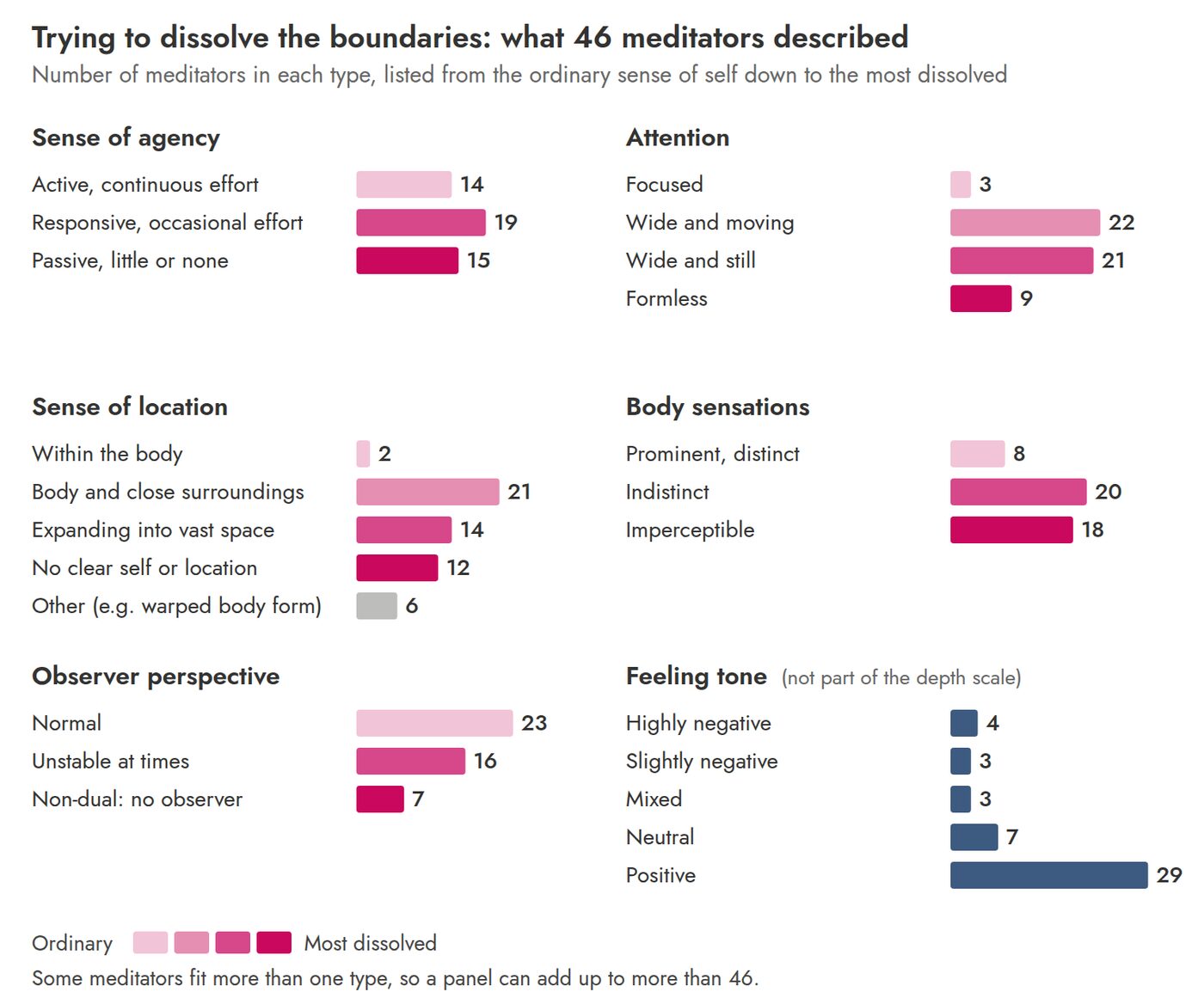
So were there different kinds of dissolvers, say some who lost the body and others who lost the observer? Mostly not. Five of the six categories rose and fell together: people who reported a passive sense of agency also tended to report formless attention, a fading sense of location and body, and a wavering observer. The correlations between them ranged from 0.50 to 0.80. A
principal component analysis
Principal component analysis (PCA) is a statistical method that looks for a small number of underlying dimensions that account for most of the variation in many related measurements. If several measures rise and fall together, PCA can show that they largely reflect one shared factor.
More on Wikipedia
Read more in the glossary
found that one dimension accounted for 58% of the variation across all six categories. Feeling tone was the exception: how pleasant the experience was had little to do with how deep it went.
The researchers added up the five categories into a single depth score. When they asked which techniques predicted a higher score, relaxing, releasing and becoming passive stood out, followed by turning attention outwards to the room and beyond. Relaxing and letting go was also the most common technique (29 people), ahead of imagination (21), such as picturing the open sky, and turning attention outwards (15). Participants generally described their techniques as creating the conditions for dissolution rather than doing the dissolving. As one put it (M28):
There’s effort in letting go. It’s… it’s funny to say that. There’s a sense of giving up on the holding on. But then there’s no need for more effort—you just give up.
In a network analysis, sense of agency had the strongest links to the other categories, which the authors read as a sign that it was central to driving the rest of the dissolution. Their interpretation is that attention normally does the work of organizing experience into “me here” and “world there”:
Based on all the evidence provided above, we suggest that by coming to complete rest, attention ceases to perform its organizational role in structuring awareness, thereby promoting dissolution of the SB and of experiential form in general.
(SB is the sense of boundaries.) There was one notable exception: an expert practitioner reached a deep dissolution with narrowly focused attention, possibly through extremely stable, single-pointed concentration on his breath.
Some caution is needed. The depth score correlated very strongly (0.91) with the raters’ overall impression of depth, which the authors take as evidence that the five categories capture dissolution well. But the same raters made both judgments from the same transcripts, and the overall rating drew partly on the same features, so a close match is not surprising. The link between techniques and depth comes from a statistical model whose estimates appear only in a figure. And because people chose their own techniques, it shows which techniques went with deeper states, not that a technique caused them.
Miscellaneous Interesting Takeaways
Holding the Boundary Turned the Body Into an Object
The team had expected that keeping a clear sense of boundaries would heighten the ordinary embodied sense of self. It didn’t, quite. Most participants took “boundaries” to mean the edges of the body, so they scanned their sensations. As a result, the body was experienced more as an object being observed, while the self felt like an observer narrowly located in the head, the chest or wherever attention happened to be. The authors conclude that the sense of a boundary around the self is not simply the boundary of the body, and that their original contrast between the two states was “overly simplistic.”
Two Routes to Losing the Observer
When the researchers looked at which categories were linked once all the others were taken into account, the loss of an observer perspective connected to two separate clusters. One combined a fading sense of location and body; the other, a passive sense of agency and formless attention. After accounting for the other categories, the two hubs, location and agency, were even negatively related. The authors suggest there may be two routes to dissolution: an active one, driven by expanding into space, and a passive, formless one. That is a hypothesis for their brain analyses, not a settled finding.
Usually Pleasant, Occasionally Frightening
Dissolving the boundary was experienced as more positive than keeping it (a statistically clear difference). Some found keeping boundaries pleasant, a feeling of familiarity and control (13 people), but slightly more found it unpleasant (14), describing it as constraining or slightly claustrophobic. Dissolving was pleasant for most, but 4 people felt strong fear related to losing control. “I felt my heart pounding as if I’m in a dramatic moment of my life,” said one (M7). The authors note that emotions were generally described as more intense in the dissolved state.
They connect this to the catalogue of meditation-related difficulties collected by Lindahl and colleagues, and to the similarity between these states and
depersonalization
Depersonalization is a dissociative experience characterized by feelings of detachment from one’s self, body, or mental processes. Individuals experiencing depersonalization may feel like an outside observer of their thoughts, feelings, or body, or they may feel as if they’re in a dream. It can occur as a temporary response to stress, as a symptom of psychiatric disorders, or as a feature of certain meditation experiences.
More on Wikipedia
Read more in the glossary
, which, as Castillo argued, can feel calm or distressing depending on how it is understood. They also flag a risk in the very technique that worked best: deep states reached by letting go of attention and effort “may also destabilize
meta-awareness
Meta-awareness is awareness of what the mind is doing as it happens: noticing that you are having a thought, feeling an emotion or have drifted into mind wandering, rather than simply being caught up in it. It is a form of metacognition. Mindfulness practices train it directly, for example each time a meditator notices the mind has wandered and brings attention back.
More on Wikipedia
Read more in the glossary
,” the ability to notice what the mind is doing. They call for more research on what training and support make dissolution experiences wholesome rather than harmful. The study found no sign that more practice made dissolution more pleasant.
More Practice Went With Deeper Dissolution, But Only as a Correlation
People with more lifetime hours of practice rated their dissolved state as more stable (a correlation of 0.60), and had higher depth scores, with a more passive sense of agency, more formless attention and more change in their observer perspective. These correlations are reported as strong, but their sizes appear only in a figure. Practice hours were estimated by the participants themselves, and people who practice more may differ in other ways. The authors are careful here:
While strong associations with lifetime meditative practice are suggestive, the results call for future longitudinal studies investigating causality of practice and moderating factors (e.g., intensity and type of practice), as well as mediating effects on adverse experiences, wellbeing, insight, and social connection.
Can Experience Be Coded Reliably?
The two raters agreed moderately to substantially, with an average kappa of 0.69 (ranging from 0.49 to 0.79 across categories), significantly better than chance (see
inter-rater reliability
Inter-rater reliability is how closely two or more people agree when they independently rate or classify the same material, such as interview transcripts. Measures such as Cohen’s kappa correct for the agreement expected by chance: 0 means chance-level agreement and 1 perfect agreement.
More on Wikipedia
Read more in the glossary
). The sense of ownership, which featured in the team’s earlier work, was dropped: descriptions of it lacked subtlety and could not be classified reliably, often because they were couched in Buddhist jargon. That is a useful reminder that what meditators say about their experience is shaped by the language their tradition gives them.
Final Reflection
This is, as the authors say, the largest study of its kind, and it is a careful one. The interviews are detailed, the classification was checked by independent raters, and the coded data are publicly available. It turns a phenomenon usually described in poetry or doctrine into something with structure: an ordered set of changes in agency, attention, location, body and perspective that tend to move together, with letting go of effort at the deep end.
It also extends the team’s earlier work in a useful direction. The 2016 study rested on one exceptional meditator. This one shows that dozens of meditators, most with far less experience, after brief targeted training, could describe some loosening of the boundary on demand, and some described it disappearing altogether. Four of the aspects found in the earlier interviews (agency, location, observer perspective and body sensations) turned up again, along with two new ones: attention and feeling tone.
The limits are those of the design. The participants volunteered, came mostly from one Insight meditation community, and were trained for three weeks specifically to produce these states, so this says little about what happens in everyday practice. Their descriptions were recalled after a long lab session, in interviews partly structured around categories the team expected, and then classified by the team itself. The authors tried to reduce pressure to perform, but participants knew what the study was looking for (see
demand characteristics
Demand characteristics are cues in an experiment that hint at what the researchers expect, which can lead participants to behave the way they think they are supposed to rather than how they normally would. Researchers reduce them by disguising the study’s purpose, measuring behavior unobtrusively, or using comparison conditions that seem just as plausible.
More on Wikipedia
Read more in the glossary
). There was no comparison group, and everyone did both states, so the study can’t say how unusual these experiences are or what causes them. Its value is as a careful map of what meditators report, and as a guide to the brain analyses that the team said would follow.
Citation
Nave, O., Trautwein, F.-M., Ataria, Y., Dor-Ziderman, Y., Schweitzer, Y., Fulder, S., & Berkovich-Ohana, A. (2021). Self-boundary dissolution in meditation: A phenomenological investigation. Brain Sciences, 11(6), 819. 10.3390/brainsci11060819
Get the next summary by email
One or two new paper summaries every couple of weeks, sent to your inbox when they go up.
No spam, and you can unsubscribe at any time. Prefer a feed reader? Use the RSS feed.