
Background Information
Psychotherapy, positive psychology and contemplative practices such as meditation all try to make people feel and function better. Each field has its own vocabulary, measures and favorite outcomes. Cortland Dahl, Christine Wilson-Mendenhall and Richard Davidson, of the Center for Healthy Minds at the University of Wisconsin–Madison, argue that what these fields lack is a shared map of which parts of well-being can actually be changed by training, and how.
This paper is their attempt at that map. It is not a new study: there are no participants and no new data. It is a review that proposes a framework and gathers evidence from well-being research, cognitive and affective neuroscience and clinical psychology to support it. Its central move is to treat well-being as something learned, more like a set of skills than a fixed trait. In the authors’ words, the four dimensions they propose
can be likened to skills, and the cultivation of well-being to building a repertoire of skills.
The framework builds on an earlier paper by Dahl, Antoine Lutz and Davidson that sorted meditation practices into families by the mental processes they train. Davidson’s lab is also behind several studies summarized on this site, including the gamma-wave recordings of long-term meditators and a trial in which two weeks of compassion training made people more generous, both of which the paper cites.
What They Did
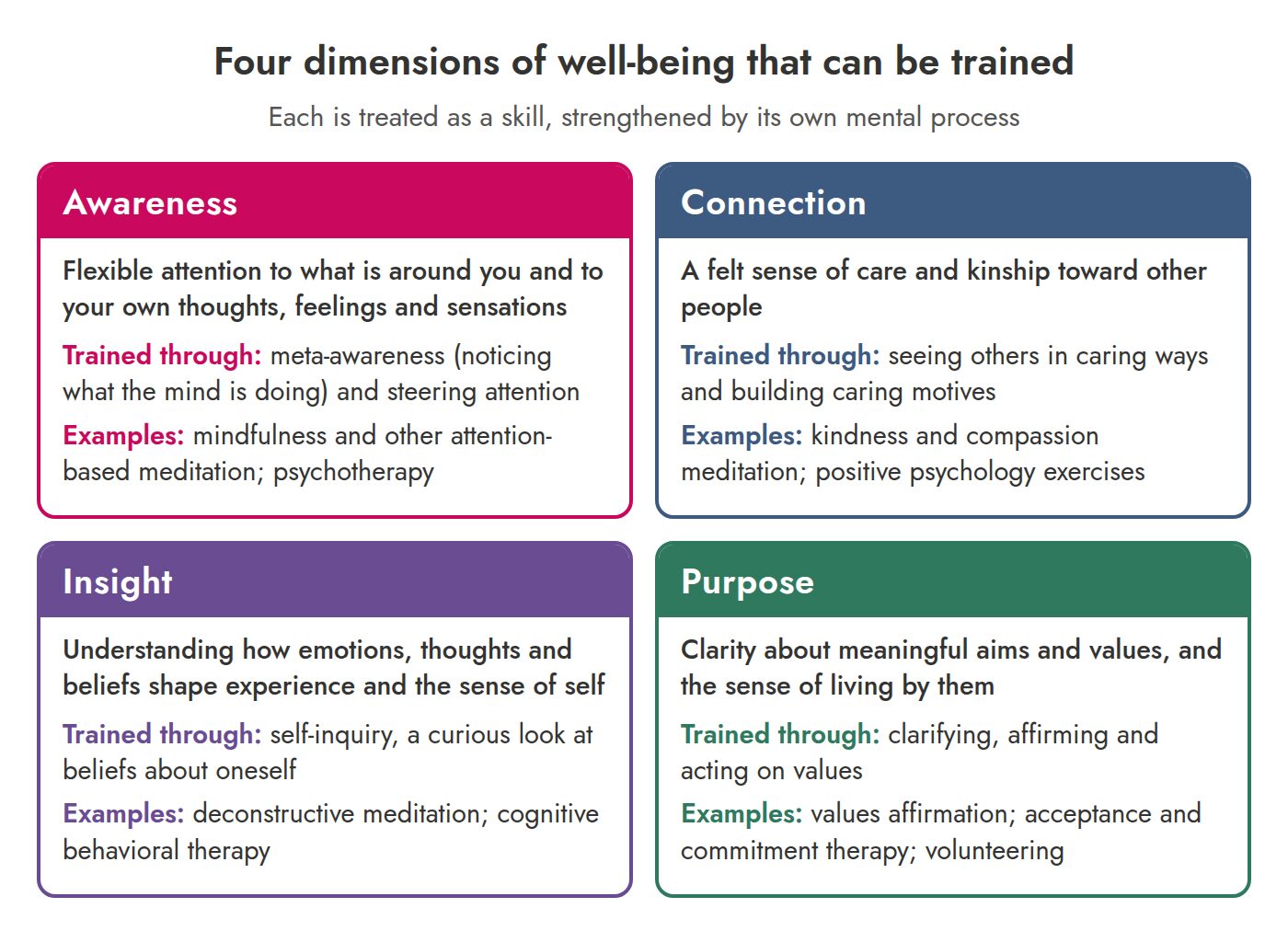
The authors propose four dimensions of well-being: awareness, connection, insight and purpose. For each, they define it, name the mental process through which it can be strengthened, review evidence that it matters for well-being, summarize what is known about its basis in the brain and body, and then present evidence that it changes with training. Examples of programs that target each dimension are listed in a supplementary table.
This is a narrative review. The authors don’t say how they chose the studies they cite, don’t rate their quality and don’t pool their results. That is normal for a paper whose aim is to propose a framework, but it means the paper shows the kind of evidence behind each dimension rather than weighing all of it. Meditation is only one route among several: the paper draws as much on psychotherapy, values exercises and volunteering as on meditation.
One Big Result: Well-Being Can Be Trained, Through Four Partly Separate Skills
The paper’s central claim is that awareness, connection, insight and purpose are each central to well-being, each rests on partly separate brain circuits, and each can be strengthened through deliberate practice. How well the cited evidence supports that claim differs from one dimension to the next.
Awareness
Awareness here means a heightened, flexible attentiveness both to the world and to inner cues such as bodily sensations, thoughts and emotions. It can be trained through
meta-awareness
Meta-awareness is awareness of what the mind is doing as it happens: noticing that you are having a thought, feeling an emotion or have drifted into mind wandering, rather than simply being caught up in it. It is a form of metacognition. Mindfulness practices train it directly, for example each time a meditator notices the mind has wandered and brings attention back.
More on Wikipedia
Read more in the glossary
(noticing what the mind is doing as it happens, such as realizing you have been “on autopilot”) and through steering attention.
The authors cite the smartphone study that found people’s minds wandering about 47% of their waking life, with lower well-being when they did. Distraction has also been linked to stress, anxiety, ADHD symptoms and depression, and to biological markers such as cortisol and shorter telomeres, though the authors note that a third factor, such as perceived stress, may explain these links. In the brain, becoming aware of one’s thoughts engages lateral parts of the prefrontal cortex that belong to the
central executive network
The central executive network (also called the frontoparietal control network) is a set of brain regions in the lateral prefrontal and parietal cortex, including the dorsolateral prefrontal cortex. It is active during demanding, goal-directed tasks, supporting working memory, directing attention and regulating emotion, and it tends to work in opposition to the default mode network.
More on Wikipedia
Read more in the glossary
, and failures to notice distraction are linked to less activity in one part of it, the
dorsolateral prefrontal cortex (dlPFC)
The dorsolateral prefrontal cortex (dlPFC) is a region on the upper outer sides of the frontal lobes. It is a core part of the brain’s executive control network, supporting working memory, directing attention and regulating emotion. Stronger dlPFC activity and connectivity have been associated with lower pain, negative emotion and stress.
More on Wikipedia
Read more in the glossary
.
For training, the evidence includes a randomized trial in which two weeks of mindfulness classes improved working memory and GRE scores in students prone to distraction, with less
mind wandering
Mind wandering is the spontaneous shift of attention away from a current task or external environment to internally generated thoughts, memories, or fantasies. This common cognitive process is associated with default mode network activation and has been extensively studied in relation to meditation practices, which often aim to reduce mind wandering.
More on Wikipedia
Read more in the glossary
helping to explain the gains, and a three-month retreat that sharpened visual perception. Meta-analyses, such as one of 47 trials of meditation programs, link mindfulness training to lower stress, anxiety and depression. The authors also say the evidence on attention is mixed: some studies, including a trial from Davidson’s own lab comparing
MBSR
Mindfulness-Based Stress Reduction (MBSR) is a program designed to help individuals cope with stress, pain, and illness. Developed by Jon Kabat-Zinn in the 1970s, it combines meditation and yoga to promote awareness and stress management. The eight-week program teaches participants to focus on the present moment non-judgmentally, enhancing their ability to manage difficulties.
More on Wikipedia
Read more in the glossary
with an
active control
An active control group is a comparison group that takes part in a different program designed to be just as engaging as the one being tested. In meditation research, it might involve exercise, music, or education classes with the same time commitment, teachers, and expectations of benefit. Comparing against an active control helps separate the effects of meditation itself from the general effects of joining a course.
More on Wikipedia
Read more in the glossary
program, found no change in sustained attention, and the field has important methodological limitations.
Connection
Connection means a felt sense of care and kinship toward other people, including people outside one’s own circle. The authors argue it can be strengthened by habitually seeing others in prosocial ways, for instance noticing what you share with a stranger, and by building motives oriented toward others’ well-being.
The evidence that relationships matter for well-being is broad. Social relationships predict health better than various biological and economic factors, and a Gallup World Poll of more than one million people in 150 countries found generosity, measured by charitable giving, to be one of the most robust predictors of life satisfaction. In the brain, the authors contrast empathy, which can bring distress and activity in pain-related regions, with compassion, which engages reward-related regions linked to positive emotion and feelings of connection.
Training evidence comes mainly from kindness-based meditation, such as
loving-kindness meditation
Loving-kindness meditation (mettā in Pali) is a Buddhist practice of deliberately cultivating warm, unconditional goodwill. Practitioners silently repeat wishes such as “may you be happy” or picture a person, usually starting with themselves or someone close and then extending the wishes to acquaintances, strangers, difficult people and all beings. It is one of the four brahmaviharas.
More on Wikipedia
Read more in the glossary
and compassion practice, and from positive psychology exercises. A
meta-analysis
A meta-analysis statistically combines the results of many earlier studies on the same question. Pooling the data can estimate an overall effect more precisely than any single study and show whether results agree across studies. Its conclusions are only as good as the studies it includes and how similar they are.
More on Wikipedia
Read more in the glossary
of kindness-based meditation found decreases in depression, anxiety and distress and increases in positive emotion and well-being, and such practices have increased feelings of social connection and helping behavior. Davidson’s lab found that compassion training increased generosity, in step with stronger connectivity between the dlPFC and a reward region, the ventral striatum. But the authors flag concerns about methodological rigor here, citing a meta-analysis titled “The limited prosocial effects of meditation” and another finding that positive psychology effects are “much smaller than previously reported.” Early findings that kindness meditation reduced implicit bias toward marginalized groups still need replication and longer follow-up.
Insight
Insight means self-knowledge about how emotions, thoughts and beliefs shape one’s experience, especially one’s sense of self: for example, seeing that an anxious prediction is driven by memories and self-critical thoughts rather than simply accepting it as reality. It is trained through self-inquiry, a curious, deliberate investigation of one’s self-related beliefs.
The authors acknowledge that insight “does not figure prominently in scientific models of well-being,” though it is central to contemplative traditions and psychotherapy. They point to research on “self-concept clarity,” a clear and stable sense of who one is, which is linked to steadier day-to-day mood and self-esteem and may help explain how stress and childhood adversity affect well-being and mental health. Self-reflection cuts both ways, though: curious, distanced self-inquiry goes with better well-being, while automatic, self-critical rumination goes with depression. In the brain, the authors note there is no single network uniquely devoted to the self. The ongoing personal narrative is linked to midline regions of the
default mode network (DMN)
The default mode network (DMN) is a system of connected brain areas that show increased activity when a person is not focused on what is happening around them, such as during daydreaming and mind-wandering. It can also be active when the individual is thinking about others or themselves, remembering the past, and planning for the future.
More on Wikipedia
Read more in the glossary
, such as the
medial prefrontal cortex (mPFC)
The medial prefrontal cortex (mPFC) is the part of the frontal lobes along the brain’s midline, just behind the forehead. It is a core part of the default mode network and is consistently active when people think about themselves, judge their own traits, or recall and plan events in their own lives.
More on Wikipedia
Read more in the glossary
, while ruminative self-reflection activates the DMN more broadly.
This is where the meditation evidence is thinnest, and the authors say so plainly: research on deconstructive meditation, which they call an important insight-based strategy, “is limited.” Most of the training evidence comes from psychotherapy.
Cognitive behavioral therapy (CBT)
Cognitive behavioral therapy (CBT) is a structured, usually short-term talk therapy that helps people notice and change unhelpful patterns of thinking and behavior. It is one of the most thoroughly tested psychological treatments and a first-line option for depression, anxiety disorders and many other conditions.
More on Wikipedia
Read more in the glossary
, which helps people identify and replace maladaptive beliefs about themselves, reduces stress, depression and anxiety. The main meditation evidence comes from the ReSource Project, a large training study in which a module the authors class as deconstructive meditation (the Perspective module) improved flexible emotion regulation and
theory of mind
Theory of mind is the ability to work out what another person thinks, believes or intends. It is also called mentalizing or cognitive perspective-taking. It is usually distinguished from empathy, which involves sharing another person’s feelings rather than reasoning about their thoughts.
More on Wikipedia
Read more in the glossary
and changed emotional self-concepts (another ReSource paper found that different modules thickened different parts of the cortex). The rest comes mostly from single-subject studies of expert meditators who can reduce their self-focus at will, with lower DMN activity, and from research suggesting that long-term practice may bring lasting changes in the DMN. The authors also note that moments of insight in problem-solving come with bursts of
gamma
Gamma brain waves are a type of brainwave pattern that oscillate at approximately 25 to 100 Hz. Gamma waves are associated with states of heightened perception, problem-solving, and consciousness. Gamma waves play a crucial role in cognitive functioning, including memory, and information processing, and are thought to integrate thoughts and information from different parts of the brain.
More on Wikipedia
Read more in the glossary
activity, as seen in long-term meditators. That parallel is suggestive at most.
Purpose
Purpose means clarity about personally meaningful aims and values, together with the sense that one can live by them. A teacher might aim to help every child learn, a life aim rarely fully achieved, and embody that aim through values such as patience and kindness in specific moments.
A strong sense of purpose is associated with more physical activity, fewer strokes and cardiovascular events, lower risk of death and even better financial health. Higher purpose predicted lower allostatic load (the wear and tear of chronic stress) 10 years later. In a study from Davidson’s lab, higher purpose went with better emotional recovery two years later, measured by a smaller startle reflex after negative images. These are associations from observational studies, which can’t show that purpose causes the better outcomes.
The training evidence comes mostly from programs other than meditation.
Acceptance and commitment therapy (ACT)
Acceptance and commitment therapy (ACT) is a form of psychotherapy that combines mindfulness and acceptance with values-based action. Rather than trying to change or get rid of difficult thoughts and feelings, people learn to notice and make room for them, clarify what matters to them, and commit to acting on those values.
More on Wikipedia
Read more in the glossary
, which combines acceptance with values-based practice, has helped people with chronic pain. Affirming personal values has reduced distress, depression and the
cortisol
Cortisol is a hormone released by the adrenal glands, especially in response to stress. It mobilizes energy and helps regulate the immune system. Because it can be measured in saliva, researchers often use it to gauge how strongly someone reacts to a stressful task, such as timed mental arithmetic. Levels also follow a daily rhythm, so studies try to test everyone at the same time of day.
More on Wikipedia
Read more in the glossary
response to stress. A brief exercise giving students a purpose for learning beyond themselves improved learning outcomes, and volunteering programs have buffered age-related decline in brain function in at-risk older adults.
Miscellaneous Interesting Takeaways
The Authors Are Candid About What Isn’t Known
The paper’s conclusion opens with its boldest line: “there is overwhelming evidence that well-being can be learned.” The same paragraph then lists what is missing:
Nevertheless, while it is clear that the four dimensions of well-being in our framework can be cultivated, we know relatively little about the most effective ways to go about training them, and whether it is best to train each dimension in isolation or to target more than one dimension through multidimensional interventions.
They add that the links between these components of well-being and later outcomes such as physical and mental health “remain elusive,” that whether the brain circuits involved actually cause changes in well-being “has hardly been studied,” and that people probably differ in what works for them. They imagine a “precision-medicine” approach that matches training to the individual. The evidence the paper itself reviews suggests that this confidence fits some dimensions better than others. For insight in particular, the authors themselves describe the meditation research as limited.
Well-Being Is Mostly Measured by Asking People
The authors note that measurement has barely moved beyond questionnaires:
Although self-report measures across all four domains are abundant, there are few valid and reliable behavioral measures.
They suggest smartphones and passive sensors could help, along with experience sampling, which prompts people at random moments in daily life. That is the method behind the wandering-mind study and a study that tracked mind wandering from the lab into everyday life. They also point out that well-being research participants, and researchers, often don’t reflect the racial, socioeconomic and cultural diversity of the population, so little is known about how context shapes what works.
Different Practices May Train Different Things
The framework implies that a single label like “meditation” hides real differences. The authors cite a meta-analysis of brain-imaging studies in which focused attention meditation went with reduced activity in parts of the DMN while open monitoring meditation did not. They suggest the first may reduce mind wandering while the second may let it continue with awareness. Different practices may therefore train different dimensions, though the authors also note overlap: compassion training, for example, also engages the central executive network that awareness training strengthens.
Competing Interests
The paper’s competing interest statement says that Davidson is the founder and president of Healthy Minds Innovations, Inc., a nonprofit associated with the Center for Healthy Minds, and serves on its board. Dahl serves as its chief contemplative officer, and Wilson-Mendenhall has consulted for it. Among the studies cited for improvements in well-being is a randomized trial of a self-guided smartphone meditation app whose title names three of the four dimensions: “Awareness, connection, and insight.” That doesn’t make the evidence wrong, and most of it comes from other groups, but readers should know the authors have a stake in programs built on these ideas. The work was funded by a National Center for Complementary and Alternative Medicine grant to Davidson.
Final Reflection
This paper doesn’t show that meditation makes people flourish. Its contribution is a vocabulary: it separates well-being into four skills, names the mental process that trains each, and collects the evidence for each in one place. That makes it easier to ask sharper questions, such as which practice trains which skill, for whom, and for how long.
Read that way, the framework is most useful as a guide to what is known and what isn’t. The evidence that meditation helps is strongest for attention-based and kindness-based training, mostly on self-reported stress and mood, and, as the 47-trial review found, the effects are often modest. For insight, the meditation evidence is still thin, and for purpose it comes mostly from programs other than meditation. The authors describe the framework as “a starting point” rather than a final model, which is the right way to read it.
Citation
Dahl, C. J., Wilson-Mendenhall, C. D., & Davidson, R. J. (2020). The plasticity of well-being: A training-based framework for the cultivation of human flourishing. Proceedings of the National Academy of Sciences, 117(51), 32197–32206. 10.1073/pnas.2014859117
Get the next summary by email
One or two new paper summaries every couple of weeks, sent to your inbox when they go up.
No spam, and you can unsubscribe at any time. Prefer a feed reader? Use the RSS feed.