
Background Information
Mindfulness courses are no longer just for patients. They are offered to students, employees, teachers, nurses, new parents and anyone in the community who wants to feel less stressed. The authors note that in the USA twice as many people practice mindfulness for wellness as to treat a specific health condition, and that mindfulness courses are often promoted “as the go-to universal tool to reduce stress and increase well-being, accessible to anyone, anywhere”.
Many trials have tested such courses, and many reviews have summarized them. But those reviews often mixed
randomized controlled trials
A Randomized Controlled Trial is a scientific study design that randomly assigns participants to either an experimental group receiving an intervention or a control group, allowing researchers to measure the true effect of the intervention while minimizing bias.
More on Wikipedia
Read more in the glossary
with weaker designs, mixed people with and without mental health conditions, or pooled comparisons with “doing nothing” together with comparisons against other activities. Julieta Galante and colleagues, led from the University of Cambridge, set out to do a comprehensive review of randomized trials only, in people who had not been selected for any illness, and to keep those comparisons apart.
Their question: 1 to 6 months after a course ends, do mindfulness-based programs improve anxiety, depression, psychological distress or mental well-being, compared with no intervention or with other interventions?
What They Did
The team registered a detailed plan in advance, developed with members of the public and professionals. They searched 13 databases up to August 2020, with no restrictions on language or country, and included unpublished work such as theses. A trial qualified if it:
- randomly assigned adults living in the community, who had not been selected for any clinical condition (courses aimed at particular groups, such as carers or medical interns, were included);
- taught an established, in-person, group-based mindfulness program led by a teacher, with at least four 1-hour sessions or the equivalent. Online courses were left out as different enough to need their own review;
- compared it with a control group and measured at least one outcome of interest with a validated questionnaire.
That gave 136 trials with 11,605 participants, run between 1997 and 2020 in 29 countries. Almost half were in North America, mainly the USA. The median trial had 60 participants, and on average 77% were women.
mbsr
Mindfulness-Based Stress Reduction (MBSR) is a program designed to help individuals cope with stress, pain, and illness. Developed by Jon Kabat-Zinn in the 1970s, it combines meditation and yoga to promote awareness and stress management. The eight-week program teaches participants to focus on the present moment non-judgmentally, enhancing their ability to manage difficulties.
More on Wikipedia
Read more in the glossary
was the most common program (32% of trials), and the most common addition to the mindfulness practice was physical activity (44% of trials). Courses ran from 4 to 30 hours of teaching, 16 on average. About half the trials used “universal” courses open to anyone. Others targeted groups at higher risk, such as healthcare workers, carers, teachers and pregnant women, or people who were already stressed.
The team sorted the comparison groups into three kinds:
- Passive controls: no intervention or a
wait-list
A wait-list control group is a comparison group that receives the program being studied only after the study period, so participants who are waiting can be compared with those already taking part. It controls for the passage of time and repeated testing, but not for the attention, expectations and setting that come with taking part in any program, which an active control group can address.
More on Wikipedia
Read more in the glossary . These made up 71% of trials. - Nonspecific
active controls
An active control group is a comparison group that takes part in a different program designed to be just as engaging as the one being tested. In meditation research, it might involve exercise, music, or education classes with the same time commitment, teachers, and expectations of benefit. Comparing against an active control helps separate the effects of meditation itself from the general effects of joining a course.
More on Wikipedia
Read more in the glossary : activities that give people time and attention without being expected to improve mental health, such as reading groups, nutrition classes or lifestyle education. - Specific active controls: activities designed to improve the same outcomes, such as exercise programs, progressive muscle relaxation, yoga or cognitive behavioral therapy courses.
This grouping follows earlier reviews, including the Goyal et al. 2014 review of meditation programs in people with medical or psychiatric conditions.
Two researchers independently rated every trial with the Cochrane risk-of-bias tool (RoB 2), and the team graded their confidence in each pooled result with
GRADE
GRADE (Grading of Recommendations Assessment, Development and Evaluation) is a widely used system for rating how much confidence to place in a body of evidence. Reviewers rate each finding as high, moderate, low or very low certainty, downgrading it for problems such as risk of bias in the studies, inconsistent results, imprecise estimates, indirect evidence and signs that unfavorable results went unpublished. Low certainty means the true effect may be substantially different from the estimate.
More on Wikipedia
Read more in the glossary
. Results were combined in a multivariate
meta-analysis
A meta-analysis statistically combines the results of many earlier studies on the same question. Pooling the data can estimate an overall effect more precisely than any single study and show whether results agree across studies. Its conclusions are only as good as the studies it includes and how similar they are.
More on Wikipedia
Read more in the glossary
, which analyzes the four outcomes together, as a standardized
effect size
Effect size is a statistical concept that quantifies the magnitude or strength of a relationship, difference, or intervention outcome. Unlike p-values which only indicate statistical significance, effect sizes measure how meaningful a result is in practical terms. Common measures include Cohen’s d (standardized mean difference), correlation coefficients (r), and odds ratios. In meditation research, effect sizes help quantify the practical impact of different meditation practices on psychological or physiological outcomes.
More on Wikipedia
Read more in the glossary
(here, a larger number means more improvement with mindfulness). With four main outcomes, they lowered the bar for
statistical significance
The multiple comparisons problem arises when researchers run many statistical tests at once. Each test has a small chance of a false positive, so across thousands of tests, such as one for every point in a brain scan, some “significant” results will turn up by chance alone. Corrections raise the bar for significance to keep the overall false-positive rate down, at the cost of making small real effects harder to detect.
More on Wikipedia
Read more in the glossary
to p < 0.0125. Besides the usual 95%
confidence interval
A confidence interval is the range of values that a study’s data are consistent with, given the uncertainty that comes from measuring a limited sample. A 95% confidence interval for an effect of 0.30 running from 0.00 to 0.59, for example, means the true effect could plausibly be anywhere from nothing to moderate. Narrower intervals mean more precise estimates; an interval that includes zero means the study can’t rule out no effect.
More on Wikipedia
Read more in the glossary
around each average, they reported a 95%
prediction interval
In a meta-analysis, a prediction interval is the range within which the true effect in a new study, run in a new setting, is likely to fall. A confidence interval describes how precisely the average effect across studies is known, and it narrows as studies accumulate. A prediction interval also takes in how much the effect genuinely varies from one setting to another, so it is wider when studies disagree. If it crosses zero, some settings may see no benefit, or even harm, even when the average effect is clearly positive.
More on Wikipedia
Read more in the glossary
: the range of effects to expect if a similar course were tried in a new setting.
One Big Result: Mindfulness Beat Doing Nothing, but Not Other Active Practices
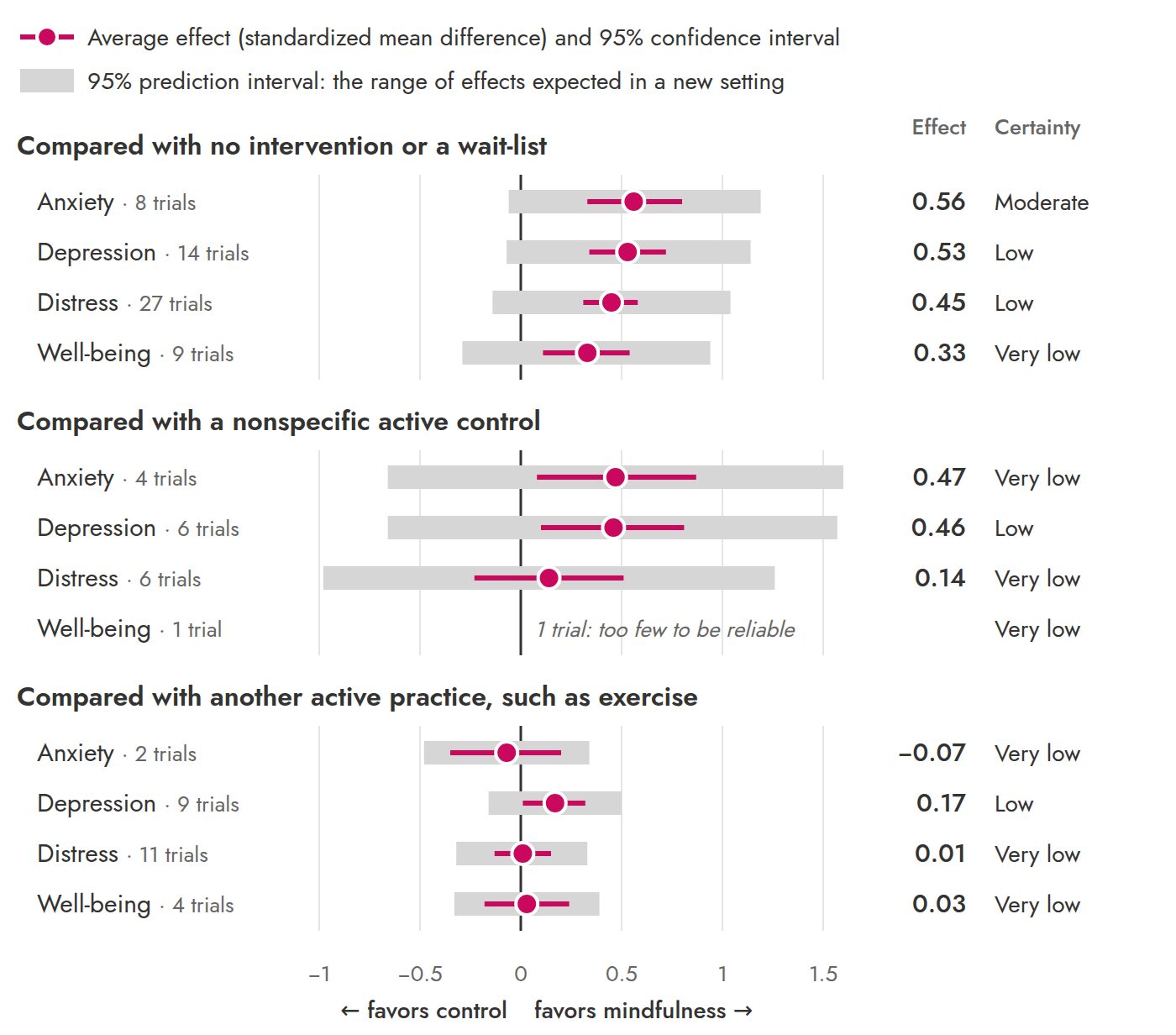
Compared with no intervention or a wait-list, 1 to 6 months after the course, mindfulness programs on average improved all four outcomes:
- Anxiety: effect size 0.56 (95% CI 0.33 to 0.80; 8 trials).
- Depression: 0.53 (0.34 to 0.72; 14 trials).
- Psychological distress: 0.45 (0.31 to 0.58; 27 trials).
- Mental well-being: 0.33 (0.11 to 0.54; 9 trials).
By a common rule of thumb these are moderate effects for anxiety, depression and distress, and a small one for well-being. Against nonspecific active controls the picture was thinner, because few trials used them. Depression improved (0.46 in 6 trials, p = 0.012, just under the corrected threshold, though the result didn’t survive several of the team’s robustness checks), anxiety showed a trend that didn’t reach the corrected threshold, distress showed no clear effect, and only one trial measured well-being.
Against activities designed to help, such as exercise or relaxation, mindfulness showed no clear advantage on any outcome. The closest was depression (0.17 in 9 trials, p = 0.04), which didn’t meet the corrected threshold. The authors’ plain-language summary puts it this way:
In these RCTs, mindfulness is neither better nor worse than other feel-good practices such as physical exercise, and RCTs in this field tend to be of poor quality, so we cannot be sure that our combined results represent the true effects.
Note that “neither better nor worse” is a reading of non-significant results from few trials, mostly rated very low certainty. The data show no advantage for mindfulness. They don’t firmly show the two are equal.
Results Varied a Lot From Setting to Setting
The averages hide a lot of spread. Even against no intervention, every prediction interval crossed zero. The authors’ reading is that in more than 5% of settings a mindfulness course may not improve anxiety or depression, and in some, people may come out with more distress or lower well-being than if they had done nothing. Settings here include the kind of community, the social context, the kind of program and how the study was run.
Some of that spread lined up with features of the trials. For depression, trials in the USA found much smaller effects than trials elsewhere: 0.24 in USA trials against 0.93 in the rest. This difference held after accounting for the trials’ risk of bias. The authors suggest that mindfulness is familiar in the USA, where it has spread since the 1970s, while elsewhere a novelty effect may be at work, fueled by advocates, for example through researchers’ allegiance to the programs they study. Courses aimed at higher-risk groups or already stressed people also improved depression (and, for stressed people, anxiety) more than courses open to anyone. That may be because people with more symptoms have more room to improve.
How Much Can the Evidence Bear?
The authors are frank about the quality of the trials. Every one of the 136 was at high risk of bias by the RoB 2 tool, which flags a trial as high risk if any one source of bias is rated high. Nearly all relied on questionnaires filled in by participants who knew whether they had taken the course. About 60% were at high risk from missing outcome data, which could favor mindfulness, since people who feel unwell may be less likely to fill in follow-up questionnaires. For about three quarters there were concerns about the randomization, mainly because they didn’t mention keeping the allocation concealed. And researchers’ allegiance to the program (for example, a trial’s authors had developed or taught it) could be ruled out in only 7 trials (5%).
GRADE certainty was moderate only for anxiety against no intervention. It was low or very low for everything else. When the team removed the trials with the most sources of high risk of bias, only the effect on distress against no intervention held up (0.30). The effects on anxiety, depression and well-being shrank and were no longer significant. Funnel plots suggested that small or unfavorable studies of depression may be missing from the record (
publication bias
Publication bias arises when studies with positive or striking results are more likely to be published than studies that find nothing. A meta-analysis that pools only published studies can then overestimate how well a treatment works. Researchers check for it with tools such as funnel plots and Egger’s test, which need a reasonable number of studies to be informative.
Read more in the glossary
). The authors conclude:
In sum, compared with taking no action, MBPs promote mental health in the average nonclinical setting but cannot be expected to work in every setting.
Miscellaneous Interesting Takeaways
Almost No Trial Asked About Harms
Of the 136 trials, 121 (89%) didn’t mention measuring adverse events or effects at all. Twelve reported none, and two reported a participant who quit the course because it felt counterproductive. One of these two was the Mindful Student Study, a trial run by some of this review’s authors, which was also the one trial that actively monitored clinically meaningful adverse events (it found no significant difference between groups). The authors warn that relying on people to volunteer problems may underestimate how often they happen by more than 20-fold. An interview study of one mindfulness course shows how much more turns up when participants are asked about specific experiences.
Shorter Courses Did No Worse
In a weaker moderator finding, each extra hour of in-person teaching went with a slightly smaller benefit for depression. The authors call this unexpected and say it may be a fluke of testing many moderators, but together with other reviews it suggests that courses don’t have to be long to help. Courses that included physical exercise appeared to do better for depression, though the comparison rested on few trials.
Teacher Credentials Didn’t Change the Results
Many trial reports said little about who taught the course. In an extra analysis restricted to the 97 trials (71%) that suggested properly trained teachers, the results barely changed, except that the effect on anxiety became stronger. The authors suggest that other aspects of teaching, such as communication skills or sharing a background with the students, may matter more than mindfulness credentials.
The Most Common Outcome Was Stress
Psychological distress was measured in 102 trials (75%), most often with the
Perceived Stress Scale
The Perceived Stress Scale (PSS) is a widely used questionnaire that asks how often, over the past month, people have felt their lives were unpredictable, out of control or overloaded. It comes in 14-, 10- and 4-item versions, each answered from never (0) to very often (4); higher totals mean more stress. It measures how stressed people feel, not physical signs of stress such as hormone levels.
More on Wikipedia
Read more in the glossary
. Almost all the outcomes were self-report questionnaires, which can be swayed by participants’ expectations when they know which group they are in.
Final Reflection
This is a careful review. It was planned in advance, it kept the different comparisons apart, and its authors had not developed or taught any of the programs. Its answer is more modest than the popular picture of mindfulness. On average, taking a mindfulness course left people in community settings less anxious, depressed and stressed, and slightly better off in well-being, than doing nothing. But it was not clearly better than other things people can do to feel better, such as exercise or relaxation training. And the benefit was far from guaranteed in any given setting.
That echoes the Goyal et al. 2014 review in clinical populations, which also found modest effects against matched programs and no evidence that meditation beats other active treatments. The authors’ advice for teachers is practical:
In the meantime, it is important for mindfulness practitioners not to assume that MBPs will work universally and to discuss this with their students.
They suggest that courses aimed at people at higher risk may be a better bet than courses for everyone, and that new programs should be rolled out alongside good research, ideally with active comparison groups, measures beyond self-report and researchers with no stake in the program. For someone deciding whether to sign up, the review suggests a mindfulness course is a reasonable option among several, not a sure thing and not obviously better than, say, an exercise class.
Citation
Galante, J., Friedrich, C., Dawson, A. F., Modrego-Alarcón, M., Gebbing, P., Delgado-Suárez, I., Gupta, R., Dean, L., Dalgleish, T., White, I. R., & Jones, P. B. (2021). Mindfulness-based programmes for mental health promotion in adults in nonclinical settings: A systematic review and meta-analysis of randomised controlled trials. PLOS Medicine, 18(1), e1003481. 10.1371/journal.pmed.1003481
Get the next summary by email
One or two new paper summaries every couple of weeks, sent to your inbox when they go up.
No spam, and you can unsubscribe at any time. Prefer a feed reader? Use the RSS feed.