
Background Information
Mindfulness programs have become a common workplace perk. The authors cite a survey in which nearly one in six white-collar workers in the United States reported some form of mindfulness practice in the previous year, and companies such as Aetna and Goldman Sachs have offered training to staff. The research behind these programs was thinner than their popularity suggested. Only a handful of
randomized controlled trials
A Randomized Controlled Trial is a scientific study design that randomly assigns participants to either an experimental group receiving an intervention or a control group, allowing researchers to measure the true effect of the intervention while minimizing bias.
More on Wikipedia
Read more in the glossary
had tested mindfulness in for-profit companies, and they compared it either with a
wait-list
A wait-list control group is a comparison group that receives the program being studied only after the study period, so participants who are waiting can be compared with those already taking part. It controls for the passage of time and repeated testing, but not for the attention, expectations and setting that come with taking part in any program, which an active control group can address.
More on Wikipedia
Read more in the glossary
, which controls for little beyond the passage of time, or with a different program such as yoga or cognitive behavioral therapy, which tended to work about as well.
Two other questions were open. One was dose: companies often offer a single seminar, and no one knew whether a few hours of training does anything, or whether the benefits need weeks of practice. The other was measurement. Most earlier studies asked people to look back over the past month and rate how stressed they had been, a judgment that memory can color. The authors wanted to catch stress as it happened during the workday, using
ecological momentary assessment
Ecological momentary assessment (EMA), also called experience sampling, asks people to report what they are feeling or doing several times a day, in the moment and in their everyday surroundings, usually through short surveys sent to their phones at set or random times. Because answers are given on the spot rather than recalled later, they are less colored by memory than questionnaires about the past week or month, and they can show how experiences rise and fall through the day.
More on Wikipedia
Read more in the glossary
: short surveys on people’s phones at random points through the day.
The senior author, J. David Creswell, also led the three-day mindfulness retreat study with stressed, unemployed job seekers that appears elsewhere on this site.
What They Did
The researchers recruited 60 employees, aged 21 to 57, from a digital marketing firm in Ohio with about 100 staff, a fast-paced business of client accounts and online content. People with regular meditation or similar mind–body practice were excluded. Participants received the training free but were not otherwise paid, to mimic how a company would offer such a program. The timing turned out to matter:
Notably, the firm experienced a period of significant organizational change and major restructuring during the study’s intervention and assessment period which was expected to raise overall stress levels.
Everyone first took a 4-hour, in-person workshop led by a senior instructor of the Unified Mindfulness system. It mixed teaching about mindful awareness with guided exercises: noticing and accepting what one sees, hears and feels in the body, mindful conversation, eating and music listening, letting attention move freely or narrowing it to one sense, and cultivating pleasant feelings.
Right after the workshop, a random number generator split the group. The 29 people in the “low dose” group got nothing more and were asked not to practice until the study ended. The 31 people in the “high dose” group began six weeks of further training: a series of teaching videos, 25-minute guided audio practices to do five days a week, weekly group conference calls with the instructor and an optional 15-minute individual call. The audio platform logged how long each person listened.
Stress was measured in two ways. Before and after the training, everyone filled in the
Perceived Stress Scale
The Perceived Stress Scale (PSS) is a widely used questionnaire that asks how often, over the past month, people have felt their lives were unpredictable, out of control or overloaded. It comes in 14-, 10- and 4-item versions, each answered from never (0) to very often (4); higher totals mean more stress. It measures how stressed people feel, not physical signs of stress such as hormone levels.
More on Wikipedia
Read more in the glossary
(PSS), which asks how often over the past month life has felt unpredictable, uncontrollable and overloaded. And on Tuesday, Wednesday and Thursday of the week before and the week after the training, a text message four times a day between 9 a.m. and 5 p.m. asked people how stressed they felt right now and how positive and negative their mood was, on 1-to-7 scales. They also said whether they had felt stressed since the last survey; if so, they rated how severe it was, how much of the time they’d been stressed and how well they had coped.
The researchers compared how each outcome changed in the two groups, keeping everyone in the group they were assigned to, an
intention-to-treat
An intention-to-treat analysis counts every randomized participant in the group they were assigned to, whether or not they completed or even started the treatment. It keeps the benefit of randomization, since dropping people who didn’t follow their plan can leave groups that differ in other ways, and it estimates what happens when a treatment is offered in practice rather than when it is taken exactly as intended.
More on Wikipedia
Read more in the glossary
approach. Two people dropped out of the training, both in the six-week group.
One Big Result: Perceived Stress Fell After Six Weeks of Training, but Not After the Workshop Alone
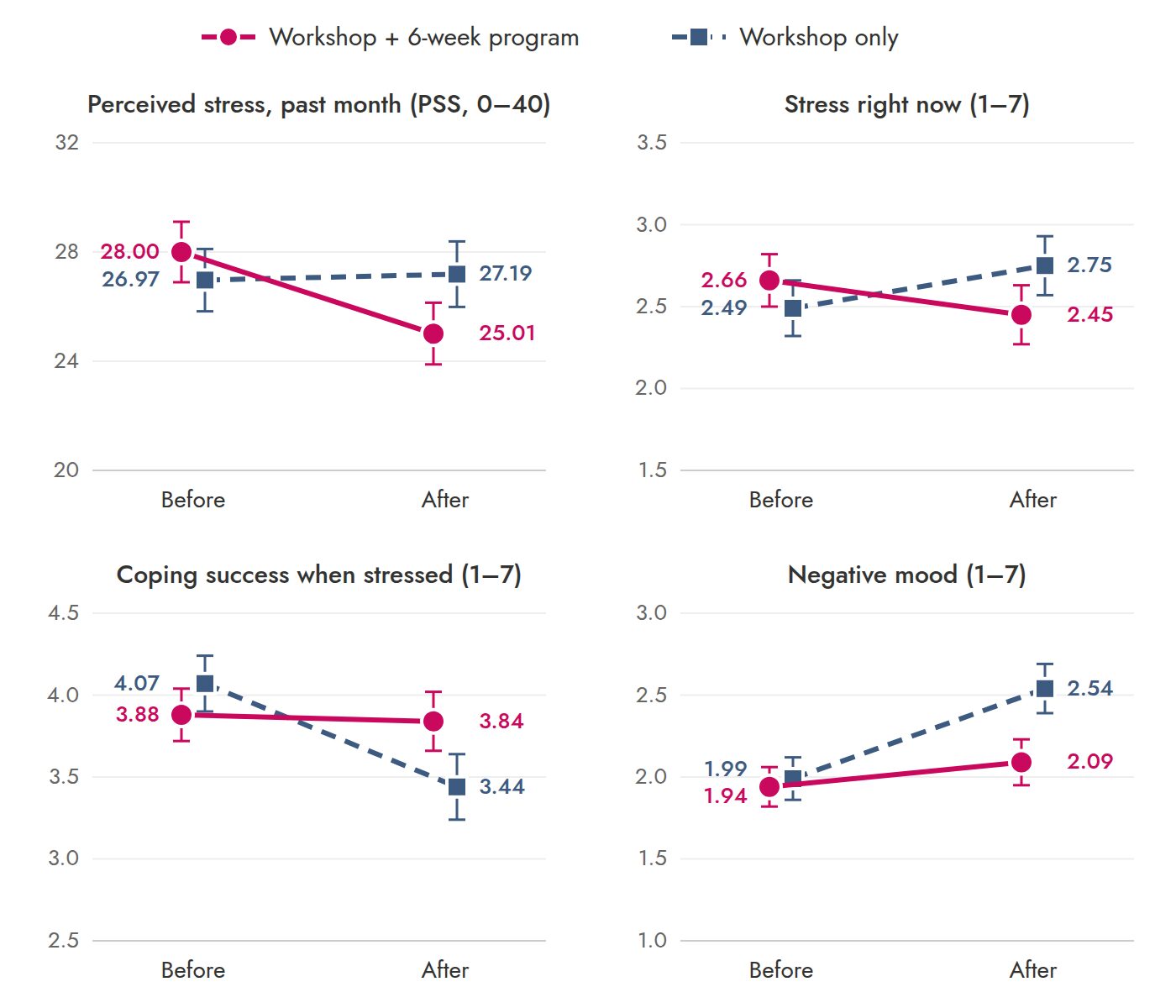
On the Perceived Stress Scale, scored from 0 to 40, the six-week group dropped from an average of 28.0 to 25.0, a decline of about 3 points that was statistically significant on its own. The workshop-only group barely moved, from 27.0 to 27.2. The difference between the groups’ changes was significant (p = .023), with an
effect size
Effect size is a statistical concept that quantifies the magnitude or strength of a relationship, difference, or intervention outcome. Unlike p-values which only indicate statistical significance, effect sizes measure how meaningful a result is in practical terms. Common measures include Cohen’s d (standardized mean difference), correlation coefficients (r), and odds ratios. In meditation research, effect sizes help quantify the practical impact of different meditation practices on psychological or physiological outcomes.
More on Wikipedia
Read more in the glossary
(Cohen’s d) of 0.52, a medium effect.
The phone surveys pointed the same way. Ratings of stress “right now” diverged between the groups (p = .014, d = 0.52), but the change came from both directions: the six-week group’s average dipped slightly, from 2.66 to 2.45, and the workshop-only group’s rose, from 2.49 to 2.75. Neither change was significant on its own (the rise was borderline, p = .06), so the abstract’s statement that the longer training “reduced” momentary stress describes the gap between the groups rather than a clear fall in the trained group.
Miscellaneous Interesting Takeaways
The Workshop-Only Group Got Worse, and the Six-Week Group Held Steady
Most of the study’s other findings follow one pattern: the workshop-only group’s well-being slipped over the six weeks, while the six-week group’s stayed about where it started. Between baseline and the end of training, the workshop-only group:
- spent more of the time between surveys feeling stressed (2.67 to 3.19 on the 1-to-7 scale),
- rated its stressful episodes as more severe (3.45 to 3.88),
- coped less successfully (4.07 to 3.44),
- felt less positive (4.56 to 4.24) and more negative (1.99 to 2.54).
The six-week group showed no significant change on any of these. The differences between the groups were significant for time stressed, coping, and positive and negative mood (effect sizes of 0.55 to 0.74), and fell just short for severity (p = .055). The authors describe this as the training “buffering” employees against a stressful period, and they are candid about what that means:
It is therefore possible that any relative benefits of HDMT are actually attributable to stress-buffering rather than direct effects.
Here HDMT is the six-week (“high dose mindfulness training”) group. Stress itself didn’t go away. About half of all phone surveys (48.8%) reported feeling stressed since the last one, and that share didn’t change over time or differ between the groups. What differed was how bad it felt and how well people handled it.
Why Did the One-Day Group Get Worse?
The study can’t say. The authors suggest the restructuring pushed stress up for everyone and only continued practice held it back, which fits the other results. But with no group that received no training at all, the study can’t show whether the workshop was simply too little to help, or made no difference either way. The authors acknowledge this, and say a third, assessment-only group would have been too small to analyze. Their practical conclusion is aimed at employers:
Given popular interest among corporations in low dose mindfulness programs, these results suggest that several hours of mindfulness training (in a single low dose seminar) is insufficient for stress buffering benefits in the workplace.
People Practiced Less Than Asked
The six-week group was asked to practice for 750 minutes in all. On average, the audio platform logged 303 minutes (median 247), about 40% of the target, though the authors note that listening timestamps gave an incomplete picture of practice. Adding each person’s practice minutes to the analysis didn’t change the results. Whether the workshop-only group practiced on its own despite being asked not to was never checked.
The phone surveys were also patchy. Of 1,440 possible surveys, 830 (57.6%) were answered, a median of 14 of 24 per person, and a software problem meant 38 of those didn’t include the mood questions. The analysis used every answer available, but people who skipped surveys at busy moments may have differed from those who answered.
Some Questions the Design Leaves Open
The comparison is between two doses of mindfulness, not between mindfulness and nothing, or mindfulness and a matched program. The six-week group also got weekly calls and personal contact with the instructor, which the workshop-only group didn’t, so the extra attention and the expectation of benefit can’t be separated from the practice itself. That matters because every outcome was self-reported by people who knew which group they were in. In a trial of MBSR against a matched health program, both groups reported similar drops in distress.
The authors list other limits themselves: the sample was small and 95% white, the single-question phone ratings hadn’t been tested or validated beforehand, and stress was never measured objectively, for instance through job performance or sick days. No physical stress measures, such as cortisol or blood pressure, were collected. Seven outcomes were tested without
correction for multiple comparisons
The multiple comparisons problem arises when researchers run many statistical tests at once. Each test has a small chance of a false positive, so across thousands of tests, such as one for every point in a brain scan, some “significant” results will turn up by chance alone. Corrections raise the bar for significance to keep the overall false-positive rate down, at the cost of making small real effects harder to detect.
More on Wikipedia
Read more in the glossary
, and everything was measured in the week or two after training, so it’s unknown whether the differences lasted. The paper also gives two counts of who completed the final questionnaires (51 in one place, 54 in another). Finally, one author, Julianna Raye, is a senior trainer with Unified Mindfulness, the system taught in the study, a conflict of interest the paper declares.
Final Reflection
This trial took mindfulness research into an ordinary workplace at a hard moment and measured stress as people lived it, several times a working day, rather than asking them to remember it. Its main lesson concerns dose. A single 4-hour workshop, the kind of program many companies offer, didn’t protect employees from a stressful restructuring, while six weeks of training with regular practice and support left them less stressed by their own account and steadier in mood and coping than colleagues who stopped after the workshop.
The findings fit a wider picture on this site. An earlier workplace trial at a biotech company found brain and immune changes after an 8-week
MBSR
Mindfulness-Based Stress Reduction (MBSR) is a program designed to help individuals cope with stress, pain, and illness. Developed by Jon Kabat-Zinn in the 1970s, it combines meditation and yoga to promote awareness and stress management. The eight-week program teaches participants to focus on the present moment non-judgmentally, enhancing their ability to manage difficulties.
More on Wikipedia
Read more in the glossary
course, and a review of 47 trials found that mindfulness programs ease anxiety and depression a little more than matched programs, while the evidence on stress itself was weak. This study adds evidence about how much training is needed, not whether mindfulness beats other ways of coping.
Its 60 employees, single firm, self-reported outcomes and lack of an untrained or matched comparison group mean it is best read as a promising, well-measured pilot. Employers weighing a one-off seminar against a longer program have a reason to favor the longer one; whether that program beats other forms of support, or keeps working after the training ends, remains to be tested.
Citation
Chin, B., Slutsky, J., Raye, J., & Creswell, J. D. (2019). Mindfulness training reduces stress at work: A randomized controlled trial. Mindfulness, 10(4), 627–638. 10.1007/s12671-018-1022-0
Get the next summary by email
One or two new paper summaries every couple of weeks, sent to your inbox when they go up.
No spam, and you can unsubscribe at any time. Prefer a feed reader? Use the RSS feed.