
Background Information
Antidepressants help many people recover from depression, but recovery is often incomplete, and poor sleep is one of the symptoms most likely to linger. Several kinds of antidepressant, including the widely used selective serotonin reuptake inhibitors (SSRIs), can themselves break up sleep and cause more awakenings. As Willoughby Britton and colleagues at the University of Arizona put it:
Sleep disturbances are one of the most common residual symptoms after successful treatment with antidepressant medication (ADM) and are associated with perpetuating mood disturbance, and increased risk for relapse
The usual fixes are to switch medication, stop it, or add a sleeping pill, and long-term sleeping pill use is discouraged. The authors asked whether mindfulness training could help instead. Earlier studies had linked mindfulness to better sleep, but almost all of them relied on what people reported about their own sleep. Few had recorded sleep objectively with
polysomnography
Polysomnography is an overnight sleep study, usually done in a sleep lab. Sensors record brain activity (EEG), eye movements, muscle activity, heart rhythm and breathing, so that each stretch of the night can be scored as wake, light sleep, deep sleep or REM sleep, and sleep disorders such as apnea can be detected.
More on Wikipedia
View in glossary
, and none had looked at people whose sleep problems came along with antidepressant treatment.
The team predicted two things: better sleep continuity (less time awake, more total sleep and higher
sleep efficiency
Sleep efficiency is the share of time in bed actually spent asleep: total sleep time divided by time in bed, given as a percentage. It can be measured in a sleep lab or estimated from sleep diaries or wrist-worn devices. Taking a long time to fall asleep or lying awake during the night lowers it, and values below about 85–90% are often taken as a sign of disturbed sleep.
More on Wikipedia
View in glossary
) and deeper sleep (more
slow-wave sleep
Slow-wave sleep (SWS), often called deep sleep, is the deepest stage of non-REM sleep (stage N3, or stages 3 and 4 under older scoring rules), when the EEG is dominated by large, slow delta waves. People are hardest to wake from it. It is concentrated in the first part of the night, declines with age, and is thought to support physical restoration and memory.
More on Wikipedia
View in glossary
and less light stage 1 sleep).
What They Did
The study was part of a larger trial of mindfulness for recurrent depression. Participants had had at least three episodes of major depression and were now in full or partial remission on antidepressants, with no change to their medication in the previous three months. About half were in full remission. Most (73%) were taking an SSRI, and a few took two medications. All of them reported sleep problems at least twice a week: every participant had spent more than half an hour awake during the night, half woke too early, and 42% had trouble falling asleep. In the diaries, about 40% met formal criteria for insomnia. People already meditating regularly, or in psychotherapy, were excluded.
Each person kept a sleep diary for three weeks, then spent an adaptation night and a recorded study night in the sleep lab. They were then randomly assigned, by sealed envelopes in a 3:2 ratio, to
mindfulness-based cognitive therapy (MBCT)
Mindfulness-based cognitive therapy (MBCT) is an 8-week group program that combines mindfulness meditation, adapted from Mindfulness-Based Stress Reduction (MBSR), with elements of cognitive behavioral therapy. It was developed to help people who have recovered from depression avoid relapse, by learning to notice and step back from patterns of negative thinking. Classes usually meet weekly, with daily meditation practice at home.
More on Wikipedia
View in glossary
or to a wait-list. Twenty-six people were randomized and two dropped out, and one lab recording failed, leaving 23 for the sleep analysis (13 MBCT, 10 wait-list). The analysis included only people who completed the study, rather than everyone randomized.
The MBCT course had eight weekly three-hour classes and a day-long retreat, with 45 minutes a day of guided practice at home. It was aimed at depression and relapse prevention, not sleep. The first author, an experienced meditator trained to teach the program, led all five groups. She also recorded each person’s group assignment, so she knew who was in which, but the staff who collected the follow-up data didn’t. Participants practiced on their own for about 40 minutes a day, five days a week, on average.
After eight weeks, everyone returned to the lab for another recorded night and kept diaries throughout. Sleep from the lab recordings and from the diaries was analyzed separately, with each person’s starting depression score taken into account. The authors focused on total time awake in bed, the minutes it took to fall asleep plus the minutes awake after first falling asleep, because their participants had a mix of both kinds of sleep problem. Because the study was small and exploratory, they also reported trends (p < 0.10) of at least a medium effect size.
One Big Result: Less Time Awake at Night, in the Lab and in Diaries
Compared with the wait-list, the MBCT group spent less time awake at night, by both measures.
- In the sleep lab: the MBCT group’s total time awake fell from 57.0 to 46.7 minutes, while the wait-list group’s rose from 53.1 to 69.9 minutes. The difference between the groups’ changes was significant (p = 0.035), with a large
effect size
Effect size is a statistical concept that quantifies the magnitude or strength of a relationship, difference, or intervention outcome. Unlike p-values which only indicate statistical significance, effect sizes measure how meaningful a result is in practical terms. Common measures include Cohen’s d (standardized mean difference), correlation coefficients (r), and odds ratios. In meditation research, effect sizes help quantify the practical impact of different meditation practices on psychological or physiological outcomes.
More on Wikipedia
View in glossary by the authors’ benchmarks (ηp² = 0.20). Sleep efficiency followed the same pattern, rising from 86.0% to 88.7% in the MBCT group and falling from 87.1% to 82.1% in the wait-list group, but only as a trend (p = 0.09). - In the diaries: the MBCT group’s reported time awake fell from 46.8 to 27.7 minutes, while the wait-list group’s stayed at about 35 minutes (p = 0.046). Diary sleep efficiency rose from 81.3% to 88.8% in the MBCT group, against 85.1% to 86.1% in the wait-list group, the strongest result in the study (p = 0.007, ηp² = 0.33).
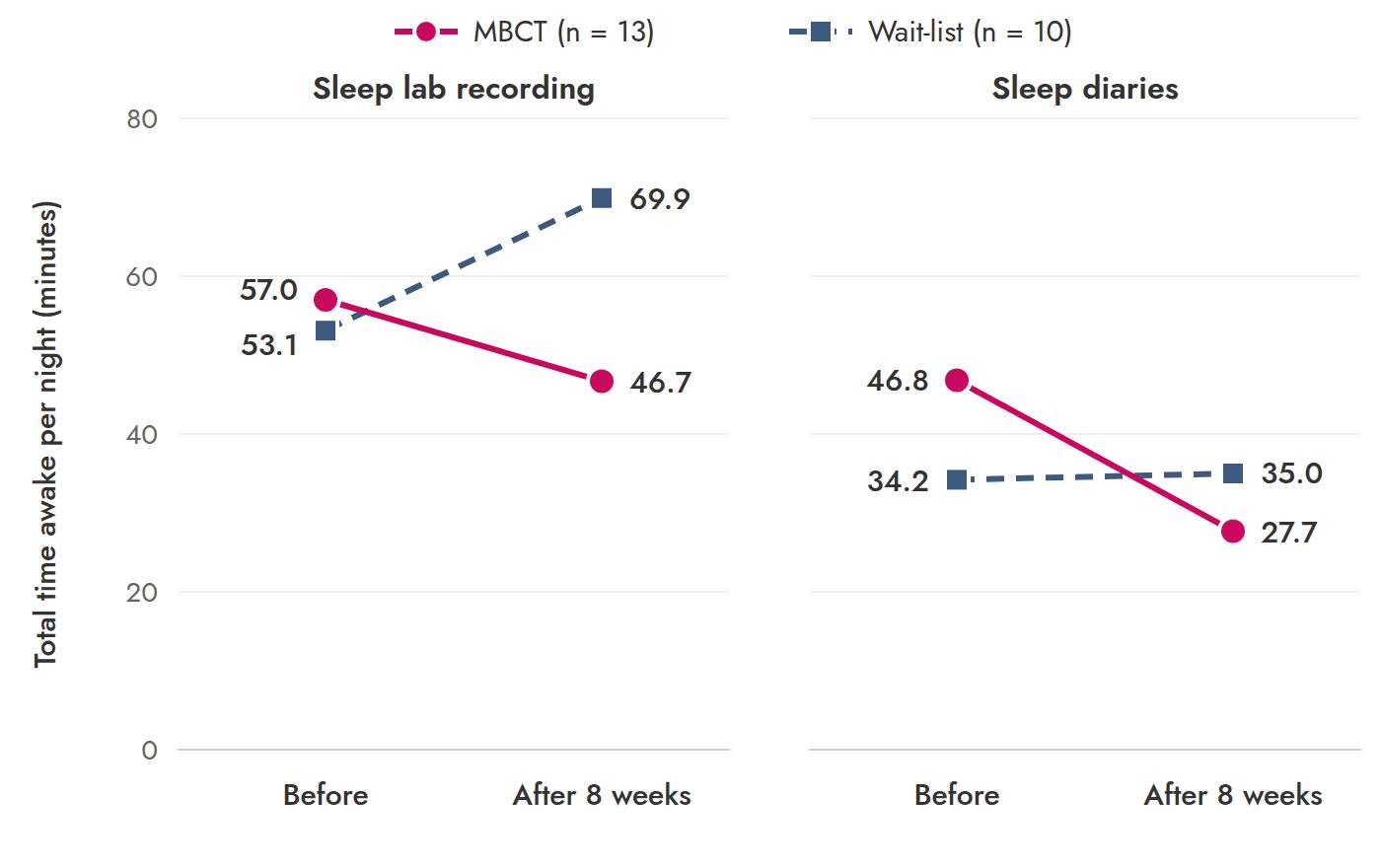
The two measures didn’t tell quite the same story, and the authors say so:
By subjective accounts, MBCT showed clear improvement over relatively stable controls, where by PSG measurement, deterioration of control sleep may have contributed to the group x time interaction.
In other words, the lab result is partly a story about the wait-list group’s sleep getting worse. Their depression scores also rose slightly, so the authors suggest some of them may have been starting to relapse. They are frank that they can’t tell how much mindfulness improved sleep and how much it prevented a decline that came with returning depression.
The paper’s title says MBCT improved polysomnographic sleep. That is fair for total time awake, but it was the only lab measure to reach significance, and the MBCT group’s own improvement in the lab was about 10 minutes. The MBCT group also started with more diary-reported time awake than the wait-list group (about 47 minutes against 34), so it had more room to improve.
Miscellaneous Interesting Takeaways
Sleep Depth Didn’t Change
The second prediction wasn’t borne out. Light (stage 1) sleep and slow-wave “deep” sleep, the lightest and deepest stages of
non-REM sleep
Non-rapid eye movement (NREM) sleep makes up most of a night’s sleep. It runs from light sleep (stages N1 and N2) to deep, slow-wave sleep (N3), alternating with REM sleep in cycles of about 90 minutes. During NREM sleep, brain activity is dominated by slow waves and the brain responds much less to the outside world.
More on Wikipedia
View in glossary
, didn’t change, and neither did total sleep time:
It is important to note that these meditation-related benefits were specific to sleep continuity and not sleep depth or architecture.
Slow-wave sleep was unusually low at the start, under 8% of total sleep time in 80% of participants, and it stayed between 5% and 8% after the course. The authors point out that two studies comparing advanced meditators with non-meditators had found more slow-wave sleep (a pattern also reported in long-term Vipassana practitioners), but eight weeks of training in newcomers to meditation didn’t reproduce it here. The paper didn’t analyze
REM sleep
Rapid Eye Movement (REM) sleep is a sleep stage marked by vivid dreaming, rapid eye movements, and heightened brain activity similar to wakefulness. REM sleep supports emotional regulation, memory consolidation, and neuroplasticity. It typically increases in the later part of the night.
More on Wikipedia
View in glossary
at all, because different antidepressants affect REM in different ways.
Falling Asleep and Staying Asleep, Separately
Total time awake combines two things: the minutes taken to fall asleep and the minutes awake later in the night. Neither one changed significantly on its own, in the lab or in the diaries, although time awake after falling asleep came close in the diaries (p = 0.053). The authors suggest that the combined measure suits a group with mixed sleep problems, and that the sample may have been too small to detect the parts separately.
Self-Reports Respond More Than Recordings
Other sleep studies of mindfulness, such as Ong et al.’s insomnia trial, have found that people’s own reports change more than their recorded sleep. The authors see the same pattern here and in the wider literature: self-reports have mostly shown meditation helping sleep or making little difference, while objective and EEG-based measures more often point toward meditation keeping people more awake or aroused. Among the studies they cite for that second pattern is their own earlier paper from the same larger trial (Britton et al., 2010, Psychosomatic Medicine), which used the same methods with people who weren’t taking antidepressants. In this sample, though, there was no sign of lighter sleep: stage 1 sleep didn’t change. The authors suggest future studies separate the effects of meditation on sleep depth and on sleep continuity.
Better Sleep Went With Better Mood, at Least on Paper
Depression scores fell in the MBCT group (from 8.3 to 5.1 on the Beck Depression Inventory) and rose in the wait-list group (from 11.8 to 14.4), a difference that was only a trend (p = 0.07). People whose mood improved also tended to report less time awake, more total sleep and higher sleep efficiency in their diaries, even with the questionnaire’s sleep items left out. Changes in the lab recordings, however, weren’t linked to mood at all.
What the Paper Doesn’t Report
Participants logged their daily practice, including whether they fell asleep while meditating, but the paper doesn’t say whether people who practiced more slept better. It reports that no adverse events occurred during the trial, without describing how they were checked. Britton’s later work found that asking about specific experiences turns up far more unwanted effects of mindfulness courses than waiting for people to report them (Britton et al., 2021), so “no adverse events” here doesn’t mean that nobody had a difficult experience.
Final Reflection
This was a small, early trial, run in 2004–2005, and the authors call it preliminary. With 13 people in one group and 10 in the other, a wait-list rather than an active comparison, many sleep measures tested without correction and only completers analyzed, it can only suggest an effect. Its contribution is that it recorded sleep objectively in a group that clinicians often struggle to help: people whose depression has fully or partly lifted on medication but whose nights are still broken.
What it suggests is specific. A mindfulness course that wasn’t designed for sleep was followed by less time awake in bed, most clearly in people’s own accounts, without making sleep any deeper. Later trials in people with sleep problems found clear gains in reported sleep, including against a matched sleep hygiene course (Black et al., 2015), and smaller, less consistent changes in recorded sleep (Ong et al., 2014). A meta-analysis of such trials found that mindfulness improved reported sleep quality more than matched classes, though only two of the trials measured sleep objectively (Rusch et al., 2019). Whether mindfulness helps antidepressant users stay on their medication, as the authors hope, is a question this study raises but doesn’t answer.
Citation
Britton, W. B., Haynes, P. L., Fridel, K. W., & Bootzin, R. R. (2012). Mindfulness-based cognitive therapy improves polysomnographic and subjective sleep profiles in antidepressant users with sleep complaints. Psychotherapy and Psychosomatics, 81(5), 296–304. 10.1159/000332755
Get the next summary by email
One or two new paper summaries every couple of weeks, sent to your inbox when they go up.
No spam, and you can unsubscribe at any time. Prefer a feed reader? Use the RSS feed.