
Background Information
In 2013, a team at the University of Wisconsin–Madison reported that long-term meditators had more gamma activity during non-REM sleep than people who had never meditated. That difference showed up on an ordinary night and rose with hours of daily practice, so the authors read it as a lasting trait built up over years.
This follow-up, from the same group and with the same meditators, asks the complementary question: what does a single day of intensive meditation do to the sleep that follows it? Sleep researchers already had a way to look for short-term effects like this. When people practice a demanding task during the day, the brain areas they used tend to show more slow, low-frequency activity in that night’s sleep. As the authors put it:
It has been demonstrated that motor and mental trainings are able to induce task-related neuroplastic changes, in waking as well as during subsequent sleep.
“Low-frequency oscillations” are the slower rhythms on an
EEG
An electroencephalogram (EEG) is a recording of brain activity. During this painless test, small sensors are attached to the scalp to pick up the electrical signals produced by the brain.
More on Wikipedia
View in glossary
, from 1 to 12 cycles per second (Hz). They include the delta waves (1–4 Hz) that dominate deep sleep, measured as
slow-wave activity
Slow-wave activity (SWA) is the strength of the slowest brain rhythms of sleep, delta waves at about 1–4 cycles per second, measured with EEG. Slow waves dominate deep (N3) non-REM sleep. SWA is highest early in the night and falls as sleep goes on, and brain areas that worked hard during the day can show more of it that night, which makes it a marker of both sleep pressure and learning-related changes in the brain.
More on Wikipedia
View in glossary
, along with
theta
Theta waves are rhythmic electrical brain activity at roughly 4–8 cycles per second, recorded with EEG. While awake, they are linked to memory, focused attention and drowsiness, and meditation studies often report more theta over the front of the head during practice. In sleep, theta is common in light non-REM sleep and in REM sleep.
More on Wikipedia
View in glossary
(4–8 Hz) and
alpha
Alpha waves are rhythmic electrical brain activity at roughly 8–13 cycles per second, recorded with EEG. They are often strongest when the eyes are closed and the mind is relaxed, and are thought to help filter out or hold back information as part of top-down control. Meditation studies have reported both increases and decreases in alpha, depending on the practice.
More on Wikipedia
View in glossary
(8–12 Hz) rhythms. The authors treat a rise in these rhythms during sleep as a trace of what the brain learned during the day, and its location on the scalp as a clue to which brain areas the day’s training engaged. They predicted that an intensive day of meditation would boost these rhythms in regions involved in attention and cognitive control.
What They Did
Of the 29 long-term meditators originally recruited for the 2013 study, 24 were included here. Three were excluded because their sleep recordings revealed a sleep disorder, and two didn’t complete the mindfulness day. All had meditated daily for at least three years and attended at least three week-long retreats, in the Theravada and Tibetan Buddhist traditions. The 24 averaged about 9,100 hours of lifetime practice (from about 1,500 to more than 32,000). About half of their sitting practice was open monitoring, a third focused attention and 15% loving-kindness.
Each meditator slept in the lab three times, wearing a 256-electrode high-density EEG cap plus standard
polysomnography
Polysomnography is an overnight sleep study, usually done in a sleep lab. Sensors record brain activity (EEG), eye movements, muscle activity, heart rhythm and breathing, so that each stretch of the night can be scored as wake, light sleep, deep sleep or REM sleep, and sleep disorders such as apnea can be detected.
More on Wikipedia
View in glossary
: once after an ordinary day (the baseline) and once after each of two full days of intensive practice. The practice days closely copied a meditation retreat. Starting at 8:15 a.m., there were six 45-minute sessions of sitting meditation and four 30-minute sessions of walking meditation, with a lunch break and a 30-minute dharma talk. One day was devoted to
Vipassana
Vipassana is a form of Buddhist meditation focused on the cultivation of insight through moment-to-moment awareness of bodily sensations, thoughts, and emotions. It emphasizes non-reactivity and equanimity, helping practitioners observe mental and physical phenomena without attachment.
More on Wikipedia
View in glossary
, a mindfulness practice of watching the flow of experience without judging it. The other was devoted to Metta, which cultivates loving-kindness and compassion toward others. The order of the two days was randomized, and the visits were months apart (about 160 days on average).
Sleeping in a lab can itself change from one visit to the next, as people get used to it. To check for that, the team also recorded 24 meditation-naive adults, chosen from 38 volunteers as the best matches for age and sex, at three matching time points. They didn’t meditate or do anything else in its place.
The team compared the meditators’
NREM sleep
Non-rapid eye movement (NREM) sleep makes up most of a night’s sleep. It runs from light sleep (stages N1 and N2) to deep, slow-wave sleep (N3), alternating with REM sleep in cycles of about 90 minutes. During NREM sleep, brain activity is dominated by slow waves and the brain responds much less to the outside world.
More on Wikipedia
View in glossary
(non-rapid eye movement sleep) after the meditation days with their baseline night across 185 electrodes, in 1-Hz steps from 1 to 40 Hz, separately for each of the first three sleep cycles of the night. That adds up to more than 20,000 comparisons, so they used a permutation method that corrects for all of them at once by looking for a connected cluster of electrodes, frequencies and cycles that changed together. The technologist who scored the sleep stages didn’t know which condition each night came from.
One Big Result: After a Day of Meditation, Slow Brain Rhythms Rose During Non-REM Sleep
The mindfulness and compassion days had the same effect: the team found no difference between the nights that followed them, so it averaged the two and compared them with baseline. After meditating, the meditators’ non-REM sleep showed more low-frequency activity, mainly over prefrontal electrodes at the front of the head and the left parietal area on the upper side of the head. This one cluster passed the correction for multiple comparisons, though narrowly (p = 0.046).
The change shifted over the course of the night:
- First cycle: it peaked around 8 Hz, at the border of theta and alpha, and included the frequencies of
sleep spindles
A sleep spindle is a brief burst of brain activity at about 11–16 cycles per second (the sigma band), lasting from about half a second to two seconds, seen on an EEG during non-REM sleep, especially stage N2. Spindles are thought to help shield sleep from outside noise and to support memory consolidation, and they can increase locally in brain areas used heavily for learning during the day.
More on Wikipedia
View in glossary (12–15 Hz), short bursts typical of light non-REM sleep. - Second cycle: it moved down into the slowest frequencies, where slow-wave activity peaked, and spread across the scalp, reaching toward the back of the head.
- Third cycle: frequencies below 5 Hz were no longer involved; the change was still largest at 8 Hz and extended up into fast beta and
gamma
Gamma brain waves are a type of brainwave pattern that oscillate at approximately 25 to 100 Hz. Gamma waves are associated with states of heightened perception, problem-solving, and consciousness. Gamma waves play a crucial role in cognitive functioning, including memory, and information processing, and are thought to integrate thoughts and information from different parts of the brain.
More on Wikipedia
View in glossary frequencies, up to 40 Hz, at the back of the head.
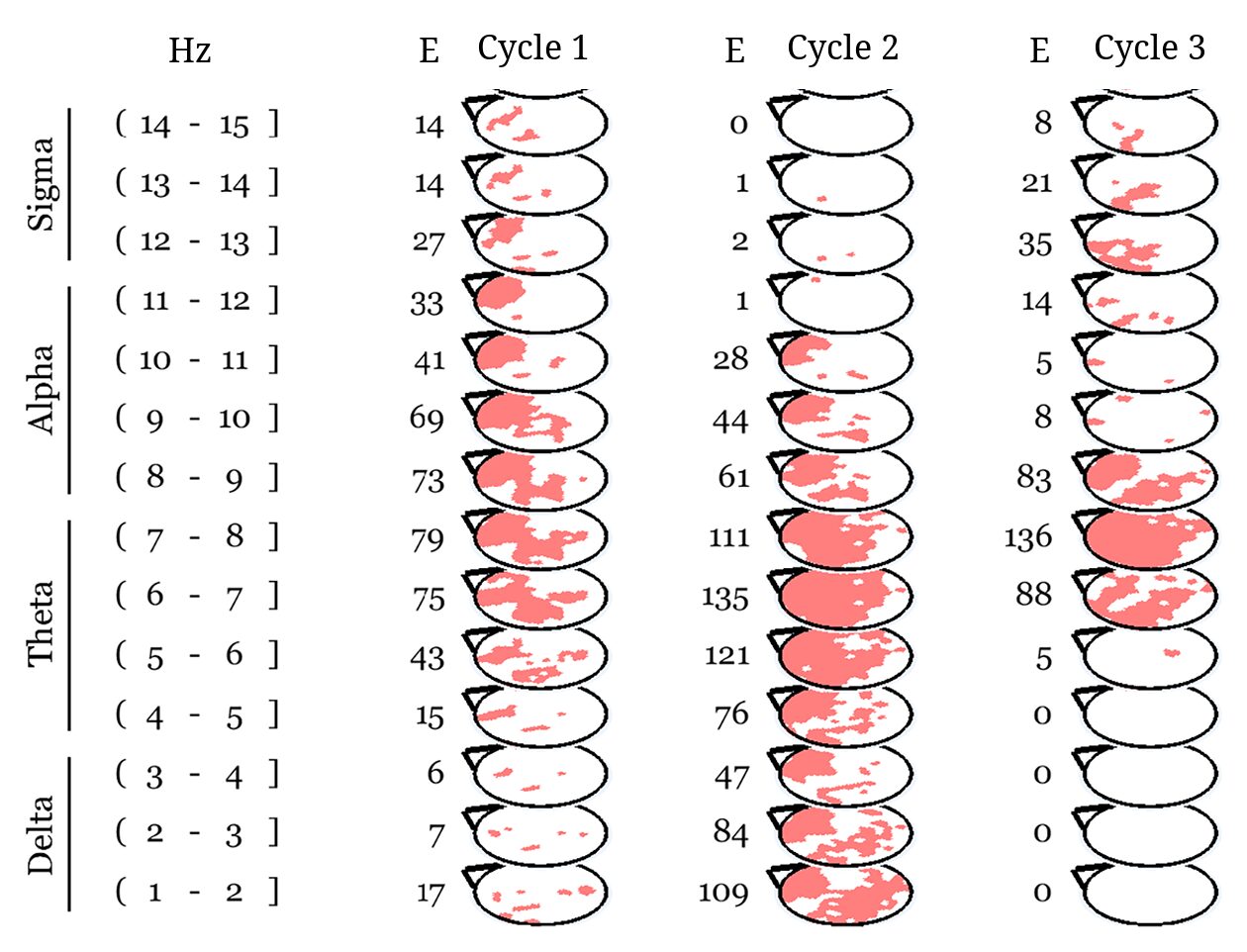
The authors note that the delayed rise in slow waves fits their earlier finding that learning a movement task in the morning boosted slow waves that night, peaking in the second sleep cycle.
The non-meditators’ sleep didn’t change across their three visits, so returning to the lab doesn’t explain the shift. But the more direct test, which compared the meditators’ change from baseline with the non-meditators’ change over the same visits, fell just short:
The between groups comparison of the changes relative to baseline still revealed a prefrontal and left parietal increase in low-frequency activity in long-term practitioners after days of practice compared to the same time points in controls … though this cluster did not survive our stringent correction for multiple comparisons (N = 1929, p = 0.057).
So the firmest evidence is a before-and-after change within the meditators. The comparison with the control group points the same way but isn’t conclusive, a nuance the abstract leaves out.
Miscellaneous Interesting Takeaways
What About Gamma?
The 2013 study’s headline was a gamma difference between meditators and non-meditators. This paper doesn’t retest that difference. What it adds is that after a meditation day, the significant cluster reached gamma frequencies (25–40 Hz) in the third sleep cycle, in a parietal-occipital area at the back of the head that overlaps the region where the earlier study found its gamma difference. That was one part of the single cluster, confined to the last of the three cycles, not a separate test of gamma. The authors propose a division of labor: the frontal low-frequency change reflects the short-term effect of a day’s practice, and gamma at the back of the head the long-term effect of years of practice.
Open-Monitoring Experience Predicted the Change
Meditators with more lifetime hours of open-monitoring practice, the core of Vipassana, showed a larger rise in low-frequency activity, mainly theta and alpha, over the same prefrontal and left parietal electrodes, most clearly in the first sleep cycle (p = 0.048). Because this was the change after the mindfulness and compassion days together, the authors take it as a sign that both practices draw on shared attention circuits. The abstract describes this more broadly, as a link to “meditation life experience.” The methods say total lifetime practice, focused attention and loving-kindness hours were tested too, but the results report a link only for open monitoring.
Sleep Itself Looked the Same
The meditation days didn’t change how the meditators slept. The paper reports no differences in total sleep time, time awake after first falling asleep or time in each sleep stage across the three nights, or between meditators and non-meditators. The meditators slept a little over six hours on each night, on average.
Extra alpha during sleep is often a sign of lighter or disturbed sleep, so the authors considered that possibility. They argue against it: delta activity rose along with alpha, time awake didn’t increase, the location doesn’t match the alpha pattern linked to poor sleep quality, and the change wasn’t related to how sleepy people said they felt.
No Change in REM Sleep
During
REM sleep
Rapid Eye Movement (REM) sleep is a sleep stage marked by vivid dreaming, rapid eye movements, and heightened brain activity similar to wakefulness. REM sleep supports emotional regulation, memory consolidation, and neuroplasticity. It typically increases in the later part of the night.
More on Wikipedia
View in glossary
, the analysis found no differences in any frequency band or sleep cycle between the nights after meditation and the baseline night. Like the gamma difference in the 2013 study, the effect was specific to non-REM sleep.
Attention and Mood Results Weren’t Reported
At each visit, participants also did an attention task and rated their mood during an evening session in the lab before going to sleep. The paper says these results “will be discussed elsewhere,” so it can’t tell us whether the changes in sleep went along with any change in how people felt or performed.
Final Reflection
This study shows that, at least in experienced practitioners, one intensive day of meditation leaves a measurable, location-specific trace in that night’s sleep, much like the traces other kinds of training leave. Together with the 2013 study, it sketches two layers: a short-term change in slower rhythms over the front of the head after a day of practice, and a lasting gamma difference at the back of the head after years of it.
The paper’s title, “Short Meditation Trainings,” could suggest beginners, but these were people with thousands of hours of practice. Whether a newcomer’s first intensive day would do the same is unknown. The meditators also had no comparison day spent on some other demanding activity, so the study can’t show that meditation in particular, rather than any intensive, structured day, produced the change. The groups were small (24 each), no effect sizes were reported, and the key comparison with non-meditators was only a trend.
What the extra activity means is open. The authors suggest that brain circuits used intensively during the day may stay active or be replayed during sleep, and even that meditators might keep a little more awareness in sleep. But they are clear about how far the data go:
At this stage, we can only speculate about the functional significance of our findings.
Citation
Dentico, D., Ferrarelli, F., Riedner, B. A., Smith, R., Zennig, C., Lutz, A., Tononi, G., & Davidson, R. J. (2016). Short meditation trainings enhance non-REM sleep low-frequency oscillations. PLoS ONE, 11(2), e0148961. 10.1371/journal.pone.0148961
Get the next summary by email
One or two new paper summaries every couple of weeks, sent to your inbox when they go up.
No spam, and you can unsubscribe at any time. Prefer a feed reader? Use the RSS feed.