
Background Information
Mindfulness-based programs (MBPs) have spread into schools, hospitals, prisons and apps, but much less is known about their side effects than about their benefits. Most trials record only serious adverse events, or wait for participants to mention a problem. Estimates of how often
meditation-related adverse effects
Meditation-related adverse effects are unpleasant experiences that a person attributes to meditation practice, ranging from mild and brief to severe and lasting. Examples include anxiety, re-living traumatic memories, trouble sleeping and feeling disconnected from oneself or the world. Researchers usually record how long each effect lasted and whether it interfered with daily functioning.
View in glossary
occur in mindfulness programs have therefore ranged from under 1% to about 70%, depending on what was counted and how people were asked.
Willoughby Britton and colleagues set out to measure these effects the way current guidelines for psychological treatments recommend. That means asking every participant about specific experiences rather than waiting for reports, having someone independent of the treatment do the asking, and recording for each experience how it felt, how long it lasted and whether it affected daily life. As they put it:
All treatments cause some harm some of the time, and multiple sources suggest that MBPs are no exception.
The team drew on earlier work by the same group. Their Varieties of Contemplative Experience study, led by Jared Lindahl (a co-author here), catalogued 59 kinds of meditation-related challenges by interviewing Buddhist meditators who had had difficulties. Because that study recruited people because they had struggled, it could map what can happen but not how often. This paper turns an early version of that catalogue into a structured interview and asks everyone who completed an ordinary 8-week mindfulness course.
What They Did
The participants came from a
randomized controlled trial
A Randomized Controlled Trial is a scientific study design that randomly assigns participants to either an experimental group receiving an intervention or a control group, allowing researchers to measure the true effect of the intervention while minimizing bias.
More on Wikipedia
View in glossary
at Brown University, run from 2012 to 2016. Adults with mild to severe depression symptoms and persistently high negative emotion, who did not already meditate regularly, were randomly assigned to one of three versions of
mindfulness-based cognitive therapy (MBCT)
Mindfulness-based cognitive therapy (MBCT) is an 8-week group program that combines mindfulness meditation, adapted from Mindfulness-Based Stress Reduction (MBSR), with elements of cognitive behavioral therapy. It was developed to help people who have recovered from depression avoid relapse, by learning to notice and step back from patterns of negative thinking. Classes usually meet weekly, with daily meditation practice at home.
More on Wikipedia
View in glossary
. One version taught only focused attention (keeping attention on an anchor such as the breath), one only open monitoring (open, receptive awareness of whatever arises), and one the standard mix of both. Each met for three hours a week for eight weeks, with a full-day silent retreat in week seven and 45 minutes a day of prescribed home practice. People with a history of psychosis, bipolar disorder, current PTSD or panic disorder, and several other conditions were screened out, following standard guidelines for these programs.
Three months after the course ended, 96 of the 104 people who started were interviewed with the Meditation Experiences Interview (MedEx-I). The interviewer, Lindahl, had no other role in running the trial. The interview opened with one broad question about any “unexpected, unpleasant, adverse or challenging experiences” from mindfulness practice. It then asked about each of 44 specific experiences across six domains, from anxiety, re-living traumatic memories and emotional blunting to perceptual changes, insomnia, pain and social difficulties.
An experience counted only if it appeared for the first time or got worse during the course, and the participant attributed it to meditation. For each one, participants said whether it happened during or just after practice, how long it lasted, whether it felt positive, negative or mixed at the time, and whether it had a positive, negative or no impact on their life or functioning.
The authors call every such experience a meditation-related side effect. They call it an adverse effect if it felt unpleasant at the time or had a negative impact on life. And they call it a “lasting bad effect” if its negative impact lasted more than a day, a week or a month.
One Big Result: Unpleasant Effects Were Common, and 6–14% Had Lasting Bad Effects
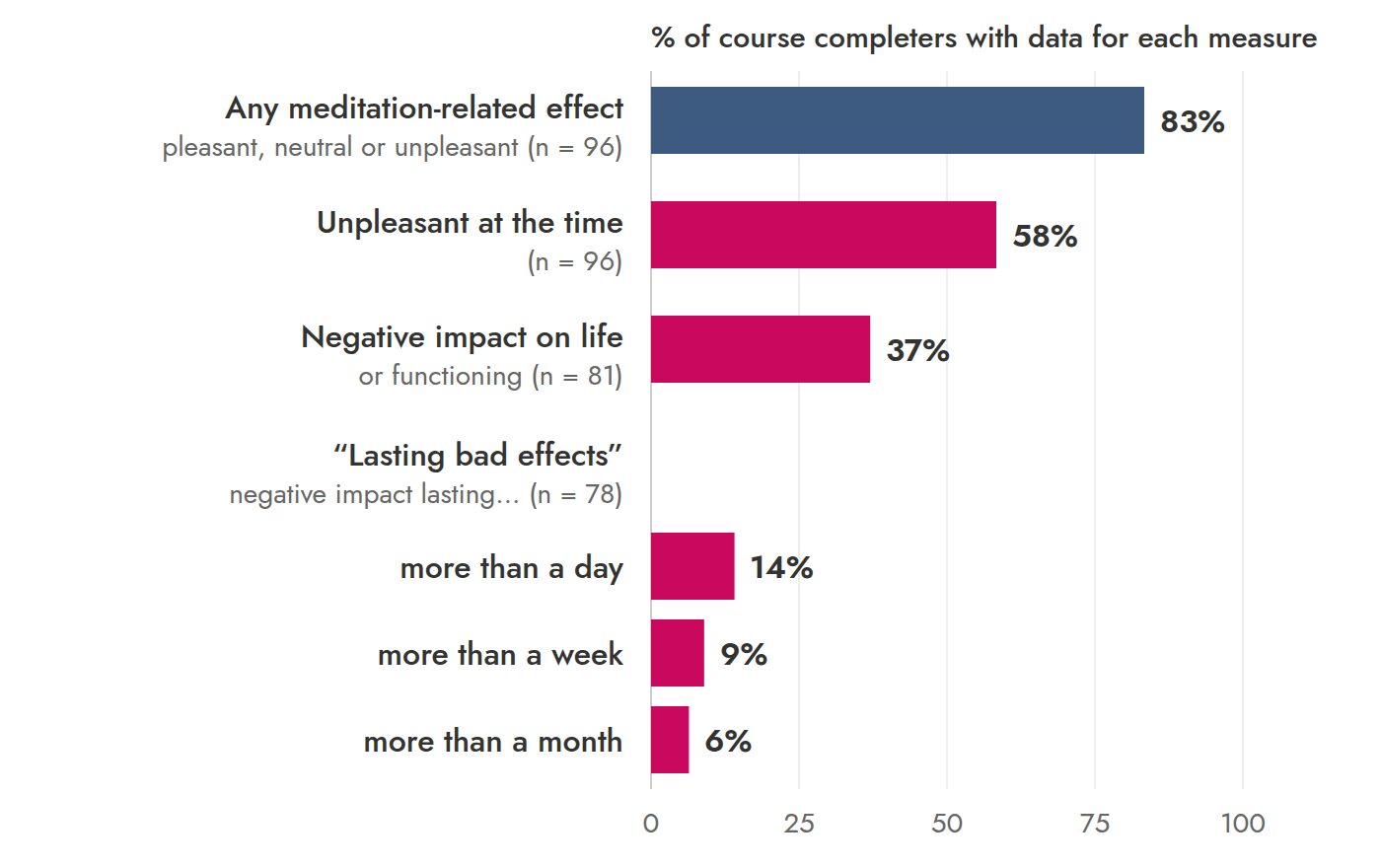
Of the 96 participants, 83% reported at least one meditation-related side effect, 266 in all. Not all were negative. Some felt neutral, mixed or even positive.
- Unpleasant at the time: 58% (56 of 96) had at least one effect that felt negative while it was happening.
- Negative impact on life: 37% (30 of the 81 with impact data) had at least one effect that interfered with daily life or functioning, called for extra help or changed their behavior, for example their willingness to meditate.
- Lasting bad effects: among the 78 with complete data, 14% had a negative impact lasting more than a day, 9% more than a week and 6% more than a month (in some cases still ongoing at the interview).
Most effects were brief. For 57% of participants, even their longest-lasting effect was over within an hour. The authors read the overall pattern as a sign that some discomfort is a normal part of learning to meditate:
Nearly 60% of the sample experienced at least one MRAE with a negative valence, suggesting that at least some transient distressing experiences during meditation are the norm and should be expected for most participants.
Here an MRAE is a meditation-related adverse effect, and a negative valence means it felt unpleasant. The authors compare their figures with studies of psychotherapy that also asked systematically, where 42–51% of clients reported new or worsening symptoms and 3–14% lasting bad effects. Those numbers come from other studies with different methods, so the comparison is a rough guide rather than a head-to-head test. Rates did not differ significantly between the three versions of the course, though the groups were small (about 30 people each).
Miscellaneous Interesting Takeaways
Asking One Broad Question Missed Most Effects
The broad opening question identified only 26 of the 80 participants (32.5%) who went on to report side effects when asked about specific experiences, missing nearly 70% of them. Its “yes” answers were also about as often false alarms as accurate: some people said yes but described nothing that met the study’s criteria. The authors argue that this is one reason published rates vary so much, and that studies relying on open questions or spontaneous reports probably undercount. A similar gap appeared in a later survey of US meditators by Goldberg, Britton and colleagues, where a general question picked up 32% and a specific checklist 50%.
Signs of Dysregulated Arousal Flagged Lasting Problems
The team looked at which experiences went with lasting bad effects. Most of the problematic ones fit what the authors call dysregulated arousal. One side is hyperarousal, such as anxiety and insomnia. The other is
dissociation
Dissociation is a disruption in the usual integration of thoughts, feelings, perceptions, memory and sense of self. Mild forms, such as daydreaming or ‘zoning out’, are common. More marked forms include depersonalization (feeling detached from oneself), derealization (feeling that the world is unreal) and emotional numbing. Dissociation can be a response to stress or trauma and is a feature of several psychiatric conditions.
More on Wikipedia
View in glossary
, such as emotional blunting,
derealization
Derealization is an experience in which the outside world feels unreal, distant, dreamlike or flat, as if seen through a fog or a pane of glass. It often occurs together with depersonalization. It can be a passing response to stress, fatigue or anxiety, and it is a symptom of some dissociative and anxiety disorders.
More on Wikipedia
View in glossary
and disturbances in the sense of self. Executive dysfunction (trouble with thinking skills such as concentration and decision-making), insomnia, emotional blunting and self-disturbance were each reported by fewer than 5% of participants. But when they occurred, the risk of a lasting bad effect (of more than a week) was 6 to 14 times higher. Anxiety, distorted sense of time and space, and re-living traumatic memories were more common (10–25%) but usually didn’t lead to lasting impairment. Because only seven people had a lasting bad effect of more than a week, these risk estimates rest on very few cases.
The dissociative experiences were less often felt as unpleasant, which matters for teachers. A calm, detached feeling may not seem like a problem, and depersonalization can feel calm rather than distressing to some long-term meditators. Yet in this study such experiences still carried a higher risk of lasting impairment. The authors conclude:
This means that re-appraisal of dissociative symptoms via non-judgmental acceptance is not sufficient to prevent impairment in functioning and should not constitute the only response.
Problems Came From Everyday Practice, Not Just Retreats
Where participants could say, 88% of effects happened during or right after meditation. Only about 6% were tied to the all-day silent retreat, and another 6% to a practice that deliberately invites a difficult emotion. Most arose during daily home practice or in class. People with lasting bad effects (of more than a week) did not do more formal practice. They did report more frequent informal practice (mindfulness woven into daily activities) after the course, 13.5 versus 4.3 times a week, and how often people practiced informally was weakly linked to how many negative-impact effects they had (r = .21). The authors read this as a sign of a dose-response relationship, though it is a correlation based on self-reported practice.
What the Study Can’t Say
The authors are open about the limits. With no group that didn’t meditate, the study relies on participants’ own judgment that an experience was new or worse and caused by meditation. Common complaints such as fatigue and digestive problems were reported but excluded for not meeting those criteria. The interview came three months after the course, so some experiences may have been forgotten. It covered only people who finished. At least one dropout left because of worsening symptoms, so the true rates may be higher. The sample was mostly white and carefully screened, and the authors expect that more diverse samples might report more harms. The interview took hundreds of hours to run and code, so the authors call for a validated, meditation-specific questionnaire that other researchers could use.
Final Reflection
The authors describe this as the first in-depth assessment of adverse effects in a mindfulness-based program. The study’s central message is about measurement: how often meditation “causes problems” depends heavily on how a problem is defined and how carefully anyone asks. Defined narrowly, as lasting harm, the rate here was 6–14%. Defined broadly, as anything that felt unpleasant, it was 58%.
None of this means mindfulness programs are unusually risky. All three versions of the course produced large improvements in depression, participants kept up their practice, and few dropped out. The authors suggest that participants found the difficulties worth tolerating for the benefits. What the study does suggest is that teachers and researchers should expect difficult experiences, ask about them directly, and watch in particular for detachment and numbness, not just for distress.
Citation
Britton, W. B., Lindahl, J. R., Cooper, D. J., Canby, N. K., & Palitsky, R. (2021). Defining and measuring meditation-related adverse effects in mindfulness-based programs. Clinical Psychological Science, 9(6), 1185–1204. 10.1177/2167702621996340
Get the next summary by email
One or two new paper summaries every couple of weeks, sent to your inbox when they go up.
No spam, and you can unsubscribe at any time. Prefer a feed reader? Use the RSS feed.