
Background Information
Most meditation research asks what practice does for people. Far less asks how often it goes badly. The site’s other posts on this theme approach that question in different ways. Lindahl and colleagues interviewed 60 Western Buddhists who had run into difficulties and catalogued 59 kinds of challenge. Because they recruited people who had struggled, their study could show what can happen but not how often it happens.
Marco Schlosser and colleagues at University College London, with collaborators in Germany and Slovenia, set out to count. Their aim was to estimate how many regular meditators have had a particularly unpleasant experience they connect to their practice, and to see which people and which kinds of practice those experiences go with. Only two earlier large surveys had tried this, the authors note. A 2017 survey by Cebolla and colleagues found that 25.4% of 342 meditators reported “unwanted effects,” and a 2018 survey by Vieten and colleagues that 32% of 1,120 meditators had felt “disturbing feelings of fear, dread, or terror” during or just after meditating.
The authors also had a conceptual concern. Words like adverse, negative or unwanted already judge an experience as harmful. Some contemplative traditions treat certain difficult experiences as a normal stage of practice, or even a sign of progress. So the team chose a more neutral label, “particularly unpleasant,” and used the paper to ask whether research should treat such experiences only as
side effects
Meditation-related adverse effects are unpleasant experiences that a person attributes to meditation practice, ranging from mild and brief to severe and lasting. Examples include anxiety, re-living traumatic memories, trouble sleeping and feeling disconnected from oneself or the world. Researchers usually record how long each effect lasted and whether it interfered with daily functioning.
View in glossary
.
What They Did
The team ran an anonymous online survey, which took about 20 minutes, between April and August 2017. They shared the link on Facebook and Twitter and sent it to Buddhist communities, meditation centres and mindfulness associations. To take part, people had to be at least 18, have good English and meditate at least once a week.
Of 2,599 people who started the survey, 1,706 finished it. The team then excluded 383 who practiced only yoga, 42 who named no meditation practice, 34 with less than two months of experience and 15 who skipped the key question. That left 1,232 regular meditators: 36% lived in Europe, 30% in Asia, 23% in North America and smaller numbers elsewhere. Their mean age was 44.8, and 53.6% were women. They were an experienced group, with a median of 6 years of regular practice, about 10 sessions a week of 28 minutes on average, and 63.5% had been on at least one meditation retreat.
The key measure was a single yes/no question:
Have you ever had any particularly unpleasant experiences (e.g., anxiety, fear, distorted emotions or thoughts, altered sense of self or the world), which you think may have been caused by your meditation practice?
Participants also filled in three questionnaires. One measured
repetitive negative thinking
Repetitive negative thinking is a habit of dwelling on problems and negative experiences, through worry about the future or rumination about the past, in a way that feels hard to stop and gets nowhere. It is common across many mental health problems, especially depression and anxiety. Researchers often measure it with the Perseverative Thinking Questionnaire.
More on Wikipedia
View in glossary
, the habit of worrying or ruminating about problems (scored 0 to 60). The others measured everyday
mindfulness
Mindfulness is the psychological process of purposely bringing one’s attention to experiences occurring in the present moment without judgment. It involves maintaining awareness of thoughts, feelings, bodily sensations, and surrounding environment with an attitude of curiosity and acceptance. In meditation contexts, mindfulness practices typically involve focusing attention on the breath or body sensations as anchors to the present moment while acknowledging and releasing distracting thoughts.
More on Wikipedia
View in glossary
and self-compassion.
They also listed which kinds of meditation they practiced. The team sorted these into three families, following a scheme proposed by Cortland Dahl, Antoine Lutz and Richard Davidson:
- Attentional practices train steady attention, for example mindfulness of breathing, breath counting, samatha, mantra recitation and the mindfulness taught in
MBSR
Mindfulness-Based Stress Reduction (MBSR) is a program designed to help individuals cope with stress, pain, and illness. Developed by Jon Kabat-Zinn in the 1970s, it combines meditation and yoga to promote awareness and stress management. The eight-week program teaches participants to focus on the present moment non-judgmentally, enhancing their ability to manage difficulties.
More on Wikipedia
View in glossary courses. - Constructive practices cultivate helpful emotional patterns, here loving-kindness and compassion meditation.
- Deconstructive practices investigate experience to loosen fixed beliefs about the self and the world. The survey counted
Vipassana
Vipassana is a form of Buddhist meditation focused on the cultivation of insight through moment-to-moment awareness of bodily sensations, thoughts, and emotions. It emphasizes non-reactivity and equanimity, helping practitioners observe mental and physical phenomena without attachment.
More on Wikipedia
View in glossary (insight meditation), Mahamudra, Dzogchen, Shikantaza (“just sitting”), self-inquiry and koan practice (the Zen practice of working with a paradoxical question).
For one analysis, the team compared 176 people who practiced only deconstructive types with 557 who practiced only attentional and/or constructive types. The rest, who mixed both kinds, were left out of that comparison, because the authors judged a mixed group too broad to be meaningful.
The statistics were simple. Each possible predictor (age, sex, education, religiosity, years of practice, sessions per week, session length, retreat experience, meditation type and the three questionnaire scores) was tested in its own logistic regression against the yes/no answer. Only religiosity got a second, adjusted model, which accounted for continent of residence.
One Big Result: One in Four Said Yes, and Retreat-Goers and Deconstructive Practitioners Said Yes More Often
Of the 1,232 meditators, 315, or 25.6% (95% confidence interval 23.1% to 28.0%), said they had had a particularly unpleasant experience that they thought meditation may have caused. That is close to the 25.4% in Cebolla’s survey.
Four characteristics went with a higher or lower chance of saying yes. The team reported each as an
odds ratio
An odds ratio compares the odds of an outcome in one group with the odds in another, where the odds are the chance something happens divided by the chance it doesn’t. An odds ratio of 1 means no difference, above 1 means higher odds in the first group, and below 1 lower odds. When an outcome is common, an odds ratio looks bigger than the difference in percentages: 30% versus 20% is an odds ratio of about 1.7.
More on Wikipedia
View in glossary
, which compares the odds of saying yes in one group with the odds in another (1 means no difference).
- Retreats: 29.0% of people who had ever attended a meditation retreat said yes, against 19.6% of those who never had (odds ratio 1.68, p < 0.001).
- Religion: 22.0% of religious participants said yes, against 30.6% of non-religious ones (odds ratio 0.64, p = 0.001). The link weakened only slightly after accounting for where people lived (odds ratio 0.72, p = 0.024).
- Type of practice: 29.6% of people who practiced only deconstructive types said yes, against 20.3% of those who practiced only attentional and/or constructive types (odds ratio 1.65, p = 0.011).
- Sex: 23.0% of women said yes, against 28.5% of men (odds ratio 0.75, p = 0.030). The authors call this weak evidence.
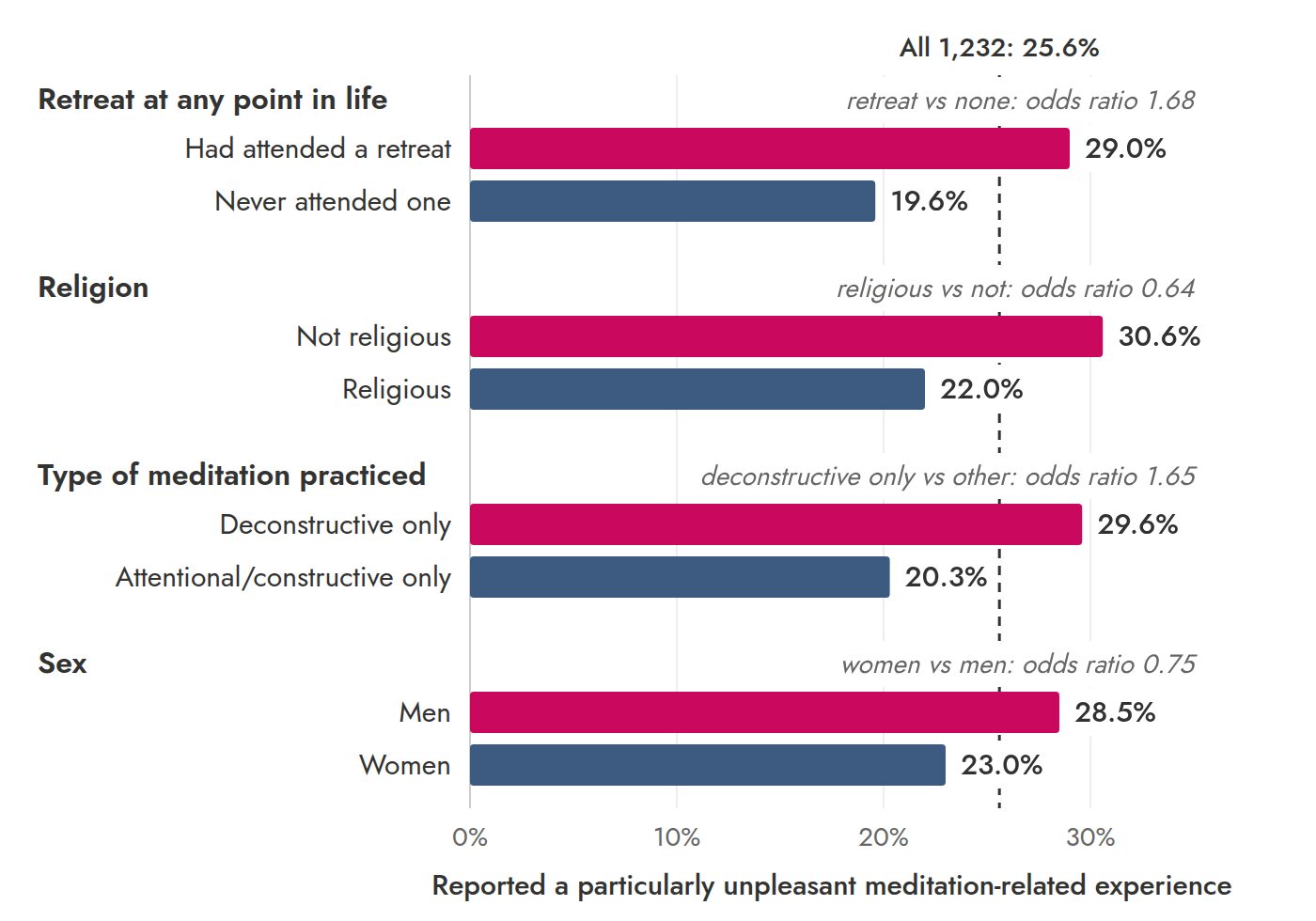
Odds ratios can sound bigger than the underlying difference. The “65% higher odds” for deconstructive-only practitioners, for instance, is a gap of about 9 percentage points (29.6% against 20.3%). These are moderate differences: in every group, somewhere between one in five and one in three people said yes.
The timing matters for how to read the retreat finding. The survey asked only whether someone had ever been on a retreat, not whether the unpleasant experience happened there. The authors are explicit about this:
Importantly, our data does not capture whether the particularly unpleasant meditation-related experiences happened before, during, or after a meditation retreat…
Miscellaneous Interesting Takeaways
Worry and Rumination Showed a Small Link
People with higher scores for repetitive negative thinking were slightly more likely to say yes (odds ratio 1.02, 95% CI 1.00 to 1.03, p = 0.025). The authors call the association “small in magnitude” and the evidence weak. They offer two readings and can’t choose between them. People prone to worry and rumination may find it harder to let go of distressing material that comes up in meditation. Or an unpleasant experience may itself set off long stretches of worry and rumination.
The abstract lists women, religious participants and repetitive negative thinking among its findings alongside retreats and deconstructive practice. In the results, though, the authors call the evidence for sex and repetitive negative thinking weak. The paper reports no correction for testing twelve possible predictors, so these two (each with p of about 0.03) are the likeliest to be chance findings.
Why Might Religious Meditators Report Fewer Problems?
The authors offer several possible explanations, none of which this survey could test. Religious meditators may live within one consistent framework for making sense of strange experiences, rather than several competing ones such as Buddhist and psychiatric views. They may have a stronger community, more contact with other practitioners and easier access to experienced teachers. Or they may simply be less willing to report such experiences, if unpleasant states carry stigma or seem to threaten their religious identity.
The first idea echoes Castillo’s argument about depersonalization: long-term meditators he interviewed experienced
depersonalization
Depersonalization is a dissociative experience characterized by feelings of detachment from one’s self, body, or mental processes. Individuals experiencing depersonalization may feel like an outside observer of their thoughts, feelings, or body, or they may feel as if they’re in a dream. It can occur as a temporary response to stress, as a symptom of psychiatric disorders, or as a feature of certain meditation experiences.
More on Wikipedia
View in glossary
as calm “witnessing,” because they had a framework that made it meaningful rather than frightening. Lindahl’s study likewise found that the way practitioners interpreted their difficulties shaped how distressing they were.
Deconstructive Practice and Retreats: Several Possible Explanations
Deconstructive practices deliberately probe the sense of a permanent, separate self. The authors suggest that experiencing the self as “a vibrating field of fleeting and interpenetrating sensations” could, for some, bring a fear of annihilation. They note that some traditions teach attentional and constructive practices first, partly to prepare students for this. But the arrow could run the other way. People already prone to difficult experiences might be drawn to deconstructive practice, or to retreats, where experienced teachers offer close guidance. Retreat experience might also stand in for something else, such as personality or motivation.
Because each predictor was tested alone, the survey can’t separate overlapping factors either. Retreat-goers and people practicing vipassana, for example, may be partly the same people.
The retreat link fits with Lindahl’s study, where about three-quarters of the reported difficulties were encountered during or immediately after a retreat. In Britton and colleagues’ mindfulness course study, by contrast, most adverse effects arose in everyday home practice and only about 6% were tied to the course’s silent day. That was a short course for beginners with a single retreat day, so the two studies describe very different practice settings.
How Much People Practiced Didn’t Matter
Years of practice, sessions per week and session length showed no link with unpleasant experiences, and neither did mindfulness, self-compassion, age or education. The authors contrast this with Cebolla’s survey, which they cite as finding unwanted effects more likely in sessions over 40 minutes. Cebolla’s paper actually reports only that most of the people with unwanted effects had been practicing for more than 20 minutes at a time, with no comparison against people without them. It also differs from Goldberg and colleagues’ US survey, where more lifetime hours of practice went with more adverse effects, though not with any impairment. The samples differ. Goldberg’s participants were mostly light practitioners who had tried meditation, recruited to roughly match the US population, and fewer than 7% had been on a residential retreat. Schlosser’s were committed, self-selected practitioners, most of whom had been on retreat.
One Question Can’t Say Much
The authors are frank that a single question can say only so much. Their data gave no indication of what kind of experience people meant, how severe it was, how long it lasted or what impact it had. A “yes” here could mean a frightening afternoon or months of impairment.
How you ask also changes the answer. In Britton’s study, a broad opening question picked up only about a third of the people who went on to report effects when asked about 44 specific experiences. In Goldberg’s survey, a general question found 32% and a 10-item checklist 50%. Schlosser’s question included examples, which may have helped recall, but the authors also note that listing examples could steer people toward those particular experiences. Other factors could push the 25.6% either way. The survey did not ask about earlier mental health problems, so some of what people reported may reflect conditions they already had, though the authors point out that participants were asked specifically about experiences they thought meditation may have caused. And the sample was self-selected, so it may not represent regular meditators in general.
Side Effect or Part of the Path?
The paper’s last section is as much philosophy as science. The authors argue that biomedical labels like “adverse event” may not fit everything that happens in meditation. Some traditions describe difficult experiences as integral to practice, and the authors want research to be able to tell those apart from experiences that are merely harmful. As they put it, the open question is:
are particularly unpleasant meditation-related experiences merely negative side effects or rather constitutive, perhaps even essential, elements of (especially rigorous) meditative practice?
If necessary difficulties are avoided, some benefits of practice might be lost. If unnecessary ones are cultivated, people might suffer for nothing. Answering that, they argue, will take long-term studies that follow meditators over time.
Final Reflection
This survey gives a rough but useful number: about a quarter of committed, regular meditators say they have had at least one particularly unpleasant experience they think meditation may have caused. That is not a measure of harm. The question didn’t ask about severity, and the paper can’t say which experiences were brief and which were lasting.
The more interesting results are the patterns. People who had attended retreats or who practiced only insight-style deconstructive meditation said yes more often, while religious participants said yes less often. None of these links can show that retreats or vipassana cause difficult experiences, and other explanations remain open, including that people prone to such experiences seek out these practices. Read alongside the other studies on this theme, the survey supports a modest conclusion: unpleasant experiences are a fairly common part of regular practice. The questions worth asking next, as the authors argue, are when they happen, how severe they are, for whom, and whether some of them are part of the path rather than a detour from it.
Citation
Schlosser, M., Sparby, T., Vörös, S., Jones, R., & Marchant, N. L. (2019). Unpleasant meditation-related experiences in regular meditators: Prevalence, predictors, and conceptual considerations. PLoS ONE, 14(5), e0216643. 10.1371/journal.pone.0216643
Get the next summary by email
One or two new paper summaries every couple of weeks, sent to your inbox when they go up.
No spam, and you can unsubscribe at any time. Prefer a feed reader? Use the RSS feed.