
Background Information
By the 2010s, many studies had documented benefits from meditation and mindfulness courses, but their harms had barely been counted. What the literature held was mostly case reports of severe reactions, such as psychosis, and trials that seldom reported unwanted effects at all. Ausiàs Cebolla of the University of Valencia and colleagues in Spain and Brazil argued that the spread of mindfulness in the West had come with “a gentle, positive vision of the technique, without the necessary balance related to the negative consequences of any practice.”
Their aim was to estimate how often meditators experience what they called unwanted effects, a broad term for
meditation-related adverse effects
Meditation-related adverse effects are unpleasant experiences that a person attributes to meditation practice, ranging from mild and brief to severe and lasting. Examples include anxiety, re-living traumatic memories, trouble sleeping and feeling disconnected from oneself or the world. Researchers usually record how long each effect lasted and whether it interfered with daily functioning.
View in glossary
, and to see whether the type, frequency or years of practice made a difference. They went in with three predictions: unwanted effects would be few, mild and temporary; they would be more frequent with more practice; and some types of meditation would be more prone to them than others.
The same year, Lindahl and colleagues published interviews with 60 Western Buddhists who had run into difficulties, cataloguing 59 kinds of challenge. Because those participants were chosen for having struggled, that study mapped what can happen. Cebolla’s team tried to count how often it happens.
What They Did
The team built an online survey and shared it from April 2013 to July 2015 through Spanish-, English- and Portuguese-language research websites on mindfulness and meditation, local and national mindfulness associations, Zen monasteries and the websites of meditation groups (sanghas). The invitation said the research was to “study the occurrence of certain unexpected (not normally expected) and/or unwanted effects during the practice of meditation or mindfulness”.
Of 914 people who opened the link, most of them Spanish speakers, 908 agreed to take part. The team then excluded 509 who did not complete the survey or answer it correctly, and 57 with less than two months of meditation experience, the minimum the authors judged necessary to learn to meditate. That left 342 participants. Their mean age was 39.7, and 68.4% were women. 42.9% were from Spain, about a third from Latin America (including 6.5% from Brazil), 7.3% from the US and Canada and 5.8% from the UK. Most (87.7%) had a university degree. At the time of the survey, 16.6% said they were experiencing depressive symptoms and 23.4% anxiety symptoms.
Participants described how often they did six kinds of practice: focused attention (keeping attention on one object, such as the breath), open monitoring (open awareness of whatever arises), body awareness, compassion, imagination, and informal practice (bringing mindfulness into daily activities). Informal practice was the most common daily practice (46.8% did it every day), followed by focused attention (30%). Compassion was the least practiced: 57.3% never did it.
The key measure was a single question with a yes or no answer:
Regarding the UEs, participants were first asked about the possibility “of having experienced any type of unwanted (not normally expected) or adverse reactions (with potential harm to your health) resulting from the practice of meditation” (“yes” or “no” options).
(UEs are unwanted effects.) People who said yes were asked to describe the reaction in their own words, along with where it happened (alone, in a group or on retreat), the type of practice and how long the session was. They were also asked whether the effect was continuous or temporary, whether they had stopped meditating and whether they had needed help from a medical centre or therapist. Three experts sorted the written descriptions into categories such as anxiety, pain and
depersonalization
Depersonalization is a dissociative experience characterized by feelings of detachment from one’s self, body, or mental processes. Individuals experiencing depersonalization may feel like an outside observer of their thoughts, feelings, or body, or they may feel as if they’re in a dream. It can occur as a temporary response to stress, as a symptom of psychiatric disorders, or as a feature of certain meditation experiences.
More on Wikipedia
View in glossary
, agreeing on 95% of them.
Finally, everyone was invited to rate a checklist of potential unwanted effects drawn from the literature, such as “greater self-criticism” and “boredom,” from 0 (“never”) to 10 (“frequently”). The aim was to catch effects that people had forgotten or not thought to mention. 276 people completed it, including those who had answered no.
One Big Result: A Quarter Reported Unwanted Effects, Mostly Temporary Where Described
Of the 342 meditators, 87 (25.4%) said yes: they had experienced an unwanted or adverse reaction that they attributed to meditation.
Only 41 of the 87 described what had happened. Their accounts fell into these groups:
- Anxiety, including panic attacks: 12 people. One wrote: “During a meditation a painful image came to my mind, and my heart started to beat fast, and I started to feel fear and panic.”
-
Depersonalization
Depersonalization is a dissociative experience characterized by feelings of detachment from one’s self, body, or mental processes. Individuals experiencing depersonalization may feel like an outside observer of their thoughts, feelings, or body, or they may feel as if they’re in a dream. It can occur as a temporary response to stress, as a symptom of psychiatric disorders, or as a feature of certain meditation experiences.
More on Wikipedia
View in glossary and Derealization Derealization is an experience in which the outside world feels unreal, distant, dreamlike or flat, as if seen through a fog or a pane of glass. It often occurs together with depersonalization. It can be a passing response to stress, fatigue or anxiety, and it is a symptom of some dissociative and anxiety disorders.
More on Wikipedia
View in glossary : 8. One person described awareness becoming “very close to me, and everything around me was becoming very distant.” - Dizziness or loss of consciousness: 6, for example a “feeling of falling into a void.”
- Pain in the stomach, head or muscles, or nausea: 5.
- Hypomania or depressive symptoms: 2, for example “feelings of being over-energized and an inability to sleep.”
- Emotional ups and downs (emotional lability): 2.
- Trouble focusing the eyes: 2.
- Other symptoms: 4.
Of the 43 people who said how long their effect lasted, 34 called it temporary and 9 continuous. Of the 44 who answered the follow-up questions, 33 had kept meditating and 11 had stopped. Five had needed help from a medical centre or therapist, which is 1.5% of all 342 participants.
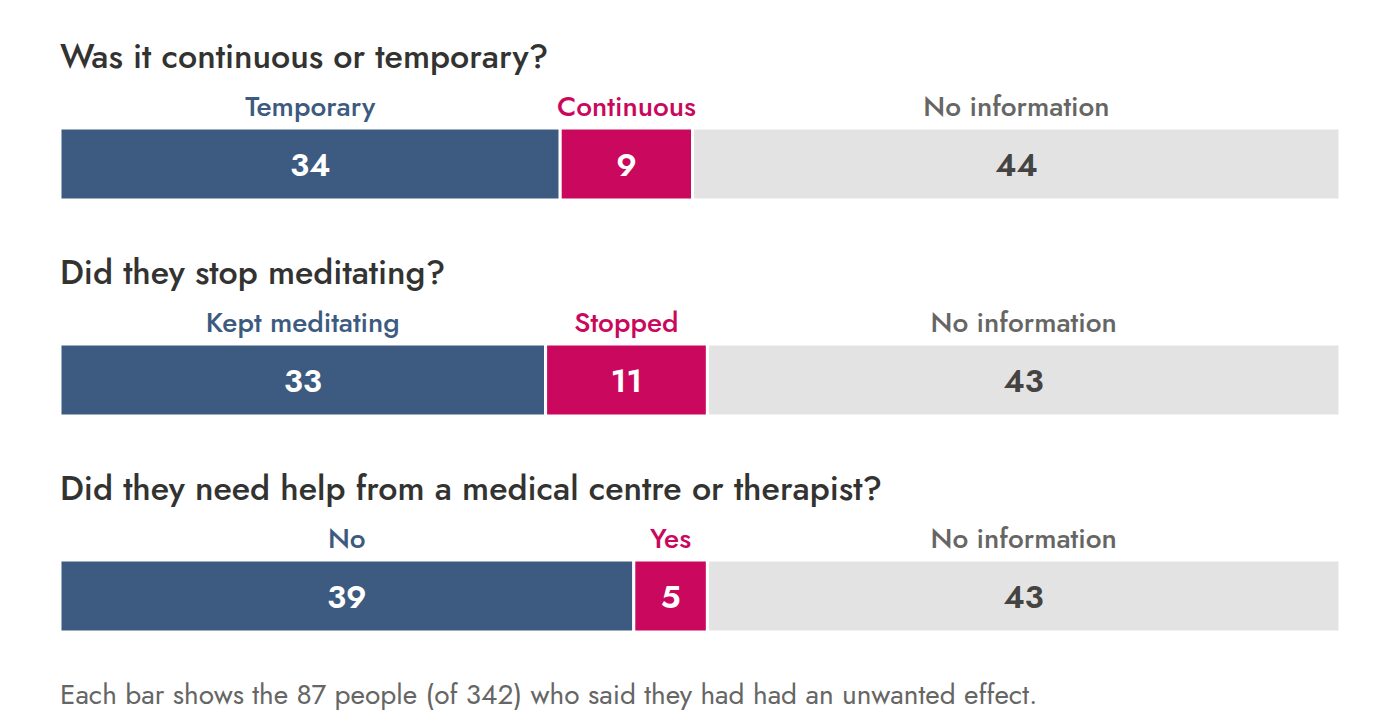
Among people who gave details, then, the picture is mostly of brief effects that didn’t stop people practicing. The large gap is the people who said yes and then said nothing more. The authors stress this themselves:
We found a high percentage of reported UEs (25.4% of respondents), although it must be emphasized that a great deal of essential information was lost because many participants (approximately 50%) did not provide complete details about the episodes.
The paper says the severity of the effects “varies considerably,” but the survey had no severity rating. Whether people stopped meditating or sought help is the closest it comes to measuring how serious an effect was.
Miscellaneous Interesting Takeaways
Alone, Focused Attention, Long Sessions: Counts, Not Risks
The abstract reports that unwanted effects were more often linked to practicing alone, to focused attention meditation and to sessions of more than 20 minutes. These figures come only from the people who reported an effect and said where or how it happened:
- Setting: of 57 who said, 36 were practicing alone, 12 were on retreat and 9 were in a group.
- Practice: of 40 who named one, 15 were doing focused attention, 8 open monitoring, 7 a body scan, 7 mantra meditation, 2 yogic breathing (pranayama) and 1 awareness of emotions.
- Session length: of 23 who gave one, 9 were meditating for more than 40 minutes, 9 for 21–40 minutes, 1 for 16–20 minutes and 4 for 5–15 minutes.
Without knowing how much of their practice time people spent in each setting or style, these counts can’t show that any of them is riskier. Focused attention, for instance, was the most widely practiced formal style in the sample: 81% did it at least once a month, against 43% for compassion. It would come up most often even if it were no riskier than the others. The authors make this point about practice settings and session length:
Prospective studies are necessary to weigh the percentage of total meditation time devoted to long sessions and group practice because it is possible that these findings are simply explained by the fact that most meditation time is made up of individual long sessions.
Few Predictors Held Up
The formal tests found little. Whether someone said yes was not related to current anxiety or depressive symptoms, to years of practice, to how they had learned to meditate (self-taught, from a religious teacher, in therapy, or on a secular course) or to their cultural background. For how often people did each of the six kinds of practice, only one link was significant: people who practiced body awareness more often reported fewer unwanted effects. The paper gives no group percentages or effect size for this, and it was one of at least a dozen tests (frequency and years for each of six practices) with no correction for
multiple comparisons
The multiple comparisons problem arises when researchers run many statistical tests at once. Each test has a small chance of a false positive, so across thousands of tests, such as one for every point in a brain scan, some “significant” results will turn up by chance alone. Corrections raise the bar for significance to keep the overall false-positive rate down, at the cost of making small real effects harder to detect.
More on Wikipedia
View in glossary
, so it could be a chance finding.
That leaves the second prediction, more practice bringing more unwanted effects, without support from the tests. The discussion nonetheless says the study “confirmed our second hypothesis that a higher frequency of practice may generate more UEs, especially in terms of the duration of the session,” which rests on the session-length counts above rather than on a comparison. Similarly, the discussion says focused attention went with higher checklist scores for “greater self-criticism” and “feeling that the time not spent meditating is wasted,” but the results section reports no such analysis.
The Checklist Turned Up Mostly Low Scores, and Some Unusual Items
On the 0–10 checklist, average scores ranged from 1.8 to 3.7. The highest were for greater self-criticism (3.7), greater emotional pain (3.3) and hypersensitivity to, or rejection of, urban life (3.3). For every item, between about 45% and 77% of people answered 0, and no item got the maximum score from more than 4.6% of people. The items given a 10 most often were “feelings of being alienated from society” (4.6%), “difficulty in feeling comfortable in the world” (4.2%) and a feeling that something is lacking (4.2%).
Several items are less about distress than about how meditators relate to other people, such as feeling superior to others (average 2.2), feeling that “only people who meditate are valuable” (1.8) and a “need for continuous meditation” (2.7). These are rarely asked about elsewhere.
The checklist is hard to interpret, though. There was no group of non-meditators to compare with, and some items, such as “greater awareness of their negative traits,” could be read as part of practice rather than a problem. The methods describe an 18-item list, while the results table lists 22 items. Scores on two items, greater emotional pain and need for continuous meditation, differed with how people had learned to meditate, but the differences were small (each explaining under 4% of the variation in scores), and the paper does not make clear which group comparisons belong to which item.
The Same Rate as Schlosser’s Survey, From a Different Question
Two years later, Schlosser and colleagues asked 1,232 mostly English-speaking regular meditators a similar single question, and 25.6% said yes, almost exactly the 25.4% found here. The two surveys share a design: an online, self-selected sample of people with at least two months of practice, a single yes/no question and a reliance on memory. But they asked different things. Cebolla’s question was about “unwanted (not normally expected) or adverse reactions (with potential harm to your health),” while Schlosser’s asked about “particularly unpleasant experiences” that meditation “may have” caused, with examples. The samples also differed: this one was smaller, mostly Spanish-speaking and 68% women, and did not require weekly practice.
The two surveys also differ in what they could say about predictors. Schlosser’s team tested each factor with
odds ratios
An odds ratio compares the odds of an outcome in one group with the odds in another, where the odds are the chance something happens divided by the chance it doesn’t. An odds ratio of 1 means no difference, above 1 means higher odds in the first group, and below 1 lower odds. When an outcome is common, an odds ratio looks bigger than the difference in percentages: 30% versus 20% is an odds ratio of about 1.7.
More on Wikipedia
View in glossary
and found that people who had been on retreat and those who practiced only insight-style meditation said yes more often. This survey ran few formal tests and found almost nothing. Both found no link with years of practice. A matching rate from two different questions and populations is striking, but neither sample represents meditators in general, so it could partly be coincidence.
Why 25% Could Be Too Low or Too High
Single broad questions tend to miss things. In Britton and colleagues’ mindfulness course study, a broad opening question picked up only about a third of the people who reported effects when asked about 44 specific experiences. In Goldberg and colleagues’ US survey, a general question found 32% and a specific checklist 50%. This question also asked only about reactions that were “not normally expected,” and it mentioned “potential harm to your health,” which may have set a higher bar than “unpleasant.”
Other factors could push the number up. The invitation named unwanted effects as the topic, and more than half of those who agreed to take part did not finish. The authors suggest the people who stayed may have been those keen to share their experiences, a form of
self-selection bias
Self-selection bias arises when people decide for themselves whether to take part in a study, so those who do may differ from those who don’t in ways that affect the results. A survey advertised as being about the unwanted effects of meditation, for example, may draw more people who have had such effects, making them look more common than they are among meditators in general.
More on Wikipedia
View in glossary
. They also note that in some traditions difficult experiences are seen as part of spiritual development, so some meditators may not have called them unwanted at all. That echoes Castillo’s interviews, in which long-term meditators experienced depersonalization as calm “witnessing,” whereas eight people here reported it as an unwanted effect.
Final Reflection
This was one of the first surveys to try to count unwanted effects of meditation, and the authors call it the first large-scale, multicultural one. Its headline number, a quarter of meditators reporting an unwanted or adverse reaction, was closely matched by a later survey. Among those who gave details, anxiety was the most common effect, most effects were temporary, most people kept meditating, and 5 needed professional help.
The weaknesses are large, though, and the authors are open about most of them. Half of the people who reported an effect said nothing more about it. The questions were not validated, the effects were recalled from memory, and the sample chose to take part in a study about unwanted effects. The links to practicing alone, focused attention and long sessions are counts among people who had problems, not comparisons of risk, and the discussion reads more into the results than the tests support. What the survey does show is that, when asked, a sizeable minority of meditators say practice has brought them something they did not want. The authors’ main recommendation follows from that: future trials should ask about unwanted effects with standardized questionnaires, as drug trials do for side effects.
Citation
Cebolla, A., Demarzo, M., Martins, P., Soler, J., & Garcia-Campayo, J. (2017). Unwanted effects: Is there a negative side of meditation? A multicentre survey. PLoS ONE, 12(9), e0183137. 10.1371/journal.pone.0183137
Get the next summary by email
One or two new paper summaries every couple of weeks, sent to your inbox when they go up.
No spam, and you can unsubscribe at any time. Prefer a feed reader? Use the RSS feed.