
Background Information
By 2018, eight-week courses such as
Mindfulness-Based Stress Reduction (MBSR)
Mindfulness-Based Stress Reduction (MBSR) is a program designed to help individuals cope with stress, pain, and illness. Developed by Jon Kabat-Zinn in the 1970s, it combines meditation and yoga to promote awareness and stress management. The eight-week program teaches participants to focus on the present moment non-judgmentally, enhancing their ability to manage difficulties.
More on Wikipedia
Read more in the glossary
and
Mindfulness-Based Cognitive Therapy (MBCT)
Mindfulness-based cognitive therapy (MBCT) is an 8-week group program that combines mindfulness meditation, adapted from Mindfulness-Based Stress Reduction (MBSR), with elements of cognitive behavioral therapy. It was developed to help people who have recovered from depression avoid relapse, by learning to notice and step back from patterns of negative thinking. Classes usually meet weekly, with daily meditation practice at home.
More on Wikipedia
Read more in the glossary
had a substantial research record for reducing stress, anxiety and depression. But they ask a lot: weekly group sessions in person and up to 45 minutes of home practice a day. Meditation apps had meanwhile become hugely popular, offering short, self-guided sessions on a phone at little cost. The evidence for those apps lagged far behind their download numbers.
The authors, who worked for Headspace, point to two weaknesses in the early app studies. Most compared the app with a
wait-list control group
A wait-list control group is a comparison group that receives the program being studied only after the study period, so participants who are waiting can be compared with those already taking part. It controls for the passage of time and repeated testing, but not for the attention, expectations and setting that come with taking part in any program, which an active control group can address.
More on Wikipedia
Read more in the glossary
or with no program at all, which can’t separate the effects of meditation from the effects of signing up for something meant to help. And others measured only
mindfulness
Mindfulness is the psychological process of purposely bringing one’s attention to experiences occurring in the present moment without judgment. It involves maintaining awareness of thoughts, feelings, bodily sensations, and surrounding environment with an attitude of curiosity and acceptance. In meditation contexts, mindfulness practices typically involve focusing attention on the breath or body sensations as anchors to the present moment while acknowledging and releasing distracting thoughts.
More on Wikipedia
Read more in the glossary
itself, rather than how people felt. It was also an open question whether a dose as small as 10 short sessions could do anything; some earlier work suggested that stress reductions take at least four weeks of practice to appear.
So the team set out to test the first 10 sessions of the Headspace app against an
active control
An active control group is a comparison group that takes part in a different program designed to be just as engaging as the one being tested. In meditation research, it might involve exercise, music, or education classes with the same time commitment, teachers, and expectations of benefit. Comparing against an active control helps separate the effects of meditation itself from the general effects of joining a course.
More on Wikipedia
Read more in the glossary
designed to match it as closely as possible.
What They Did
Participants were recruited through an email advertisement sent by a third-party recruitment service. To take part, people had to be 18 to 50, fluent in English, have no current or past psychiatric illness, have not meditated in the previous 6 months, have never used Headspace, and own a smartphone and a computer. Everything happened online, and those who finished received a £25 (or equivalent) Amazon voucher.
In this
randomized controlled trial
A Randomized Controlled Trial is a scientific study design that randomly assigns participants to either an experimental group receiving an intervention or a control group, allowing researchers to measure the true effect of the intervention while minimizing bias.
More on Wikipedia
Read more in the glossary
, eligible volunteers were assigned by computer to one of two programs, both delivered through the Headspace app:
- Meditation: the app’s introductory course “Take 10,” 10 sessions of about 10 minutes each, guided by Andy Puddicombe, a former Buddhist monk, that teach techniques such as breath awareness and the body scan.
- Audiobook: 10 excerpts of the same length from Puddicombe’s book The Headspace Guide to Meditation and Mindfulness, narrated by him. They explained the background and ideas of mindfulness and his experiences training as a Buddhist monk, with any guided exercises cut out.
Both groups saw the same screens and heard the same voice; only the content of the sessions differed. The app encourages one session a day, but this wasn’t enforced: people had up to a month to finish, received no reminders from the researchers, and in practice took about 16 days on average.
Before and after the program, everyone filled in three questionnaires about the past week:
- Stress Overload Scale: a 30-item measure of feeling that demands outweigh one’s resources. It has two halves, each scored from 12 to 60: event load, which the paper describes as stress resulting from external pressure, and personal vulnerability.
- Scale of Positive and Negative Experience: how often a person felt six positive and six negative feelings, combined into an “affect balance” score from −24 (unhappiest) to 24 (happiest).
- Brief Irritability Test: five statements about feeling frustrated and irritable, rated by how often they apply.
The paper reports the numbers of people at each step in its text and in a flow diagram. Of 171 people who responded to the advertisement, 11 were excluded at screening. According to the diagram, 87 were then assigned to the app and 82 to the audiobook. But 81 people dropped out after being randomized and before filling in even the first questionnaire: 33 of those assigned to the app (38%) and 48 of those assigned to the audiobook (59%). Of the 88 who started a program, 13 in the app group and 6 in the audiobook group didn’t finish it. That left 69 people who were analyzed: 41 in the app group and 28 in the audiobook group. The authors had calculated that 52 would be enough to detect the effect they expected.
The main analysis used only those who finished. As a check, the authors also ran an
intention-to-treat analysis
An intention-to-treat analysis counts every randomized participant in the group they were assigned to, whether or not they completed or even started the treatment. It keeps the benefit of randomization, since dropping people who didn’t follow their plan can leave groups that differ in other ways, and it estimates what happens when a treatment is offered in practice rather than when it is taken exactly as intended.
More on Wikipedia
Read more in the glossary
that included everyone who had given baseline data (87 people), though not the 81 who left before then.
One Big Result: The App Group Improved More on Mood, Irritability and Stress From Outside Pressure
On three of the four scores, the app group changed more than the audiobook group:
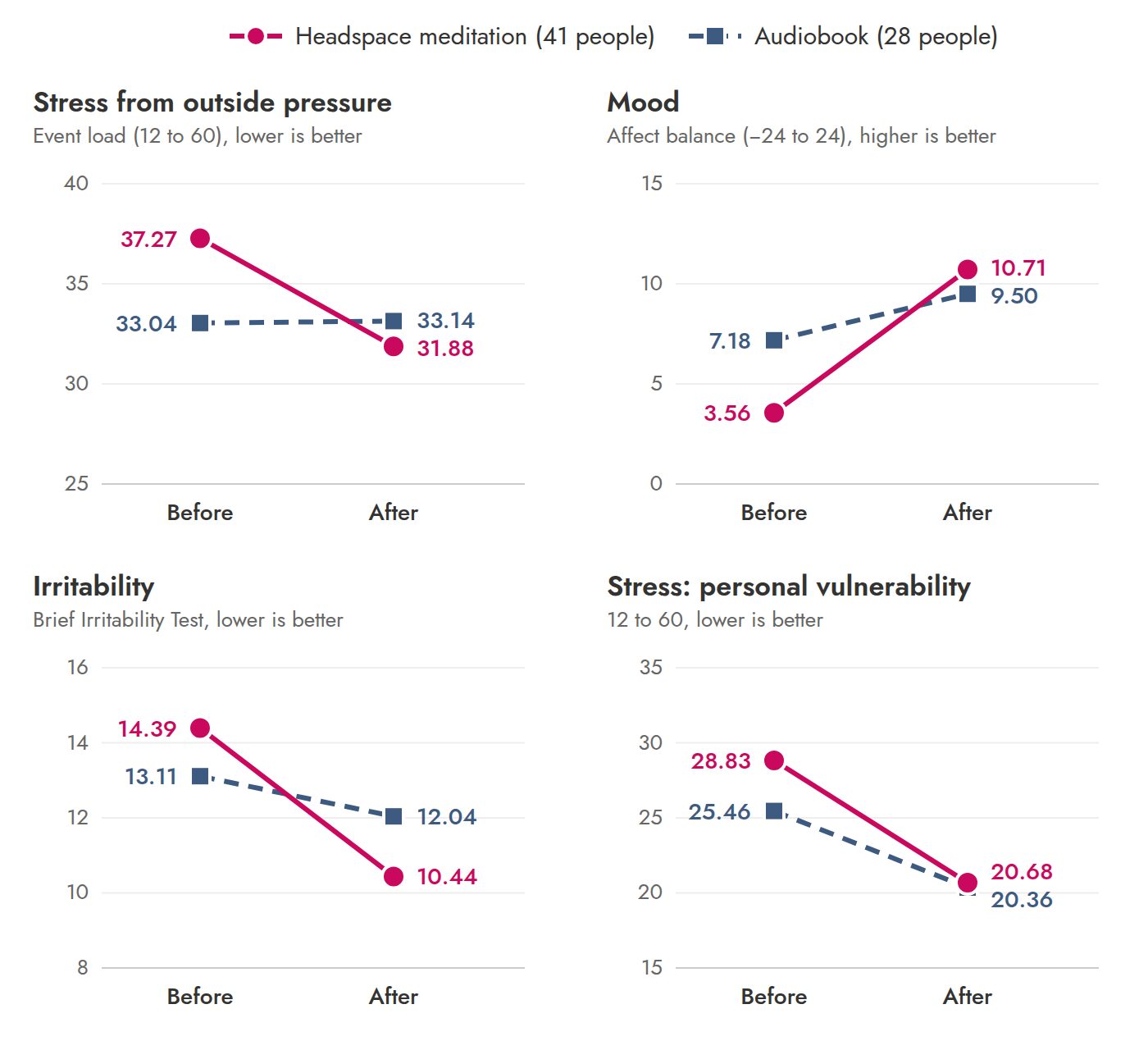
- Stress from outside pressure (event load): the app group’s scores fell from 37.27 to 31.88, while the audiobook group’s didn’t change (33.04 to 33.14). The difference in change between the groups was significant (p = .004).
- Mood (affect balance): the app group rose from 3.56 to 10.71 and the audiobook group from 7.18 to 9.50, a rise that just missed significance on its own (p = .06). The app group’s larger gain was significant (p = .01).
- Irritability: the app group fell from 14.39 to 10.44, while the audiobook group’s small drop, from 13.11 to 12.04, was not significant (p = .25). The difference between the groups was significant (p = .022).
The
effect sizes
Effect size is a statistical concept that quantifies the magnitude or strength of a relationship, difference, or intervention outcome. Unlike p-values which only indicate statistical significance, effect sizes measure how meaningful a result is in practical terms. Common measures include Cohen’s d (standardized mean difference), correlation coefficients (r), and odds ratios. In meditation research, effect sizes help quantify the practical impact of different meditation practices on psychological or physiological outcomes.
More on Wikipedia
Read more in the glossary
for these differences between the groups were 0.45, 0.47 and 0.44, which are small-to-moderate by the usual conventions. The authors note that the stress effect is close to the averages earlier reviews had found for stress in online (0.40) and in-person (0.51) mindfulness programs. All three results held up in the intention-to-treat analysis.
The fourth score went differently. Stress from personal vulnerability fell substantially in both groups (from 28.83 to 20.68 with the app, and from 25.46 to 20.36 with the audiobook), and the difference between them was not significant (p = .09; effect size 0.26). In the authors’ words:
This revealed that stress relating to personal vulnerability was effectively reduced by both the mindfulness and audiobook interventions, suggesting that this benefit was not unique to the practice of mindfulness.
That shared improvement is a reminder of why an active control matters. Without the audiobook group, the drop in personal-vulnerability stress would have looked like a benefit of meditation. Even “effectively reduced by both” claims more than this design can show, though: with no group that received nothing, the drop could also reflect the passage of time, expectations, or people who joined during a stressful patch drifting back toward their usual level.
Miscellaneous Interesting Takeaways
The Researchers Worked for Headspace
The paper’s conflict-of-interest statement is short:
ME, JM, MJB, and BS were employed by Headspace Inc. at the time of conducting this study.
That is, the company that makes the app designed the study, ran it, analyzed the data and wrote the paper, and both programs being compared were the company’s own products. The study was approved by the University College London ethics committee, and the paper is open about the affiliation, but no independent team was involved in collecting or analyzing the data. That doesn’t mean the results are wrong. It does mean they are worth weighing alongside independent trials, and it may explain some of the paper’s framing: it twice describes the app’s popularity and top rating, and the discussion concludes that mindfulness training via Headspace “is at least as affective [sic] at reducing stress associated with external pressure as other digital platforms or in-person programs,” a comparison resting on one effect size from one small trial set against averages from reviews of many.
The App Group Started Out Worse
Before the programs began, the app group reported more stress on both halves of the stress scale, lower mood and more irritability than the audiobook group. None of these gaps was statistically significant on its own, and randomization would be expected to produce some imbalance. But the gaps all point the same way, and afterward the app group had caught up, ending slightly ahead on three scores (the chart above shows this). Part of the app group’s larger improvement may therefore reflect starting from a worse point, since people who score high on a questionnaire about their recent stress tend to score lower the next time anyway, a pattern known as
regression to the mean
Regression to the mean is the tendency for unusually high or low measurements to be followed by ones closer to average, because part of any single measurement is chance. People who score as very stressed on a questionnaire one week will, on average, score a little less stressed the next, with or without treatment. In a trial, a group that happens to start out worse can therefore seem to improve more, which is one reason researchers compare against a control group and adjust for starting scores.
More on Wikipedia
Read more in the glossary
. The paper’s analysis compares changes between the groups without adjusting for starting scores, so it can’t tell these explanations apart.
Who Dropped Out, and When
The uneven dropout before anyone started is the study’s biggest weakness. Randomization only guarantees comparable groups if the people assigned stay in, and here 59% of those assigned to the audiobook left before filling in a single questionnaire, against 38% of those assigned to the app. People were randomized before filling in anything and were then sent the baseline questionnaires along with a voucher code that unlocked their program, so some may have seen what they’d been given and lost interest. The paper says the reasons are unknown. Either way, the people who stayed in the audiobook group may differ from those who stayed in the app group in ways that matter. The intention-to-treat check guards against bias from those who quit partway, but not from these early losses.
Self-Report, Expectations and No Follow-Up
Every outcome was a questionnaire about how the past week had felt. Both programs were presented as well-being programs, but someone who has been listening to a book about meditation may well be able to tell they haven’t been meditating. Most people in the study already believed meditation could improve well-being: 71% of the app group’s finishers agreed or strongly agreed, compared with 57% of the audiobook group’s, a difference that wasn’t significant. Expectations after assignment weren’t measured.
The authors list the study’s other limits themselves. It measured nothing after the program ended, so it can’t say whether the changes lasted or whether people kept meditating. It didn’t measure mindfulness, so it can’t say whether mindfulness was the reason for the changes. Audiobook listeners might have tried meditating on their own. And the participants were broadly typical of the general population in stress, mood and irritability, not people with high stress or a mental health condition:
Similarly, the majority of participants in our study identified as White/Caucasian, had a university degree, and had positive expectations about the benefits of meditation prior to beginning the intervention. These characteristics substantially limit the generalizability of the results…
Some Statistical and Reporting Details
- Four outcomes, no correction. The paper tested four scores without adjusting for
multiple comparisons
The multiple comparisons problem arises when researchers run many statistical tests at once. Each test has a small chance of a false positive, so across thousands of tests, such as one for every point in a brain scan, some “significant” results will turn up by chance alone. Corrections raise the bar for significance to keep the overall false-positive rate down, at the cost of making small real effects harder to detect.
More on Wikipedia
Read more in the glossary . With a simple Bonferroni correction (a calculation not in the paper), which would require p below .0125, the irritability result (p = .022) would no longer count as significant; the stress and mood results would. - The confidence intervals don’t fit the effect sizes. Table 2 gives between-group effect sizes of about 0.45 with
confidence intervals
A confidence interval is the range of values that a study’s data are consistent with, given the uncertainty that comes from measuring a limited sample. A 95% confidence interval for an effect of 0.30 running from 0.00 to 0.59, for example, means the true effect could plausibly be anywhere from nothing to moderate. Narrower intervals mean more precise estimates; an interval that includes zero means the study can’t rule out no effect.
More on Wikipedia
Read more in the glossary each running from below −1 to above +2. Intervals that wide would mean the study couldn’t rule out a large harm, which doesn’t square with the significant tests. They look like a calculation or reporting error, so the significance tests are the better guide. - Other inconsistencies. The irritability test is described as an average of five items scored 1 to 6, but the reported scores (around 10 to 14) look like totals rather than averages. The flow diagram lists 160 people as randomized, though the numbers it assigns to the two groups add up to 169. None of these changes the main comparisons, but they suggest the paper wasn’t checked closely.
- Who benefited. Exploratory analyses found that age, gender, education, ethnicity, beliefs about meditation and the number of days taken to finish didn’t predict how much anyone improved. The authors note those analyses were underpowered.
Final Reflection
This trial asked a practical question that matters to millions of app users: does a brief, self-guided introduction to meditation do anything measurable? For these 69 healthy beginners, ten 10-minute sessions on the Headspace app went with better mood, less irritability and less stress from outside pressure than listening to the same teacher talk about mindfulness for the same amount of time. Its best feature is that comparison: an audiobook delivered through the same app, in the same voice, is a much stronger control than a wait list, and it showed that one kind of stress fell in the audiobook group too, without any meditation.
The abstract concludes that “smartphone apps are an effective delivery medium for mindfulness training.” One small, short, company-run trial can’t carry that much weight. The analyzed groups were shaped by uneven dropout before the programs started, the app group began with somewhat worse scores, every outcome was self-reported by people who knew which program they had, and nothing was measured after the last session. The differences between the groups were modest.
Independent work on this site suggests how to calibrate. A review of 47 trials with active controls found that mindfulness programs eased anxiety and depression only slightly more than matched programs, and that the evidence on stress was weak. And like the four short mindfulness sessions tested against The Hobbit, this study shows that a very small dose can produce measurable short-term differences against an audiobook. It is a reasonable early signal that a few minutes a day on an app may help people feel a little better, one that needed independent trials with longer follow-up to confirm.
Citation
Economides, M., Martman, J., Bell, M. J., & Sanderson, B. (2018). Improvements in stress, affect, and irritability following brief use of a mindfulness-based smartphone app: A randomized controlled trial. Mindfulness, 9(5), 1584–1593. 10.1007/s12671-018-0905-4
Get the next summary by email
One or two new paper summaries every couple of weeks, sent to your inbox when they go up.
No spam, and you can unsubscribe at any time. Prefer a feed reader? Use the RSS feed.