
Background Information
Mindfulness-based therapies have spread quickly into clinics over the past two decades, and so have doubts about how good the evidence for them really is. Critics have pointed out that many trials compare mindfulness with a
wait-list control group
A wait-list control group is a comparison group that receives the program being studied only after the study period, so participants who are waiting can be compared with those already taking part. It controls for the passage of time and repeated testing, but not for the attention, expectations and setting that come with taking part in any program, which an active control group can address.
More on Wikipedia
Read more in the glossary
, which shows only that doing something beats doing nothing, and that trials don’t always specify which symptoms a program is supposed to change. Others worry about selective publication:
Others have questioned the degree to which selective reporting of results may introduce systematic bias into the literature, thereby overstating the efficacy of mindfulness-based interventions…
A large earlier review by Goyal and colleagues took a strict approach. It kept only trials with an
active control group
An active control group is a comparison group that takes part in a different program designed to be just as engaging as the one being tested. In meditation research, it might involve exercise, music, or education classes with the same time commitment, teachers, and expectations of benefit. Comparing against an active control helps separate the effects of meditation itself from the general effects of joining a course.
More on Wikipedia
Read more in the glossary
and found that mindfulness programs eased anxiety, depression and pain slightly more than programs matched for time and attention, but showed no advantage over established treatments such as exercise or therapy.
Simon Goldberg, Richard Davidson, the psychotherapy researcher Bruce Wampold and colleagues set out to probe those findings further. Instead of keeping only some kinds of comparison, they included them all and graded each by how demanding it was. That let them ask the question clinicians most want answered: how does mindfulness compare not just with nothing, but with the treatments people with a given disorder would otherwise receive?
What They Did
The team searched four research databases and a public repository of mindfulness studies for
randomized controlled trials
A Randomized Controlled Trial is a scientific study design that randomly assigns participants to either an experimental group receiving an intervention or a control group, allowing researchers to measure the true effect of the intervention while minimizing bias.
More on Wikipedia
Read more in the glossary
published up to January 2017. To qualify, a trial had to:
- enroll adults with a psychiatric condition for which the American Psychological Association lists evidence-based treatments. Participants needed a formal diagnosis or symptoms above a standard cut-off, such as a score above 13 on the Beck Depression Inventory. Stress alone did not count;
- test a program with mindfulness meditation as a core part and home practice, delivered live over more than one session. Programs that mix meditation with other techniques, such as
mindfulness-based cognitive therapy (MBCT)
Mindfulness-based cognitive therapy (MBCT) is an 8-week group program that combines mindfulness meditation, adapted from Mindfulness-Based Stress Reduction (MBSR), with elements of cognitive behavioral therapy. It was developed to help people who have recovered from depression avoid relapse, by learning to notice and step back from patterns of negative thinking. Classes usually meet weekly, with daily meditation practice at home.
More on Wikipedia
Read more in the glossary , were included. Therapies that teach a mindful attitude without formal meditation, such as Acceptance and Commitment Therapy (ACT) and Dialectical Behavior Therapy (DBT), were not, nor were mantra meditation and programs delivered only by app or video; - report symptoms specific to the disorder, such as depression scores for people with depression or abstinence for smokers.
From 5,582 unique records, 171 studies qualified. They covered 142 independent groups of participants, 12,005 people in all, published between 2000 and 2016. Participants averaged 44 years old, 64% were women, and 44% of the trials were run in the United States. Depression was the most studied condition (30% of trials). Others included anxiety disorders, chronic pain, smoking and other addictions, schizophrenia, weight and eating problems, and insomnia.
The key step was grading each comparison group into one of five tiers:
- No treatment: the comparison group got nothing beyond what the mindfulness group also got, as on a wait-list.
- Minimal treatment: something very brief, such as 5- to 10-minute counseling sessions for smokers.
- Non-specific active control: an activity with no rationale for how it would help, a kind of psychological placebo. One trial’s control group discussed air travel, shopping and places they had lived.
- Specific active control: a real therapy with a rationale and specific ingredients, such as a form of short-term psychodynamic psychotherapy, but not one established for that disorder.
- Evidence-based treatment: a treatment recognized as effective for that particular disorder, such as cognitive behavioral therapy (
CBT
Cognitive behavioral therapy (CBT) is a structured, usually short-term talk therapy that helps people notice and change unhelpful patterns of thinking and behavior. It is one of the most thoroughly tested psychological treatments and a first-line option for depression, anxiety disorders and many other conditions.
More on Wikipedia
Read more in the glossary ) or antidepressants. The authors’ example is a trial comparing mindfulness-based stress reduction ( MBSR Mindfulness-Based Stress Reduction (MBSR) is a program designed to help individuals cope with stress, pain, and illness. Developed by Jon Kabat-Zinn in the 1970s, it combines meditation and yoga to promote awareness and stress management. The eight-week program teaches participants to focus on the present moment non-judgmentally, enhancing their ability to manage difficulties.
More on Wikipedia
Read more in the glossary ) with CBT-I Cognitive behavioral therapy for insomnia (CBT-I) is a structured, usually short-term talk therapy for chronic sleeplessness. It combines changes to sleep habits and schedules, such as limiting time in bed, with work on unhelpful thoughts about sleep. It is widely recommended as a first-line treatment for insomnia.
More on Wikipedia
Read more in the glossary in people with cancer and insomnia.
For each group in each trial, the team measured how much symptoms changed from before to after treatment, and then compared the change in the mindfulness group with the change in the comparison group. The result is an
effect size
Effect size is a statistical concept that quantifies the magnitude or strength of a relationship, difference, or intervention outcome. Unlike p-values which only indicate statistical significance, effect sizes measure how meaningful a result is in practical terms. Common measures include Cohen’s d (standardized mean difference), correlation coefficients (r), and odds ratios. In meditation research, effect sizes help quantify the practical impact of different meditation practices on psychological or physiological outcomes.
More on Wikipedia
Read more in the glossary
in Cohen’s d units, where 0.2 is conventionally called small, 0.5 medium and 0.8 large; positive values favor mindfulness. They pooled these in a
meta-analysis
A meta-analysis statistically combines the results of many earlier studies on the same question. Pooling the data can estimate an overall effect more precisely than any single study and show whether results agree across studies. Its conclusions are only as good as the studies it includes and how similar they are.
More on Wikipedia
Read more in the glossary
for each tier, first across all disorders and then for each disorder that had at least four trials with that kind of comparison. They did this at the end of treatment and at the longest follow-up, which 79 samples reported, on average 6.4 months later.
One Big Result: Mindfulness Beat Weaker Comparisons and Matched Proven Treatments
The kind of comparison mattered a great deal: the tougher the comparison, the smaller mindfulness’s advantage. At the end of treatment, mindfulness therapies did better than:
- No treatment: d = 0.55 (89 comparisons), a medium effect;
- Minimal treatment: d = 0.37 (only 4 comparisons);
- Non-specific active controls: d = 0.35 (9 comparisons);
- Specific active controls: d = 0.23 (42 comparisons), a small effect.
Against evidence-based treatments, there was no difference at all: d = −0.004 across 28 comparisons, with a 95%
confidence interval
A confidence interval is the range of values that a study’s data are consistent with, given the uncertainty that comes from measuring a limited sample. A 95% confidence interval for an effect of 0.30 running from 0.00 to 0.59, for example, means the true effect could plausibly be anywhere from nothing to moderate. Narrower intervals mean more precise estimates; an interval that includes zero means the study can’t rule out no effect.
More on Wikipedia
Read more in the glossary
of −0.15 to 0.14.
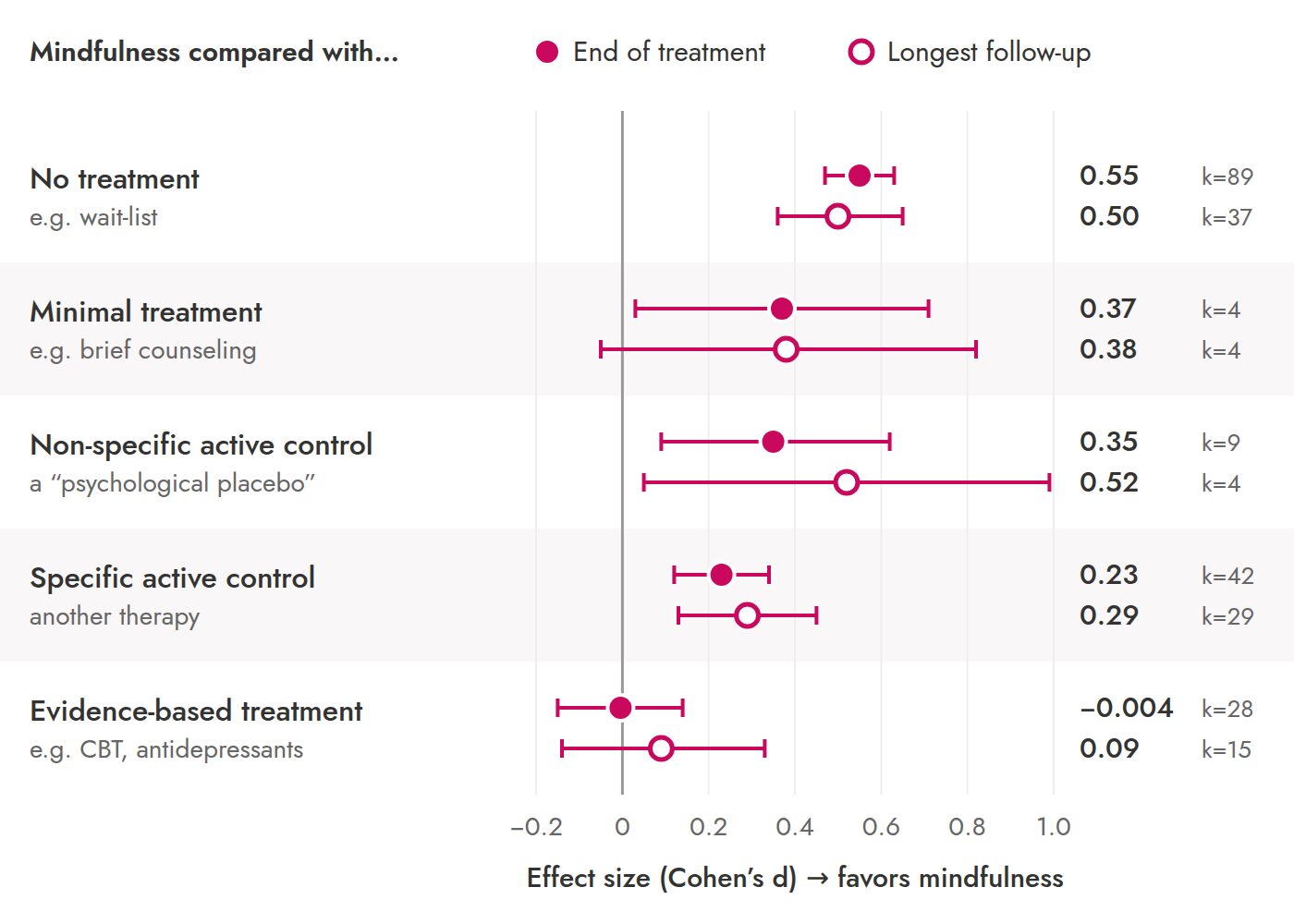
The pattern largely held at follow-up. Mindfulness still beat no treatment (d = 0.50), non-specific controls (d = 0.52, from only 4 comparisons) and other therapies (d = 0.29), and still didn’t differ from evidence-based treatments (d = 0.09, 95% CI −0.14 to 0.33, 15 comparisons). The one change was minimal treatment, where the advantage (d = 0.38) was no longer statistically significant, again with only 4 comparisons.
The authors summarize:
Mindfulness treatments were shown, in general, to be of similar potency with first-line psychological (and psychiatric) interventions when compared directly and superior to other active comparison conditions (as well as waitlist control conditions), with relatively little variation across disorders.
“No difference” isn’t quite the same as “just as good.” The authors didn’t run a formal equivalence test, and these 28 comparisons pool several disorders and many different treatments. Still, at the end of treatment the confidence interval is narrow enough to rule out a large difference in either direction. At follow-up, with fewer trials, it is wider.
Miscellaneous Interesting Takeaways
Depression Had the Clearest Evidence
Because the team only analyzed a disorder within a comparison tier when at least four trials were available, only some combinations could be tested. Depression was the only condition with enough trials to be tested against no treatment, other therapies and evidence-based treatments at both time points, and the authors call it the clearest case. Mindfulness beat no treatment and beat other therapies (at follow-up, d = 0.35), and did about as well as evidence-based treatments such as antidepressants and CBT (at follow-up, d = 0.04). That fits with the pooled data on MBCT for relapse prevention and a large trial in which MBCT did about as well as staying on antidepressants.
Other disorders had thinner evidence:
- Anxiety: better than no treatment, and no different from other therapies or evidence-based treatments.
- Pain: better than no treatment at both time points, and no different from other therapies.
- Smoking: mindfulness outperformed evidence-based smoking treatments, such as cessation programs promoted by the American Lung Association (d = 0.42). This was the only disorder where mindfulness beat an evidence-based treatment.
- Other addictions: a mixed picture. Mindfulness beat other therapies (d = 0.27) but not, statistically, no treatment (d = 0.35, 95% CI −0.06 to 0.76). The authors put this down to the five no-treatment trials being few and small, averaging about 30 participants each.
- Schizophrenia and weight and eating problems: better than no treatment; for weight and eating, no different from other therapies.
Across all the no-treatment comparisons at the end of treatment, the disorder-specific effects for anxiety, depression, pain, schizophrenia and weight and eating ranged from d = 0.45 to 0.89. The authors’ bottom line:
Based on our findings, it appears that the strongest recommendation can be made for mindfulness treatments for depression with evidence also supporting the use of mindfulness for treating pain conditions, smoking, and addictive disorders.
Some of these disorder results are fragile. The advantage over other therapies for addictions lost statistical significance when each trial contributed only its most rigorous comparison group (d = 0.29, 95% CI −0.04 to 0.62). The follow-up advantage over other therapies for depression did the same when trials of people with two conditions contributed only one of them (d = 0.15, 95% CI −0.13 to 0.44).
Why This Review Found More Than Goyal’s
Goyal and colleagues found no evidence that mindfulness beat other active treatments, while this review found a small advantage (d = 0.23). The authors suggest two reasons: they looked only at the symptoms specific to each disorder, and pooling many more trials across disorders gave them more statistical power to detect a difference. The two reviews also asked about different people. Goyal included people with medical conditions such as heart disease and cancer, and people under stress, while this review required a psychiatric diagnosis or clinical-level symptoms. Notably, the “specific active controls” here are therapies that are not established for the disorder in question. Beating them is a weaker claim than beating an evidence-based treatment, and against those this review, too, found no advantage, only parity.
Checks for Bias Mostly Held Up, With Caveats
The team checked for
publication bias
Publication bias arises when studies with positive or striking results are more likely to be published than studies that find nothing. A meta-analysis that pools only published studies can then overestimate how well a treatment works. Researchers check for it with tools such as funnel plots and Egger’s test, which need a reasonable number of studies to be informative.
Read more in the glossary
by looking for lopsided funnel plots, a sign that small studies with unfavorable results are missing, and found signs of it in several analyses. A standard correction, trim-and-fill, which estimates and adds the apparently missing studies, lowered some estimates but changed only one conclusion: the follow-up advantage over no treatment for schizophrenia was no longer significant. The search covered only peer-reviewed journal articles in English, so unpublished trials and dissertations were left out.
Trial quality was uneven. Only 41% of comparisons gave both groups the same amount of treatment time, about 55% of studies reported an
intention-to-treat analysis
An intention-to-treat analysis counts every randomized participant in the group they were assigned to, whether or not they completed or even started the treatment. It keeps the benefit of randomization, since dropping people who didn’t follow their plan can leave groups that differ in other ways, and it estimates what happens when a treatment is offered in practice rather than when it is taken exactly as intended.
More on Wikipedia
Read more in the glossary
analysis, and about 49% included at least one measure that wasn’t self-report, such as a clinician’s diagnosis or biologically confirmed abstinence. None of these features predicted how well mindfulness did, with one exception: among trials against non-specific controls, those with objective outcomes showed a much smaller effect at follow-up (d = 0.25) than those without (d = 1.34). That comparison rests on only a handful of trials, but it is a reminder that self-report questionnaires can flatter a treatment.
Results also varied widely. Within every comparison tier except minimal treatment, there was significant
heterogeneity
In a meta-analysis, heterogeneity is how much the results of the pooled studies differ from one another beyond what chance alone would produce, for example because they enrolled different people or compared the treatment with different things. It is often summarized by the I² statistic, the share of the variation due to real differences between studies; values of 50% or more are usually read as substantial. High heterogeneity makes a single pooled number harder to interpret.
More on Wikipedia
Read more in the glossary
, meaning the trials disagreed more than chance would explain. A single pooled number hides that spread.
What the Study Can’t Say
The authors acknowledge that the trials were unevenly spread: many disorders and comparisons had too few studies to analyze, and direct comparisons with first-line treatments were scarce. They also lumped related outcomes and disorders together, such as pain intensity with pain-related functioning, and obesity with eating disorders, which could hide differences between them. They could not test how much practice matters or who benefits most, because the trials didn’t report enough. Some trials contributed more than one comparison, because they had several control groups or participants with two conditions, though the sensitivity analyses that removed these duplicates left most conclusions unchanged. Finally, the authors disclosed that co-author Richard Davidson founded and leads a non-profit organization, Healthy Minds Innovations, and sits on the board of the Mind and Life Institute, which also funded the first author through an award.
Final Reflection
This review’s main contribution is its ladder of comparisons. It shows plainly how much the answer to “does mindfulness work?” depends on what it is compared with: a medium effect against no treatment shrinks to a small one against other therapies and to nothing at all against treatments already known to work. That last result is the encouraging one. Across 28 head-to-head comparisons, mindfulness therapies did about as well as first-line treatments such as CBT and antidepressants, and for depression in particular the evidence was consistent at every level.
It is also a picture with gaps. The authors themselves say it remains difficult to recommend mindfulness for particular disorders, because the trials are spread unevenly, results vary widely and some favorable results may be overrepresented. The study supports mindfulness-based therapies as a reasonable option alongside established treatments, especially for depression, rather than as a replacement for them, and it makes a clear case for more trials that test mindfulness directly against the best treatments available.
Citation
Goldberg, S. B., Tucker, R. P., Greene, P. A., Davidson, R. J., Wampold, B. E., Kearney, D. J., & Simpson, T. L. (2018). Mindfulness-based interventions for psychiatric disorders: A systematic review and meta-analysis. Clinical Psychology Review, 59, 52–60. 10.1016/j.cpr.2017.10.011
Get the next summary by email
One or two new paper summaries every couple of weeks, sent to your inbox when they go up.
No spam, and you can unsubscribe at any time. Prefer a feed reader? Use the RSS feed.