
Background Information
Depression often comes back. People who have had several episodes face a high risk of another, and the authors cite relapse or recurrence rates of 50–80% for people with recurrent depression who have no ongoing treatment. In the UK, national guidelines (from NICE) recommend that people with a history of recurrent depression stay on antidepressants for at least two years to stay well. But many people don’t keep taking them, the protection lasts only as long as the medication does, and many patients would prefer a psychological approach that keeps working after it ends.
Mindfulness-based cognitive therapy (MBCT)
Mindfulness-based cognitive therapy (MBCT) is an 8-week group program that combines mindfulness meditation, adapted from Mindfulness-Based Stress Reduction (MBSR), with elements of cognitive behavioral therapy. It was developed to help people who have recovered from depression avoid relapse, by learning to notice and step back from patterns of negative thinking. Classes usually meet weekly, with daily meditation practice at home.
More on Wikipedia
Read more in the glossary
was designed for exactly this group: people who have recovered from depression and want to stay well. (A smaller trial on this site looked at its effect on sleep in people in remission on antidepressants: Britton et al., 2012.) A meta-analysis of six trials (593 people) had found that MBCT cut the risk of relapse by about a third compared with usual care or placebo. What remained uncertain was whether it could stand in for long-term medication. Only two small trials had compared MBCT with staying on antidepressants, so Willem Kuyken and colleagues ran a large one, PREVENT.
Their question was whether MBCT, combined with support to taper or stop antidepressants, would do better than staying on medication at preventing relapse over two years. That makes it a superiority trial: it was built to detect an advantage for MBCT, not to prove the two approaches equal. And unlike most trials of MBCT, it compared two active treatments, with no group that received neither.
What They Did
The team searched the records of family doctors’ (GP) practices in Bristol and Devon, in south-west England, for patients on a therapeutic dose of antidepressants, and invited those who might be eligible. Some people also referred themselves. To take part, people had to be adults with recurrent major depression, at least three past episodes, now in full or partial remission and on maintenance antidepressants. People in a current episode, or with substance misuse, psychosis or bipolar disorder, persistent self-injury, or ongoing psychotherapy were excluded.
Of 2,188 people assessed between 2010 and 2011, 424 were recruited from 95 practices and randomly assigned, 212 to each group:
- MBCT with support to taper (MBCT-TS): eight weekly group sessions of 2¼ hours, followed by four refresher sessions roughly every three months over the next year. Four trained therapists ran 21 groups, and an independent expert checked recordings of their sessions for competence and adherence to the MBCT manual. The therapist and the patient’s GP supported tapering or stopping antidepressants. Guidance suggested starting to taper after about six weeks, but the GP and patient decided how.
- Maintenance antidepressants: patients’ GPs supported them in staying on a therapeutic dose for the two years.
In both groups, people stayed in the trial whatever they decided about their medication. Participants knew which group they were in, but the researchers who assessed them didn’t. (When asked to guess, the assessors were right 56% of the time, a little better than chance.)
Assessors interviewed participants about their mood at five points over two years, using a structured clinical interview to identify any period that met the diagnostic criteria for a major depressive episode. The main outcome was how long people stayed well before such a relapse. The trial also measured depression-free days, depressive symptoms, other psychiatric and physical conditions, quality of life, and the costs of all health and social care, which let the team ask whether MBCT was good value. The main analysis was by
intention-to-treat analysis
An intention-to-treat analysis counts every randomized participant in the group they were assigned to, whether or not they completed or even started the treatment. It keeps the benefit of randomization, since dropping people who didn’t follow their plan can leave groups that differ in other ways, and it estimates what happens when a treatment is offered in practice rather than when it is taken exactly as intended.
More on Wikipedia
Read more in the glossary
: everyone counted in the group they were assigned to, whatever they did afterwards. The researchers kept in touch with 366 people (86%) for the full two years.
One Big Result: MBCT With Tapering Was Not Superior, as 44% and 47% Relapsed
Over two years, 94 of 212 people (44%) in the MBCT group relapsed, compared with 100 of 212 (47%) who stayed on antidepressants. The
hazard ratio
A hazard ratio compares how fast an event happens in two groups over time, such as recovery or death, at any given moment among the people it hasn’t happened to yet. A hazard ratio of 2 means the event is happening at twice the rate in one group as in the other; 1 means no difference. It comes from survival analysis (often a Cox proportional hazards model), which can include people who leave a study early by counting the time they were followed.
More on Wikipedia
Read more in the glossary
was 0.89 (95% CI 0.67–1.18, p = 0.43): at any point, the MBCT group was relapsing at about 89% of the rate of the medication group, a difference small enough to be chance.
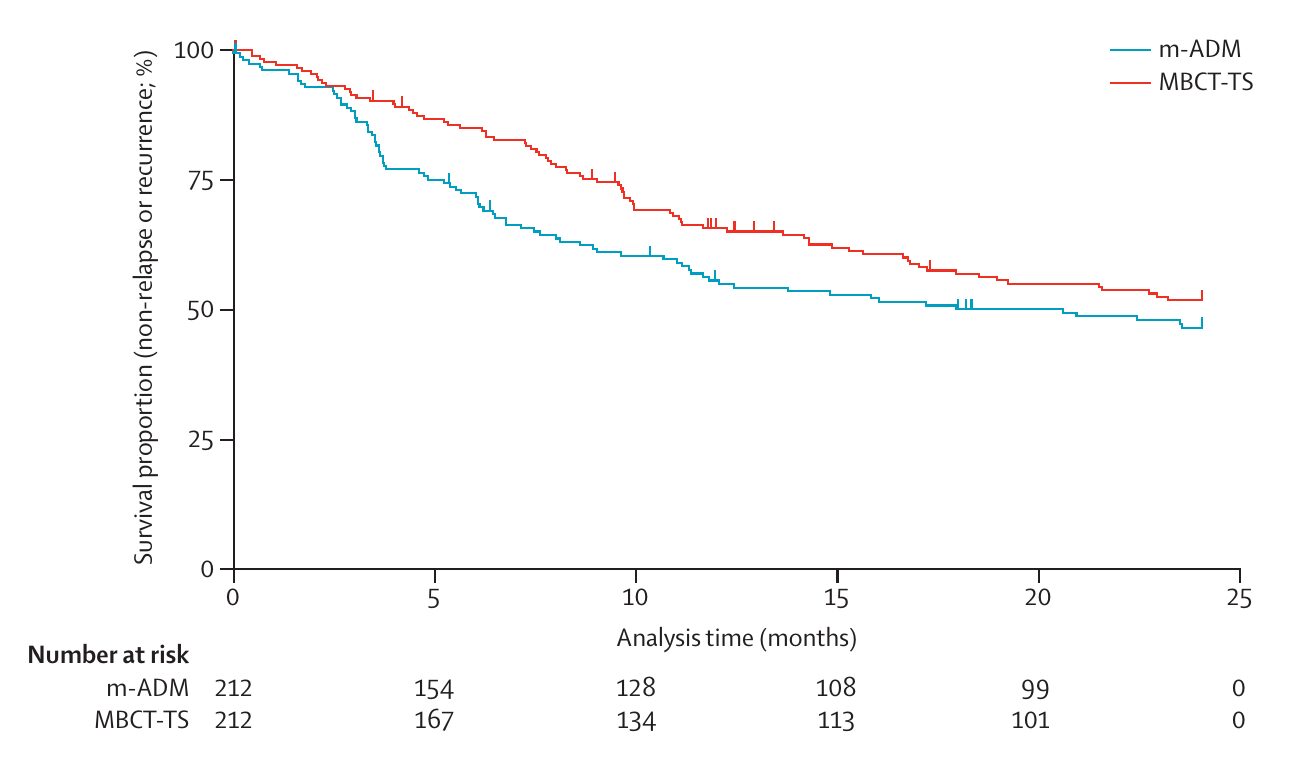
The authors’ summary is plain:
We found no evidence that MBCT-TS is superior to maintenance antidepressant treatment for the prevention of depressive relapse in individuals at risk for depressive relapse or recurrence.
The secondary outcomes told the same story. Depression-free days were identical on average (607 of roughly 730 in each group), and depressive symptoms didn’t differ over the two years. None of the differences between groups on any secondary measure, at any follow-up, exceeded a standardized mean difference of 0.4. A few quality-of-life scores came out slightly better for the medication group in the analysis that filled in missing data (p = 0.02–0.04), but those differences were small and, with many measures tested, could be chance. The paper reports them in a table without commenting on them.
It helps to be clear about what “not superior” means here. The confidence interval runs from a 33% lower relapse rate with MBCT to an 18% higher one, so the trial can’t rule out a modest advantage for either approach. It was sized to detect a large advantage for MBCT (a hazard ratio of 0.63), which its pilot study had suggested and which didn’t appear. The authors’ claim that MBCT is a reasonable alternative rests partly on this trial and partly on pooling it with the two earlier, smaller ones (see below); the trial wasn’t designed as a formal test of equivalence.
Miscellaneous Interesting Takeaways
Both Groups Did Fairly Well
Just over half of each group stayed well for two years. The authors compare this with older data in which relapse rates for people with three or more past episodes reached 80% over two years, and conclude that both treatments were linked to lasting good outcomes. But with no group that received neither treatment, this trial can’t show how either one compares with no treatment. They say so themselves:
The design included neither a usual care nor an attention control group. The absence of an attention control group means any effects of MBCT cannot be inferred to be specific to MBCT
That is, people in the MBCT group also received group support, time with a therapist and extra attention, and the trial can’t separate those from mindfulness itself. Their own suggestion for future research is to test MBCT with tapering against usual care, no treatment or a placebo pill.
Not Everyone Tapered, and Not Everyone Stayed on Medication
This was a pragmatic trial, meant to reflect real choices, so people weren’t forced to follow their group’s plan. In the MBCT group, 206 of 212 started the course, on average people attended six of the eight sessions, and 176 (83%) attended at least four. Of those 176, 124 (71%) stopped their antidepressants, 29 (17%) reduced the dose and 23 (13%) didn’t reduce it at all. In the medication group, 50 people (24%) didn’t stay on a therapeutic dose throughout.
So the trial compared two strategies, not “mindfulness without drugs” against “drugs without mindfulness.” The authors call this both a strength and a limitation: it reflects what happens in practice, but antidepressant use wasn’t fully controlled. When they looked only at people who did what was asked (attended at least four sessions and reduced or stopped medication, or stayed on a therapeutic dose), MBCT came out slightly ahead, but still not significantly (hazard ratio 0.77, 95% CI 0.56–1.06). The authors caution that such comparisons are no longer randomized and are open to bias, because the people who follow a plan can differ from those who don’t.
MBCT Cost About the Same, but Wasn’t Better Value
Because MBCT is taught in groups, the course cost only £112 per participant. Over two years, total health and social care costs averaged £2,485 per person in the MBCT group and £2,360 in the medication group, a difference of £124 that could easily be chance (95% CI −£750 to £973). Medication costs were lower in the MBCT group (£40 against £70), but other services made up most of the costs and didn’t differ much.
Weighing costs against benefits, MBCT was on average slightly more expensive and slightly better at preventing relapse, so any gain came at a small extra cost. Measured in
quality-adjusted life years
A quality-adjusted life year (QALY) is a measure used in health economics that combines how long people live with how well they live. A year in full health counts as 1 QALY, and a year in poorer health counts as less, based on questionnaires such as the EQ-5D. Dividing a treatment’s extra cost by the QALYs it gains shows whether it is good value compared with other options.
More on Wikipedia
Read more in the glossary
, it was on average slightly more expensive and slightly worse. Either way, the chance that MBCT was the better value never rose above 52%, roughly a coin toss. In the authors’ words:
Cost-effectiveness analysis does not support the hypothesis that MBCT-TS is more cost effective than maintenance antidepressants, in terms of either relapse or recurrence or QALYs.
Childhood Abuse Was the One Subgroup That Stood Out
The team planned in advance to check whether results differed by depression symptoms at the start, by recruitment area, and by reported childhood abuse. Earlier trials had suggested that MBCT helps most those at highest risk, such as people who report
childhood adversity
Adverse childhood experiences are potentially traumatic events that happen before age 18, such as abuse, neglect, or growing up with household substance use or violence. Researchers usually measure them with a short yes/no questionnaire and add up the total. Higher ACE scores are associated with poorer physical and mental health in adulthood, and in meditation research they have been linked to a higher chance of meditation-related adverse effects.
More on Wikipedia
Read more in the glossary
. Among people who reported more severe childhood abuse, 47% relapsed after MBCT against 59% on medication. Among those who reported less, the pattern reversed: 42% against 35%. That difference between subgroups was significant (interaction p = 0.03), but it was one of several subgroup tests, the groups were about 100 people each, and people reporting more abuse also differed in other ways, with more past episodes, suicide attempts and psychiatric treatment. The authors treat it as a lead for future research.
Putting the Three Trials Together
Before PREVENT, a pilot trial by the same team (123 people, 15 months) had found 47% relapse with MBCT and tapering against 60% on medication. A second trial, of 84 people, found similar rates for the two (28% and 27%), both much lower than on a placebo pill (71%). When the authors pooled the three trials at the 60-week point available in all of them, MBCT with tapering came out ahead, with a risk ratio of 0.76 (95% CI 0.59–0.98), about a 24% lower risk of relapse. This pooled result supports their conclusion that MBCT with tapering is an alternative to long-term medication “at similar costs,” but it covers a shorter time than the two years of PREVENT itself, where the difference wasn’t significant.
Safety and Who Took Part
The trial recorded only serious adverse events: ten in all, split evenly between the groups, including two deaths in each. An independent committee judged none of them to be related to the treatments or the trial. Serious events are a high bar. Studies that ask MBCT participants about specific experiences find that unpleasant effects of meditation are much more common (Britton et al., 2021), and this trial wasn’t set up to catch those.
The participants were a particular group: people already on long-term antidepressants who were willing either to stay on them or to try a group course and come off them. Almost all (99%) were white. The findings apply to people open to either choice, not necessarily to everyone weighing their options with their doctor. The paper declares that two of the authors (Kuyken and Evans) were co-directors of a mindfulness teaching organization and taught MBCT.
Final Reflection
PREVENT was the largest trial of any mindfulness-based program at the time, and it asked a practical question: for people prone to recurrent depression, is a mindfulness course with support to come off medication better than simply staying on it? Over two years, the answer was no. Relapse rates were similar (44% and 47%), and symptoms, quality of life and costs were broadly similar too.
That result is often read as “MBCT works as well as antidepressants,” and the authors lean that way, pointing to the pooled data from three trials. It is a reasonable reading, but it goes a step beyond what this trial was built to show: it looked for superiority, its confidence interval leaves room for a modest advantage either way, and many people in the MBCT group didn’t fully come off medication. It also can’t say how either strategy compares with no ongoing treatment.
For someone with recurrent depression who would rather not take antidepressants indefinitely, the trial offers useful reassurance: in this carefully supported setting, people who took an MBCT course and were helped to taper relapsed no more often than those who stayed on medication. Who benefits most, and why, is still being worked out. The hint that people with more difficult childhoods may gain most from MBCT is one of the more interesting leads.
Citation
Kuyken, W., Hayes, R., Barrett, B., Byng, R., Dalgleish, T., Kessler, D., Lewis, G., Watkins, E., Brejcha, C., Cardy, J., Causley, A., Cowderoy, S., Evans, A., Gradinger, F., Kaur, S., Lanham, P., Morant, N., Richards, J., Shah, P., Sutton, H., Vicary, R., Weaver, A., Wilks, J., Williams, M., Taylor, R. S., & Byford, S. (2015). Effectiveness and cost-effectiveness of mindfulness-based cognitive therapy compared with maintenance antidepressant treatment in the prevention of depressive relapse or recurrence (PREVENT): A randomised controlled trial. The Lancet, 386(9988), 63–73. 10.1016/S0140-6736(14)62222-4
Get the next summary by email
One or two new paper summaries every couple of weeks, sent to your inbox when they go up.
No spam, and you can unsubscribe at any time. Prefer a feed reader? Use the RSS feed.