
Background Information
Addiction is often described as a chronic, relapsing condition. Two of the strongest short-term warning signs of a return to drinking or drug use are negative mood, especially depressive symptoms, and craving. Many people use substances to escape bad feelings, and over time a low mood can become a cue that sets off craving almost automatically.
MBRP
Mindfulness-Based Relapse Prevention (MBRP) is an 8-week group program for people recovering from alcohol or drug problems, developed by Sarah Bowen, G. Alan Marlatt and colleagues. Modeled on mindfulness-based cognitive therapy, it combines mindfulness meditation with cognitive-behavioral relapse prevention skills such as spotting high-risk situations. Participants practice noticing cravings and difficult emotions as passing experiences rather than automatically acting on them.
Read more in the glossary
was designed to target exactly that chain. It combines Alan Marlatt’s cognitive-behavioral relapse prevention program (spotting high-risk situations, building coping skills) with mindfulness meditation, using the structure of
mindfulness-based cognitive therapy (MBCT)
Mindfulness-based cognitive therapy (MBCT) is an 8-week group program that combines mindfulness meditation, adapted from Mindfulness-Based Stress Reduction (MBSR), with elements of cognitive behavioral therapy. It was developed to help people who have recovered from depression avoid relapse, by learning to notice and step back from patterns of negative thinking. Classes usually meet weekly, with daily meditation practice at home.
More on Wikipedia
Read more in the glossary
, which was built to stop low mood from spiraling into another episode of depression. Participants practice noticing physical sensations, thoughts, emotions and cravings without reacting to them on autopilot. The authors describe the idea this way:
It is hypothesized that clients’ mindful recognition of and attention to problematic cognitive and affective states provide a “pause,” interrupting the habitual reaction.
A year earlier, Sarah Bowen and colleagues had published a pilot trial of MBRP as aftercare for people leaving addiction treatment. As this paper summarizes it, people given MBRP had lower rates of substance use over four months than those in usual aftercare, with greater drops in craving, and the drop in craving statistically explained part of the difference. Katie Witkiewitz and Bowen then went back to the same data to ask a narrower question: did MBRP change how depressive symptoms led to craving, and craving to substance use?
What They Did
The trial took place in 2007–2008 at a private, nonprofit agency that offered inpatient and intensive outpatient treatment for alcohol and drug problems. Its 168 participants had finished that treatment within the previous two weeks. They were aged 18 to 70 (average 40), 64% were men, and 46% were not White. About 41% were unemployed. Their main drugs were alcohol (45%), cocaine or crack (36%) and methamphetamine (14%). People with current psychosis, imminent suicide risk or a high risk of relapse were excluded.
Participants were randomly assigned to MBRP (93 people) or to the agency’s usual aftercare (75 people). The trial deliberately put more people into MBRP because the researchers worried that more of them would drop out.
- MBRP groups of 6–10 met for eight weekly two-hour sessions led by two therapists with master’s degrees, mixing guided meditation, exercises and discussion. Participants got CDs for daily meditation practice at home.
- Treatment as usual was the agency’s ongoing aftercare, which people joined on a rolling basis: 12-step work, process groups and psychoeducation, led by licensed chemical dependency counselors.
Everyone answered online questionnaires before the course, right after it, and two and four months later. This paper uses three of them, chosen so that each came before the next in time:
- Depressive symptoms right after the course, on the 21-item Beck Depression Inventory (BDI-II).
- Craving for alcohol or drugs two months later, on the five-item Penn Alcohol Craving Scale, adapted to cover drugs too. It asks how often, how strongly and how long people craved over the previous week.
- Days of alcohol or drug use in the 60 days between the two-month and four-month follow-ups, reconstructed with a calendar method (the Timeline Followback).
The authors then fitted a series of statistical path models, adjusting for each person’s starting levels of depression, craving and substance use, their total hours of treatment, gender and race. First they tested a
mediation
Mediation analysis is a statistical method that tests whether a third variable helps explain the link between a cause and an effect, for example whether a brain change helps explain why a training program altered a health marker. It estimates how much of the overall effect runs through that variable. A significant result is consistent with a causal pathway but does not prove one on its own.
More on Wikipedia
Read more in the glossary
: whether craving helps explain why people with more depressive symptoms went on to use more. Then they tested
moderation
Moderation is when the strength of a link between two things depends on a third factor, called the moderator. For example, low mood might strongly predict craving in one treatment group but hardly at all in another; treatment group then moderates the link between mood and craving. Researchers test it with an interaction term in a regression. Combined with mediation analysis, it is called moderated mediation.
More on Wikipedia
Read more in the glossary
: whether the link from depression to craving differed between the groups. Finally they put the two together in a “moderated mediation” model, asking whether that weaker link in the MBRP group carried through, via craving, to fewer days of use.
Dropout was a real problem. Only 61% of participants (103) completed the questionnaire right after the course, 57% (95) the two-month follow-up and 73% (122) the four-month follow-up, though rates didn’t differ significantly between groups. The models used every available answer from all 168 people, by
intention to treat
An intention-to-treat analysis counts every randomized participant in the group they were assigned to, whether or not they completed or even started the treatment. It keeps the benefit of randomization, since dropping people who didn’t follow their plan can leave groups that differ in other ways, and it estimates what happens when a treatment is offered in practice rather than when it is taken exactly as intended.
More on Wikipedia
Read more in the glossary
, with a method that assumes the missing answers can be predicted from the data that were collected.
One Big Result: In Usual Care, Low Mood Went With Craving and Then Substance Use; After MBRP, That Link Nearly Disappeared
Across everyone, the expected chain showed up. More depressive symptoms at the end of the course predicted more craving two months later, and more craving predicted more days of use in the following two months. Craving statistically accounted for a small part of the link between depression and substance use (about 7%; indirect effect 0.23, 95%
confidence interval
A confidence interval is the range of values that a study’s data are consistent with, given the uncertainty that comes from measuring a limited sample. A 95% confidence interval for an effect of 0.30 running from 0.00 to 0.59, for example, means the true effect could plausibly be anywhere from nothing to moderate. Narrower intervals mean more precise estimates; an interval that includes zero means the study can’t rule out no effect.
More on Wikipedia
Read more in the glossary
0.08 to 0.40).
But the chain looked very different in the two groups. In usual care, people who ended the course with more depressive symptoms reported clearly more craving two months later (r = .54) and used on more days (r = .53). In the MBRP group, depressive symptoms were barely linked to later craving (r = .12) and, if anything, slightly negatively linked to days of use (r = −.19). Neither of those MBRP correlations was statistically significant. Craving still went with substance use in both groups.
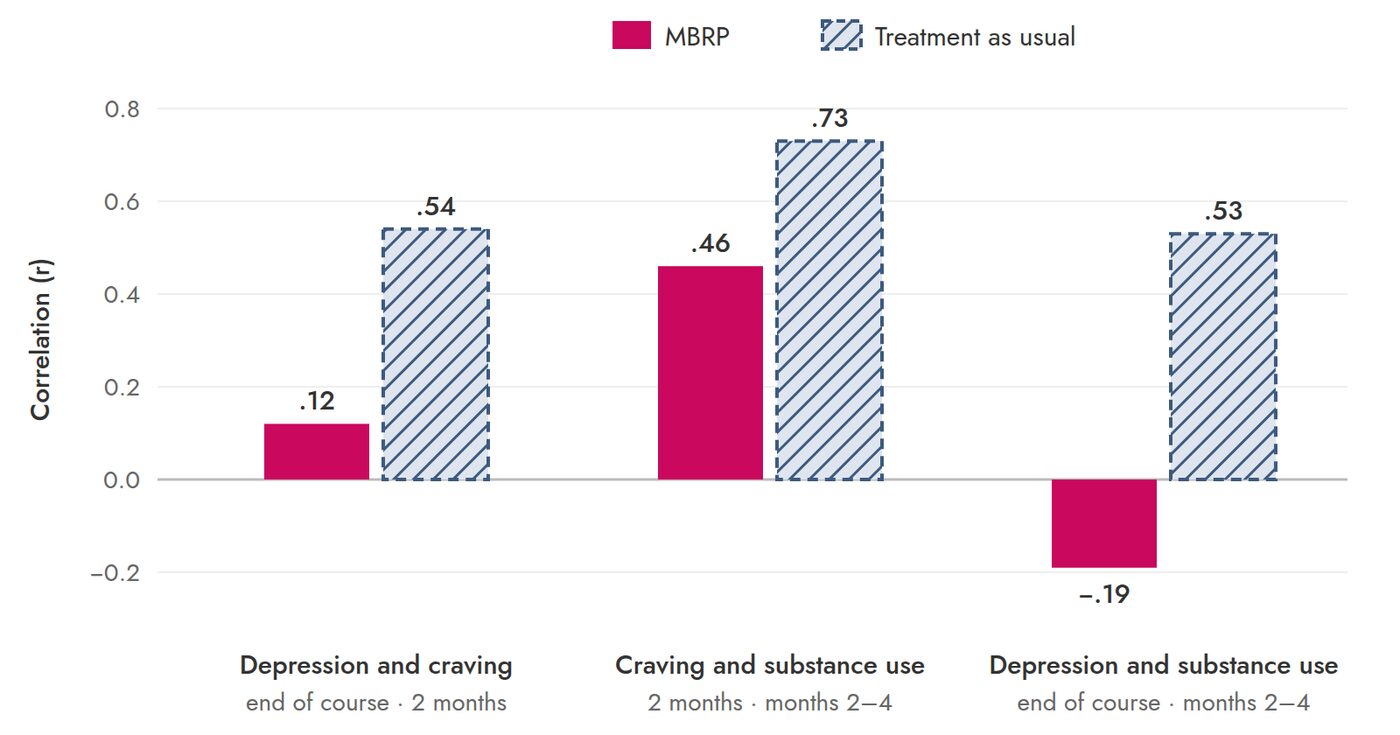
The formal tests, which adjusted for starting levels and the other covariates, agreed:
- Moderation: the link from depressive symptoms to later craving depended on which group people were in (β = −0.32, p = .001). By conventional benchmarks this interaction was a medium-sized effect (f² = 0.21).
- Moderated mediation: this weaker depression–craving link in MBRP carried through, via craving, to fewer days of substance use (indirect effect −0.06, 95% confidence interval −0.13 to −0.01; f² = 0.18). The full model accounted for 50% of the variation in days of use.
Looked at group by group, the path from depression through craving to substance use was close to statistically significant in usual care (p = .05, though its confidence interval of −0.02 to 0.09 included zero) and essentially absent in MBRP (p = .65). The abstract states this more firmly, as craving mediating the link in usual care, than the group-by-group numbers do.
Importantly, MBRP didn’t seem to work by making people less depressed. Average depression scores were in the mild range in both groups, both before and after the course, and didn’t differ significantly between them. What changed was what depressive symptoms led to. As the authors put it:
Importantly, the levels of depressive symptoms across intervention groups did not differ, thus it may be the reaction to the experience of negative emotional states, rather than the emotional states themselves, that are problematic.
Miscellaneous Interesting Takeaways
MBRP Seemed to Help Most When Mood Was Lowest
When the authors split people by depression score, those with the highest scores (BDI above 20) had significantly less craving and fewer days of use if they had been in MBRP rather than usual care. The pattern may have reversed at the other end: among people with minimal or mild symptoms, those in MBRP used on more days than those in usual care. If this holds up, MBRP’s advantage may be concentrated among people whose low mood would otherwise drive craving. That is a post hoc reading of plotted subgroups, though, and the authors call it a “potential” pattern.
MBRP’s Overall Effect on Substance Use Had Faded by Four Months
This analysis doesn’t show that MBRP reduced substance use overall at the end of follow-up. In the 60 days before the four-month follow-up, people in usual care reported an average of 9.3 days of use and those in MBRP 5.6, a difference that was not statistically significant. In the adjusted path model, MBRP’s direct effect on days of use was also not significant (p = .06). According to the authors, the groups’ substance use had differed significantly during the course and in the first two months after it, but not by four months. They suspect the lack of ongoing meditation support after the course let the benefit fade. Most people used little either way: fewer than 30% in each group reported any days of use in those 60 days, and 29–33% of those who did used on only one day.
Practice Kept Up, Mindfulness Scores Didn’t Explain It
MBRP participants attended 65% of sessions on average. Right after the course, 86% said they were still meditating (about 2.6 hours a week), and 54% were still practicing four months later. The authors report that every MBRP participant who kept meditating to four months reported no days of use, regardless of their depression. That is striking, but people who keep up a practice may differ in many ways from those who stop, and the authors note that “a causal relation has not been established.” Curiously, gains on a standard mindfulness questionnaire were not related to changes in depressive symptoms or craving, so the finding can’t be put down to higher mindfulness scores, at least as that questionnaire measures them.
What the Study Can’t Say
The authors list a long set of limits, and they matter:
- Secondary analysis of a pilot. The trial was designed to test whether MBRP reduced substance use, not this specific chain. The sample was modest, and the methods for testing moderated mediation were still new. The authors write that the results “should be considered preliminary until replicated in subsequent studies with larger samples.” The plotted subgroup results used the 140 people with enough data.
- Missing data. No follow-up was completed by more than 73% of participants, and whether people completed the study was related to their depression scores after the course. The statistical method assumes the missing answers can be predicted from the collected data, which can’t be checked.
- Self-report only. Depression, craving and days of use were all self-reported online. Recalled days of use have held up reasonably well in earlier research, but the authors call self-reported craving problematic and suggest physiological and brain measures next time.
- Not a like-for-like comparison. MBRP participants received more total treatment hours (12.8 vs 9.8), were taught by therapists with more formal training, and met in closed groups that stayed together for eight weeks, while usual care had rolling admission. Neither participants nor therapists could be blinded. The groups also differed by chance in racial make-up (63% White in MBRP vs 45% in usual care). Treatment hours and race were adjusted for, but any of these differences could contribute.
- No test against another active therapy. Usual care was a real treatment, but the trial didn’t compare MBRP with, say, standard relapse prevention without meditation, so it can’t show that mindfulness itself made the difference.
- Short follow-up and a particular sample. Follow-up ended four months after the course. More than half the participants had been mandated to treatment by a court or had other legal involvement, so drug testing may have kept use low, and the results may not apply to people who come to treatment voluntarily.
- A weaker test of mediation than ideal. The authors couldn’t adjust for substance use at two months, before craving was measured, which the stricter version of the test requires.
Final Reflection
This is an early, small study, but it asks a sharper question than “does mindfulness help addiction?” It asks how it might help, and its answer fits what MBRP was designed to do. People who finished MBRP were no less depressed than those in usual care, but their low mood seemed to set off less craving, and less craving went with less substance use. That matches the idea in the authors’ quote: not getting rid of difficult feelings, but changing the automatic reaction to them.
The findings are suggestive rather than settled. They come from one agency, rely entirely on self-report, lost many participants to follow-up, and rest on a statistical chain that the authors themselves call preliminary. MBRP was later tested in a larger trial with a longer follow-up, which is the better guide to whether it reduces relapse. What this paper adds is a plausible mechanism worth testing directly: for people in early recovery, the risk may lie less in feeling low than in what low mood automatically sets in motion.
Citation
Witkiewitz, K., & Bowen, S. (2010). Depression, craving, and substance use following a randomized trial of mindfulness-based relapse prevention. Journal of Consulting and Clinical Psychology, 78(3), 362–374. 10.1037/a0019172
Get the next summary by email
One or two new paper summaries every couple of weeks, sent to your inbox when they go up.
No spam, and you can unsubscribe at any time. Prefer a feed reader? Use the RSS feed.