
Background Information
Mindfulness courses have been found to ease anxiety and stress in many groups of patients. A meta-analysis of 142 trials found that, for anxiety, mindfulness-based treatments beat no treatment and did about as well as other therapies. The harder question is how they work. What changes in a person over eight weeks of meditation that then makes them less anxious?
The obvious candidate is mindfulness itself, as measured by questionnaires about how attentive and non-judgmental people are toward their experience. Another is
decentering
Decentering is the ability to observe thoughts, feelings and memories as passing events in the mind rather than as facts about reality or fixed parts of who you are: noticing “I’m having the thought that I’ll fail” rather than simply believing “I’ll fail.” It is thought to be one of the ways mindfulness-based programs and cognitive therapies work, and is usually measured by questionnaire, for example with the Experiences Questionnaire.
Read more in the glossary
. The authors, a team at Massachusetts General Hospital led by Elizabeth Hoge, define it as a “metacognitive capacity” to observe what arises in the mind (thoughts, feelings, memories) “as mere psychological events.” They add that it means seeing those events as temporary, rather than as part of who you are:
This ability also involves recognizing that one’s thoughts, feelings, and urges are transient internal events rather than inherent, permanent aspects of the self or accurate representations of reality
That is what links decentering to the question of how meditation changes the sense of self. It describes a shift in one’s relationship to one’s own mind: the anxious thought is still there, but it is no longer taken to be me or the truth. The authors note that decentering and mindfulness overlap in theory, but distinguish them: mindfulness is heightened awareness with an attitude of non-judgment, while decentering is more specifically the ability to take a psychologically distanced stance.
Earlier work had linked decentering to recovery from depression. Gains in decentering during
cognitive behavioral therapy
Cognitive behavioral therapy (CBT) is a structured, usually short-term talk therapy that helps people notice and change unhelpful patterns of thinking and behavior. It is one of the most thoroughly tested psychological treatments and a first-line option for depression, anxiety disorders and many other conditions.
More on Wikipedia
Read more in the glossary
, or during
mindfulness-based cognitive therapy (MBCT)
Mindfulness-based cognitive therapy (MBCT) is an 8-week group program that combines mindfulness meditation, adapted from Mindfulness-Based Stress Reduction (MBSR), with elements of cognitive behavioral therapy. It was developed to help people who have recovered from depression avoid relapse, by learning to notice and step back from patterns of negative thinking. Classes usually meet weekly, with daily meditation practice at home.
More on Wikipedia
Read more in the glossary
, a program designed to prevent depressive relapse, predicted more lasting improvement. But to the authors’ knowledge, no study had formally tested whether decentering mediates the benefits of a mindfulness program, or pitted it against mindfulness as competing explanations.
They chose to test this in
generalized anxiety disorder
Generalized anxiety disorder (GAD) is an anxiety disorder marked by excessive, hard-to-control worry about many everyday matters, such as health, work or family, lasting at least six months. The worry comes with physical and mental symptoms such as restlessness, tiring easily, trouble concentrating, irritability, muscle tension and poor sleep.
More on Wikipedia
Read more in the glossary
(GAD), a condition defined by chronic worry about many topics, along with physical symptoms such as restlessness, poor concentration and disturbed sleep. People with GAD are often caught up in worries about the future and ruminations about the past, so the ability to step back from those thoughts seemed a plausible route to relief.
What They Did
The data came from an earlier
randomized controlled trial
A Randomized Controlled Trial is a scientific study design that randomly assigns participants to either an experimental group receiving an intervention or a control group, allowing researchers to measure the true effect of the intervention while minimizing bias.
More on Wikipedia
Read more in the glossary
by the same group, in which adults diagnosed with GAD through a structured clinical interview were randomly assigned to one of two 8-week group courses:
-
Mindfulness-Based Stress Reduction (MBSR)
Mindfulness-Based Stress Reduction (MBSR) is a program designed to help individuals cope with stress, pain, and illness. Developed by Jon Kabat-Zinn in the 1970s, it combines meditation and yoga to promote awareness and stress management. The eight-week program teaches participants to focus on the present moment non-judgmentally, enhancing their ability to manage difficulties.
More on Wikipedia
Read more in the glossary : breath awareness, body scans and gentle hatha yoga, with daily home practice guided by recordings. It was slightly shortened for this clinical group: the usual all-day retreat became 4 hours, and home practice was cut from 40 to 20 minutes a day. - Stress Management Education (SME): an
active control group
An active control group is a comparison group that takes part in a different program designed to be just as engaging as the one being tested. In meditation research, it might involve exercise, music, or education classes with the same time commitment, teachers, and expectations of benefit. Comparing against an active control helps separate the effects of meditation itself from the general effects of joining a course.
More on Wikipedia
Read more in the glossary with no meditation or other mind-body practice. It taught healthy living through education about diet, exercise, sleep, time management and resilience, and had its own half-day session with a stability-ball exercise class and a dietitian’s lecture. Its purpose was to match MBSR on group support, instructor attention and expectations of benefit.
The decentering questionnaire was added after the trial had started, so only part of the trial’s sample completed it. This paper analyzes that subgroup: 38 people, 19 in each course, with an average age of 37.6. The authors report that they did not differ from the full trial sample in demographics.
Everyone filled in four questionnaires before and after the course:
- Anxiety: the 21-item Beck Anxiety Inventory (BAI), scored 0 to 63.
- Worry: the 15-item Penn State Worry Questionnaire–Past Week (PSWQ-PW).
- Decentering: the 11-item decentering subscale of the Experiences Questionnaire, scored 11 to 55, with higher scores meaning more decentering. The paper doesn’t list its items.
- Mindfulness: the 39-item Five Facet Mindfulness Questionnaire (FFMQ), which also yields scores for five facets: observing, describing, acting with awareness, non-judging and non-reactivity to inner experience.
The key analysis was a
mediation analysis
Mediation analysis is a statistical method that tests whether a third variable helps explain the link between a cause and an effect, for example whether a brain change helps explain why a training program altered a health marker. It estimates how much of the overall effect runs through that variable. A significant result is consistent with a causal pathway but does not prove one on its own.
More on Wikipedia
Read more in the glossary
. It asks whether the difference between the courses in how much anxiety fell can be traced, statistically, through how much each course changed decentering or mindfulness. The authors used
bootstrapping
Bootstrapping is a statistical technique that gauges how uncertain a result is by resampling the data. It draws thousands of new samples of the same size from the original participants (with replacement), recalculates the result in each, and uses the spread of those results to build a confidence interval. It makes fewer assumptions about the shape of the data than traditional tests and is commonly used to test indirect effects in mediation analysis.
More on Wikipedia
Read more in the glossary
, resampling their data 4,000 times to build a
confidence interval
A confidence interval is the range of values that a study’s data are consistent with, given the uncertainty that comes from measuring a limited sample. A 95% confidence interval for an effect of 0.30 running from 0.00 to 0.59, for example, means the true effect could plausibly be anywhere from nothing to moderate. Narrower intervals mean more precise estimates; an interval that includes zero means the study can’t rule out no effect.
More on Wikipedia
Read more in the glossary
around each indirect effect. An indirect effect counted as significant if its 95% confidence interval did not include zero. They tested each mediator on its own and then both together, to see which one still carried the effect when the other was accounted for.
One Big Result: Gains in Decentering Statistically Accounted for MBSR’s Extra Drop in Anxiety
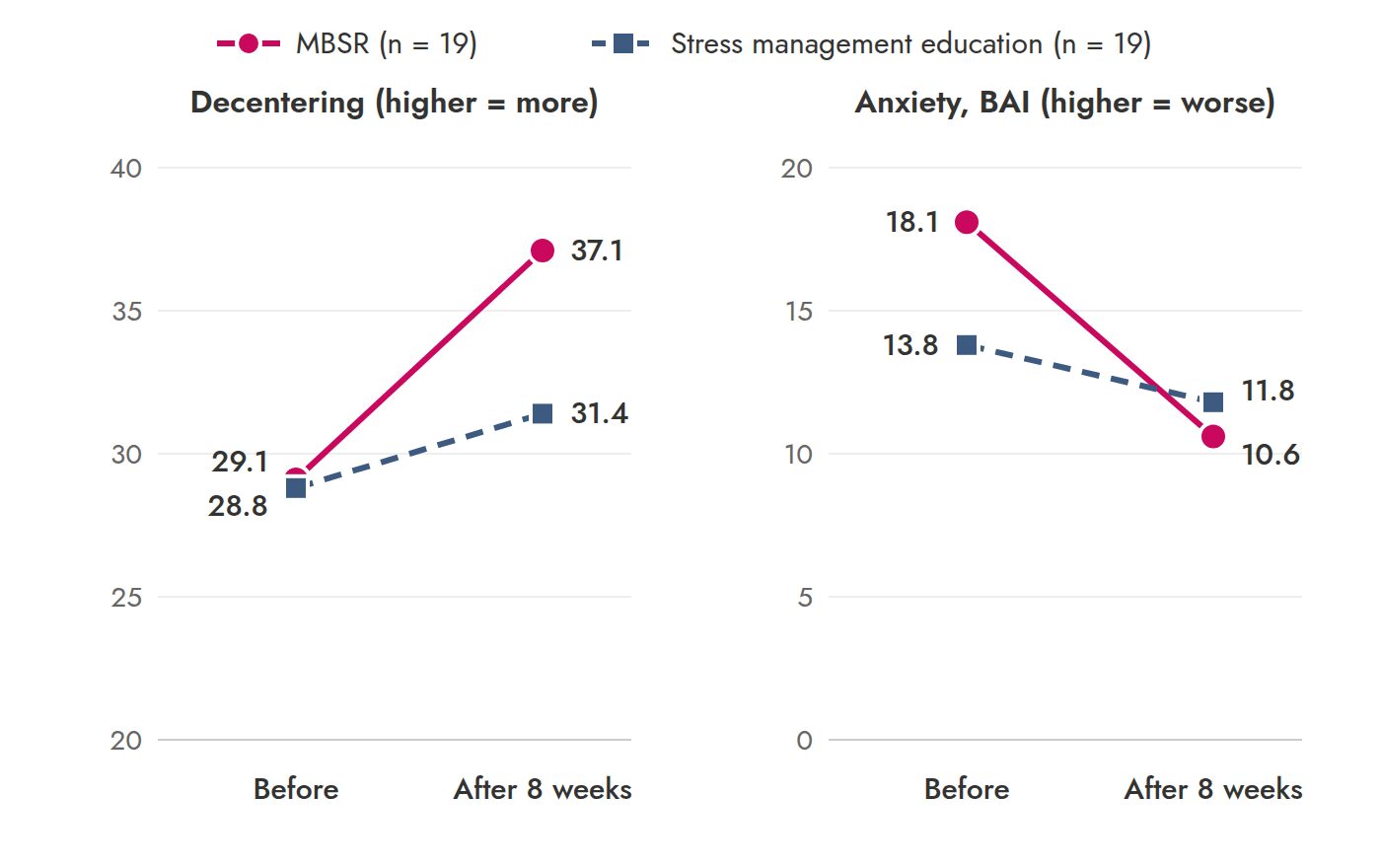
Both groups improved, but the MBSR group changed more. Decentering rose by 8.0 points on average after MBSR and by 2.6 points after SME, a clear difference between the groups (p < 0.001). Anxiety fell by 7.5 points after MBSR and by 2.0 after SME, a smaller and more borderline difference (more on that below). Mindfulness scores rose by 17.2 points after MBSR and 5.5 after SME, a difference that fell short of significance (p = 0.079).
Across everyone, people whose anxiety fell most also tended to gain most in decentering (r = −0.53) and in mindfulness (r = −0.54). The two gains were themselves correlated (r = 0.56), so the question was which of them better explained MBSR’s advantage.
Tested one at a time, both counted as mediators: decentering (indirect effect 5.84; 95% CI 2.04 to 13.44) and mindfulness (2.69; 95% CI 0.01 to 8.97, only just clear of zero). Tested together, only decentering remained:
- Decentering: indirect effect 3.66, 95% CI 0.68 to 8.38.
- Mindfulness: indirect effect 1.89, 95% CI −0.06 to 7.17, not significant.
Swapping the overall mindfulness score for its five facets didn’t change the picture: decentering was still the only significant mediator. The authors conclude that MBSR’s improvements in GAD symptoms are “in part explained” by increased decentering.
The abstract also reports that once decentering was in the model, the remaining direct effect of MBSR on anxiety was no longer significant, which it reads as decentering “fully” mediating the effect. In a sample of 38, though, a non-significant remainder is weak evidence that nothing else is going on. The “in part” wording is the safer reading.
Why decentering would matter most for this measure is a matter of interpretation. The BAI mainly measures what the authors call physiological anxiety, the bodily arousal that comes with it. They suggest:
It could be that having a psychologically distanced stance buffers individuals from the distress associated with physical signs of anxiety.
Miscellaneous Interesting Takeaways
Worry Followed Mindfulness, Not Decentering
For the second outcome, worry, the pattern reversed. Gains in mindfulness mediated the drop in worry (indirect effect 2.66; 95% CI 0.23 to 6.06), and decentering did not (3.66; 95% CI −0.54 to 8.76). Among the five facets of mindfulness, only non-reactivity to inner experience (letting thoughts and feelings come and go without reacting to them) and acting with awareness (as opposed to acting on autopilot) were significant, both with lower confidence limits just above zero.
There is a catch. In this subgroup, the two courses did not differ significantly in how much worry fell (8.8 points after MBSR, 6.7 after SME; p = 0.26). An indirect effect can still be tested when the overall difference between groups isn’t significant, but it makes the worry finding more tentative than the anxiety one. The authors nonetheless read the split, decentering for anxiety and mindfulness for worry, as evidence that the two are distinct skills.
The Groups Weren’t Far Apart, and the Statistics Are Borderline
The authors note that comparing MBSR with an attention control yields a smaller difference between groups, which they put down to the control course’s own benefits of expectation, attention and group support. MBSR’s advantage on anxiety was significant only with a one-sided test, which the authors justified because they were checking, in a smaller subgroup, a result already found in the full trial (t = −1.83, p = 0.038). A conventional two-sided test would not have reached the usual 0.05 threshold. The MBSR group also started out more anxious (18.1 vs 13.8 on the BAI; d = 0.49), though the difference was not statistically significant. A group that starts higher has more room to fall, for example through
regression to the mean
Regression to the mean is the tendency for unusually high or low measurements to be followed by ones closer to average, because part of any single measurement is chance. People who score as very stressed on a questionnaire one week will, on average, score a little less stressed the next, with or without treatment. In a trial, a group that happens to start out worse can therefore seem to improve more, which is one reason researchers compare against a control group and adjust for starting scores.
More on Wikipedia
Read more in the glossary
.
The mediation results lean on confidence intervals, as is standard for this method. The paper’s table also gives conventional p-values “for completeness,” and by those, several of the effects called significant would not be: the mindfulness-only mediator of anxiety has p = 0.21, and decentering in the joint model p = 0.051. Several lower confidence limits sit barely above zero. None of this makes the result wrong, but it is a fragile one.
What This Kind of Mediation Can’t Show
Randomization means the difference between the groups in anxiety can be credited to the courses. It doesn’t randomize decentering. Decentering and anxiety were measured at the same two moments, before and after, so the data can’t say which changed first. Feeling less anxious could make it easier to see one’s thoughts as passing events, rather than the other way round. The authors acknowledge this directly:
A third limitation is that the nature of the assessments (pre- and post-treatment only) precludes us from establishing that change in decentering and mindfulness preceded change in anxiety.
Every measure was also a self-report questionnaire, so a general shift in how people described themselves after taking a course could move several scores together. And since the BAI emphasizes bodily arousal rather than the worry at the core of GAD, the authors note it may not capture GAD distress precisely. The findings may not apply to other conditions.
Who Ran the Study
The work was funded mainly by a U.S. National Institutes of Health grant. One author listed consulting and research grants, and spousal equity in several companies. The others declared no conflicts of interest. One co-author, David Fresco, led the paper that validated the decentering questionnaire used here, and co-authored the papers on emotion regulation therapy, which the discussion offers as an example of a treatment designed to build decentering. That doesn’t undermine the analysis, but it is useful context.
Final Reflection
This small study puts a number on an idea at the heart of mindfulness-based therapy: that what helps may be less a matter of becoming more attentive than of changing one’s relationship to one’s own mind, coming to treat thoughts and feelings as passing events rather than as truths about oneself. In this sample, that shift tracked MBSR’s advantage over a well-matched health course better than general mindfulness did.
The evidence is suggestive rather than decisive. With 38 people, borderline group differences and only before-and-after questionnaires, the study shows that decentering and anxiety moved together in the way a causal pathway would predict, not that one drove the other. Testing it properly would take larger trials that measure decentering week by week, to see whether it shifts before anxiety falls.
For the question of how meditation changes the sense of self, decentering may be an everyday relative of what other studies explore at the extremes. Experienced Vipassana meditators asked to experience the present without being “in the center” are deliberately loosening the sense of self. Decentering asks for less: not that the self disappears, but that a worry be seen as a worry rather than as part of who one is. In this trial, that more modest shift went with feeling less anxious.
Citation
Hoge, E. A., Bui, E., Goetter, E., Robinaugh, D. J., Ojserkis, R. A., Fresco, D. M., & Simon, N. M. (2015). Change in decentering mediates improvement in anxiety in mindfulness-based stress reduction for generalized anxiety disorder. Cognitive Therapy and Research, 39(2), 228–235. 10.1007/s10608-014-9646-4
Get the next summary by email
One or two new paper summaries every couple of weeks, sent to your inbox when they go up.
No spam, and you can unsubscribe at any time. Prefer a feed reader? Use the RSS feed.