
Background Information
Many contemplative traditions, especially in Buddhism, aim to see through the feeling of being a fixed, separate self. Some experienced meditators describe moments in which that feeling seems to fall away. Classic
psychedelic drugs
Classic psychedelics are drugs such as psilocybin (the active compound in “magic mushrooms”), LSD, mescaline and DMT that profoundly alter perception, emotion and the sense of self, mainly by stimulating the brain’s serotonin 2A receptors. They are being studied as possible treatments for conditions such as depression and addiction, mostly in carefully controlled clinical settings, and are controlled substances in most countries.
More on Wikipedia
Read more in the glossary
, such as psilocybin and LSD, are also known for dramatic changes in the sense of self at high doses, a phenomenon researchers call
ego dissolution
Ego dissolution (also called ego death) is a temporary loss of the ordinary sense of being a separate self, often described as the boundary between self and world melting away, sometimes with a feeling of oneness. It is reported at high doses of psychedelic drugs and in some deep meditative states, and researchers usually measure it with questionnaires.
More on Wikipedia
Read more in the glossary
. Raphaël Millière, Robin Carhart-Harris, Leor Roseman, Fynn-Mathis Trautwein and Aviva Berkovich-Ohana noticed that the two fields rarely talk to each other, and asked whether “losing the self” in meditation and on psychedelics is the same thing.
This paper is a review, not a new study: it has no participants and no new data. When it was published, the first author was in the Faculty of Philosophy at the University of Oxford, Carhart-Harris and Roseman were in the Psychedelic Research Group at Imperial College London, Trautwein was at the Max Planck Institute for Human Cognitive and Brain Sciences in Leipzig, and Berkovich-Ohana was at the University of Haifa. Several studies the review relies on are their own, including meditation studies summarized on this site.
This site is about meditation, so this summary covers the psychedelic research only as far as it sheds light on meditation. Nothing here is a suggestion to take these drugs. One point of vocabulary: by “self-consciousness” the authors mean a person’s awareness of themselves, the sense of self, not the social awkwardness of feeling watched.
The authors start with two warnings. First, neither “meditation” nor “psychedelic states” is a single thing: the style of practice, the drug and dose, the person’s experience and personality all shape what happens. And dramatic changes are the exception:
In particular, dramatic disruptions of self-consciousness seem to occur mostly for highly experienced meditators or with high doses of psychedelics.
Second, they suspect that experiences described in the same words, “selflessness” or “ego dissolution,” may differ a great deal.
What They Did
This is a narrative review mixing philosophy of mind with neuroscience. The authors don’t say how they chose the studies they cite, don’t rate their quality and don’t pool their results. Their aim is conceptual: to break the sense of self into parts, then ask what the evidence says about how meditation and psychedelics affect each part.
They begin by summarizing the brain findings for each.
Meditation. A
meta-analysis
A meta-analysis statistically combines the results of many earlier studies on the same question. Pooling the data can estimate an overall effect more precisely than any single study and show whether results agree across studies. Its conclusions are only as good as the studies it includes and how similar they are.
More on Wikipedia
Read more in the glossary
of 78 brain-imaging studies found distinct patterns for four common styles: focused attention, mantra recitation, open monitoring and loving-kindness. Focused attention went with reduced activity in two hubs of the
default mode network (DMN)
The default mode network (DMN) is a system of connected brain areas that show increased activity when a person is not focused on what is happening around them, such as during daydreaming and mind-wandering. It can also be active when the individual is thinking about others or themselves, remembering the past, and planning for the future.
More on Wikipedia
Read more in the glossary
, a set of regions most active during self-reflection,
mind wandering
Mind wandering is the spontaneous shift of attention away from a current task or external environment to internally generated thoughts, memories, or fantasies. This common cognitive process is associated with default mode network activation and has been extensively studied in relation to meditation practices, which often aim to reduce mind wandering.
More on Wikipedia
Read more in the glossary
and thinking about one’s past and future. Many studies of mindfulness meditation have found reduced activity in key DMN nodes, the
medial prefrontal cortex
The medial prefrontal cortex (mPFC) is the part of the frontal lobes along the brain’s midline, just behind the forehead. It is a core part of the default mode network and is consistently active when people think about themselves, judge their own traits, or recall and plan events in their own lives.
More on Wikipedia
Read more in the glossary
and the
posterior cingulate cortex
The posterior cingulate cortex (PCC) is a region toward the back of the brain’s midline. It is a central hub of the default mode network and tends to be active during self-related thought and mind-wandering. Many meditation studies track PCC activity or connectivity as a window onto the DMN.
More on Wikipedia
Read more in the glossary
, and one found the drop larger during meditation than during an active thinking task (Garrison et al., 2015). The
Insula
The insula is a region of cortex folded deep inside each side of the brain. It helps represent the body’s internal state (interoception) and is involved in emotion, empathy and compassion. Its front part, the anterior insula, comes up often in meditation research.
More on Wikipedia
Read more in the glossary
, a region central to
interoception
Interoception is the sense of the body’s internal state: feeling your heartbeat, breathing, hunger, warmth, tension and other sensations from inside the body. Interoceptive awareness is how much attention a person pays to these signals. Practices such as the body scan, which moves attention through the body part by part, aim to strengthen it.
More on Wikipedia
Read more in the glossary
(the sense of the body’s internal state), turned up across styles, which the authors read as a sign that attention to the body, especially the breath, is central to most practice.
Psychedelics.
fMRI
An fMRI (functional Magnetic Resonance Imaging) measures changes in blood flow related to neural activity in the brain, offering insights into brain function and activity patterns.
More on Wikipedia
Read more in the glossary
studies of psilocybin and ayahuasca found reduced activity across many regions, including DMN hubs. Psilocybin, ayahuasca and LSD all made the DMN less internally coherent (its regions’ activity rose and fell together less) while increasing
connectivity
Functional connectivity is the degree to which activity in different brain regions rises and falls together over time. It is usually measured with fMRI as the correlation between regions’ signals. It shows coordinated activity, not physical wiring. Researchers use it to see how brain networks such as the DMN communicate in different mental states.
More on Wikipedia
Read more in the glossary
between brain regions and between networks. When volunteers rated their ego dissolution, higher ratings went with several of these changes, such as a less coherent DMN under LSD. In many of these studies, ego dissolution was measured with a single questionnaire item.
The authors then take apart the sense of self.
One Big Result: “Self-Loss” Is Not One Thing, and Meditation and Psychedelics Reach Different Versions of It
The review’s central claim is that the sense of self has several components that can be disrupted separately. Meditation and psychedelics can each disrupt several of them, but not the same ones to the same degree. The authors sort the components into two families.
The narrative self: thoughts, memories and plans about “me”
The narrative self is the running story of who we are: thoughts about ourselves, memories of our past and plans for our future, what researchers call mental time travel. The authors describe two ways it can be switched off.
Self-related thinking stops. Much of ordinary waking life is spent in self-involving thought, often about the future, and much of it goes unnoticed. Meditation trains
meta-awareness
Meta-awareness is awareness of what the mind is doing as it happens: noticing that you are having a thought, feeling an emotion or have drifted into mind wandering, rather than simply being caught up in it. It is a form of metacognition. Mindfulness practices train it directly, for example each time a meditator notices the mind has wandered and brings attention back.
More on Wikipedia
Read more in the glossary
: noticing when the mind has wandered and coming back. The authors suggest that once attention steadies, experienced meditators can have long stretches with no self-related thought at all, and they connect this to the reduced activity in the medial prefrontal and posterior cingulate cortex. Psychedelics also lower activity in these regions, and under psychedelics a less coherent DMN has gone with ego dissolution and with less mental time travel to the past. On this first route, the two seem to converge.
Access to facts about oneself goes missing. This is more dramatic: a temporary, amnesia-like loss of knowledge about oneself. Here the evidence is anecdotal. Respondents to an unpublished online survey by Millière, of experienced psychedelic users, described forgetting they were human. The authors speculate that very large reductions in DMN coherence might explain this, and point to studies linking a weakened DMN to memory loss. They think this second route is mostly specific to psychedelics, since that degree of DMN disruption “does not appear to be such a reliable feature of meditation.”
The bodily self: owning, feeling and locating one’s body
The authors also distinguish a more basic, “minimal” or embodied self, which doesn’t need any thinking about oneself. Within it, they separate three things.
Body ownership, the sense that this body is mine. The authors draw on studies of experienced meditators by Berkovich-Ohana’s group. In one (Dor-Ziderman et al., 2013), 12 long-term mindfulness meditators tried to induce a “selfless” mode of awareness during
MEG
Magnetoencephalography (MEG) records the tiny magnetic fields produced by electrical activity in the brain, using very sensitive sensors in a helmet-shaped device. Like EEG, it tracks brain activity millisecond by millisecond, but because magnetic fields pass through the skull with little distortion, it can usually locate where in the brain the activity comes from more accurately.
More on Wikipedia
Read more in the glossary
recording, and four described losing the sense of ownership. In another, a single meditator with about 20,000 hours of practice, interviewed in depth about the state he could enter at will, said: “There is no sense of mine [and] there is no sense of me.” People on psychedelics often report
depersonalization
Depersonalization is a dissociative experience characterized by feelings of detachment from one’s self, body, or mental processes. Individuals experiencing depersonalization may feel like an outside observer of their thoughts, feelings, or body, or they may feel as if they’re in a dream. It can occur as a temporary response to stress, as a symptom of psychiatric disorders, or as a feature of certain meditation experiences.
More on Wikipedia
Read more in the glossary
-like experiences, such as looking at a hand and not feeling it as their own. One hypothesis is that psychedelics loosen the brain’s top-down expectations about the body.
Bodily awareness, simply feeling bodily sensations. Here the two routes may part. Many meditation practices direct attention toward the body, so the authors would not expect bodily awareness to vanish. In the expert meditator’s deepest state, the body faded but did not disappear: “there is a kind of very light sense of body in this experience,” he said. Several mindfulness meditators in another study reported that bodily sensations faded into the background. Psychedelics, DMT and 5-MeO-DMT in particular, may suppress awareness of the body completely. Volunteers given psilocybin or LSD score fairly high on questionnaire items such as “it seemed to me as if I did not have a body anymore,” and in a DMT study, then still in preparation, almost all participants reported losing awareness of their body for several minutes at the peak. The authors add that both settings involve sitting or lying still, eyes closed or blindfolded, and that this sensory deprivation may itself loosen the sense of the body.
Self-location, the sense of being somewhere in space. Both routes seem able to remove it. The expert meditator said, “there’s no real location at all,” and several long-term mindfulness practitioners described “spacelessness.” On psychedelics, people describe merging with their surroundings and score high on questionnaire items such as “it seemed to me that my environment and I were one.” In the brain, both lines of evidence point to the
temporoparietal junction (TPJ)
The temporoparietal junction (TPJ) is the area where the brain’s temporal and parietal lobes meet, toward the back and side of the head. It helps combine signals from the body and senses into a sense of where the self is, and it is central to theory of mind: working out what other people think and intend.
More on Wikipedia
Read more in the glossary
, a region that helps work out where the self is. In experienced meditators,
beta
Beta brain waves are a type of brainwave pattern that oscillate between approximately 12 to 30 Hz. Beta waves are typically associated with active thinking, focus, alertness, and engagement with the external world. They are prominent during conscious, goal-directed activity and are linked to cognitive tasks such as problem-solving, decision-making, and sustained attention.
More on Wikipedia
Read more in the glossary
activity there fell as the boundary between self and world dissolved (Dor-Ziderman et al., 2016), and under LSD, stronger ego dissolution went with increased connectivity of the TPJ and the insula. These are different measures in different people, and the authors call the link a hypothesis that needs more data.
The authors leave out the sense of agency, the feeling of being in control of one’s actions, because the concept is ambiguous and there is little evidence on how either route affects it.
“Total” self-loss: the same label for different experiences
Even when every component of the self seems to go, the authors argue, the experiences can differ. Their tentative comparison, below, puts the clearest difference in something that isn’t part of the self at all: how much else is in experience. Ego dissolution on psychedelics usually comes with vivid sensations and visions, while the available reports of some selfless states in meditation suggest very sparse experience.
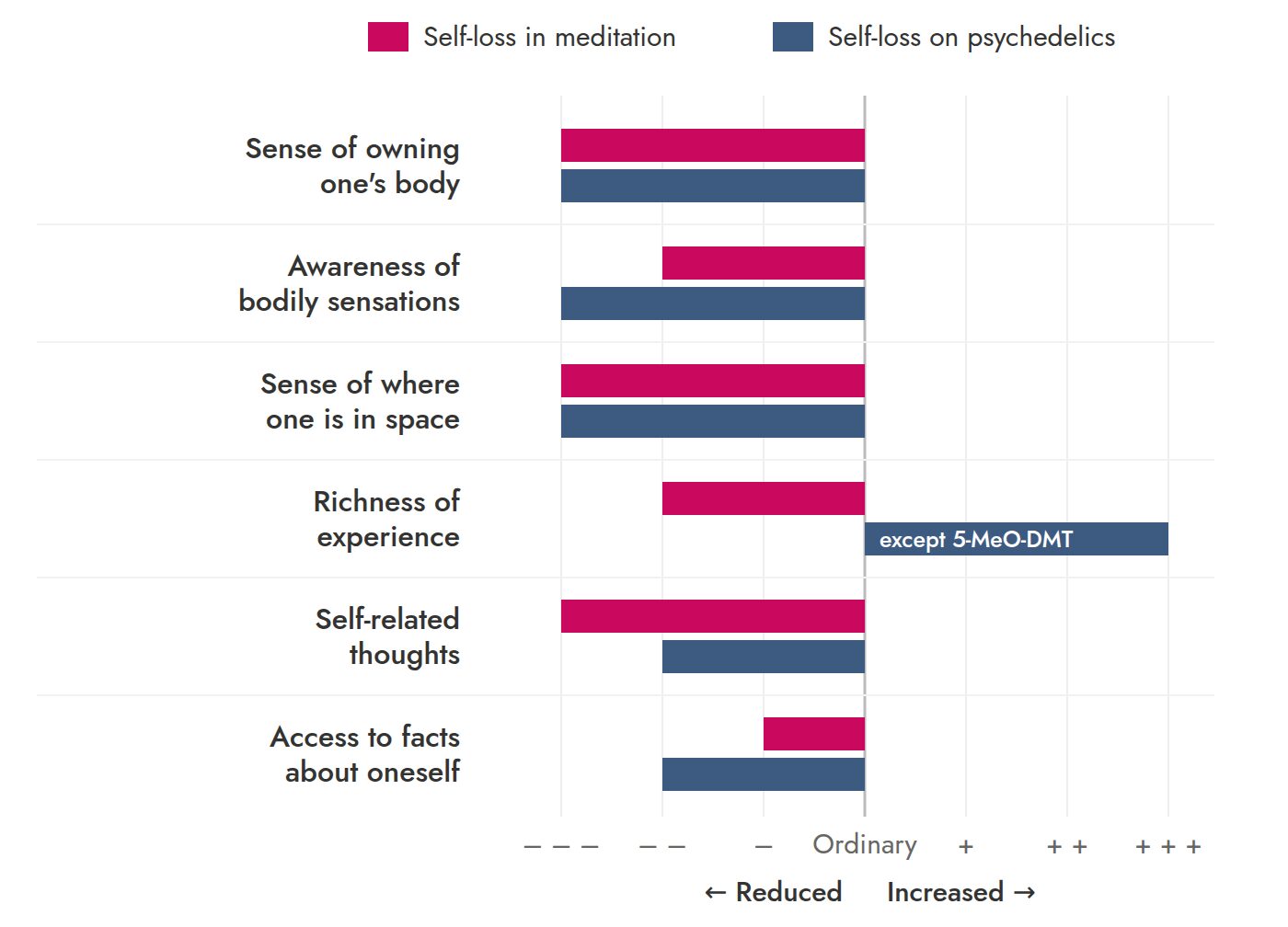
They build this into a model in which an altered state is plotted on several dimensions rather than on a single scale from “self” to “no self.” A typical meditation session, for instance, might involve more bodily awareness than usual (through attention to the breath) and fewer self-related thoughts, with no loss of self at all. The conclusion of their analysis is direct:
The upshot of this discussion is that there is no such thing as “self-loss” or “ego dissolution” in absolute terms.
Miscellaneous Interesting Takeaways
Non-Dual Awareness and “Pure Consciousness”
Some traditions aim beyond any one component of the self. Practices of
nondual awareness
Nondual awareness is a style of meditation, found in Tibetan Buddhism and other contemplative traditions, that does not focus on any particular object or experience. Instead the meditator rests in awareness itself, without splitting experience into an observing subject and the things observed, or into inner and outer. It is usually described as effortless, in contrast with practices that deliberately direct attention.
More on Wikipedia
Read more in the glossary
, found in Tibetan Buddhist Dzogchen and Mahāmudrā and in Hindu Advaita Vedanta, hold that the split between a subject and the objects it experiences is an illusion that can be seen through. The authors examine two readings. On one, ordinary experience carries a special, built-in sense of “mineness,” which non-dual practice removes. They find that assumption about ordinary experience controversial. On the other, which they prefer, non-dual states are what remains when self-related thought, and perhaps the bodily components, all switch off, so that nothing in experience marks a boundary between self and world. In one brain-imaging study, the usual opposition between the DMN and attention networks weakened during non-dual meditation, though similar changes have been seen in other kinds of meditation and after psilocybin.
“Pure consciousness,” a state said to be entirely empty of content, raises a philosophical problem: if there is something it is like to be in a state, it has some content. As the authors put it, “the experience of absence is not equivalent to the absence of experience.” They suggest a more modest reading: a state of extreme absorption lacking ordinary content.
Samadhi
Samadhi is a state of deep meditative absorption, or one-pointed concentration, described in Hindu and Buddhist traditions. In Buddhism it is closely tied to the jhanas, a series of increasingly refined absorption states. Its deepest stages are described as having almost no content: no thoughts, no pleasure or pain, and no sense of an individual self.
More on Wikipedia
Read more in the glossary
practice, which moves through stages called
jhanas
Jhana refers to states of deep concentration or meditative absorption in Buddhist practice, achieved through intense focus and mindfulness. These states represent progressive levels of mental and emotional calm, clarity, and bliss, cultivated through the practice of meditation, leading to profound insight and enlightenment.
More on Wikipedia
Read more in the glossary
toward a “formless” or “objectless” state, is often described this way, but the brain evidence is “still extremely sparse.” The review cites a single-participant study of the jhanas that found reduced activity in parietal areas that may represent the body’s orientation in space, matching the meditator’s experience of losing the body’s boundaries. A later case study of one expert, published after this review, found brain networks becoming less compartmentalized and more interconnected, most of all in the formless jhanas; it too followed a single person. Anecdotal reports suggest one psychedelic, 5-MeO-DMT, can produce similarly empty states, which is why the authors flag it as an exception.
How to Study Self-Loss Better
The review’s recommendations are mostly about measurement:
- Ask about each component separately. Psychedelic studies have often measured ego dissolution with one item (“I experienced a disintegration of myself or ego”), and the validated Ego Dissolution Inventory doesn’t separate narrative from bodily self-loss either. The authors suggest questionnaires with items on self-related thoughts and mental time travel and on body ownership, bodily awareness and self-location, then testing statistically whether these fall into two separate factors.
- Don’t rely on reports alone. Implicit measures could back them up. The authors suggest measuring peripersonal space, the zone around the body that the brain treats as “near me,” which can be measured with an established method and might blur when people report losing their location.
- Treat reports with care. They argue the reports are probably not confabulated, since they converge across groups and some come from interviews designed to reduce bias. They still note that most studies are small, and that reporting the experience of losing something does not prove it was there to begin with.
- Mind the design differences. In a footnote, they point out that meditative self-loss is hard to produce on demand in the lab, while drug effects depend more predictably on dose, and that a true placebo is hard to achieve with drugs whose effects are so obvious.
A State of Self-Loss Is Not a Selfless Person
The last section, written by Trautwein, Berkovich-Ohana, Carhart-Harris and Roseman, asks whether these experiences leave lasting traces. For meditation, there is some evidence of trait-level change in the narrative self: practitioners show reduced resting DMN activity and connectivity compared with controls, and an 8-week mindfulness course helped people disengage from “narrative self-focus.” Trautwein’s own study found hints of a smaller brain bias toward one’s own face in long-term loving-kindness meditators. Structural brain findings in the DMN are less consistent (Fox et al., 2014). Whether practice lastingly changes the bodily self hasn’t been systematically studied. For psychedelics, the authors state plainly that there is no evidence ego dissolution has lasting effects on either aspect of the self.
They also contrast how benefits seem to arise. In psychedelic therapy, the intensity of a “mystical-type” experience predicts later improvement. Meditation’s long-term benefits, by contrast, “do not appear to be necessarily mediated by intense experiences,” but by gradual training of skills such as attention and noticing mind wandering, and perhaps by “decentering,” the ability to step back from one’s thoughts, which has been found to explain part of the effect of mindfulness programs. The authors speculate that quieting self-related thought might help well-being, given the link between mind wandering and unhappiness, but say this “remains unsubstantiated by significant evidence.”
Nor are changes in the sense of self always welcome. In the Varieties of Contemplative Experience study of Western Buddhist meditators who had had difficulties, more than 75% reported changes in their sense of self, with reactions ranging “from neutral curiosity, to bliss and joy, to fear and terror.” (Elsewhere on this site, Castillo, 1990 discusses why depersonalization in meditators can feel calm or alarming.)
Finally, the authors warn against equating a temporary experience of selflessness with being selfless, more altruistic or compassionate:
While it is important to avoid conflating states of self-loss with “selflessness” as a trait or moral construct, it is possible that correlations might exist between these distinct notions, although perhaps only for a subset of highly experienced meditators or drug-users.
Final Reflection
This review doesn’t show that meditation and psychedelics do the same thing to the self, or that either is a shortcut to the other. Its contribution is a set of distinctions. “Losing the self” might mean that self-related thoughts fall silent, that facts about oneself become unavailable, that the body no longer feels like one’s own or can’t be felt at all, or that the sense of being somewhere disappears, with experience either vivid or nearly empty. Those are different experiences, and studies that lump them together under one questionnaire item can’t tell them apart.
For meditators, two points stand out. Dramatic self-loss is reported mostly by highly experienced practitioners, while the authors think meditation’s long-term benefits more likely come from steady training than from peak experiences. And the evidence on meditative self-loss is still thin: a handful of small studies, many of single experts, several from the authors’ own labs, plus the authors’ careful reading of first-person reports. The comparison with psychedelics leans further on anecdotal reports from drug users. The authors are open about this, calling their model “tentative.” Read as a map of questions to test rather than a set of findings, it is a useful one.
Citation
Millière, R., Carhart-Harris, R. L., Roseman, L., Trautwein, F.-M., & Berkovich-Ohana, A. (2018). Psychedelics, meditation, and self-consciousness. Frontiers in Psychology, 9, 1475. 10.3389/fpsyg.2018.01475
Get the next summary by email
One or two new paper summaries every couple of weeks, sent to your inbox when they go up.
No spam, and you can unsubscribe at any time. Prefer a feed reader? Use the RSS feed.