
Background Information
“Meditation” is a little like “sport”: a single word for many activities that differ in what they focus on, how much effort they take and what they are for. Yet much of the research treats it as one thing. Widely studied programs such as
MBSR
Mindfulness-Based Stress Reduction (MBSR) is a program designed to help individuals cope with stress, pain, and illness. Developed by Jon Kabat-Zinn in the 1970s, it combines meditation and yoga to promote awareness and stress management. The eight-week program teaches participants to focus on the present moment non-judgmentally, enhancing their ability to manage difficulties.
More on Wikipedia
Read more in the glossary
and
MBCT
Mindfulness-based cognitive therapy (MBCT) is an 8-week group program that combines mindfulness meditation, adapted from Mindfulness-Based Stress Reduction (MBSR), with elements of cognitive behavioral therapy. It was developed to help people who have recovered from depression avoid relapse, by learning to notice and step back from patterns of negative thinking. Classes usually meet weekly, with daily meditation practice at home.
More on Wikipedia
Read more in the glossary
mix several practices together, which makes it impossible to tell what any one of them does. Studies of what meditation feels like from the inside usually look at a single practice, without comparing it to others.
Bethany Kok and Tania Singer, at the Max Planck Institute for Human Cognitive and Brain Sciences in Leipzig, set out to compare four common practices side by side:
- Breathing meditation: resting attention on the breath, noticing when the mind wanders and bringing it back.
- Body scan: moving attention through the body one part at a time, typically starting at the head, and observing the sensations in each part.
- Loving-kindness meditation: calling up warmth and care by picturing a loved person, then extending those feelings in turn to oneself, a close person, a neutral person, a difficult person and finally strangers and all human beings.
- Observing thoughts: learning to watch thoughts without getting caught up in them. Participants first practiced labeling each thought as it came up, with labels such as “past” or “future,” “positive” or “negative,” and “self” or “other.” Then they practiced simply watching thoughts come and go without reacting. The authors describe the aim as “decentering,” a kind of
meta-awareness
Meta-awareness is awareness of what the mind is doing as it happens: noticing that you are having a thought, feeling an emotion or have drifted into mind wandering, rather than simply being caught up in it. It is a form of metacognition. Mindfulness practices train it directly, for example each time a meditator notices the mind has wandered and brings attention back.
More on Wikipedia
Read more in the glossary .
The authors expected each practice to leave its own signature. Breath and body practices should most increase presence and body awareness, loving-kindness should most increase warmth and positive thoughts about others, and observing thoughts should most increase awareness of thinking itself, without necessarily reducing how much people think.
What They Did
The data come from the ReSource Project, a secular nine-month mental training program run by Singer’s department. The same project produced the brain scans in Valk et al. 2017, which found that each training module was linked to thickening in a different part of the cortex. That study included more people, among them untrained retest groups who were scanned but did no practice. This paper uses something different: the short questionnaires that participants in the three training cohorts filled in online every time they meditated.
Participants were recruited in two German cities and screened out if they had previous meditation experience or a mental or physical illness, among other reasons. Of 242 people at the start, 13 never logged a meditation session, leaving 229 for analysis: 78 in cohort 1, 78 in cohort 2 and 73 in cohort 3. Their average age was about 41 (range 20 to 55), and 58 to 60% of each cohort were women.
The program had three 13-week modules, each opening with a 3-day retreat and followed by weekly 2-hour sessions with teachers:
- Presence: breathing meditation (10-minute guided recordings) and body scan (20-minute recordings), each to be practiced at least 5 days a week.
- Affect:
loving-kindness meditation
Loving-kindness meditation (mettā in Pali) is a Buddhist practice of deliberately cultivating warm, unconditional goodwill. Practitioners silently repeat wishes such as “may you be happy” or picture a person, usually starting with themselves or someone close and then extending the wishes to acquaintances, strangers, difficult people and all beings. It is one of the four brahmaviharas.
More on Wikipedia
Read more in the glossary , at least 5 days a week. - Perspective: observing-thoughts meditation, at least 5 days a week.
Affect and Perspective also included daily partner exercises, which this paper leaves out. Cohorts 1 and 2 both began with Presence, then did Affect and Perspective in opposite orders; cohort 2 started two months after cohort 1. Cohort 3 did only the Affect module, so its loving-kindness practice could be compared with loving-kindness learned after three months of attention training. The authors say the modules were matched in retreat length, weekly practice, session structure and teachers, so that each module served as a comparison for the others.
Just before and just after each session, participants answered questions on the study website, mostly on a slider from 0 (“not at all”) to 19 (“very much”):
- Every day: how pleasant and how energetic they felt (on a 0 to 8 grid), and how warm, how present and how aware of their body they felt.
- On rotating days: how much their thoughts were about the future, the past, themselves, other people, and how positive or negative they were. They also rated how distracted, occupied and busy with thoughts they were (averaged into “thought distraction”) and how aware they were of having thoughts and of what the thoughts were about (averaged into “thought awareness”). For these questions, the “before” ratings covered the previous 30 minutes and the “after” ratings covered the meditation itself.
In all, the researchers collected about 66,390 ratings, representing more than 11,000 hours of meditation. Participants practiced less than asked, though: on average 4.5 to 4.9 breathing sessions a week, 4.3 to 4.4 body scans, 3.4 to 4 loving-kindness sessions and 3.6 to 3.7 observing-thoughts sessions.
The researchers used multilevel statistical models to estimate how much each rating changed from before to after each practice, and compared the practices within the same people. Because cohort 2 ran the same program two months after cohort 1, they treated it as a replication. Rather than correcting for the many tests they ran (
multiple comparisons
The multiple comparisons problem arises when researchers run many statistical tests at once. Each test has a small chance of a false positive, so across thousands of tests, such as one for every point in a brain scan, some “significant” results will turn up by chance alone. Corrections raise the bar for significance to keep the overall false-positive rate down, at the cost of making small real effects harder to detect.
More on Wikipedia
Read more in the glossary
), they interpreted only results that appeared in both cohorts. They also ran an exploratory network analysis to see which changes tended to go together within each practice.
One Big Result: Each Practice Left Its Own Mark on Thought and Feeling
Each practice had a signature, which the authors call a “fingerprint”:
- Body scan raised body awareness (
interoceptive awareness
Interoception is the sense of the body’s internal state: feeling your heartbeat, breathing, hunger, warmth, tension and other sensations from inside the body. Interoceptive awareness is how much attention a person pays to these signals. Practices such as the body scan, which moves attention through the body part by part, aim to strengthen it.
More on Wikipedia
Read more in the glossary ) the most of any practice, by 2.34 points in both cohorts, against 1.37 to 1.70 for the other three. It also cut back on thinking: thoughts about the future, the past, other people and negative things all fell, with the biggest drop in thoughts about other people (2.90 and 2.64 points). It did not raise awareness of thoughts (−0.17 and +0.01). - Loving-kindness was the only practice that increased positive thoughts (by 0.58 and 1.03 points). Thoughts about other people went up during loving-kindness (0.29 and 0.65) while they fell during the other practices. That rise was statistically significant in only one cohort, though, and the paper’s results and discussion name different cohorts.
- Observing thoughts raised awareness of thoughts the most (1.47 and 1.25 points). It also reduced distraction by thoughts, but no more than breathing meditation or loving-kindness did.
- Breathing meditation had no unique effects. What it did, the others also did.
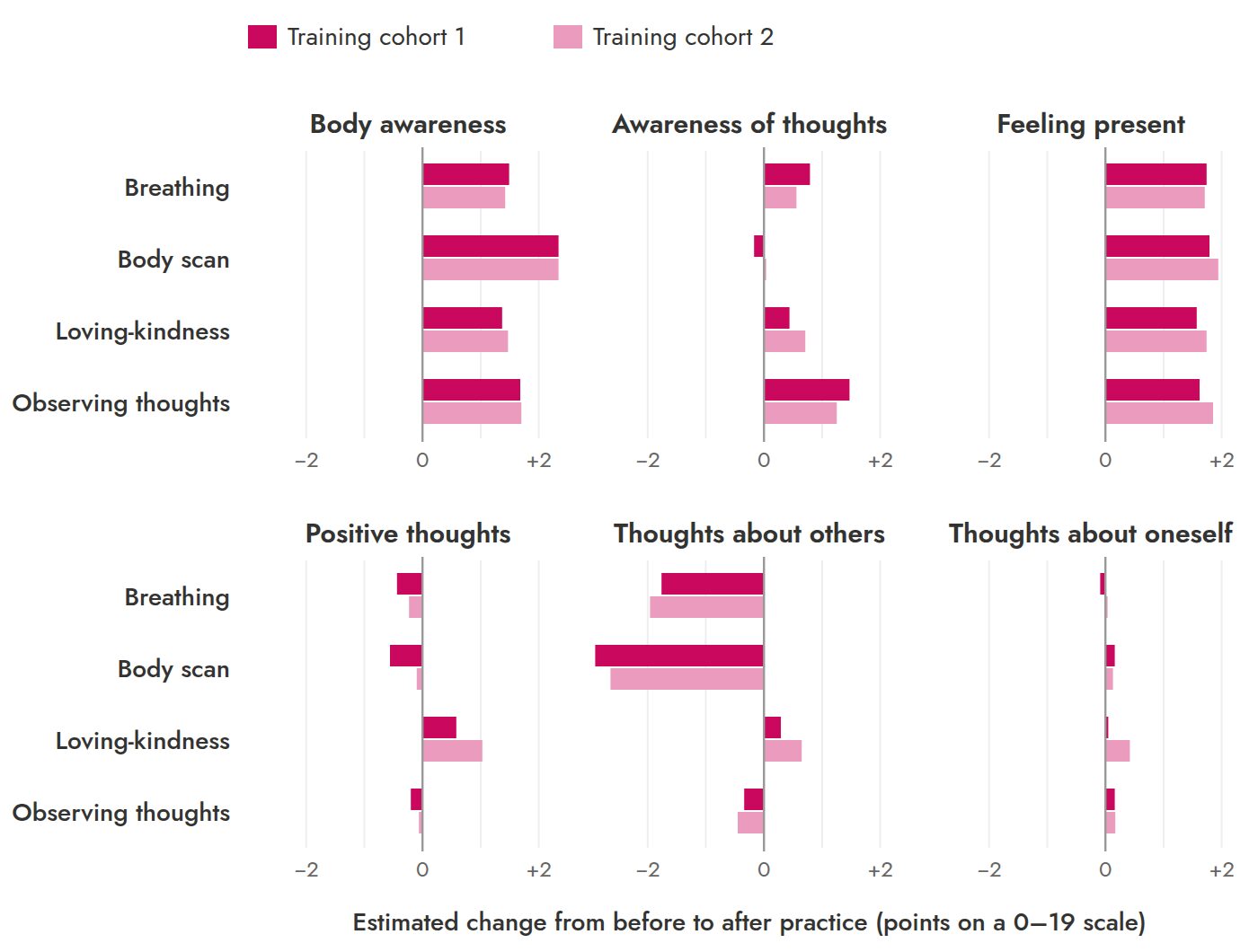
The abstract says loving-kindness “led to the greatest increase in feelings of warmth,” but the results are more modest. Warmth rose more during loving-kindness (0.65 and 0.59 points) than during body scan (0.34 and 0.29), but not reliably more than during breathing meditation or observing thoughts. Positive mood rose during all four practices, and again loving-kindness did not stand out.
What the four had in common was just as striking. All of them left people feeling more pleasant, more energetic, more present and more aware of their bodies, and less distracted by thoughts. The rise in feeling present was similar for every practice, between 1.57 and 1.94 points. The authors offer an analogy for this mix of shared and specific effects:
The analogy may be to a runner learning the geography of a city; depending on where the runner goes, she will learn about a different neighborhood, but no matter where she runs, her muscular and cardiovascular system will show a similar pattern of development over time.
Miscellaneous Interesting Takeaways
No Practice Changed How Much People Thought About Themselves
Thoughts about other people, the future and the past shifted a great deal depending on the practice. Thoughts about oneself barely moved. The estimated changes ranged from −0.09 to +0.42 points, and none was statistically significant in either cohort:
“Selflessness” is an additional pursuit often associated with meditation. However, in both TC1 and TC2, there was no significant change in the amount of self-related thoughts for any of the four practices.
This held even for loving-kindness, which extends warmth toward oneself as well as others, and for observing thoughts, in which people practiced labeling thoughts as “self” or “other.” It’s worth being clear about what was measured, though. The question asked how much of what people were thinking was about themselves. That’s different from the felt sense of being a separate self, which is what studies such as Dor-Ziderman et al. 2013 tried to capture in long-term meditators. These were beginners, practicing each method for three months.
Loving-Kindness Linked Thoughts of Self and Others
The network analysis looked at which changes tended to rise and fall together. During loving-kindness, more positive thoughts went with more thoughts about both oneself and others, and this cluster went with fewer negative, past-focused thoughts. Loving-kindness was the only practice to link thoughts of self and others positively. The authors suggest that “the more participants think positive thoughts of self and others, the more ruminative thoughts (negative and past-focused) are suppressed.”
During breathing meditation and body scan, the picture was different. A cluster tied thoughts about other people and the future to fewer thoughts about oneself, which the authors interpret as
mind wandering
Mind wandering is the spontaneous shift of attention away from a current task or external environment to internally generated thoughts, memories, or fantasies. This common cognitive process is associated with default mode network activation and has been extensively studied in relation to meditation practices, which often aim to reduce mind wandering.
More on Wikipedia
Read more in the glossary
: attention drifting away from oneself and the breath or body, toward other people and what might happen.
These patterns come from correlations among the changes and were exploratory. They fit loosely with Trautwein et al. 2016, in which long-term loving-kindness practitioners showed hints of a smaller brain bias toward their own face over a friend’s, but neither study shows that the practice changes how the self is represented over the long term.
Observing Thoughts Separated Noticing Thoughts From Being Caught by Them
During breathing meditation and body scan, awareness of thoughts and distraction by thoughts went together with body awareness and feeling present. During observing thoughts, awareness of thoughts and distraction by thoughts came apart, and the other changes split into four small, separate clusters. The authors read this as people getting better at telling the difference between noticing a thought and being pulled along by it, an approach to thoughts they liken to what MBCT trains.
Loving-Kindness Worked Much the Same Without the Attention Training First
Cohort 3 began with loving-kindness, without the three months of breath and body practice. Even so, their loving-kindness sessions raised feeling present, body awareness and awareness of thoughts, and reduced distraction, as much as in the other cohorts. The authors take this as a sign that these shared effects belong to all four practices, or to the setting in which they were taught, rather than being carried over from the first module. Cohort 3 also showed the largest rise in positive mood and warmth during loving-kindness, but a smaller drop in negative thoughts. This comparison was between different groups who practiced in different seasons and with different amounts of practice, so, as the authors note, those differences may not come from the training itself.
The Shifts Didn’t Fade Over the Months
The size of the before–after change didn’t shift steadily with time, so people did not seem to get used to the practices and stop feeling their effects. The flip side is that this paper is about what happens during and right after a session. It doesn’t show whether months of practice changed how people think and feel the rest of the time.
What the Design Can and Can’t Show
-
Everything is self-report. The authors designed the ratings to limit memory bias, with in-the-moment questions and sliders rather than fixed numbers, but they acknowledge the core limit:
However, self-report remains only as valid as the participant’s own ability to introspect.
-
“Before” and “after” weren’t quite the same kind of question. For thoughts and distraction, “before” covered the previous half hour of ordinary life and “after” covered the meditation. So fewer thoughts about the future during a body scan partly shows that people followed the instruction to attend to the body.
-
There was no non-meditating comparison for these ratings. The practices were compared with one another, so differences between them are informative, but the lift that all four shared, in mood, energy and presence, could come from simply taking time out to sit quietly. The authors suggest the improvements in mood and energy “could be due to the pleasant effects of learning a new self-care skill.” Participants also knew what each practice was meant to do, which could color their ratings ( demand characteristics Demand characteristics are cues in an experiment that hint at what the researchers expect, which can lead participants to behave the way they think they are supposed to rather than how they normally would. Researchers reduce them by disguising the study’s purpose, measuring behavior unobtrusively, or using comparison conditions that seem just as plausible.
More on Wikipedia
Read more in the glossary ); the paper doesn’t discuss this. -
Order and season. In cohorts 1 and 2, the breath and body module always came first, and people practiced less in the later modules, so, as the authors note, differences between the first module’s practices and the later ones could partly reflect how much people practiced. Swapping the order of loving-kindness and observing thoughts between the cohorts, and starting cohort 2 two months later, guards against this for those two practices and against effects of the seasons.
-
Many tests, no correction. Thirteen ratings were compared across four practices in two cohorts. Requiring results to appear in both cohorts reduces the risk of chance findings, but the two cohorts learned the same practices from the same teachers, so it isn’t a fully independent replication.
-
Who took part. Healthy middle-aged beginners from two German cities, all of whom volunteered for a nine-month meditation program.
Final Reflection
This study offers unusually detailed evidence for a simple idea: the kind of meditation you do matters. With tens of thousands of ratings from the same people practicing four different methods, each method left a recognizable short-term fingerprint. Body scan tuned people into their bodies and quieted their thinking, loving-kindness turned thoughts more positive and toward others, and observing thoughts made people more aware of thinking itself. It’s the experiential counterpart of the brain findings from the same project, where each module was linked to its own pattern of cortical change (Valk et al. 2017).
The shared effects deserve equal attention. Every practice left people feeling better, more energetic, more present and less pulled around by their thoughts, which fits with research showing that a wandering mind tends to be an unhappy one (Killingsworth & Gilbert 2010). Without a non-meditating comparison, though, it’s hard to know how much of that shared lift comes from meditation and how much from setting time aside.
For the question of the self, the most interesting result is a null one. Across months of sessions, none of the four practices, including one that extends warmth to oneself and one that trains people to label “self” thoughts, changed how much beginners thought about themselves during meditation compared with the half hour before. What changed was how those thoughts connected to others, most clearly in loving-kindness. Whatever loosening of the self long-term meditators describe, it didn’t show up here as fewer self-related thoughts in the first months of practice.
Citation
Kok, B. E., & Singer, T. (2017). Phenomenological fingerprints of four meditations: Differential state changes in affect, mind-wandering, meta-cognition, and interoception before and after daily practice across 9 months of training. Mindfulness, 8(1), 218–231. 10.1007/s12671-016-0594-9
Get the next summary by email
One or two new paper summaries every couple of weeks, sent to your inbox when they go up.
No spam, and you can unsubscribe at any time. Prefer a feed reader? Use the RSS feed.