
Background Information
Few things grab your attention like yourself. Psychology research has long found that attention, memory and motivation tilt toward whatever relates to the self. Brain recordings show the same tilt. In
EEG
An electroencephalogram (EEG) is a recording of brain activity. During this painless test, small sensors are attached to the scalp to pick up the electrical signals produced by the brain.
More on Wikipedia
Read more in the glossary
studies, your own name or face triggers a larger
P300
The P300 is a positive brain wave, recorded with EEG, that peaks roughly 300 to 600 milliseconds after something rare or meaningful appears, such as a target a person is watching for or a striking, personally relevant picture. It tends to be larger for things that draw more attention, so researchers use its size as a rough index of how much processing the brain gives a stimulus. It has several parts, including the P3a and the P3b.
More on Wikipedia
Read more in the glossary
than comparable stimuli that aren’t about you. The P300 is a brain wave that appears roughly a third to half a second after something rare or meaningful catches your attention.
Loving-kindness meditation
Loving-kindness meditation (mettā in Pali) is a Buddhist practice of deliberately cultivating warm, unconditional goodwill. Practitioners silently repeat wishes such as “may you be happy” or picture a person, usually starting with themselves or someone close and then extending the wishes to acquaintances, strangers, difficult people and all beings. It is one of the four brahmaviharas.
More on Wikipedia
Read more in the glossary
works directly on the line between self and others. Practitioners silently wish well-being to themselves, then to someone close, and then to a widening circle of acquaintances, strangers and difficult people. In the authors’ words, the practice involves relating to the self as “like the other” and seeing the other as “like the self.” Loving-kindness and related compassion practices have been linked to greater kindness toward others, including more generous giving after two weeks of compassion training, but less is known about how they change the way the mind processes “me” versus “you.”
Fynn-Mathis Trautwein and colleagues, working in Freiburg, Germany, reasoned that if long practice weaves other people into a person’s sense of self, the brain’s preference for the self should shrink. Their yardstick was the P300 to a person’s own face compared with a close friend’s face:
…if the self representation of an individual is less isolated but instead embedded more into a social context, then self- and other-related stimuli should also elicit more similar cognitive processing.
What They Did
The team recruited 12 meditators from local meditation centers and 12 people with no meditation experience, matched for age, sex, handedness and education. To qualify, meditators needed at least two years of meditating at least once a week, including at least three months of weekly loving-kindness practice that wished well to themselves and to specific other people.
The EEG of one meditator was too noisy to use, so the researchers dropped that person and their matched partner, leaving 11 in each group (six women and five men each, aged 26 to 61, average about 42). Of the meditators, six practiced in Tibetan Buddhist traditions, three in Theravada and two in no particular tradition. They had practiced for about 11½ years on average (from 2 to 31 years) and loving-kindness for about 9 years, though with wide variation. They estimated about 2,400 hours of sitting meditation on average, and in the eight weeks before the study they averaged 2.5 hours of loving-kindness practice a week. That is experienced, but well short of the 10,000 to 50,000 hours of the Buddhist practitioners in Lutz et al. 2004.
Before the session, everyone handed in a photo of their own face and one of a close other: someone of the same sex with whom they had a close, positive relationship, such as a good friend, but not a family member. Meditators were asked to pick someone toward whom they could easily direct loving-kindness. The photos were converted to gray scale, cropped and matched for brightness.
In the lab, participants watched 750 pictures flash on a screen in an
oddball task
An oddball task shows a long stream of frequent, ordinary stimuli interrupted now and then by rare ones. Some rare stimuli are targets that call for a response, such as a button press; others are distracters to be ignored. Rare stimuli trigger a P300 brain response that the frequent ones don’t, which makes the task a standard way to study attention with EEG.
More on Wikipedia
Read more in the glossary
while a 64-electrode cap recorded their EEG. Their only job was to press a button whenever a flower appeared. Their own face and their friend’s face popped up now and then as distracters they were meant to ignore. Averaging the brain’s response over many such moments gives an
event-related potential
for each type of picture.
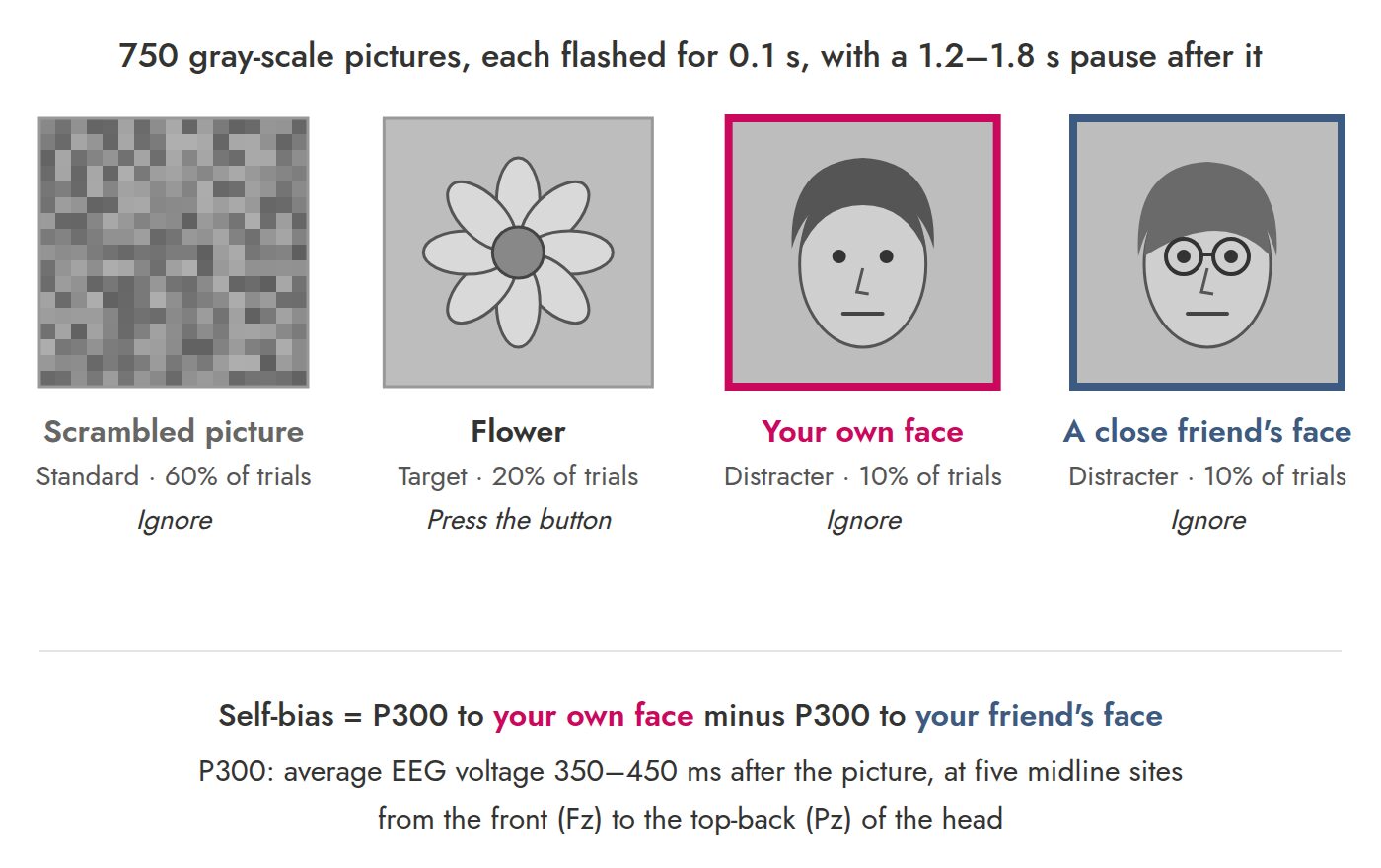
The key measure was the size of the P300, averaged 350 to 450 milliseconds after each face appeared, at five electrodes running along the midline of the head from the forehead (Fz) to the top-back of the head (Pz). “Self-bias” meant how much bigger the P300 was for one’s own face than for the friend’s.
Participants also filled in questionnaires measuring compassionate love for strangers and humanity, compassionate love for the friend in the photo,
self-compassion
Self-compassion means treating yourself with the kindness you would offer a friend when you fail or suffer. In psychologist Kristin Neff’s widely used definition it has three parts: kindness toward oneself rather than harsh judgment, seeing one’s difficulties as part of shared human experience rather than as isolating, and mindful awareness of painful feelings without being swept away by them. It is usually measured with Neff’s Self-Compassion Scale.
More on Wikipedia
Read more in the glossary
, and how close they felt to that friend.
The meditators then stayed for two more rounds of the same task. Before one, they spent 10 minutes on loving-kindness meditation, first toward themselves for about two and a half minutes and then toward the friend in the photo. Before the other, they spent the same time thinking about themselves and then the friend in an emotionally neutral way, for example about their personal characteristics. Half did the two exercises in one order and half in the other.
One Big Result: Meditators’ Brains Favored Their Own Face Less, but Only Over the Back of the Head
Across the two groups, a person’s own face triggered a larger P300 than their close friend’s face, even though the friend was someone they knew and liked. That confirms earlier findings and extends them, since in some earlier studies the comparison was someone familiar but not personally known.
Did the meditators show less of this self-bias? Averaged across all five electrodes, no. The groups’ self-bias was about the same. But the group difference depended on where on the scalp you looked, a pattern that was statistically significant. At Pz, toward the back of the head, non-meditators’ brains responded clearly more to their own face than to their friend’s, while meditators’ brains showed no reliable difference.
That pattern needs care. A difference being clear in one group and not the other doesn’t by itself show that the two groups differ, and the direct test of whether the groups’ self-bias differed at Pz fell just short of significance (p = 0.072). The same was true when the researchers pooled six electrodes over that area (p = 0.079). The authors acknowledge this:
Group effects on P300 amplitudes do not fully support the hypothesis that differences between self- and other-related P300 are in general smaller in LKM practitioners…
What mostly drove the pattern was where the response to one’s own face was strongest. In meditators it peaked toward the front and center of the head; in non-meditators it was spread more toward the center and back. The authors speculate that in non-meditators the own face recruited a back-of-the-head process (the
P3b
The P3b is a positive brain wave, recorded with EEG, that peaks over the top and back of the head roughly 300 to 600 milliseconds after a person notices a target they were looking for. It is one part of the P300 response. Researchers use its size as a rough index of how much attention or processing the brain devotes to that target.
More on Wikipedia
Read more in the glossary
) usually reserved for targets, as if the self-face were treated like something to look out for, while in meditators it was handled more like the friend’s face: a distracter, if a slightly stronger one.
Could meditators simply be paying attention differently overall? The groups didn’t differ in their brain responses to the flowers or the scrambled pictures, or in how accurately and quickly they pressed the button. Whatever differed seems to be specific to their own face.
Miscellaneous Interesting Takeaways
More Practice Went With a Smaller Self-Bias
Among the 11 meditators, those who had meditated for more months had a smaller self-bias at Pz, after accounting for age (r = −0.70), as did those with more months of loving-kindness practice (r = −0.58), with similar results over the pooled electrodes around Pz. These are strong correlations, but they come with caveats. With 11 people, a correlation can swing a lot from one sample to the next, and small samples tend to inflate effects, as the authors themselves note. Pz was chosen because it was where the group difference looked largest, and the correlations were tested one-tailed, in the expected direction only. Across the study, the paper reports results as significant at p ≤ 0.05 without describing any adjustment for the number of tests (
multiple comparisons
The multiple comparisons problem arises when researchers run many statistical tests at once. Each test has a small chance of a false positive, so across thousands of tests, such as one for every point in a brain scan, some “significant” results will turn up by chance alone. Corrections raise the bar for significance to keep the overall false-positive rate down, at the cost of making small real effects harder to detect.
More on Wikipedia
Read more in the glossary
).
Meditators Reported More Compassion for Strangers and Themselves, but Not for Their Friend
On the questionnaires, meditators reported more compassionate love for strangers and humanity (5.00 vs 4.08 on a 1–7 scale, a large
effect size
Effect size is a statistical concept that quantifies the magnitude or strength of a relationship, difference, or intervention outcome. Unlike p-values which only indicate statistical significance, effect sizes measure how meaningful a result is in practical terms. Common measures include Cohen’s d (standardized mean difference), correlation coefficients (r), and odds ratios. In meditation research, effect sizes help quantify the practical impact of different meditation practices on psychological or physiological outcomes.
More on Wikipedia
Read more in the glossary
) and more self-compassion (3.70 vs 3.09 on a 1–5 scale). They didn’t differ from non-meditators in compassion for the friend in the photo (5.32 vs 5.42) or in how close they felt to that friend. That fits the aim of loving-kindness to extend care beyond the people we already love, and it makes it less likely that the brain difference simply reflects meditators having closer friends.
Across both groups, those with more compassion for humanity (r = −0.52) and more self-compassion (r = −0.44) had a smaller self-bias at Pz. Because meditators scored higher on compassion and, at Pz, tended to have a smaller self-bias, these correlations may partly restate the difference between the groups rather than add independent evidence.
Ten Minutes of Loving-Kindness Didn’t Shift the Brain Response
If loving-kindness weakens self-bias, a session of it just before the task might do so too. It didn’t: the P300 difference between the two faces was no smaller after loving-kindness than after the neutral thinking exercise. The authors list possible reasons: the effect of the first exercise may have carried over into the second, a short meditation’s effect may fade too quickly, thinking about a friend may itself bring self and other closer, or meditators’ self-bias may already have been too low to shrink further. They also allow that loving-kindness may not directly change this kind of processing at all.
Two other measures did shift, though they don’t tell a single story. People occasionally pressed the button by mistake when a face appeared. After loving-kindness, meditators made no more of these slips for their own face than for their friend’s, while after the neutral exercise they made slightly more for their own face, a significant difference. Yet after loving-kindness the P300 peaked later for their own face than for the friend’s (460 vs 395 milliseconds), a gap not seen after the neutral exercise. In the first round, before either exercise, non-meditators tended to make a few more slips for their own face than for their friend’s while meditators didn’t, but that group difference wasn’t significant.
Loving-Kindness Wasn’t the Only Practice
Every meditator also did other practices, such as mindfulness meditation. Mindfulness has been linked to quieter self-focused thinking, for example in the brain’s
DMN
The default mode network (DMN) is a system of connected brain areas that show increased activity when a person is not focused on what is happening around them, such as during daydreaming and mind-wandering. It can also be active when the individual is thinking about others or themselves, remembering the past, and planning for the future.
More on Wikipedia
Read more in the glossary
(Garrison et al., 2015), so the authors acknowledge that part of the group difference may come from it rather than from loving-kindness specifically.
Final Reflection
This small study asked a question at the heart of contemplative traditions: does practice loosen the line the mind draws between “me” and “others”? It offers a hint. In a simple, implicit brain measure, the extra response to one’s own face over a friend’s looked smaller in loving-kindness practitioners, at least toward the back of the head, and smaller still in those who had practiced longest. The same people reported more compassion for strangers and for themselves.
But the evidence is preliminary, as the question mark in the paper’s title (“Decentering the Self?”) suggests. With 11 people per group, the key group comparison was only a trend, the result depended on where on the scalp one looked, and a short meditation in the lab changed nothing in the main measure. The authors are clear about what their design can and can’t show:
While a strong correlation with the amount of meditative practice is supportive of this interpretation, it is not possible to directly infer a causal role of LKM from these cross-sectional results.
They also note that blurring self and other isn’t simply good. Telling one’s own feelings apart from someone else’s may help people act effectively on others’ behalf and avoid being overwhelmed by their distress. Larger studies that follow the same people before and after loving-kindness training would be needed to show whether the practice itself rebalances how the brain treats self and other.
Citation
Trautwein, F.-M., Naranjo, J. R., & Schmidt, S. (2016). Decentering the self? Reduced bias in self- vs. other-related processing in long-term practitioners of loving-kindness meditation. Frontiers in Psychology, 7, 1785. 10.3389/fpsyg.2016.01785
Get the next summary by email
One or two new paper summaries every couple of weeks, sent to your inbox when they go up.
No spam, and you can unsubscribe at any time. Prefer a feed reader? Use the RSS feed.