
Background Information
Most meditation research looks at states in which experience changes: attention sharpens, thoughts quiet down, the sense of self loosens. Buddhist texts more than two thousand years old describe something more radical. In an event called
cessation
In Buddhist meditation, a cessation (Pali nirodha) is a complete gap in experience reported by some very advanced meditators: for a moment, consciousness itself seems to switch off and then return, with almost no sense of time having passed, often followed by a feeling of unusual clarity. Theravada teachings link brief cessations to the last of the stages of insight, called fruition, and also describe a longer attainment, nirodha samāpatti. Science has studied cessations in only a handful of meditators.
More on Wikipedia
Read more in the glossary
(nirodha in Pali), a very advanced meditator reports that consciousness itself briefly switches off, and then comes back.
The authors describe what is reported this way:
During cessation, consciousness is momentarily absent (as reported by the meditator), and there may also be subsequent awareness of this absence having occurred. However, unlike sleep, there is almost no awareness of time having passed.
In the Theravada Buddhist tradition, cessations come at the end of a sequence of meditative “stages of insight,” at a final stage called fruition. Teachers describe them as lasting only seconds, and say meditators come out of them with a sudden sense of mental clarity.
For neuroscience, this is an unusual opportunity. Scientists usually study the loss of consciousness through general anesthesia or sleep. A drug-free loss of consciousness that a person can steer toward from within, and that starts and ends abruptly, might reveal which brain activity consciousness depends on. But cessations are hard to study. Few people report them, they can’t be produced on cue, and capturing one means recording the brain continuously while relying on the meditator to say when it happened. Before this study, the authors found only one neuroimaging study of cessation: two meditators, with three cessations each.
The research team, from the Meditation Research Program at Massachusetts General Hospital and collaborators in Australia and the Netherlands, took a different approach. Instead of a few cessations from several people, they recorded many from one person, the same strategy the program later used for an expert meditator’s jhana states. Based on earlier work, they predicted the main changes would show up in
alpha waves
Alpha waves are rhythmic electrical brain activity at roughly 8–13 cycles per second, recorded with EEG. They are often strongest when the eyes are closed and the mind is relaxed, and are thought to help filter out or hold back information as part of top-down control. Meditation studies have reported both increases and decreases in alpha, depending on the practice.
More on Wikipedia
Read more in the glossary
.
What They Did
The participant was one of the paper’s authors, Daniel Ingram, a meditation teacher who was 51 at the time and had practiced for 26 years. Based on about an hour of daily practice plus roughly a year of retreat at 14 hours a day, the team estimated his lifetime practice at 23,110 hours. He had trained in several approaches, including Mahasi-style noting, the
jhanas
Jhana refers to states of deep concentration or meditative absorption in Buddhist practice, achieved through intense focus and mindfulness. These states represent progressive levels of mental and emotional calm, clarity, and bliss, cultivated through the practice of meditation, leading to profound insight and enlightenment.
More on Wikipedia
Read more in the glossary
and
Vipassana
Vipassana is a form of Buddhist meditation focused on the cultivation of insight through moment-to-moment awareness of bodily sensations, thoughts, and emotions. It emphasizes non-reactivity and equanimity, helping practitioners observe mental and physical phenomena without attachment.
More on Wikipedia
Read more in the glossary
, and said he could deliberately incline his meditation toward cessations.
Between November 2019 and March 2020 he meditated with eyes closed during 29
EEG
An electroencephalogram (EEG) is a recording of brain activity. During this painless test, small sensors are attached to the scalp to pick up the electrical signals produced by the brain.
More on Wikipedia
Read more in the glossary
recordings, each lasting from about 7 minutes to an hour, wearing a cap with 20 dry electrodes. He did one of two practices: a form of insight meditation called “review practice,” aimed specifically at cessation, or fire kasina, a traditional Theravada practice of concentrating on visual sensations generated inside the mind.
Finding the cessations. Each cessation came with an involuntary flutter of the eyes and a large blink, which stood out clearly against the otherwise still, eyes-closed EEG. The meditator and another author independently marked these blinks in the raw recordings and picked the same moments. In one session, he also pressed a button after each of seven cessations. The button press came a median of 3.6 seconds after the blink (range 2.1 to 7.2 seconds), which supports the idea that the blink marks the event and that cessations are very brief. In the other sessions he didn’t press a button, so that monitoring for one wouldn’t affect his meditation.
Grading them. After every session, he rated each cessation on its build-up, entry, the event itself, the exit and the aftereffects. He reported 46 grade A cessations, 12 grade B and 11 grade C. The team kept only grade A events, which they took to be the clearest, and only those at least 80 seconds from another cessation and 40 seconds from the start or end of a session. After one recording could not be read because of a technical glitch, 37 cessations remained.
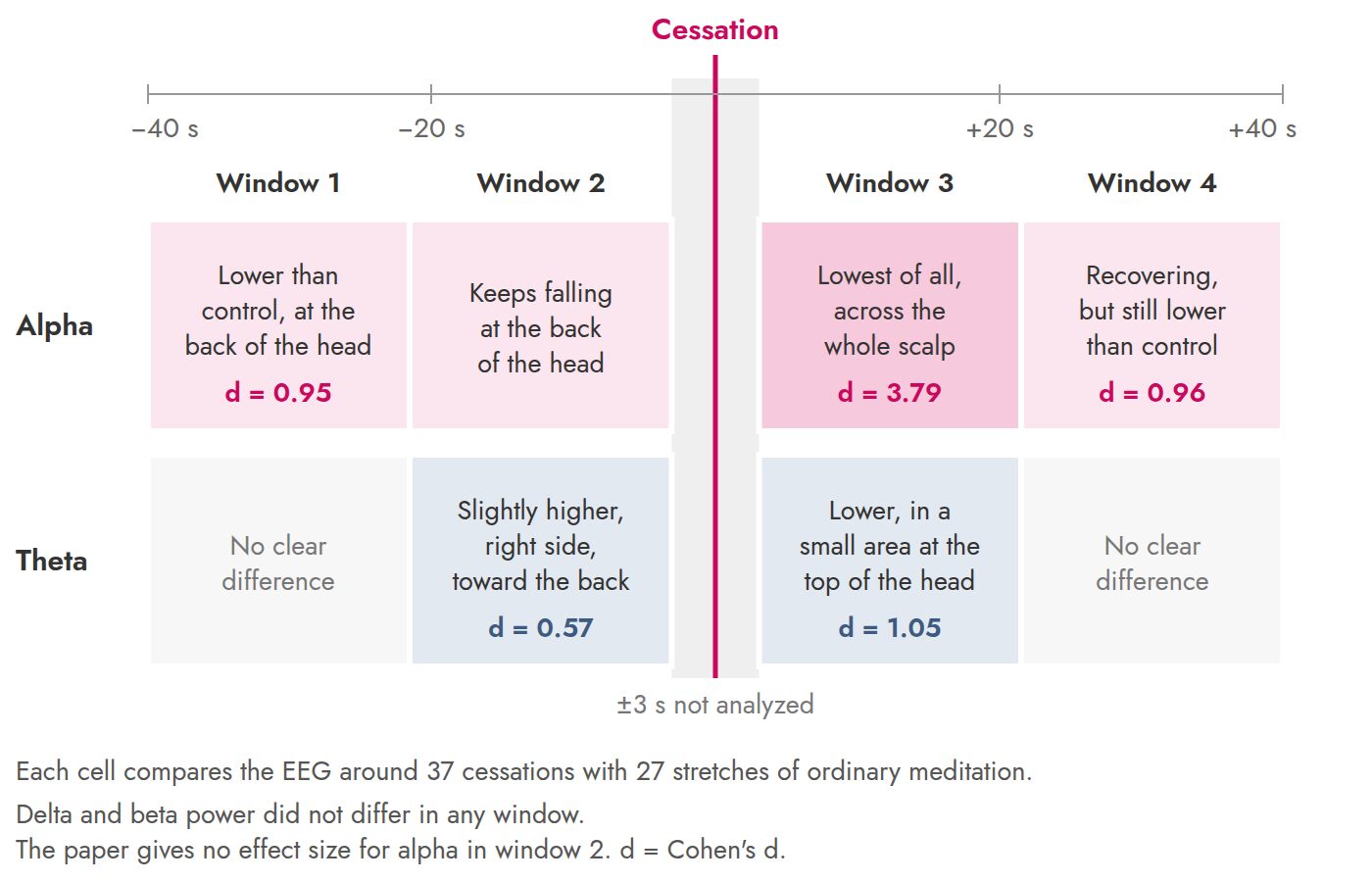
The comparison. For control data, a computer placed 27 markers at random points in the same sessions, each at least 160 seconds from any cessation. The team then analyzed the 80 seconds around every cessation and every control marker, split into four windows of about 18 seconds each: two before the event and two after. The 3 seconds on either side of the cessation were dropped, because the eye movements swamp the EEG there.
In each window they measured brain-wave power in standard frequency bands, using a method that separates true rhythmic activity from the brain’s non-rhythmic background activity. Alpha was the prediction; differences in the other bands were treated as exploratory and weren’t corrected for
multiple comparisons
The multiple comparisons problem arises when researchers run many statistical tests at once. Each test has a small chance of a false positive, so across thousands of tests, such as one for every point in a brain scan, some “significant” results will turn up by chance alone. Corrections raise the bar for significance to keep the overall false-positive rate down, at the cost of making small real effects harder to detect.
More on Wikipedia
Read more in the glossary
. They set aside the fastest band,
gamma
Gamma brain waves are a type of brainwave pattern that oscillate at approximately 25 to 100 Hz. Gamma waves are associated with states of heightened perception, problem-solving, and consciousness. Gamma waves play a crucial role in cognitive functioning, including memory, and information processing, and are thought to integrate thoughts and information from different parts of the brain.
More on Wikipedia
Read more in the glossary
, because at those frequencies scalp recordings pick up a lot of muscle activity.
One Big Result: Alpha Waves Faded for 40 Seconds Before Each Cessation and Were Lowest Just After
Compared with the control stretches, alpha power was already lower over the back of the head in the first window, 22 to 40 seconds before the cessation. It kept falling as the cessation approached, and in the window just after the event (3 to 22 seconds afterward) it was at its lowest and lower across the whole scalp. In the last window, 22 to 40 seconds after, it was recovering toward its earlier level but was still lower than in the control stretches. Alpha power at the control points stayed steady across the four windows, so the change was tied to the cessations.
A second analysis tracked power in seven brain regions, two seconds at a time. Over the regions at the back of the head (occipital and parietal), alpha fell steadily across the whole 40 seconds before a cessation and climbed steadily across the 40 seconds after it. In the other regions, alpha only showed the steady climb back after the event.
The differences were large in statistical terms. The
effect size
Effect size is a statistical concept that quantifies the magnitude or strength of a relationship, difference, or intervention outcome. Unlike p-values which only indicate statistical significance, effect sizes measure how meaningful a result is in practical terms. Common measures include Cohen’s d (standardized mean difference), correlation coefficients (r), and odds ratios. In meditation research, effect sizes help quantify the practical impact of different meditation practices on psychological or physiological outcomes.
More on Wikipedia
Read more in the glossary
for the window just after a cessation was a Cohen’s d of 3.79. That number compares moments within one person’s recordings, though, not groups of people, so it can’t be set beside the effect sizes from typical studies.
Alpha waves are thought to reflect top-down processing: the brain using its expectations to predict and filter incoming sensory information. Alpha over the back of the head is also linked to turning attention away from the outside world. The authors connect the decline to a theory two of them have proposed: that deep meditation gradually takes apart the brain’s layered, top-down predictions about the world, and that if this goes far enough, consciousness itself can drop out.
Miscellaneous Interesting Takeaways
Theta Changed Only a Little
Theta waves
Theta waves are rhythmic electrical brain activity at roughly 4–8 cycles per second, recorded with EEG. While awake, they are linked to memory, focused attention and drowsiness, and meditation studies often report more theta over the front of the head during practice. In sleep, theta is common in light non-REM sleep and in REM sleep.
More on Wikipedia
Read more in the glossary
, often linked to relaxed alertness in meditation, were slightly higher than control in the window just before a cessation, mostly over the right side toward the back of the head. Just after the cessation, theta was lower in a small area at the top of the head. The regional analysis told a somewhat different story: theta rose over the 40 seconds before the event in three regions until it was close to the control level. These theta results were modest, exploratory and not fully consistent between the two analyses. Delta and
beta
Beta brain waves are a type of brainwave pattern that oscillate between approximately 12 to 30 Hz. Beta waves are typically associated with active thinking, focus, alertness, and engagement with the external world. They are prominent during conscious, goal-directed activity and are linked to cognitive tasks such as problem-solving, decision-making, and sustained attention.
More on Wikipedia
Read more in the glossary
power didn’t differ around cessations.
Unlike Anesthesia, and Unlike Most Meditation
Under drugs such as propofol, alpha tends to shift from the back of the head toward the front as people lose consciousness. Here, alpha simply dropped, most of all just after the event. The authors suggest that drop could reflect the brain becoming newly alert:
the suppression in post-cessation global alpha power may be an indication of renewed wakefulness … which some meditators (including the participant in the current study) describe as a kind of inner “reset”
They also note that many studies of
mindfulness
Mindfulness is the psychological process of purposely bringing one’s attention to experiences occurring in the present moment without judgment. It involves maintaining awareness of thoughts, feelings, bodily sensations, and surrounding environment with an attitude of curiosity and acceptance. In meditation contexts, mindfulness practices typically involve focusing attention on the breath or body sensations as anchors to the present moment while acknowledging and releasing distracting thoughts.
More on Wikipedia
Read more in the glossary
meditation find alpha increases, the opposite of this pattern. Falling alpha is also seen in disorders of consciousness such as coma, so the authors suggest cessations may resemble unconsciousness more than they resemble other meditative states. That is a suggestion, not something this study tested.
Not Just the Eyes
A well-known EEG effect is that alpha drops sharply when people open their eyes. Since each cessation came with eye movements and a blink, could that explain the result? The authors argue it can’t fully: the decline began about 40 seconds before the blink, which points to a gradual change in the brain rather than a reflex. They also acknowledge that the control stretches had no blinks, but argue that adding deliberate blinks would have created a different problem, since the cessation blinks were involuntary.
A Different Result From the Only Earlier Study
The earlier study of two meditators found that cessations came with more long-range synchronization in gamma waves, the brain’s fastest rhythms. This study didn’t look at synchronization, and it set gamma aside because muscle activity contaminates it. The authors suggest the different methods, the much larger number of cessations here, the different ways the meditators signaled a cessation, and the different meditators may explain why the results don’t line up.
Final Reflection
This is a careful attempt to study something most meditation science hasn’t touched: not a change in what a person experiences, but a reported gap in experience altogether. The design is unusual in a useful way. Thirty-seven events from one person give enough repetitions to see a consistent pattern, and the brain changes began well before the eye blink that marked each event, so they aren’t simply a side effect of it. The power values were also fairly consistent across the 37 cessations, which suggests they weren’t wildly different events.
There are real limits, and the authors name the main one:
such a protocol simultaneously reduces the generalizability of the current results, that is, it may be that the alpha suppression effect observed may be idiosyncratic to the participant.
Other limits matter too. The EEG can’t confirm that consciousness was absent; that rests on the meditator’s own account. The events were located by a blink that may be peculiar to him, and checked against button presses in only one session. And the participant is not an outside volunteer: he is a co-author who helped design and run the study, and has provided research funding to the program that ran it, all of which the paper discloses. The paper’s discussion says the results “validate” experienced meditators’ ability to change their state of consciousness at will, while the abstract more cautiously calls them “evidence.” What the study shows is a distinctive, repeatable brain pattern around the moments one meditator reports as cessations. Whether it holds for other practitioners, and how it compares with other deep states studied in single expert meditators, such as content-free awareness and jhana, are questions for studies with more meditators.
Citation
Chowdhury, A., van Lutterveld, R., Laukkonen, R. E., Slagter, H. A., Ingram, D. M., & Sacchet, M. D. (2023). Investigation of advanced mindfulness meditation “cessation” experiences using EEG spectral analysis in an intensively sampled case study. Neuropsychologia, 190, 108694. 10.1016/j.neuropsychologia.2023.108694
Get the next summary by email
One or two new paper summaries every couple of weeks, sent to your inbox when they go up.
No spam, and you can unsubscribe at any time. Prefer a feed reader? Use the RSS feed.