
Background Information
Depression often comes back. For people who have had several episodes, staying well once they recover is a major challenge, and the usual way to protect them is to keep taking antidepressants for the long term. Willem Kuyken and colleagues call relapse prevention in recurrent depression a significant public health problem, and note that finding a non-drug treatment as effective as antidepressants would be an important development.
Mindfulness-based cognitive therapy (MBCT)
Mindfulness-based cognitive therapy (MBCT) is an 8-week group program that combines mindfulness meditation, adapted from Mindfulness-Based Stress Reduction (MBSR), with elements of cognitive behavioral therapy. It was developed to help people who have recovered from depression avoid relapse, by learning to notice and step back from patterns of negative thinking. Classes usually meet weekly, with daily meditation practice at home.
More on Wikipedia
Read more in the glossary
was designed for exactly this situation. It teaches people who are currently well but at high risk of relapse to combine systematic
mindfulness
Mindfulness is the psychological process of purposely bringing one’s attention to experiences occurring in the present moment without judgment. It involves maintaining awareness of thoughts, feelings, bodily sensations, and surrounding environment with an attitude of curiosity and acceptance. In meditation contexts, mindfulness practices typically involve focusing attention on the breath or body sensations as anchors to the present moment while acknowledging and releasing distracting thoughts.
More on Wikipedia
Read more in the glossary
training with elements of cognitive therapy, targeting thinking patterns implicated in relapse. An earlier
meta-analysis
A meta-analysis statistically combines the results of many earlier studies on the same question. Pooling the data can estimate an overall effect more precisely than any single study and show whether results agree across studies. Its conclusions are only as good as the studies it includes and how similar they are.
More on Wikipedia
Read more in the glossary
of 6 randomized trials with 593 patients (Piet and Hougaard, 2011) had found that MBCT reduced the risk of relapse by about a third compared with usual care or placebo.
That left two open questions. Does MBCT hold up against an active treatment, especially antidepressants? And does it work better for some people than for others? The second question is hard to answer from published results, because each trial reports only group averages. So the team, made up mostly of investigators from the original trials, went back to the raw data:
Unlike meta-analyses of aggregate data at the trial level, IPD analyses permit the investigation of patient-level characteristics that may be potential moderators of treatment effects.
IPD stands for individual patient data. In an
individual patient data meta-analysis
An individual patient data (IPD) meta-analysis pools the raw records of every participant from several trials, rather than the summary results each trial published. Re-analyzing everyone together, the same way, lets researchers ask whether a treatment works better for some kinds of patients than others. It depends on the original trial teams sharing their data, which isn’t always possible.
More on Wikipedia
Read more in the glossary
, every participant’s record from every trial is pooled into one data set and analyzed the same way, so the researchers can ask, for example, whether people who still had some symptoms when they started got more out of MBCT than people who had none.
What They Did
The team updated the earlier review’s search of six research databases to November 2014, using the same rules. They included randomized trials in adults with recurrent major depression in full or partial remission that compared MBCT, taught according to its treatment manual, with at least one other treatment, including usual care. The outcome had to be relapse into a new episode of major depression, diagnosed by clinical interview.
Ten trials qualified. The authors of nine shared their raw data, giving 1,329 randomized participants. The tenth trial’s data weren’t available. Relapse status and timing were known for 1,258 people (94.7%). Their average age was 47, 75% were women, and of those with data, 58% had had five or more episodes of depression.
The comparisons differed from trial to trial:
- Usual care: five trials compared MBCT with treatment as usual.
- Antidepressants: four trials compared MBCT with maintenance antidepressants. In two of them, the MBCT group came off their antidepressants. The largest, the PREVENT trial with 424 people randomized, compared MBCT combined with stopping antidepressants against staying on them. In a third trial, MBCT was added on top of continued medication.
- Another psychological program: one three-arm trial compared MBCT with both usual care and cognitive psychological education.
A placebo pill arm in one trial (30 people) was left out of all analyses.
Because people relapsed at different times and were followed for different lengths of time, the team analyzed time to relapse, cutting off follow-up at 60 weeks. The result is a
hazard ratio
A hazard ratio compares how fast an event happens in two groups over time, such as recovery or death, at any given moment among the people it hasn’t happened to yet. A hazard ratio of 2 means the event is happening at twice the rate in one group as in the other; 1 means no difference. It comes from survival analysis (often a Cox proportional hazards model), which can include people who leave a study early by counting the time they were followed.
More on Wikipedia
Read more in the glossary
: the rate of relapse at any given moment in the MBCT group divided by the rate in the comparison group. Below 1 means fewer relapses with MBCT. They ran the analysis two ways: first within each trial, then combining the results (a “two-stage” analysis), and with all participants in a single model that kept each trial’s own baseline (a “one-stage” analysis). They pooled three comparisons: MBCT against everything else, against active treatments (antidepressants or cognitive psychological education) and against antidepressants alone.
One Big Result: MBCT Cut the Relapse Rate by About 30%, and Held Up Against Antidepressants
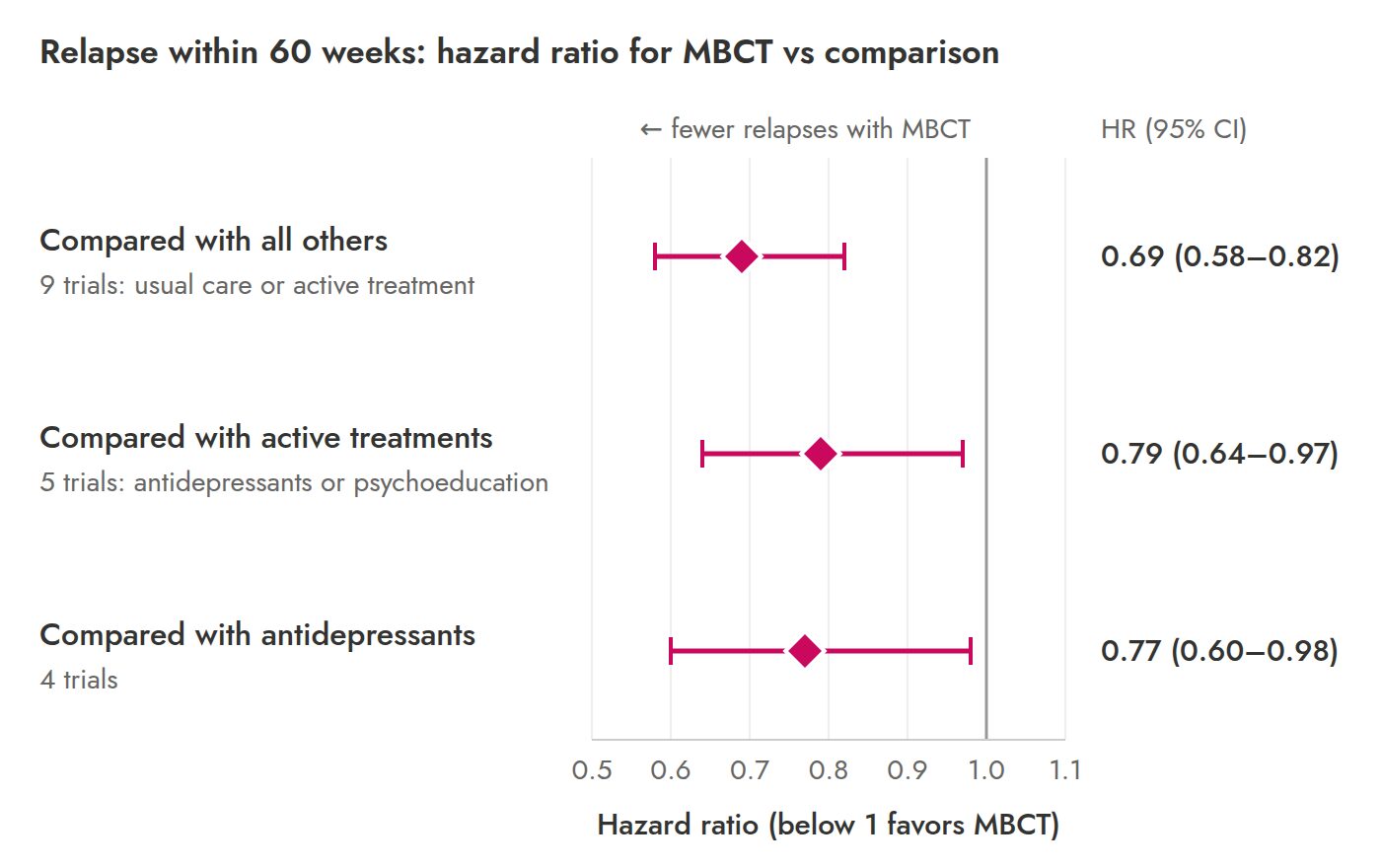
Of the 596 people who took MBCT, 229 (38%) relapsed within 60 weeks, compared with 327 of the 662 (49%) who didn’t. Allowing for the timing of relapses and the differences between trials, the pooled hazard ratio was 0.69 (95% confidence interval 0.58–0.82): at any given point in follow-up, the MBCT groups were relapsing about 31% less often.
The comparisons with active treatments were smaller but pointed the same way:
- Against active treatments (5 trials): hazard ratio 0.79 (0.64–0.97).
- Against maintenance antidepressants (4 trials): hazard ratio 0.77 (0.60–0.98).
The trials agreed closely.
Heterogeneity
In a meta-analysis, heterogeneity is how much the results of the pooled studies differ from one another beyond what chance alone would produce, for example because they enrolled different people or compared the treatment with different things. It is often summarized by the I² statistic, the share of the variation due to real differences between studies; values of 50% or more are usually read as substantial. High heterogeneity makes a single pooled number harder to interpret.
More on Wikipedia
Read more in the glossary
, the variation between trials beyond chance, was very low (I² of 1.7% for the main comparison and 0% for the other two), and the one-stage analyses gave almost identical numbers. The authors describe the trials as modest in size, with effects pointing the expected way that individually fell short of statistical significance; combined, they gave a clear result. The authors summed up the step forward:
Extending previous work, we found that MBCT reduces the risk of depressive relapse/recurrence compared with the current mainstay approach, maintenance antidepressants.
That conclusion is worth reading carefully. The upper ends of the confidence intervals against active treatments (0.97 and 0.98) come close to 1, which would mean no difference, and the paper’s own Key Points summary describes the same result more cautiously, as “comparable outcomes” to other active treatments. The comparison is also not a simple pill-versus-meditation contest. In two of the four antidepressant trials, people in the MBCT group came off their medication, and in another they took MBCT on top of it. A fair reading is that MBCT did at least as well as staying on antidepressants, and possibly somewhat better.
Miscellaneous Interesting Takeaways
People With More Remaining Symptoms Seemed to Benefit Most
Being in remission doesn’t always mean being symptom-free. Trial averages on the depression questionnaires at the start ranged from 4.0 to 19.9. The team tested whether MBCT’s effect depended on each person’s characteristics. Age, sex, education and relationship status made no detectable difference to how well MBCT worked, which the authors take as a sign that it suits a broad range of people.
Depression severity at the start did matter. People with higher starting scores were more likely to relapse, but they also gained more from MBCT. For each standard deviation higher their starting score, MBCT’s hazard ratio against the comparison groups was multiplied by 0.80 (0.66–0.97). The authors’ reading is that MBCT may be particularly helpful for people who still have significant symptoms, and that it did no harm to those with few:
Patients with lower baseline scores appeared to receive less benefit but were not disadvantaged by MBCT.
The authors are clear that this finding needs confirming. The moderator analyses were exploratory, not planned with enough participants to detect such effects, and numerous, which raises the risk of a chance finding. The abstract calls it “some evidence” rather than a firm result. Information on race and ethnicity and on employment, which the team had hoped to test, couldn’t be obtained from the trials.
The Protection Faded Over Time
The hazard ratio of 0.69 is an average over 60 weeks, and the data suggested MBCT’s effect wasn’t constant. A model that let the effect change over time found a stronger protective effect early in follow-up that weakened as the weeks went on, though this trend fell just short of significance (P = .052) once patient characteristics were added to the model. The authors acknowledge this in their conclusions (“There is a reduction in protective effects over time.”) and call for trials with longer follow-up.
Low Risk of Bias, but Some Reasons for Caution
Using a standard checklist for trial quality (the Cochrane risk of bias tool), the team rated the risk of bias as generally low. Two of the nine trials didn’t keep the people assessing relapse unaware of who had taken MBCT, and one of these also had incomplete outcome data, with 18% of participants missing. Filling in the missing outcomes in that trial in the way most favorable to MBCT gave a hazard ratio of 0.63, and in the way least favorable 0.74, so the conclusion held either way.
Other caveats are less easy to resolve:
- Possible missing trials. A funnel plot, a check for
publication bias
Publication bias arises when studies with positive or striking results are more likely to be published than studies that find nothing. A meta-analysis that pools only published studies can then overestimate how well a treatment works. Researchers check for it with tools such as funnel plots and Egger’s test, which need a reasonable number of studies to be informative.
Read more in the glossary , showed some asymmetry: there were no small trials in which MBCT came out worse. That pattern can mean unfavorable trials went unpublished. A statistical test didn’t confirm it (P = .18), but with only nine trials such tests have little power, as the authors acknowledge. - A missing tenth trial. The data from one eligible trial weren’t shared, which the authors call “an impediment to IPD, transparency, and external scrutiny.”
- Researcher allegiance. The authors note that the trials were largely run by proponents of MBCT, and that researchers’ allegiance to a therapy can influence results in psychotherapy trials. All the authors except an independent statistician and an independent reviewer had been investigators on at least one of the pooled trials, several founded or direct mindfulness centers, and some receive royalties from MBCT books or fees for MBCT training.
Adverse Events Were Barely Measured
Adverse events were formally recorded in six of the nine trials, and none were attributed to MBCT. But the trials that recorded them tracked serious adverse events, and the authors themselves note that adverse events were not systematically recorded or reported. That is a much coarser net than the detailed interviews in Britton et al., 2021, which found that over half of participants in an MBCT course had a meditation-related experience that felt unpleasant at the time, and 6–14% one with lasting bad effects. The authors list systematic recording of adverse events among their recommendations for future trials.
What Future Trials Should Do
The authors close with a list for the field: use an active comparison, measure relapse the same way, follow people for longer, check that MBCT is taught as intended, collect background details such as ethnicity and employment, plan the analyses of who benefits most in advance, assess cost-effectiveness, share data and record adverse events.
Final Reflection
For a meditation-based program, this is unusually strong evidence. The trials were randomized, run by different teams in five countries, measured a hard clinical outcome (a diagnosed relapse, not a questionnaire score) and agreed closely with one another. Pooled, they show that MBCT reduced the risk of relapse in recurrent depression compared with usual care, and did at least as well as maintenance antidepressants.
The limits are real too. Most of the evidence comes from MBCT’s own developers and advocates, the benefit seemed to fade over the follow-up period, and the finding that people with more remaining symptoms benefit most is a promising lead rather than a settled fact. For someone who has recovered from repeated depression, the practical message is that MBCT is a credible option alongside antidepressants, to weigh with their doctor rather than a reason to stop medication on their own. For a closer look at what happens in an MBCT course, see how it changed sleep in antidepressant users with lingering sleep problems.
Citation
Kuyken, W., Warren, F. C., Taylor, R. S., Whalley, B., Crane, C., Bondolfi, G., Hayes, R., Huijbers, M., Ma, H., Schweizer, S., Segal, Z., Speckens, A., Teasdale, J. D., Van Heeringen, K., Williams, M., Byford, S., Byng, R., & Dalgleish, T. (2016). Efficacy of mindfulness-based cognitive therapy in prevention of depressive relapse: An individual patient data meta-analysis from randomized trials. JAMA Psychiatry, 73(6), 565–574. 10.1001/jamapsychiatry.2016.0076
Get the next summary by email
One or two new paper summaries every couple of weeks, sent to your inbox when they go up.
No spam, and you can unsubscribe at any time. Prefer a feed reader? Use the RSS feed.