
Background Information
By the late 2000s, a handful of studies had linked meditation to changes in the immune system and stress hormones. An MBSR course had boosted antibody responses to a flu vaccine, and five days of integrative body–mind training had been linked to a smaller
cortisol
Cortisol is a hormone released by the adrenal glands, especially in response to stress. It mobilizes energy and helps regulate the immune system. Because it can be measured in saliva, researchers often use it to gauge how strongly someone reacts to a stressful task, such as timed mental arithmetic. Levels also follow a daily rhythm, so studies try to test everyone at the same time of day.
More on Wikipedia
View in glossary
rise during a stressful arithmetic task. Almost all of this work, though, tested practices that aim to calm the mind, sharpen attention or build
mindfulness
Mindfulness is the psychological process of purposely bringing one’s attention to experiences occurring in the present moment without judgment. It involves maintaining awareness of thoughts, feelings, bodily sensations, and surrounding environment with an attitude of curiosity and acceptance. In meditation contexts, mindfulness practices typically involve focusing attention on the breath or body sensations as anchors to the present moment while acknowledging and releasing distracting thoughts.
More on Wikipedia
View in glossary
.
Compassion meditation was a different kind of practice, and less studied. Interest in it had grown after research on advanced Tibetan Buddhist practitioners, including the finding that long-term practitioners produce unusually strong gamma waves during compassion meditation. There was also evidence that people high in self-compassion react less badly to stressful situations in the lab, such as a mock job interview. The authors reasoned that if compassion training reduced people’s emotional reactions to stress, it might also dampen the body’s physical stress response.
They focused on two measures.
Interleukin-6 (IL-6)
Interleukin-6 (IL-6) is a signaling protein (a cytokine) that immune cells release to coordinate inflammation. It is measured from a blood sample, usually in picograms per milliliter. Persistently elevated IL-6 is associated with chronic stress, aging and a higher risk of cardiovascular disease, which makes it a common marker in studies of whether meditation affects health.
More on Wikipedia
View in glossary
is a signaling protein that immune cells release during
inflammation
Inflammation is a biological response of the immune system to injury, infection, or stress, characterized by the release of signaling molecules called cytokines. Chronic inflammation is linked to impaired cognitive function, increased risk of disease, and accelerated aging.
More on Wikipedia
View in glossary
, and it is one of the most reliable markers of the immune system’s reaction to a stressful lab task. Chronic stress raises IL-6, and even mildly raised levels predict later vascular disease, diabetes and dementia. Cortisol, the main stress hormone, also helps keep inflammation in check. The researchers predicted that compassion training would shrink both responses to stress compared with a control group.
What They Did
The participants were students aged 17 to 19 (average 18.5) in an introductory health education class at Emory University in 2006. They were medically healthy, were not in psychiatric treatment and did not have moderate or severe depression. They were told the study was about the health effects of meditation, and that anyone assigned to the comparison group would be offered a meditation class the following semester. In this
randomized controlled trial
A Randomized Controlled Trial is a scientific study design that randomly assigns participants to either an experimental group receiving an intervention or a control group, allowing researchers to measure the true effect of the intervention while minimizing bias.
More on Wikipedia
View in glossary
, 89 students were randomly assigned, separately for men and women, to one of two programs.
Compassion meditation. The program was designed and taught by one of the authors, Lobsang Tenzin Negi, and was later developed at Emory into a course called Cognitively-Based Compassion Training (CBCT); this paper simply calls it compassion meditation. It was secular in presentation but drew on
Lojong
Lojong, Tibetan for “mind training,” is a set of Tibetan Buddhist practices for cultivating compassion, traced to the Indian teachers Atisha and Shantideva. Rather than simply observing thoughts, it uses reasoning and reflection to question habitual attitudes toward oneself and others, such as sorting people into friends, enemies and strangers, and to extend warmth step by step to a widening circle of people, including those one dislikes.
More on Wikipedia
View in glossary
, Tibetan Buddhist “mind training.” The “cognitive” part is the key difference from mindfulness. Mindfulness asks you to notice thoughts and feelings without judging them. Lojong instead uses reasoning to challenge habitual attitudes toward other people, for example by examining why we sort people into friends, enemies and strangers, and then practices feeling warmth for a widening circle of people.
Students met for 50 minutes twice a week for six weeks, with about 20 minutes of meditation in each class, and had a CD to guide practice at home. The course built in stages:
- Weeks 1–2: Steadying attention by focusing on the breath, then mindfulness: watching thoughts and body sensations without judgment.
- Weeks 3–4: Reflecting that everyone, oneself included, wants to be happy and avoid suffering, and examining how changeable the line between “friends” and “enemies” really is.
- Weeks 5–6: Reflecting on the drawbacks of self-centeredness, then generating compassion first for people close to them, and finally for strangers and people they dislike.
Health discussion group. The
active control
An active control group is a comparison group that takes part in a different program designed to be just as engaging as the one being tested. In meditation research, it might involve exercise, music, or education classes with the same time commitment, teachers, and expectations of benefit. Comparing against an active control helps separate the effects of meditation itself from the general effects of joining a course.
More on Wikipedia
View in glossary
group also had 12 hours of classes, led by graduate students, on topics relevant to college students’ health: stress management, substance abuse, depression and anxiety, eating disorders, sexual health and more, with group discussion, mock debates and role play. To match the meditators’ home practice, they wrote a 2–3 page self-improvement paper each week.
Meditators logged their practice in an online diary within 48 hours. The researchers’ main measure of how engaged each person was: the average number of meditation sessions per week, counting classes and any home session longer than ten minutes.
The stress test. Between weeks 8 and 10 of the study, after the courses had ended, everyone took the
Trier Social Stress Test
The Trier Social Stress Test (TSST) is a standard laboratory stressor. After a few minutes to prepare, a person gives a short speech, often a mock job interview, and then does mental arithmetic aloud, in front of a panel of unsmiling judges and often a camera. The mix of public evaluation and lack of control reliably raises stress hormones such as cortisol, so researchers use it to compare how strongly people react to stress.
More on Wikipedia
View in glossary
(TSST), a standard lab stressor in which people give a speech and then do mental arithmetic. Each student arrived at a hospital research unit 90 minutes beforehand to get used to a catheter in a vein, and all tests ran between 2 and 5 p.m. Blood was drawn just before the stress test and repeatedly over the following 90 minutes to measure cortisol and IL-6. Students rated their mood on the
Profile of Mood States (POMS)
The Profile of Mood States (POMS) is a questionnaire in which people rate how strongly they have felt a list of moods. It gives scores on six scales: tension–anxiety, depression–dejection, anger–hostility, fatigue–inertia, confusion–bewilderment and vigor–activity, the only positive one. Researchers use it to track short-term changes in mood, for example before and after a training program.
More on Wikipedia
View in glossary
just before and right after the test, which the researchers combined into a single distress score.
Of the 89 students randomized, 28 dropped out before the stress test (12 from meditation, 16 from the control group), mostly because of scheduling conflicts, not wanting to continue the meditation training, or illness or unwillingness to do the stress test. That left 61: 33 meditators and 28 controls. Those who dropped out didn’t differ from those who stayed in age, sex, weight or depressive symptoms, and the two final groups were similar on all of these.
One Big Result: Compassion Training Made No Overall Difference, but Meditators Who Practiced More Had Smaller IL-6 and Distress Responses
The stress test worked. Across all students, IL-6 rose significantly by 60 minutes after the test began and was highest at 90 minutes, the last sample. Cortisol peaked at 30 minutes, and distress rose from before to after the test.
But the main comparison the trial was designed for came up empty. Students who had taken compassion training did not differ from the health discussion group in IL-6, cortisol or distress, before, during or after the stress test (for example, IL-6: p = .35; cortisol: p = .64). Several other ways of analyzing the responses gave the same answer.
The researchers then looked within the meditation group, where practice varied widely. On average, meditators did 3.6 sessions a week, counting classes, with a range from 1.3 to 7.9. Most practiced less than the recommended one session a day. Here a pattern appeared: the more sessions a week someone did, the smaller their IL-6 at its 90-minute peak (correlation r = −0.46, p = .008, or −0.51 after allowing for each person’s IL-6 before the test). More practice also went with lower distress right after the test (r = −0.43, p = .014), though that weakened to a trend once distress before the test was taken into account (p = .095). Practice was not linked to the cortisol response (r = −0.10).
The authors frame both readings of their results honestly:
The lack of a main effect of group raises the possibility that compassion meditation training may have limited impact on health-relevant physiological or behavioral responses to psychosocial stress. Alternatively, however, it may be that the effect of compassion meditation on stress responses is dose dependent and only apparent in individuals who commit to some minimum amount of practice time.
The catch is that a correlation within the meditation group can’t show which way the influence runs. The students chose how much to practice, and nobody’s stress response was measured before training. As the authors acknowledge:
Because we did not conduct TSSTs prior to meditation training, we cannot rule out the possibility that individuals who a priori had reduced physiological/behavioral stress responses may have been more able or willing to engage in meditation practice.
In other words, calmer people may simply have been the ones who kept practicing.
Miscellaneous Interesting Takeaways
Splitting the Meditators by Practice Didn’t Settle the Question
To probe this, the researchers split the meditators at the median into a high-practice group (17 people) and a low-practice group (16) and compared both with the controls. The three groups didn’t differ at the start of the study in age, sex, weight or depressive symptoms, or in IL-6 and cortisol just before the stress test.
For IL-6, the high-practice group had a significantly smaller response than the low-practice group (overall p = .041). The controls fell in between, and neither practice group differed significantly from them. The authors read this as reassuring: the low practicers weren’t unusually reactive compared with controls, so the correlation isn’t just a sign that unusually stress-prone people practiced less. But the high practicers weren’t significantly different from controls either, so the same data can’t show that practice lowered anyone’s response below where it would otherwise have been.
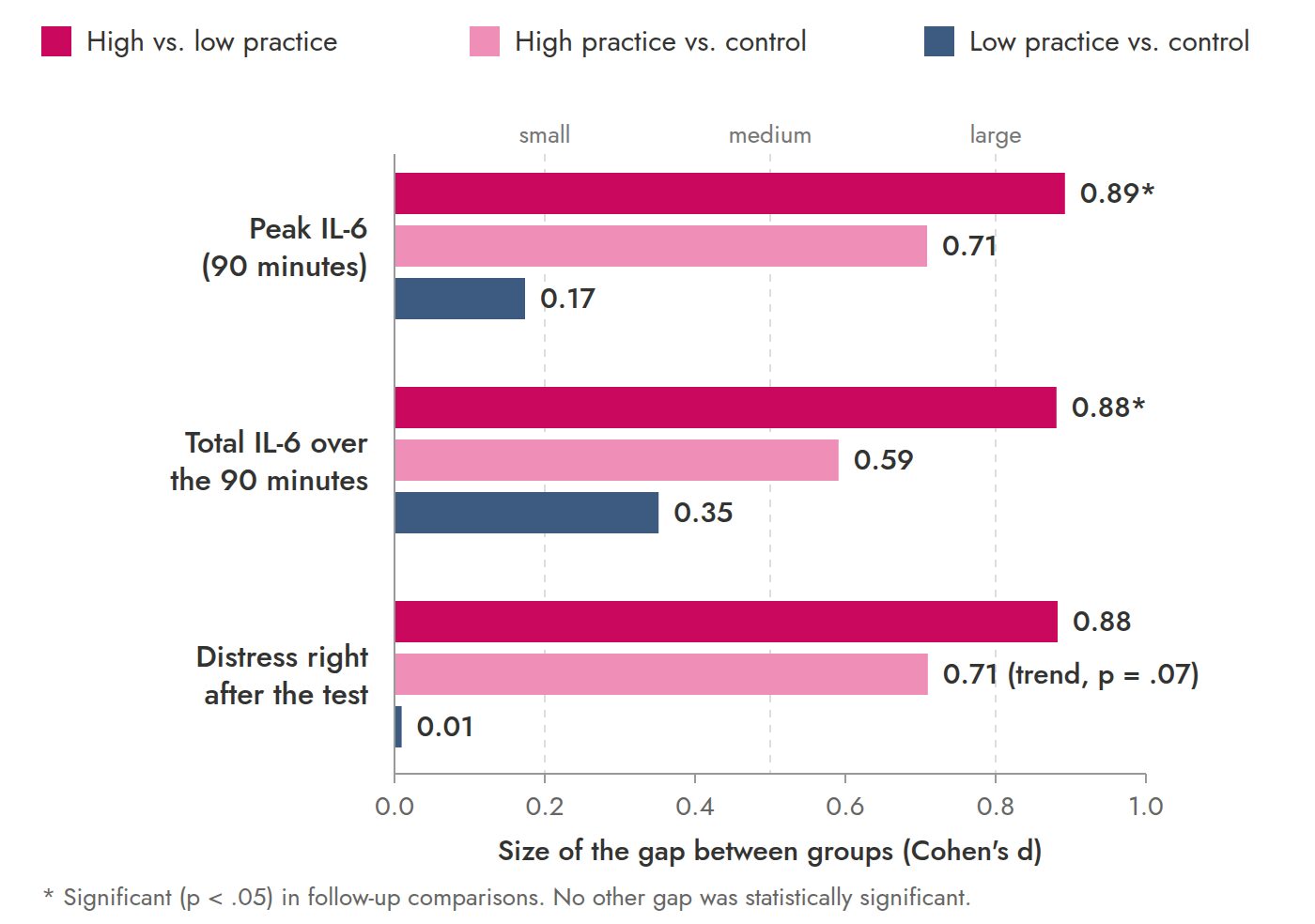
The gaps between high and low practicers were large as
effect sizes
Effect size is a statistical concept that quantifies the magnitude or strength of a relationship, difference, or intervention outcome. Unlike p-values which only indicate statistical significance, effect sizes measure how meaningful a result is in practical terms. Common measures include Cohen’s d (standardized mean difference), correlation coefficients (r), and odds ratios. In meditation research, effect sizes help quantify the practical impact of different meditation practices on psychological or physiological outcomes.
More on Wikipedia
View in glossary
go, but each group had only 16 or 17 people, so even large gaps were only just significant. Splitting the meditators into three groups instead of two gave a similar result for peak IL-6 (p = .047) but not for total IL-6 or distress.
The Distress Difference Was There Before the Stress Test
One detail complicates the distress result. Just before the stress test, the high-practice group already reported less distress than the low-practice group (p = .004). After the test, follow-up comparisons between the three groups weren’t significant, and only a trend set the high practicers apart from controls (p = .07). The paper’s abstract says that high practicers “exhibited lower” distress scores than those below the median, which the post-test comparisons don’t clearly support. The high practicers felt calmer going in, which fits the possibility that calmer people practiced more as well as the possibility that practice made them calmer.
Cortisol Didn’t Budge
Neither the training nor the amount of practice was linked to cortisol. The authors find this intriguing, because cortisol normally restrains inflammation, so a smaller IL-6 response with no change in cortisol suggests some other route. They note that they didn’t measure other stress hormones or other immune markers, and that a larger study might have found a cortisol difference. (Their discussion mentions a trend toward smaller cortisol responses after compassion training at p = .10, but the group comparison reported in the Results for that measure has p = .23.)
Why Practice Might Matter More for Compassion Training
The authors note that earlier research on practice time is contradictory: some meditation studies find that more practice goes with better outcomes and others don’t. Compassion training may be especially sensitive to practice, they suggest, because it builds step by step from attention training toward the hardest exercises, such as generating warmth toward people one dislikes. Students who practiced more were more likely to have engaged with the later compassion exercises, which may be what mattered. They also point out that the three earlier studies of compassion-based meditation had all found links with practice time.
Was It Compassion, or Just Effort?
The control group’s weekly paper didn’t match either the time or the experiential nature of daily meditation, and the students knew they were in a meditation study, so meditators may have expected more benefit. The authors raise a further possibility:
Thus it is possible that associations between TSST outcomes and practice reflect a generalized effect of the time and effort involved in practicing rather than a specific effect of meditation practice per se.
A few other points are worth adding. Many outcomes and analyses were run, with no correction for
multiple comparisons
The multiple comparisons problem arises when researchers run many statistical tests at once. Each test has a small chance of a false positive, so across thousands of tests, such as one for every point in a brain scan, some “significant” results will turn up by chance alone. Corrections raise the bar for significance to keep the overall false-positive rate down, at the cost of making small real effects harder to detect.
More on Wikipedia
View in glossary
, and the key IL-6 group difference was close to the significance line. The participants were healthy 17- to 19-year-olds from one university, nearly a third of those randomized didn’t complete the study, and only those who did were analyzed. And the stress responses were measured once, weeks after training, so the study says nothing about how long any effect might last.
Final Reflection
This was a careful early attempt to test compassion meditation against a credible alternative, and its headline result is a null one: six weeks of compassion training did not, on average, change how young adults’ bodies or moods responded to a stressful speech and math test. The more interesting finding, that meditators who practiced more had smaller IL-6 and distress responses, came from a comparison the students had sorted themselves into, which is exactly the kind of evidence randomization is meant to replace. The authors are candid about this, and they sketch the study that would settle it: give the stress test both before and after training.
Later studies on this site have found more specific effects with tighter designs. A three-day mindfulness retreat was followed by a drop in IL-6 that a matched relaxation retreat didn’t produce, and in a trial that also used the TSST, an MBSR course and a matched health program eased stress and cortisol responses equally, while a skin flare grew less after MBSR. On the compassion side, two weeks of compassion training made people more generous than a comparison training, a sign that the practice can change behavior even in the short term.
Taken together, this study is best read as a lead rather than a finding: practicing compassion meditation regularly might be linked to a gentler inflammatory response to stress, but this design can’t tell whether the practice caused it or whether the people who could keep up the practice were less reactive to begin with.
Citation
Pace, T. W. W., Negi, L. T., Adame, D. D., Cole, S. P., Sivilli, T. I., Brown, T. D., Issa, M. J., & Raison, C. L. (2009). Effect of compassion meditation on neuroendocrine, innate immune and behavioral responses to psychosocial stress. Psychoneuroendocrinology, 34(1), 87–98. 10.1016/j.psyneuen.2008.08.011
Get the next summary by email
One or two new paper summaries every couple of weeks, sent to your inbox when they go up.
No spam, and you can unsubscribe at any time. Prefer a feed reader? Use the RSS feed.