
Background Information
By 2013, a handful of studies had linked meditation programs to changes in the immune system: lower inflammatory signals, more active immune cells, a stronger response to a vaccine. What they couldn’t say was how a mental practice reaches inside the body’s cells. This study looked for an answer in
gene expression
Gene expression is the process by which a cell reads a gene and uses it to make a product, usually by copying it into a messenger molecule (mRNA) that is then used to build a protein. Every cell carries the same DNA, but cells turn genes up and down within hours in response to signals such as hormones, infection or stress. Researchers often measure a gene’s mRNA to see how active it is; that says nothing about the DNA sequence itself, which doesn’t change.
More on Wikipedia
View in glossary
.
Every cell in your body carries the same DNA, but each one uses only some of its genes at any moment. When a cell “expresses” a gene, it copies it into a messenger molecule (mRNA) that is used to build a protein. Immune cells turn genes up and down within hours in response to hormones, infection or stress. Measuring mRNA shows how active a gene is at that moment. It says nothing about the DNA sequence, which a day of meditation does not change.
One layer of control over gene activity is
epigenetics
Epigenetics is the study of chemical marks on DNA, and on the histone proteins it is wound around, that help switch genes on or off without changing the DNA sequence. Examples include DNA methylation and the acetylation of histones. Some marks change within hours in response to the environment and others last for years, which makes them a candidate link between experience and health.
More on Wikipedia
View in glossary
: chemical marks on DNA, and on the spool-like proteins called histones that DNA is wound around, which make genes easier or harder to read.
Histone deacetylases (HDACs)
Histone deacetylases (HDACs) are enzymes that remove small chemical tags called acetyl groups from histones, the spool-like proteins that DNA is wound around, and from other proteins. Removing these tags generally packs DNA more tightly, making nearby genes harder to read. Drugs that block HDACs (HDAC inhibitors) are used to treat some cancers and are being studied as anti-inflammatory treatments.
More on Wikipedia
View in glossary
are enzymes that strip one kind of mark, acetyl groups, from histones and from other proteins. Drugs that block HDACs dampen
inflammation
Inflammation is a biological response of the immune system to injury, infection, or stress, characterized by the release of signaling molecules called cytokines. Chronic inflammation is linked to impaired cognitive function, increased risk of disease, and accelerated aging.
More on Wikipedia
View in glossary
in experiments, which is why a team from Barcelona and the University of Wisconsin–Madison, led by Perla Kaliman and Richard Davidson, wondered whether meditation might work through this machinery. In animals, stress can change histone marks within an hour or two, but as the authors noted:
However, no data are currently available regarding the possibility of an epigenetic basis for the effects of mindfulness meditation.
What They Did
The researchers compared two groups. The 19 meditators had practiced daily for at least three years, at least 30 minutes a day, and had attended at least three retreats of five days or more. They averaged about 6,240 hours of lifetime practice (from 1,440 to 14,730), in
Vipassana
Vipassana is a form of Buddhist meditation focused on the cultivation of insight through moment-to-moment awareness of bodily sensations, thoughts, and emotions. It emphasizes non-reactivity and equanimity, helping practitioners observe mental and physical phenomena without attachment.
More on Wikipedia
View in glossary
, concentration and compassion (metta) practices from the Theravada and Tibetan Buddhist traditions. The 21 controls had never meditated; they had answered an advertisement for a study of a well-being program. The two groups had a similar spread of age, gender, race and body-mass index, and the paper lists exclusions for immune, inflammatory and mental disorders, ongoing medical problems and regular medication.
Everyone spent one day, from 8 am to 4 pm, at the university’s Center for Investigating Healthy Minds, in small groups of four that included both meditators and controls. The meditators followed a program modeled on the all-day session of an
MBSR
Mindfulness-Based Stress Reduction (MBSR) is a program designed to help individuals cope with stress, pain, and illness. Developed by Jon Kabat-Zinn in the 1970s, it combines meditation and yoga to promote awareness and stress management. The eight-week program teaches participants to focus on the present moment non-judgmentally, enhancing their ability to manage difficulties.
More on Wikipedia
View in glossary
course, built around recorded teachings by the Vipassana teacher Joseph Goldstein: talks, guided and unguided sitting meditation, walking meditation and a mindful lunch. The controls read, watched documentaries, played computer games and went for walks, with no phones or internet. The two programs were matched for physical activity, the rooms were balanced across groups, everyone ate the same food, and participants didn’t interact with one another.
Blood was drawn at 8 am and 4 pm. From each sample, the team isolated peripheral blood mononuclear cells, the white blood cells with a single round nucleus (mainly lymphocytes and monocytes), and measured the activity of 23 genes in three sets:
- 7 body-clock genes, to check whether a day of sitting with eyes closed disturbed the cells’ daily rhythm;
- 10 genes for chromatin-modifying enzymes, including five HDACs and enzymes that add or remove other histone and DNA marks;
- 6 inflammation-related genes, including those for the inflammatory signals
IL-6
Interleukin-6 (IL-6) is a signaling protein (a cytokine) that immune cells release to coordinate inflammation. It is measured from a blood sample, usually in picograms per milliliter. Persistently elevated IL-6 is associated with chronic stress, aging and a higher risk of cardiovascular disease, which makes it a common marker in studies of whether meditation affects health.
More on Wikipedia
View in glossary and TNF-α Tumor necrosis factor alpha (TNF-α) is a signaling protein (a cytokine) that immune cells release early in inflammation. It helps fight infection and repair tissue, but high or persistent levels contribute to inflammatory diseases such as rheumatoid arthritis, psoriasis and inflammatory bowel disease.
More on Wikipedia
View in glossary .
In smaller subsets of people, the team also measured overall levels of four histone marks and the amount of one inflammatory protein, COX2. The analyses compared each group’s 4 pm level, adjusted for its 8 am level, age, gender, body-mass index and ethnicity.
Separately, each person took the
Trier Social Stress Test
The Trier Social Stress Test (TSST) is a standard laboratory stressor. After a few minutes to prepare, a person gives a short speech, often a mock job interview, and then does mental arithmetic aloud, in front of a panel of unsmiling judges and often a camera. The mix of public evaluation and lack of control reliably raises stress hormones such as cortisol, so researchers use it to compare how strongly people react to stress.
More on Wikipedia
View in glossary
, an impromptu speech and mental arithmetic in front of two judges and a camera, twice, about 12 weeks apart, while saliva samples tracked their
cortisol
Cortisol is a hormone released by the adrenal glands, especially in response to stress. It mobilizes energy and helps regulate the immune system. Because it can be measured in saliva, researchers often use it to gauge how strongly someone reacts to a stressful task, such as timed mental arithmetic. Levels also follow a daily rhythm, so studies try to test everyone at the same time of day.
More on Wikipedia
View in glossary
. For the meditators, the second test came the day after the meditation day. For the controls, it wasn’t tied to the leisure day.
The researchers were open about what this design can’t do:
The current study was not designed to parse the contribution of group (trained meditators versus naïve controls), from the contribution of the intervention (mindfulness practice versus leisure).
They chose to combine years of experience with a day of intensive practice, they explain, to give themselves the best chance of detecting an effect at all. It also means that any difference could come from either one, or from other ways the two groups of people differed.
One Big Result: By Evening, Five Genes Were Less Active in the Meditators
At 8 am, the two groups looked the same: none of the 23 genes differed between them. By 4 pm, five did, all lower in the meditators than in the controls:
- Three HDAC genes. HDAC2 fell from 1.03 to 0.83 in the meditators while rising slightly in the controls (1.07 to 1.12). HDAC3 fell from 1.03 to 0.78, against 1.03 to 0.96. For HDAC9, the gap came mostly from the controls: their level rose from 1.07 to 1.48, while the meditators’ barely moved (1.11 to 1.03).
- RIPK2, the gene for an enzyme that helps switch on inflammatory signaling, fell from 1.11 to 0.91 in the meditators and rose from 1.04 to 1.14 in the controls.
- COX2, the gene for the inflammatory enzyme that aspirin and ibuprofen block, fell in both groups, but more in the meditators (1.22 to 0.77, against 1.25 to 0.98).
The numbers are each group’s average mRNA level for the gene, measured relative to a reference gene (TBP). The adjusted group differences were statistically significant, from p = 0.022 for HDAC2 to p < 0.001 for HDAC9.
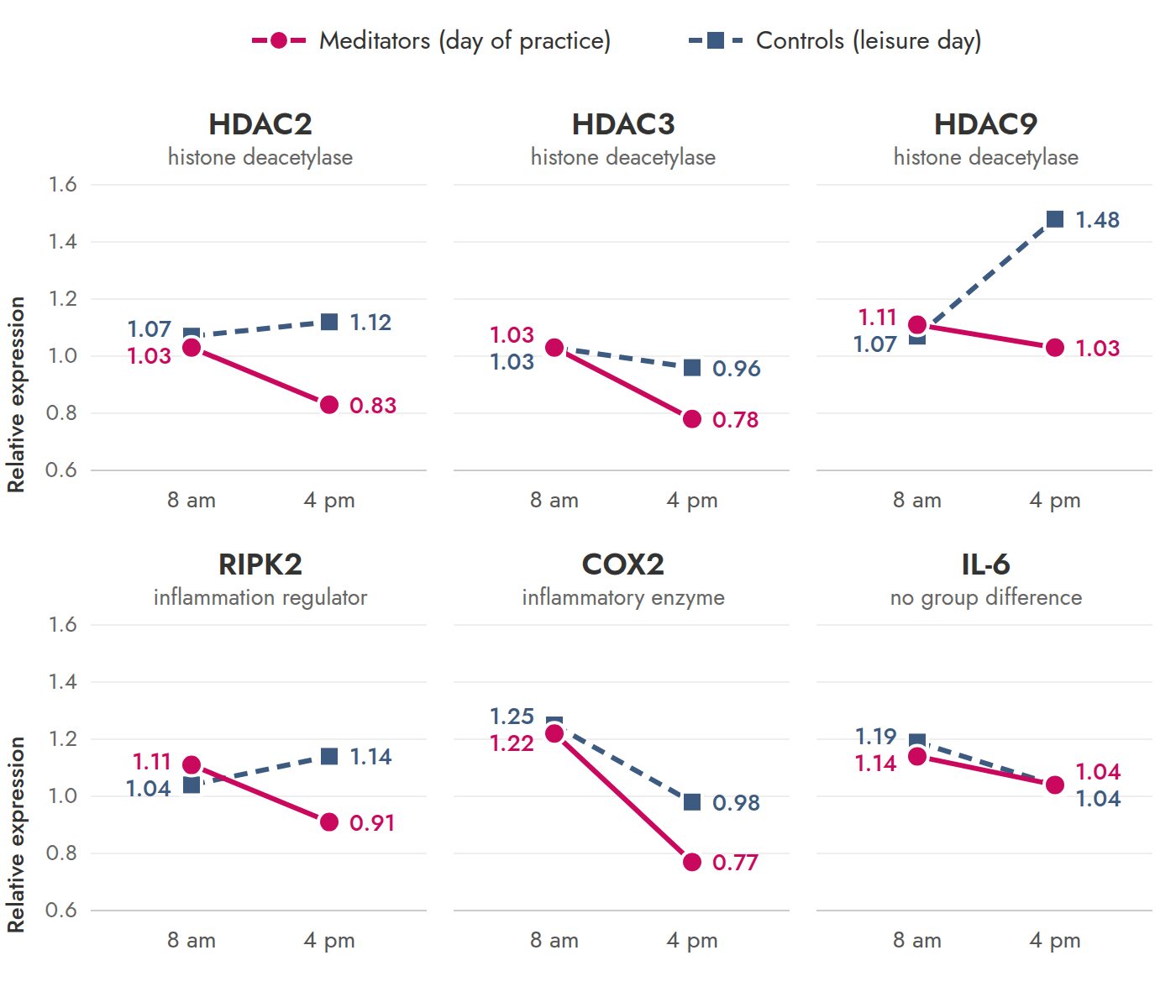
The other 18 genes didn’t differ between the groups by 4 pm. They included the seven body-clock genes, two other HDACs (HDAC1 and HDAC5), the related enzyme SIRT1, four enzymes that add or remove other histone and DNA marks, and four inflammation-related genes: IL-6, TNF-α and two genes for receptors that guide immune cells (CCR7 and CXCR1). The authors note that CCR7, CXCR1 and TNF-α tended to be lower in the meditators after the day, but none of the differences reached significance. So the anti-inflammatory pattern the authors describe rests on two genes, not on the classic inflammatory signals that most studies measure in blood.
The two inflammation-related genes tracked the HDAC genes. Across all 40 participants, those whose RIPK2 activity was lower also had lower HDAC2, HDAC3 and HDAC9 activity (partial correlations above 0.64, after accounting for group). That fits the authors’ idea that lower HDAC activity could quiet inflammatory genes, but it is a correlation between genes measured in the same blood, not evidence that one caused the other.
Miscellaneous Interesting Takeaways
Less HDAC mRNA Doesn’t Necessarily Mean Less HDAC Activity
The study measured how much of each HDAC gene’s message was present, not how much HDAC protein the cells made or how active the enzyme was. The authors say so directly:
Hence, we cannot definitely conclude from our data that the downregulation of HDAC gene expression had an impact on epigenetic mechanisms.
They had too little material to measure HDAC protein. The histone marks they could measure, in only 10 to 14 people per group because some samples didn’t yield enough protein, gave mixed results. Acetylation of histone H4, which should rise if HDACs are less active, tended to be higher in the meditators, but the difference wasn’t significant by the usual two-sided test (p = 0.064). Acetylation of histone H3 didn’t differ. A mark linked to gene activation (H3K4me3) rose over the day in the controls, a daily rhythm seen in other studies, and stayed flat in the meditators. The abstract lists both H4 and H3K4me3 among the “alterations,” which makes the H4 result sound firmer than it was.
For COX2, the team also measured the protein itself, in six people per group, and found that it dropped more over the day in the meditators, a borderline result (p = 0.05). In a separate test on a lab-grown line of human immune cells, a drug that blocks HDACs cut COX2 gene activity by 50% within 30 minutes, which shows that the link the authors propose is at least possible.
The Cortisol Link Is Weaker Than the Abstract Suggests
The abstract says that RIPK2 and HDAC2 activity “was associated with a faster cortisol recovery” after the stress test. The recovery score measured how far cortisol fell back from its peak toward its starting level within 40 minutes, and the team compared it between the two stress tests, 12 weeks apart. Pooling both groups, the change in recovery correlated with the change in HDAC2 activity over the meditation or leisure day (r = 0.58, p = 0.029). The correlation with RIPK2 (r = 0.51, p = 0.065) didn’t reach significance, and neither did any link with the other HDACs or COX2.
Several details make this result hard to interpret. The two groups’ second stress tests meant different things: for the meditators, it came the day after the meditation day, while for the controls it wasn’t connected to their leisure day, and the authors note that for the controls, the change reflects getting used to the test. The paper doesn’t report whether the groups’ cortisol recovery differed. It also doesn’t say how many people these correlations included. And the paper describes lower gene activity going with better recovery, while reporting positive correlations, without spelling out how the two change scores were oriented.
Twenty-Three Genes, Five Differences
With 23 genes tested, some differences could turn up by chance alone, the problem of
multiple comparisons
The multiple comparisons problem arises when researchers run many statistical tests at once. Each test has a small chance of a false positive, so across thousands of tests, such as one for every point in a brain scan, some “significant” results will turn up by chance alone. Corrections raise the bar for significance to keep the overall false-positive rate down, at the cost of making small real effects harder to detect.
More on Wikipedia
View in glossary
. The authors re-estimated each result by bootstrapping (resampling their data 1,000 times) and describe this as controlling for multiple comparisons. Bootstrapping checks how stable each estimate is, but it doesn’t raise the bar for significance to account for the number of tests. A strict Bonferroni correction for 23 genes would require p below about 0.002. Only HDAC9 (p < 0.001) and RIPK2 (p = 0.001) meet it; HDAC3 (p = 0.003), COX2 (p = 0.007) and HDAC2 (p = 0.022) don’t. With 19 and 21 people, the study also had little power to detect smaller differences in the genes that didn’t change.
The Body Clock Kept Time
Gene activity in blood cells rises and falls over the day, which is why comparing a meditation day with a same-length control day matters. The seven body-clock genes behaved the same in both groups, at both times. One of them, DBP, swung strongly between morning and afternoon, equally in meditators and controls. So a day of meditation, with long stretches of sitting with eyes closed, didn’t throw off the cells’ daily rhythm. The authors present this as the first test of meditation’s effect on these genes.
What It Might Mean for Health, According to the Authors
The authors point out that HDAC inhibitors and COX2 inhibitors are both used or studied as anti-inflammatory drugs, and suggest that meditation may act on similar pathways. They connect this to earlier evidence that meditation eases pain, and to other studies in which meditation programs were followed by lower activity of the inflammatory NF-κB pathway in blood cells. These are hypotheses for later studies, not findings of this one: the participants were healthy, inflammation in the body (such as inflammatory proteins in the blood) wasn’t measured, and gene activity was tracked for only eight hours, so it’s unknown whether the differences lasted.
Final Reflection
This was one of the first studies to look for molecular changes in immune cells over a single day of meditation, and it found some: by the end of the day, experienced meditators had lower activity in three HDAC genes and two inflammation-related genes than people who had spent the day at leisure, though the morning had shown no differences. Measuring the same people before and after the day gives it an edge over a one-time comparison of meditators and non-meditators, such as the telomere study on this site, which found more active telomere-maintenance genes in long-term meditators.
Still, it is a small, non-randomized study, and its design can’t say whether the day of meditation or the years of practice behind it produced the differences, or whether some other difference between the two groups of people did. The authors themselves called for testing a single day of practice in people who have never meditated. Only some of the five results would survive a strict correction for the number of genes tested, the inflammatory signals most often measured in blood (IL-6 and TNF-α) didn’t differ, and the link to stress hormones rests largely on one correlation in a small, pooled sample.
It fits a broader picture from this research group and others. The same lab later found that experienced meditators’ sleep showed more slow brain rhythms after a similar intensive day of practice. In a randomized trial with the same stress test, a provoked skin inflammation grew less after an MBSR course than after a matched health program, though inflammatory proteins in the skin didn’t differ. And in stressed job seekers, a three-day mindfulness retreat was followed by a drop in IL-6 four months later. Read with those, this study is best seen as an early, intriguing clue that a day of intensive practice can be accompanied by quick shifts in which genes immune cells are using. It is not evidence that meditation changes your genes, and its findings needed testing in larger, randomized studies.
Citation
Kaliman, P., Álvarez-López, M. J., Cosín-Tomás, M., Rosenkranz, M. A., Lutz, A., & Davidson, R. J. (2014). Rapid changes in histone deacetylases and inflammatory gene expression in expert meditators. Psychoneuroendocrinology, 40, 96–107. 10.1016/j.psyneuen.2013.11.004
Get the next summary by email
One or two new paper summaries every couple of weeks, sent to your inbox when they go up.
No spam, and you can unsubscribe at any time. Prefer a feed reader? Use the RSS feed.