
Background Information
Many people with chronic pain take opioid painkillers every day for months or years. According to this paper, about a quarter of people on such long-term opioid therapy misuse their medication. That means behavior that departs from the prescription, such as using opioids to ease negative emotions rather than pain. Misuse is a risk factor for
opioid use disorder
Opioid use disorder is the medical term for opioid addiction: a pattern of opioid use, whether of prescribed painkillers, heroin or other opioids, that a person struggles to control and that causes significant harm or distress. Signs include strong cravings, needing more to get the same effect, and continuing to use despite problems at home, work or with health. It is usually treated with medications such as buprenorphine or methadone, often alongside counseling.
More on Wikipedia
Read more in the glossary
, the medical name for opioid addiction. The authors note that very few full-scale trials have tested treatments for people who have both problems at once, and that guidelines from the US Centers for Disease Control and Prevention encourage doctors to consider non-drug therapies such as mindfulness.
Mindfulness-Oriented Recovery Enhancement (MORE)
Mindfulness-Oriented Recovery Enhancement (MORE) is an 8-week group program developed by the social work researcher Eric Garland for addiction, stress and chronic pain, including opioid misuse. It combines mindfulness meditation with reappraisal (reframing unhelpful thoughts, a technique from cognitive behavioral therapy) and savoring (deliberately dwelling on pleasant experiences). Its aim is to shift the brain’s reward system from valuing drugs back toward valuing natural rewards.
More on Wikipedia
Read more in the glossary
is aimed at people with this combination of problems, and the trial followed a 2013 treatment manual for it written by Eric Garland, a social work researcher at the University of Utah who led the trial. Its rationale is that long-term opioid use changes the brain’s stress and reward circuits, making pain and distress feel worse and ordinary pleasures feel weaker, which pushes people toward higher doses. MORE tries to reverse that spiral. It combines
mindfulness
Mindfulness is the psychological process of purposely bringing one’s attention to experiences occurring in the present moment without judgment. It involves maintaining awareness of thoughts, feelings, bodily sensations, and surrounding environment with an attitude of curiosity and acceptance. In meditation contexts, mindfulness practices typically involve focusing attention on the breath or body sensations as anchors to the present moment while acknowledging and releasing distracting thoughts.
More on Wikipedia
Read more in the glossary
meditation, reappraisal (a technique from
cognitive behavioral therapy
Cognitive behavioral therapy (CBT) is a structured, usually short-term talk therapy that helps people notice and change unhelpful patterns of thinking and behavior. It is one of the most thoroughly tested psychological treatments and a first-line option for depression, anxiety disorders and many other conditions.
More on Wikipedia
Read more in the glossary
for reframing unhelpful thoughts) and savoring (deliberately dwelling on pleasant experiences to strengthen positive emotions). Garland and his colleague Matthew Howard also reviewed the wider evidence on mindfulness-based treatments for addiction. Howard was a co-investigator on this trial, but died in 2018, before it was finished.
Small pilot studies of MORE had shown promise, but with short follow-up. This was the first full-scale trial, with 9 months of follow-up, and it was run where most of these patients get their prescriptions: primary care.
What They Did
Between 2016 and 2020, the team recruited adults from six University of Utah primary care clinics in the Salt Lake Valley. To qualify, people needed a doctor-confirmed chronic pain condition, a prescription for daily opioids for at least three months, an average pain rating of 3 or more out of 10, and a score of 9 or more on the Current Opioid Misuse Measure (COMM), a questionnaire whose cutoff flags likely misuse. People receiving cancer treatment, those with psychosis, suicidal behavior or a severe substance use disorder other than opioids, and anyone who had already done a mindfulness program were excluded.
The 250 people enrolled were an unwell group. They had lived with pain for an average of 14.7 years, most often in the lower back, and 76% had two or more pain conditions. Their average daily dose was the equivalent of 101 mg of morphine, though a few very high doses pulled that average up (the middle half took 16–90 mg). Most met diagnostic criteria for major depression (68%) and for opioid use disorder (63%), although having the disorder wasn’t required to take part. They averaged 52 years old, 64% were women and 87% were White.
In this
randomized controlled trial
A Randomized Controlled Trial is a scientific study design that randomly assigns participants to either an experimental group receiving an intervention or a control group, allowing researchers to measure the true effect of the intervention while minimizing bias.
More on Wikipedia
Read more in the glossary
, 129 people were assigned to MORE and 121 to supportive group psychotherapy, an
active control group
An active control group is a comparison group that takes part in a different program designed to be just as engaging as the one being tested. In meditation research, it might involve exercise, music, or education classes with the same time commitment, teachers, and expectations of benefit. Comparing against an active control helps separate the effects of meditation itself from the general effects of joining a course.
More on Wikipedia
Read more in the glossary
. Both met in groups of 6 to 12 for eight weekly 2-hour sessions at the clinics, and the same social workers led both. In MORE, people practiced mindfulness of the breath and body, reappraisal and savoring, and were asked to do 15 minutes of audio-guided practice a day. The paper describes the mindfulness component this way:
Mindfulness consisted of meditation on breathing and body sensations to strengthen self-regulation of compulsive opioid use and to mitigate pain and opioid craving by reinterpreting these experiences as innocuous sensory information.
They were also asked to practice for 3 minutes before each opioid dose, to tell whether they were taking it for pain or out of craving. The support groups discussed coping with pain, opioid side effects and using opioids to manage emotions. The social workers listened, encouraged people to express their feelings and support one another, but taught no skills. To match MORE’s homework, the support group was asked to write in a journal for 15 minutes a day.
The trial had three primary outcomes, measured after treatment and 3, 6 and 9 months later:
- Opioid misuse, rated yes or no with the Drug Misuse Index, which combines the COMM questionnaire, a clinician’s checklist of problem drug behaviors and urine tests. Anyone scoring 9 or more on the COMM was rated as misusing. Someone below that cutoff was rated as misusing only if both the clinician’s checklist and the urine test were positive. Everyone began the study rated as misusing.
- Pain severity and pain interference (how much pain gets in the way of daily life), each scored from 0 to 10 on the Brief Pain Inventory.
The staff who did the assessments didn’t know who was in which group, and neither did Garland, the principal investigator, nor the statistician until the study ended. The participants, of course, knew which program they were getting, though they weren’t told which one was the experimental treatment.
One Big Result: At 9 Months, 45% in MORE Had Stopped Misusing Opioids, Compared With 24% in Support Groups
Opioid misuse fell in both groups, but further with MORE. Among those still in the study at 9 months, 36 of 80 people in MORE (45.0%) were no longer rated as misusing opioids, compared with 19 of 78 in supportive therapy (24.4%). The support group’s improvement partly faded between 6 and 9 months, while MORE’s held.
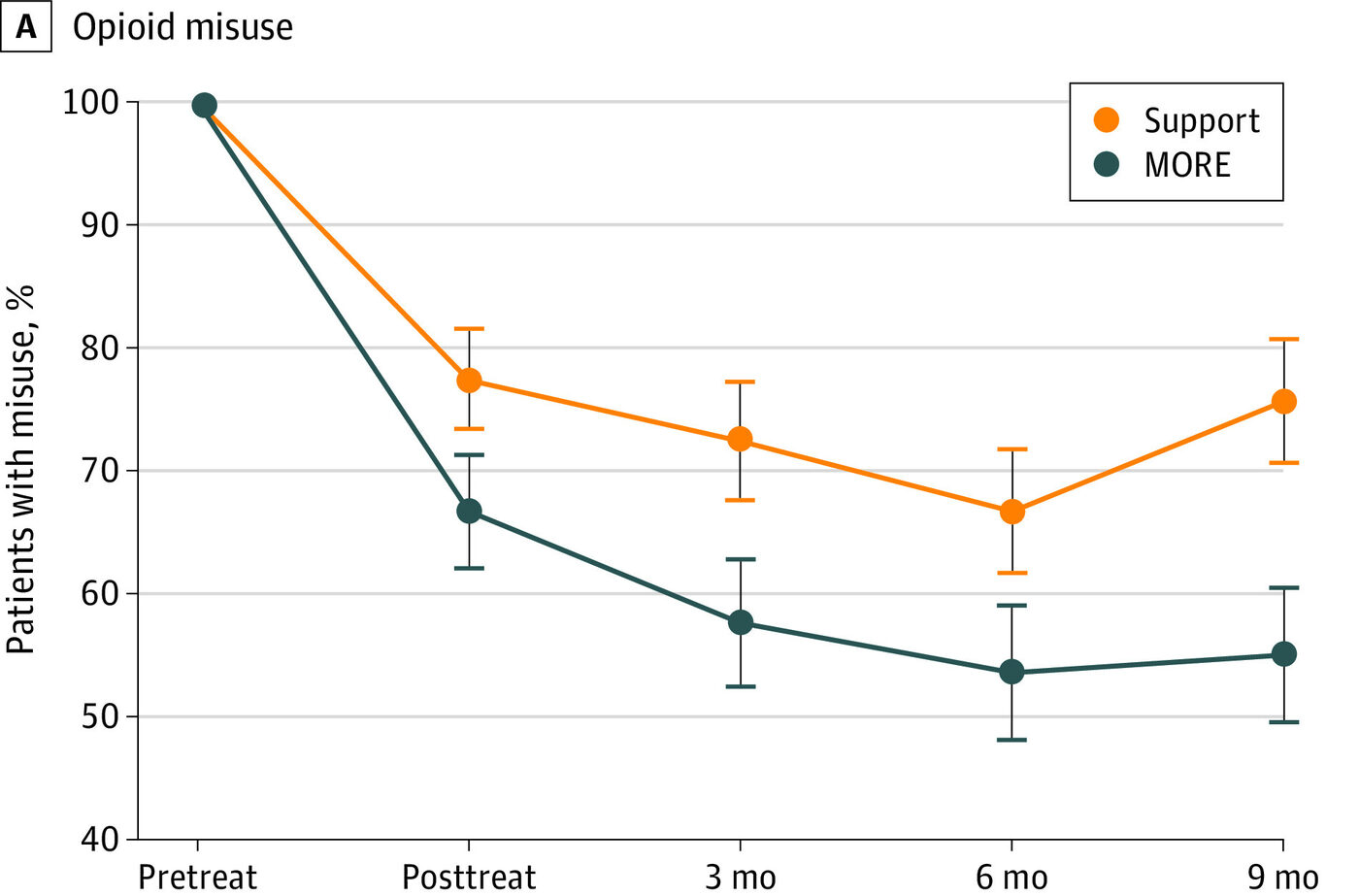
Those 9-month percentages count only the people who came back. The main analysis, which used everyone’s data across all four follow-up visits (an
intention-to-treat analysis
An intention-to-treat analysis counts every randomized participant in the group they were assigned to, whether or not they completed or even started the treatment. It keeps the benefit of randomization, since dropping people who didn’t follow their plan can leave groups that differ in other ways, and it estimates what happens when a treatment is offered in practice rather than when it is taken exactly as intended.
More on Wikipedia
Read more in the glossary
analysis), put the odds of escaping misuse at about twice as high with MORE (
odds ratio
An odds ratio compares the odds of an outcome in one group with the odds in another, where the odds are the chance something happens divided by the chance it doesn’t. An odds ratio of 1 means no difference, above 1 means higher odds in the first group, and below 1 lower odds. When an outcome is common, an odds ratio looks bigger than the difference in percentages: 30% versus 20% is an odds ratio of about 1.7.
More on Wikipedia
Read more in the glossary
2.06, 95%
confidence interval
A confidence interval is the range of values that a study’s data are consistent with, given the uncertainty that comes from measuring a limited sample. A 95% confidence interval for an effect of 0.30 running from 0.00 to 0.59, for example, means the true effect could plausibly be anywhere from nothing to moderate. Narrower intervals mean more precise estimates; an interval that includes zero means the study can’t rule out no effect.
More on Wikipedia
Read more in the glossary
1.17–3.61). Averaged over follow-up, that corresponds to a 15-percentage-point difference in the chance of misusing.
Pain eased more with MORE too. On the 0–10 scales, and adjusting for where people started, MORE beat supportive therapy by 0.49 points for pain severity and 1.07 points for pain interference, averaged over follow-up. The supportive therapy group’s pain scores barely moved over the 9 months, drifting slightly up. Those differences are modest in raw terms (standardized
effect sizes
Effect size is a statistical concept that quantifies the magnitude or strength of a relationship, difference, or intervention outcome. Unlike p-values which only indicate statistical significance, effect sizes measure how meaningful a result is in practical terms. Common measures include Cohen’s d (standardized mean difference), correlation coefficients (r), and odds ratios. In meditation research, effect sizes help quantify the practical impact of different meditation practices on psychological or physiological outcomes.
More on Wikipedia
Read more in the glossary
of 0.36 and 0.58, roughly small to medium). Measured another way, at 9 months half the MORE group who were assessed (35 of 70) had a clinically meaningful drop in pain severity, compared with 29.3% (22 of 75) in supportive therapy. For interference, the figures were 58.6% (41 of 71) and 25.3% (19 of 75).
All three primary outcomes passed a stricter significance threshold set to allow for testing three outcomes, and the results held up in several analyses that made different assumptions about the people who dropped out.
Miscellaneous Interesting Takeaways
Lower Doses, Less Distress, Less Craving
The secondary outcomes all favored MORE as well:
- Opioid dose: by 9 months, 35.5% of the MORE participants with dose data (22 of 62) had cut their daily dose by at least half, compared with 15.9% (11 of 69) in supportive therapy. The typical (median) daily dose in the MORE group fell from 35 to 23 mg morphine-equivalent, while in supportive therapy it was 38 mg at both the start and the end. This held when people on methadone or buprenorphine, which can be prescribed for opioid addiction, were left out.
- Emotional distress: MORE reduced distress on a 0–63 depression, anxiety and stress scale by 2.79 points more than supportive therapy, mostly through lower depression scores.
- Craving: participants rated their opioid craving from 0 to 10 when prompted on their phones three times a day, an
ecological momentary assessment
Ecological momentary assessment (EMA), also called experience sampling, asks people to report what they are feeling or doing several times a day, in the moment and in their everyday surroundings, usually through short surveys sent to their phones at set or random times. Because answers are given on the spot rather than recalled later, they are less colored by memory than questionnaires about the past week or month, and they can show how experiences rise and fall through the day.
More on Wikipedia
Read more in the glossary method, during the 8 weeks of treatment and the month after. Craving fell by 0.49 points more in the MORE group.
Many People Left Before the End
By 9 months, 92 of the 250 participants (36.8%) had dropped out: 38.0% of the MORE group and 35.5% of the support group. The COVID-19 pandemic hit in the trial’s final year. The authors report that 4% of participants completed 9-month follow-up visits in that final year, compared with 74% in the year before the pandemic, as some declined to take part and research restrictions prevented visits. The authors point out that their rate is in line with other trials of psychosocial treatments for opioid problems, which lose about 42% on average. Because the dropout rate was similar in both groups and dropouts didn’t differ from completers at the start, the authors argue that it is unlikely to favor one group. Their sensitivity analyses, including one that assumed people who left MORE got no further benefit from it, gave similar results. That makes the result more convincing, but no statistical method can fully recover what more than a third of the sample would have reported.
The Main Outcome Leaned on Self-Report
The authors acknowledge that the main misuse measure leaned heavily on a questionnaire:
Although we used the DMI, a composite measure that combines data from clinical interviews and urine screening with self-reported opioid misuse scores on the COMM, the COMM is a major component of the DMI, which is a limitation given that it was impossible to conceal treatment assignment from participants.
Under the scoring rules, a COMM score below 9 counted as no misuse unless both the clinician’s rating and the urine test were positive. So a person who simply reported fewer problems on the questionnaire would usually be counted as having stopped misusing. People in a mindfulness program might also answer differently because they hoped or expected it would help, or wanted to please the people running it. The authors note that the study was presented to participants as a comparison of two behavioral treatments, without signaling which was the experimental one. Pain and craving were also self-reported, but that is inherent to measuring pain. Even opioid dose was measured by interviewing people about their opioid use since the previous visit.
The Program’s Author Led the Trial
Garland wrote MORE’s treatment manual and led this trial. The paper’s conflict of interest statement reports that he directs the university center that provides MORE in research trials, receives payment for seminars and teaching that train clinicians in MORE and mindfulness, and receives royalties from BehaVR and from sales of books related to MORE. These, the statement says, were outside the submitted work. The trial was funded by the US National Institute on Drug Abuse, which had no role in the analysis or the writing.
Several features of the design reduce the room for bias. The trial was registered, its primary outcomes and analysis plan were prespecified, assessors and the statistician were blind to group, the same therapists ran both programs, and recordings of the sessions were checked for adherence to each protocol. Still, as with many therapies tested mainly by the people who created them, independent replication would strengthen the case.
No Treatment-Related Harms Reported
Adverse events were asked about at every visit and reviewed by an independent medical monitor. None were judged to be related to either program. Seventeen people (7 in MORE, 10 in supportive therapy) had unrelated problems such as pneumonia.
What the Comparison Can and Can’t Show
Supportive group therapy was a fair control for the attention, group contact and homework time that come with any 8-week program. But it is not a standard treatment for opioid misuse, so the trial doesn’t show that MORE beats an established therapy. The authors compare MORE’s effects on pain with those of
CBT
Cognitive behavioral therapy (CBT) is a structured, usually short-term talk therapy that helps people notice and change unhelpful patterns of thinking and behavior. It is one of the most thoroughly tested psychological treatments and a first-line option for depression, anxiety disorders and many other conditions.
More on Wikipedia
Read more in the glossary
in a separate meta-analysis, and MORE’s look larger, but that comparison is across different studies with different patients and measures, not a head-to-head test. A large earlier trial they cite found that CBT reduced pain but not opioid use in people on long-term opioid therapy, which makes MORE’s effect on misuse notable, but the authors themselves call for trials comparing MORE directly with CBT or
MBSR
Mindfulness-Based Stress Reduction (MBSR) is a program designed to help individuals cope with stress, pain, and illness. Developed by Jon Kabat-Zinn in the 1970s, it combines meditation and yoga to promote awareness and stress management. The eight-week program teaches participants to focus on the present moment non-judgmentally, enhancing their ability to manage difficulties.
More on Wikipedia
Read more in the glossary
. They also note that MORE is an intensive program, while even brief CBT can help pain and distress in people who don’t misuse opioids.
The authors attribute MORE’s lasting effect to the program’s distinctive mechanisms, such as boosting the brain’s response to natural rewards and reducing reactions to opioid cues like the sight of a pill bottle. Those mechanisms come from earlier studies of MORE; this trial measured outcomes, not mechanisms. The MORE group also began with slightly higher pain scores than the support group (5.6 versus 5.2 for severity), which the pain analyses adjusted for.
Final Reflection
Before this trial, according to the authors, only pilot studies of MORE and three other small studies had tested behavioral treatments for people with both chronic pain and opioid misuse. This one was full-scale and run in ordinary primary care clinics, with patients who had years of pain, high doses and frequent depression and addiction. Against a control group that got the same time, attention and homework, an 8-week program combining mindfulness, reappraisal and savoring left more people free of misuse at 9 months, eased pain and its interference with daily life, and helped more people cut their opioid dose. The effects on pain were modest per person, but the misuse result is a substantial difference for a group in whom, as the authors put it, successful treatment has proven elusive.
The caveats are real. More than a third of participants were lost by 9 months, the main outcome depended mostly on what participants said about themselves while knowing which group they were in, and the author of the program’s manual led the trial. More broadly, a meta-analysis of mindfulness treatments for psychiatric disorders, including pain and addictions, found that mindfulness programs clearly beat no treatment and placebo-like programs but on average only matched established treatments such as CBT. Whether MORE outperforms established therapies, and whether it works as well when run by other teams at scale, are the next questions the authors themselves pose.
Citation
Garland, E. L., Hanley, A. W., Nakamura, Y., Barrett, J. W., Baker, A. K., Reese, S. E., Riquino, M. R., Froeliger, B., & Donaldson, G. W. (2022). Mindfulness-Oriented Recovery Enhancement vs supportive group therapy for co-occurring opioid misuse and chronic pain in primary care: A randomized clinical trial. JAMA Internal Medicine, 182(4), 407–417. 10.1001/jamainternmed.2022.0033
Get the next summary by email
One or two new paper summaries every couple of weeks, sent to your inbox when they go up.
No spam, and you can unsubscribe at any time. Prefer a feed reader? Use the RSS feed.