
Background Information
Relapse is the central problem in treating addiction. The authors cite estimates that only about 10.6% of people in the US with a
substance use disorder
A substance use disorder is the clinical term for addiction to alcohol or other drugs: continued use despite harm, with problems such as craving, loss of control over how much is used, and failed attempts to cut down. It ranges from mild to severe, and relapse after treatment is common.
More on Wikipedia
Read more in the glossary
seek treatment, and that 40% to 60% of those treated relapse within a year.
One of the most widely used approaches to staying well afterward is
relapse prevention
Relapse prevention is a cognitive-behavioral approach to addiction treatment, developed by G. Alan Marlatt and colleagues, that helps people stay off alcohol or drugs after they have stopped. Patients learn to identify high-risk situations, such as stress or certain places and people, to plan and practice ways of coping with them, and to treat a slip as something to learn from rather than a complete failure.
More on Wikipedia
Read more in the glossary
(RP), a
cognitive-behavioral
Cognitive behavioral therapy (CBT) is a structured, usually short-term talk therapy that helps people notice and change unhelpful patterns of thinking and behavior. It is one of the most thoroughly tested psychological treatments and a first-line option for depression, anxiety disorders and many other conditions.
More on Wikipedia
Read more in the glossary
approach developed by G. Alan Marlatt (to whom this paper is dedicated) and colleagues. It teaches people to spot the situations that put them at risk of using again and to rehearse ways of coping with them. The authors note some proposed weaknesses. RP leans on avoiding high-risk situations, and on controlling the negative emotions and cravings that drive relapse rather than learning to tolerate them, even though negative mood is one of the main predictors of relapse.
Mindfulness-based relapse prevention (MBRP)
Mindfulness-Based Relapse Prevention (MBRP) is an 8-week group program for people recovering from alcohol or drug problems, developed by Sarah Bowen, G. Alan Marlatt and colleagues. Modeled on mindfulness-based cognitive therapy, it combines mindfulness meditation with cognitive-behavioral relapse prevention skills such as spotting high-risk situations. Participants practice noticing cravings and difficult emotions as passing experiences rather than automatically acting on them.
Read more in the glossary
, developed by Sarah Bowen, Neharika Chawla and Marlatt, keeps parts of RP, such as identifying personal triggers, but builds on meditation practices from
MBSR
Mindfulness-Based Stress Reduction (MBSR) is a program designed to help individuals cope with stress, pain, and illness. Developed by Jon Kabat-Zinn in the 1970s, it combines meditation and yoga to promote awareness and stress management. The eight-week program teaches participants to focus on the present moment non-judgmentally, enhancing their ability to manage difficulties.
More on Wikipedia
Read more in the glossary
and
MBCT
Mindfulness-based cognitive therapy (MBCT) is an 8-week group program that combines mindfulness meditation, adapted from Mindfulness-Based Stress Reduction (MBSR), with elements of cognitive behavioral therapy. It was developed to help people who have recovered from depression avoid relapse, by learning to notice and step back from patterns of negative thinking. Classes usually meet weekly, with daily meditation practice at home.
More on Wikipedia
Read more in the glossary
: sitting meditation and short “informal” practices for daily life. The idea is that people learn to notice craving and difficult feelings as they arise and to stay with them instead of reacting automatically. As the authors put it:
These practices may also function as exposure to internal experiences … that often precipitate relapse, such as negative affect and craving.
An earlier pilot trial of MBRP at the same agency had compared it only with usual care. It found less craving and more acceptance and awareness over 4 months, and less substance use over 2 months. A follow-up analysis of that pilot looked at how depression, craving and substance use were linked after MBRP. The authors describe this new trial as, to their knowledge, the first
randomized controlled trial
A Randomized Controlled Trial is a scientific study design that randomly assigns participants to either an experimental group receiving an intervention or a control group, allowing researchers to measure the true effect of the intervention while minimizing bias.
More on Wikipedia
Read more in the glossary
to compare MBRP with both standard RP and usual care over 12 months. They expected both structured programs to beat usual care, and MBRP to hold its gains better over time.
What They Did
Between October 2009 and July 2012, the team recruited people from a nonprofit addiction treatment agency with two sites (the paper’s funding note names Recovery Centers of King County). Patients there typically attend about a year of aftercare, the ongoing support that follows initial treatment, after either a 28-day inpatient stay or 90 days of intensive outpatient treatment (about 60% and 40% respectively). To join, people had to have completed that initial treatment and be medically cleared. People with a current psychotic disorder, dementia or suicidality were excluded.
Of those screened, 84 were ineligible and 32 declined. The remaining 286 were randomly assigned to one of three kinds of aftercare:
- Mindfulness-based relapse prevention (103 people): eight weekly 2-hour group sessions of 6 to 10 people, led by two therapists. Every session included a 20- to 30-minute guided meditation, skills practice and discussion. Early weeks built awareness of bodily sensations, emotions and thoughts. Later ones practiced mindfulness in the presence of relapse triggers and finished with self-care, compassion and social support. Participants took home audio-recorded practices and logged their daily craving and mood. All MBRP therapists had their own established meditation practice, including intensive retreats.
- Standard relapse prevention (88 people): matched to MBRP in time, format, group size, location and amount of homework. It covered high-risk situations, cognitive and behavioral coping skills, problem solving, goal setting, confidence in staying sober (self-efficacy) and social support. Participants also logged daily craving and mood.
- Treatment as usual (95 people): the agency’s standard aftercare. These were open, discussion-based groups built on the
twelve-step
A twelve-step program is a mutual-help approach to recovery from addiction based on the twelve steps of Alcoholics Anonymous, such as admitting powerlessness over the addiction, taking a moral inventory and making amends. Members meet in peer-led groups, aim for complete abstinence and are encouraged to find a sponsor. Many addiction treatment centers build their programs around these principles.
More on Wikipedia
Read more in the glossary principles of Alcoholics and Narcotics Anonymous, with abstinence as the goal. They met once or twice a week for 1½ hours and were led by licensed chemical dependency counselors.
People in the two structured programs left standard aftercare for the 8 weeks and then returned to it, so after the program everyone was in usual aftercare. Participants ranged in age from 18 to 70 (average about 38). About 70% were men, 42% were from racial or ethnic minorities, and most (82%) used more than one substance; only about 1 in 7 used alcohol alone.
Follow-ups came 3, 6 and 12 months after the 8-week program ended. At each one, research staff took people through a calendar-based interview (the Timeline Follow-back), going day by day through the previous 90 days to record drug use and heavy drinking. Heavy drinking meant at least 4 drinks on one occasion for women or 5 for men. The agency also had urine test results for 199 participants who were court-ordered or otherwise required to be tested. Everyone, including the usual-care group, was paid $40 for each assessment, with bonuses for completing all of them.
The analysis included everyone as randomized (an
intention-to-treat analysis
An intention-to-treat analysis counts every randomized participant in the group they were assigned to, whether or not they completed or even started the treatment. It keeps the benefit of randomization, since dropping people who didn’t follow their plan can leave groups that differ in other ways, and it estimates what happens when a treatment is offered in practice rather than when it is taken exactly as intended.
More on Wikipedia
Read more in the glossary
). It made two comparisons: the two structured programs together against usual care, and MBRP against RP. The team looked at how long it took people to first use drugs or first drink heavily over the follow-up year, and, at each follow-up, whether people used at all and, if they did, on how many days. The models adjusted for age, severity of dependence at the start, treatment hours, past treatment and treatment site. About 81–86% of each group completed the 6-month follow-up and 80–82% the 12-month one, with no significant difference between groups.
One Big Result: Both Programs Beat Usual Aftercare, and Mindfulness Pulled Ahead at 12 Months
At 3 months there were no significant differences between the groups. After that, the picture changed:
- Over the follow-up year, the two structured programs together had a 54% lower risk of relapse to drug use and a 59% lower risk of relapse to heavy drinking than usual care (
hazard ratios
A hazard ratio compares how fast an event happens in two groups over time, such as recovery or death, at any given moment among the people it hasn’t happened to yet. A hazard ratio of 2 means the event is happening at twice the rate in one group as in the other; 1 means no difference. It comes from survival analysis (often a Cox proportional hazards model), which can include people who leave a study early by counting the time they were followed.
More on Wikipedia
Read more in the glossary of 0.46 and 0.41). Standard RP delayed the first drug use more than MBRP did: the MBRP group’s risk of a first drug-use day was 21% higher. The two didn’t differ on the first heavy-drinking day. - At 6 months, people in either structured program were more likely than those in usual care to have avoided drugs entirely and to have avoided heavy drinking. Those who did drink heavily did so on 31% fewer days than in usual care. MBRP and RP did not differ.
- At 12 months, MBRP came out ahead of RP. MBRP participants were more likely to have avoided heavy drinking altogether: 8 of the 83 assessed reported any, compared with 17 of 72 in RP (and 19 of 76 in usual care). Among those who used drugs, MBRP participants did so on 31% fewer days than RP participants. The share using any drugs at all did not differ significantly.
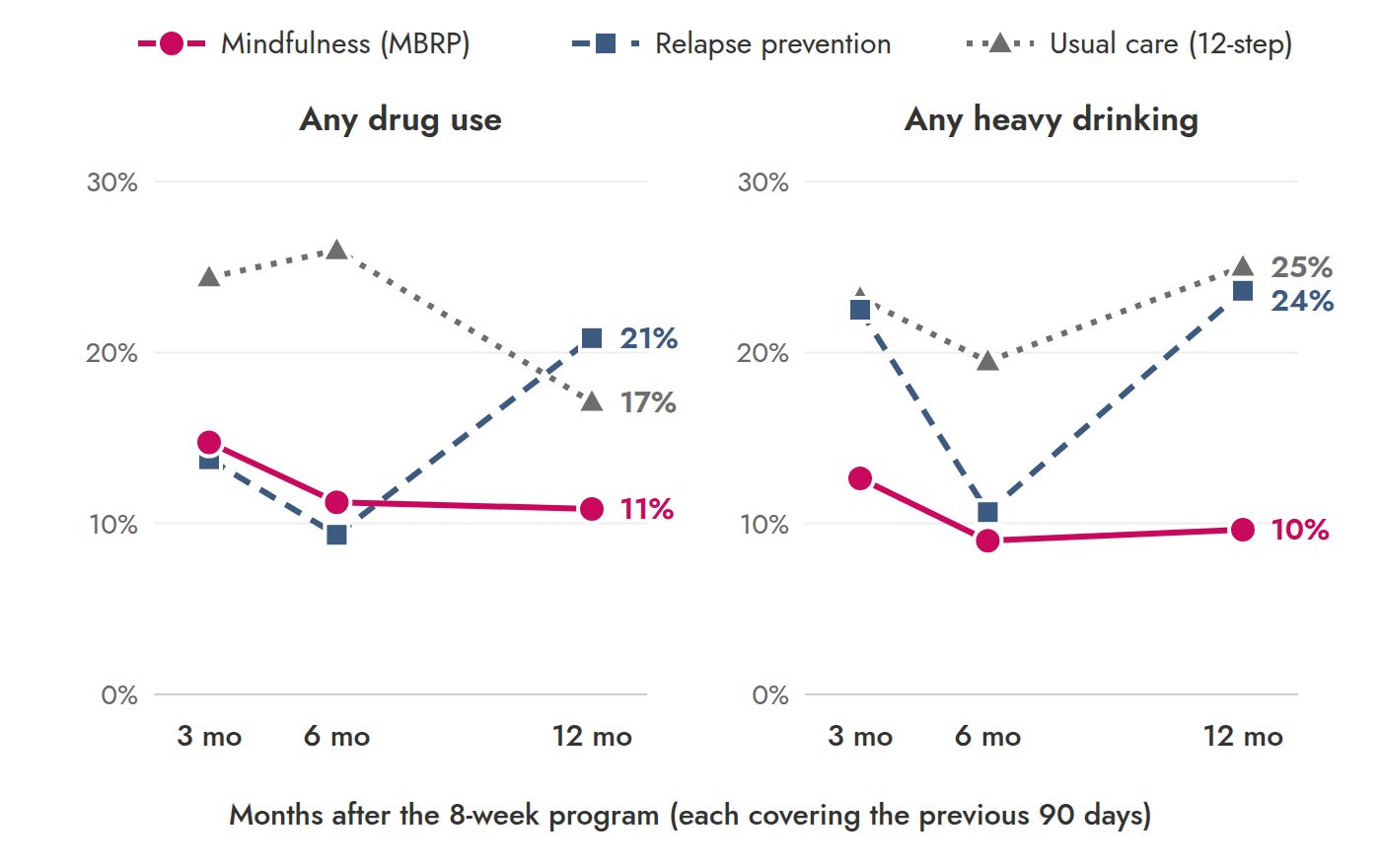
The authors sum up the pattern over time:
These findings suggest that the treatments may be equally effective at 3 months’ follow-up; both MBRP and RP, compared with TAU, blunt the probability and severity of relapses at the 6-month follow-up, with RP delaying time to first drug use; and MBRP may have a more enduring effect thereafter.
Here TAU is treatment as usual. The chart shows where the 12-month difference comes from: the mindfulness group’s drug use and heavy drinking stayed about where they were at 6 months, while the standard RP group’s rose back to around the level of usual care. The authors suggest that mindfulness practice builds a lasting ability to recognize and tolerate the discomfort of craving and negative mood, though the study didn’t test that mechanism.
Miscellaneous Interesting Takeaways
The Abstract Says a Little More Than the Tables
A few of the summary claims go slightly beyond what the results show. The abstract says that at 12 months MBRP beat both RP and usual care. But the 12-month analysis compared MBRP directly only with RP. The 12-month tests involving usual care pooled both structured programs against it, and none was significant. The abstract also says the structured programs led to fewer days of substance use at 6 months. In the results tables, that applies to heavy-drinking days; for drugs, the 6-month difference was in whether people used at all, not on how many days. And the 12-month advantage in drug-use days rests on few people, since only 9 MBRP and 15 RP participants assessed then reported using drugs. The paper ran many tests (two outcomes, three follow-ups, two comparisons and two parts to each model) without adjusting for multiple comparisons, and only a handful were significant.
Use Was Low in Every Group
At every follow-up, no more than about a quarter of any group reported drug use in the previous 90 days, and the same was true of heavy drinking. The authors note these rates were much lower than in other addiction treatment studies, as in their earlier pilot at the same agency, and suggest that ongoing aftercare and urine testing may both have played a part. Low rates make differences between groups harder to detect, and they mean the results apply to people who had already completed treatment and stayed engaged in aftercare.
Mostly Self-Reported, Partly Checked
The main outcomes came from what participants said in the calendar interview. For the 199 people with agency urine tests, self-reports and tests agreed 74.2% of the time. In 20.8% of comparisons people reported use that the test didn’t pick up, which the authors attribute to tests not always following soon after use. In 5.0%, people denied use but tested positive. The paper doesn’t say whether the research staff running the interviews knew which group each person was in.
A Fair Fight Between the Two Structured Programs
Comparing MBRP with standard RP, rather than only with usual care, is the study’s main strength. As the authors put it:
However, RP and MBRP interventions were matched on time, structure, and therapist training, differing only in the intervention delivered, thus offering a rigorous test of MBRP.
The comparison with usual care is less clean. Usual care differed in format, homework and therapists’ training, and its participants started with somewhat less severe dependence, which the models adjusted for. Attendance was modest across the board: fewer than half of each group attended at least 75% of their sessions.
Who Ran It
Several authors led MBRP or RP groups themselves, and three (Bowen, Grow and Chawla) disclosed that they run paid MBRP trainings. The study was funded by the US National Institute on Drug Abuse, which had no role in the analysis. No adverse events were reported.
Skill Use Fell Off More After Mindfulness
After the course, 88.3% of MBRP participants said they used the skills they had learned at least once a week, falling to 67.6% at 12 months. Every RP participant reported weekly skill use at both points. So the mindfulness group’s better 12-month results weren’t because more of them kept using what they had learned. The study can’t say which part of MBRP, if any, made the difference.
Final Reflection
For people leaving addiction treatment, this trial suggests that a structured 8-week aftercare group, whether mindfulness-based or standard relapse prevention, does better than the usual 12-step discussion groups over the following months. The more novel finding is that MBRP’s benefits seemed to last longer, with lower rates of heavy drinking and fewer drug-use days a year later than after standard RP, while RP did better at delaying the very first drug use.
That 12-month advantage came from one comparison in a single trial, with self-reported outcomes and small numbers of people still using. It needs replicating before it can be treated as settled. Still, it is a carefully matched head-to-head test, and it supports the idea behind MBRP: that learning to stay with craving and difficult feelings, rather than only avoiding triggers, may help people stay well once the program ends.
Citation
Bowen, S., Witkiewitz, K., Clifasefi, S. L., Grow, J., Chawla, N., Hsu, S. H., Carroll, H. A., Harrop, E., Collins, S. E., Lustyk, M. K., & Larimer, M. E. (2014). Relative efficacy of mindfulness-based relapse prevention, standard relapse prevention, and treatment as usual for substance use disorders: A randomized clinical trial. JAMA Psychiatry, 71(5), 547–556. 10.1001/jamapsychiatry.2013.4546
Get the next summary by email
One or two new paper summaries every couple of weeks, sent to your inbox when they go up.
No spam, and you can unsubscribe at any time. Prefer a feed reader? Use the RSS feed.