
Background Information
More young people go to university than ever, and UK university counseling services have faced rising demand. The authors note that in some services the number of students seeking counseling grew by 50% between 2010 and 2015, faster than the number of students. Universities have been looking for ways to help students before problems become serious, and
mindfulness
Mindfulness is the psychological process of purposely bringing one’s attention to experiences occurring in the present moment without judgment. It involves maintaining awareness of thoughts, feelings, bodily sensations, and surrounding environment with an attitude of curiosity and acceptance. In meditation contexts, mindfulness practices typically involve focusing attention on the breath or body sensations as anchors to the present moment while acknowledging and releasing distracting thoughts.
More on Wikipedia
Read more in the glossary
courses have become a popular option. Part of the appeal may be how they are framed:
Uptake of the approach might partly be explained by the perception of mindfulness training as a skill rather than a mental health intervention.
Mindfulness programs had good evidence for easing symptoms of anxiety and depression in general, as in Goyal and colleagues’ review of 47 trials. But the evidence for students was thin. Most earlier trials studied health-care students, were small, had no published plan or clear main outcome, and followed students for only a short time. None, the authors note, had actively monitored for side effects.
Julieta Galante, Peter Jones and colleagues at the University of Cambridge designed the Mindful Student Study to answer a practical question: if a university offers students a mindfulness course, are they more resilient when stress peaks? At Cambridge, stress peaks during the main exam period each May and June. The team treated lower distress during exams, a stress every student faces, as their sign of resilience.
What They Did
This was a
pragmatic trial
A pragmatic trial tests how well a treatment works in everyday practice, with ordinary participants, settings and levels of attendance, rather than under the tightly controlled conditions of an explanatory trial. It shows whether offering a program helps the people it is offered to, but it usually compares the program with usual care, so it can’t say which parts of the program caused any benefit.
More on Wikipedia
Read more in the glossary
, testing the course the way the university actually ran it rather than under idealized lab conditions. In two waves, in the terms starting October 2015 and January 2016, the team enrolled 616 Cambridge students who volunteered. Undergraduates and postgraduates aged 18 or older could join if they believed they could attend at least seven of the eight sessions. Students judged for themselves whether they met the exclusion criteria, which were those the university’s counseling service used: currently going through a severe period of anxiety or depression, severe mental illness such as psychotic episodes, a recent bereavement, or another serious health problem that would get in the way.
After an online questionnaire, a computer randomly assigned each student to one of two groups:
- The mindfulness course plus usual support (309 students). Mindfulness Skills for Students was a secular, face-to-face group course based on the book Mindfulness: A Practical Guide to Finding Peace in a Frantic World, adapted for students. It ran for eight weekly sessions of 75–90 minutes, in groups of up to 30, with meditation, reflection and discussion, and interactive exercises. Home practice started at 8 minutes a day and rose to about 15–25 minutes. One experienced, certified teacher taught all seven courses. It was free.
- Usual support only (307 students). Students kept access to everything already available: the university counseling service, support from the university and colleges, and the National Health Service (NHS). They were guaranteed a place on the course the following year.
The main outcome was psychological distress during the exam period (May 16 to June 10, 2016), measured with the Clinical Outcomes in Routine Evaluation Outcome Measure (CORE–OM), a 34-item questionnaire widely used with UK university students. Scores are averaged across items on a scale of 0 to 4, and higher scores mean more distress. Questionnaires were collected automatically online, so the people assessing outcomes didn’t know who was in which group, and neither did the statistician who ran the main analysis. The students themselves knew, which matters because the outcome was their own report. For students who started in October, the exam period came about six months after they were randomized; for those who started in January, about three months.
The main analysis was by
intention to treat
An intention-to-treat analysis counts every randomized participant in the group they were assigned to, whether or not they completed or even started the treatment. It keeps the benefit of randomization, since dropping people who didn’t follow their plan can leave groups that differ in other ways, and it estimates what happens when a treatment is offered in practice rather than when it is taken exactly as intended.
More on Wikipedia
Read more in the glossary
: every student was counted in the group they were assigned to, whether or not they went to the course. Attendance was far from complete. Of those offered the course, 182 (59%) attended at least four of the eight sessions, and 15 (5%) never went at all. The most common reasons for dropping out were timetable clashes and being too busy. Meanwhile, 26 students (8%) in the usual-support group did a mindfulness course or more than 10 hours of meditation elsewhere, and 37% of that group didn’t say either way. The team filled in missing scores using multiple imputation, a standard statistical method.
One Big Result: Students Offered the Course Were Less Distressed During Exams
Of the 616 students, 453 (74%) completed the CORE–OM during exams. Their average scores were 0.87 in the mindfulness group (237 students) and 1.11 in the usual-support group (216 students). After allowing for starting scores, sex, age and when each student took the course, the course group’s distress was on average 0.25 points lower (95%
confidence interval
A confidence interval is the range of values that a study’s data are consistent with, given the uncertainty that comes from measuring a limited sample. A 95% confidence interval for an effect of 0.30 running from 0.00 to 0.59, for example, means the true effect could plausibly be anywhere from nothing to moderate. Narrower intervals mean more precise estimates; an interval that includes zero means the study can’t rule out no effect.
More on Wikipedia
Read more in the glossary
0.16 to 0.34). That is 0.44 standard deviations, which the authors class as a moderate
effect size
Effect size is a statistical concept that quantifies the magnitude or strength of a relationship, difference, or intervention outcome. Unlike p-values which only indicate statistical significance, effect sizes measure how meaningful a result is in practical terms. Common measures include Cohen’s d (standardized mean difference), correlation coefficients (r), and odds ratios. In meditation research, effect sizes help quantify the practical impact of different meditation practices on psychological or physiological outcomes.
More on Wikipedia
Read more in the glossary
. Counting only the students who attended at least half the course gave similar results.
The two groups moved in opposite directions over the year. Distress in the usual-support group crept up from the start of the study to the exams, while the mindfulness group’s scores dropped after the course and stayed down.
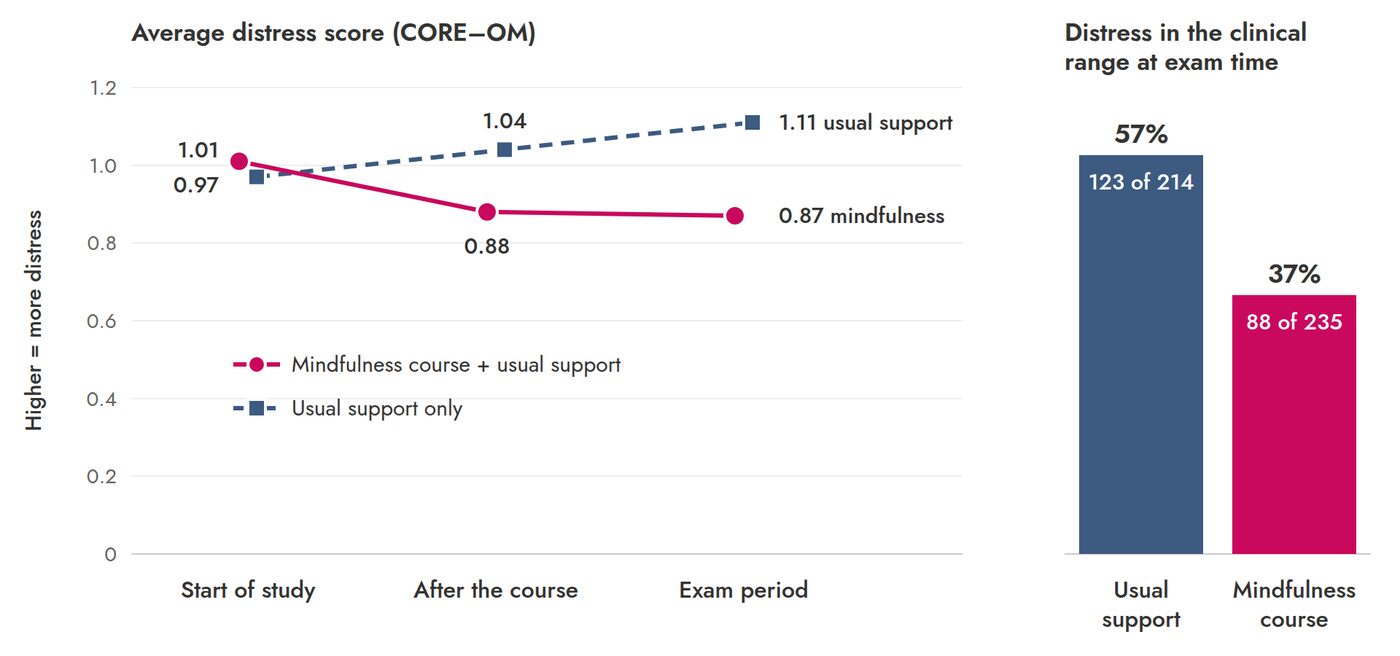
To show what that means in practice, the authors split students at a CORE–OM score of 1.0, a cut-off that distinguishes people seen in NHS clinical services from the general population. During exams, 57% (123 of 214) of the usual-support group scored above it, against 37% (88 of 235) of the mindfulness group:
MSS participants were a third less likely than support as usual participants to be in this clinical range of distress
MSS is the Mindfulness Skills for Students course; the risk ratio was 0.65 (95% CI 0.53 to 0.80). On average, about six students (95% CI four to ten) had to be offered the course to prevent one from reaching that level of distress during exams, the
number needed to treat
The number needed to treat (NNT) is how many people need to receive a treatment, or be offered it, for one more of them to avoid a bad outcome than would have without it. It is 1 divided by the difference in the share of each group that has the outcome: if 30% of an untreated group and 20% of a treated group have it, the NNT is 1 / 0.10, or 10. Lower numbers mean a bigger practical effect.
More on Wikipedia
Read more in the glossary
. The authors put it another way: on each course of 30 students, about five were spared clinical-level distress. (The raw percentages differ by 20 points, which on its own would give about five; the main text doesn’t say how the authors arrived at six.) A score above the cut-off isn’t a diagnosis, but it marks distress more typical of people seen in NHS clinical services than of the general population. This split used the scores students actually gave, without filling in missing ones.
One small inconsistency is worth knowing about if you read the paper. The abstract gives the exam-period difference as −0.14, but the Results section and Table 3 give −0.25 for the exam period and −0.14 for just after the course. The abstract appears to have borrowed the post-course figure. The standardized effect of 0.44 is the same in both.
Miscellaneous Interesting Takeaways
Wellbeing Rose, but Exam Arrangements and Coping Didn’t Change
Just after the course, distress was also lower in the mindfulness group (by 0.14 points), and wellbeing, measured with the 14-item Warwick–Edinburgh Mental Wellbeing Scale (scored 14–70), was higher, by 2.75 points after the course and 2.61 points during exams. Wellbeing in the usual-support group drifted down over the year.
Several practical outcomes didn’t differ between the groups:
- requests for special exam arrangements, for any reason or for mental health reasons
- the number of students unable to sit their exams
- how much students were thinking about leaving their course
- day-to-day coping with academic work, rated daily for two weeks during exams (191 students)
Students in the mindfulness group did report fewer problems affecting their studies (p = 0.04) and their university experience (p = 0.02). The trial measured many secondary outcomes, some with p-values close to the 0.05 line, so these are better read as leads than findings, a point the authors themselves make.
Exam Grades: More Firsts, but Also More Thirds
The authors also looked at undergraduates’ exam grades (292 students). Students offered the course were slightly more likely to get either the top grade (a first) or the lowest honours grade (a third); all seven students with a third were in the mindfulness group. The overall difference was borderline (p = 0.04) and was no longer statistically significant among students who attended at least half the course, though the pattern looked similar. The authors say they view the result with caution, though they link it to the idea that both too little and too much arousal can hurt performance. Students with a third were no more distressed during exams than higher-scoring students. Earlier small trials, such as Mrazek and colleagues’ study of two weeks of mindfulness classes, had found that mindfulness training shortly before a test improved scores. Here, with the course months before exams, the picture was more mixed.
The Course Helped More Among Students Sitting Exams
The effect on distress was 0.19 points larger in students who had exams or assessments during the exam period (267 students) than in those who didn’t (p = 0.043). It was 0.18 points smaller in men than in women, but that difference was not statistically significant (p = 0.061). The authors read the first result as a sign that the course helped most when students were under more stress, though subgroup comparisons like these are less reliable than the main result.
The mindfulness group were also more likely to donate the shopping vouchers they got for filling in questionnaires to charity (odds ratios 1.95 after the course and 1.80 during exams). An attempt to track physical activity with phone sensors produced data for only 31 students; the authors call this part of the trial essentially unsuccessful.
Side Effects Were Watched For, and Few Were Found
Unusually for a trial like this, the team actively monitored for adverse events in three ways, with an independent committee judging whether each could be related to the course. Across all time points, 20 students in the mindfulness group and 25 with usual support scored above the risk cut-offs on the CORE–OM, which triggered the reporting procedure; the abstract states that no participant had an adverse reaction related to self-harm, suicidality or harm to others. Through other routes, one student left the course because they found it unhelpful and felt it was “bringing unwanted matters to the fore”. They were referred for counseling and later told the trial they still felt positive about mindfulness. The course came with screening, a teacher students could talk to privately, and an email check whenever someone missed a session. The authors recommend that students be encouraged to raise unpleasant experiences with their teacher. Monitoring of this kind is built to catch serious problems. When Britton and colleagues interviewed everyone after a mindfulness course about 44 specific experiences, unpleasant but mostly brief effects turned out to be common.
What the Design Can and Can’t Show
The authors are candid about the limits:
The primary and most secondary outcomes were self-reported, and participants were not masked to group allocation, such that responses might have been influenced by their expectations.
The comparison was with usual support, not with another course, so the trial can’t separate mindfulness from the benefits of joining any weekly group with a supportive teacher, or from expectations. Students left on usual support might even have expected to feel worse, a nocebo effect. One teacher taught every course, so results might partly reflect that person. The participants were volunteers interested in mindfulness, out of roughly 20,000 students, and were a little more distressed at the start than typical students. And 26% didn’t complete the main questionnaire during exams, for reasons that remain largely unexplained. The authors argue that mindfulness probably contributed something specific, given evidence from earlier trials, but call for studies comparing it with other preventive programs. Results at one year were to be reported in a separate paper.
Final Reflection
The authors describe the Mindful Student Study as, to their knowledge, the largest randomized trial of mindfulness training for students at the time. Its strengths are its size, a protocol registered in advance, a single main outcome, independent monitoring of side effects, and a design that tested the course as a university would actually offer it, with ordinary attendance. Even though only 59% of those offered the course went to at least half of it, offering it went with less distress at the most stressful time of year, and with fewer students in the range seen in clinical services.
The open question is how much of that came from mindfulness itself. The students knew whether they had been given a place, they rated their own distress, and the comparison group got no course at all. Comparing a mindfulness course with another kind of group program would help sort that out. For now, the trial suggests that a free, voluntary mindfulness course is a reasonable thing for a university to offer as one part of student support, alongside counseling services rather than instead of them.
Citation
Galante, J., Dufour, G., Vainre, M., Wagner, A. P., Stochl, J., Benton, A., Lathia, N., Howarth, E., & Jones, P. B. (2018). A mindfulness-based intervention to increase resilience to stress in university students (the Mindful Student Study): A pragmatic randomised controlled trial. The Lancet Public Health, 3(2), e72–e81. 10.1016/S2468-2667(17)30231-1
Get the next summary by email
One or two new paper summaries every couple of weeks, sent to your inbox when they go up.
No spam, and you can unsubscribe at any time. Prefer a feed reader? Use the RSS feed.