
Background Information
Many people take up meditation to cope with stress, and doctors need to know what the evidence says to advise them. Earlier reviews had concluded that both mindfulness and mantra meditation reduce anxiety, depression and stress to a small or moderate degree. But those reviews mixed in uncontrolled studies and trials that compared meditation with a
wait-list
A wait-list control group is a comparison group that receives the program being studied only after the study period, so participants who are waiting can be compared with those already taking part. It controls for the passage of time and repeated testing, but not for the attention, expectations and setting that come with taking part in any program, which an active control group can address.
More on Wikipedia
Read more in the glossary
or usual care.
That matters because people who sign up for meditation tend to believe it will help (a form of
self-selection bias
Self-selection bias arises when people decide for themselves whether to take part in a study, so those who do may differ from those who don’t in ways that affect the results. A survey advertised as being about the unwanted effects of meditation, for example, may draw more people who have had such effects, making them look more common than they are among meditators in general.
More on Wikipedia
Read more in the glossary
), and many outcomes are questionnaires that those beliefs can sway. Any program that offers weekly classes, an attentive teacher and a group can make people feel better. The review’s authors, a team at the Johns Hopkins Evidence-based Practice Center funded by the US Agency for Healthcare Research and Quality, framed the question this way:
Clinicians need to know whether there are beneficial effects of meditation training beyond self-selection biases and the non-specific effects of time, attention, and expectations for improvement.
Their answer was to treat a well-matched comparison program the way a drug trial treats a placebo pill, and to include only trials that had one.
What They Did
Madhav Goyal and colleagues searched eight research databases and checked reference lists for
randomized controlled trials
A Randomized Controlled Trial is a scientific study design that randomly assigns participants to either an experimental group receiving an intervention or a control group, allowing researchers to measure the true effect of the intervention while minimizing bias.
More on Wikipedia
Read more in the glossary
of meditation in adults. Out of thousands of citations, 47 trials with 3,320 participants met their criteria. To qualify, a trial had to:
- teach a structured meditation program with at least 4 hours of training and instructions to practice at home. Yoga, tai chi, qi gong, breathing exercises, relaxation therapy and programs delivered only by audio or video were excluded, as were therapies in which meditation is only one part, such as DBT and ACT;
- enroll adults with a medical or psychiatric condition, defined broadly enough to include stressed people without a diagnosis;
- compare meditation with an
active control group
An active control group is a comparison group that takes part in a different program designed to be just as engaging as the one being tested. In meditation research, it might involve exercise, music, or education classes with the same time commitment, teachers, and expectations of benefit. Comparing against an active control helps separate the effects of meditation itself from the general effects of joining a course.
More on Wikipedia
Read more in the glossary matched in time and attention. Trials with only a wait-list or usual-care comparison were left out.
The programs fell into two families. Most were mindfulness programs: mindfulness-based stress reduction (
MBSR
Mindfulness-Based Stress Reduction (MBSR) is a program designed to help individuals cope with stress, pain, and illness. Developed by Jon Kabat-Zinn in the 1970s, it combines meditation and yoga to promote awareness and stress management. The eight-week program teaches participants to focus on the present moment non-judgmentally, enhancing their ability to manage difficulties.
More on Wikipedia
Read more in the glossary
), mindfulness-based cognitive therapy (
MBCT
Mindfulness-based cognitive therapy (MBCT) is an 8-week group program that combines mindfulness meditation, adapted from Mindfulness-Based Stress Reduction (MBSR), with elements of cognitive behavioral therapy. It was developed to help people who have recovered from depression avoid relapse, by learning to notice and step back from patterns of negative thinking. Classes usually meet weekly, with daily meditation practice at home.
More on Wikipedia
Read more in the glossary
) and other mindfulness courses. MBSR typically gave 20–27.5 hours of training over 8 weeks, and the other mindfulness programs about half that. The rest were mantra programs, mostly
Transcendental Meditation
Transcendental Meditation (TM) is a trademarked form of mantra meditation taught through a standardized course by certified teachers. Practitioners sit with eyes closed for about 20 minutes twice a day, silently repeating a mantra (a sound or word) in a way meant to be effortless, letting the mind settle rather than holding attention on an object. Researchers usually group it with other mantra-based techniques, separate from mindfulness meditation.
More on Wikipedia
Read more in the glossary
(TM), which gave 16–39 hours over 3–12 months. Fifteen trials studied psychiatric conditions such as anxiety, depression, chronic worry and insomnia; five studied smokers or people with alcohol problems; five studied chronic pain; and 16 studied other medical conditions, including heart disease, breast cancer, diabetes and HIV.
The team split the trials by the kind of comparison:
- Nonspecific active controls, such as health education, match the time, attention and expectations of a meditation program without being a known treatment. Beating one suggests meditation has an effect of its own, like a drug beating a placebo.
- Specific active controls are established treatments, such as exercise, progressive muscle relaxation, cognitive behavioral therapy or medication. These comparisons ask whether meditation works better than something else that works.
For each outcome they did two things. First, where trials reported enough data, they pooled them in a
meta-analysis
A meta-analysis statistically combines the results of many earlier studies on the same question. Pooling the data can estimate an overall effect more precisely than any single study and show whether results agree across studies. Its conclusions are only as good as the studies it includes and how similar they are.
More on Wikipedia
Read more in the glossary
, expressing results as a standardized
effect size
Effect size is a statistical concept that quantifies the magnitude or strength of a relationship, difference, or intervention outcome. Unlike p-values which only indicate statistical significance, effect sizes measure how meaningful a result is in practical terms. Common measures include Cohen’s d (standardized mean difference), correlation coefficients (r), and odds ratios. In meditation research, effect sizes help quantify the practical impact of different meditation practices on psychological or physiological outcomes.
More on Wikipedia
Read more in the glossary
with a 95%
confidence interval
A confidence interval is the range of values that a study’s data are consistent with, given the uncertainty that comes from measuring a limited sample. A 95% confidence interval for an effect of 0.30 running from 0.00 to 0.59, for example, means the true effect could plausibly be anywhere from nothing to moderate. Narrower intervals mean more precise estimates; an interval that includes zero means the study can’t rule out no effect.
More on Wikipedia
Read more in the glossary
. Second, because many trials didn’t report enough to be pooled, they also compared how much each group improved from its starting point, counting a relative difference of 5% or more as potentially meaningful. Two reviewers then graded the strength of the evidence for each outcome, weighing the trials’ risk of bias, precision, consistency and directness:
- High: further research is very unlikely to change confidence in the estimate.
- Moderate: further research may change the estimate.
- Low: further research is likely to change the estimate.
- Insufficient: the evidence is unavailable or inadequate to draw a conclusion.
One Big Result: Mindfulness Eased Anxiety, Depression and Pain a Little More Than Matched Programs
Against nonspecific active controls, mindfulness programs had moderate evidence of improving three outcomes:
- Anxiety: effect size 0.38 after 8 weeks and 0.22 at 3–6 months.
- Depression: effect size 0.30 after 8 weeks and 0.23 at 3–6 months.
- Pain: effect size 0.33.
They had low evidence of improving stress or distress and the mental health part of quality of life.
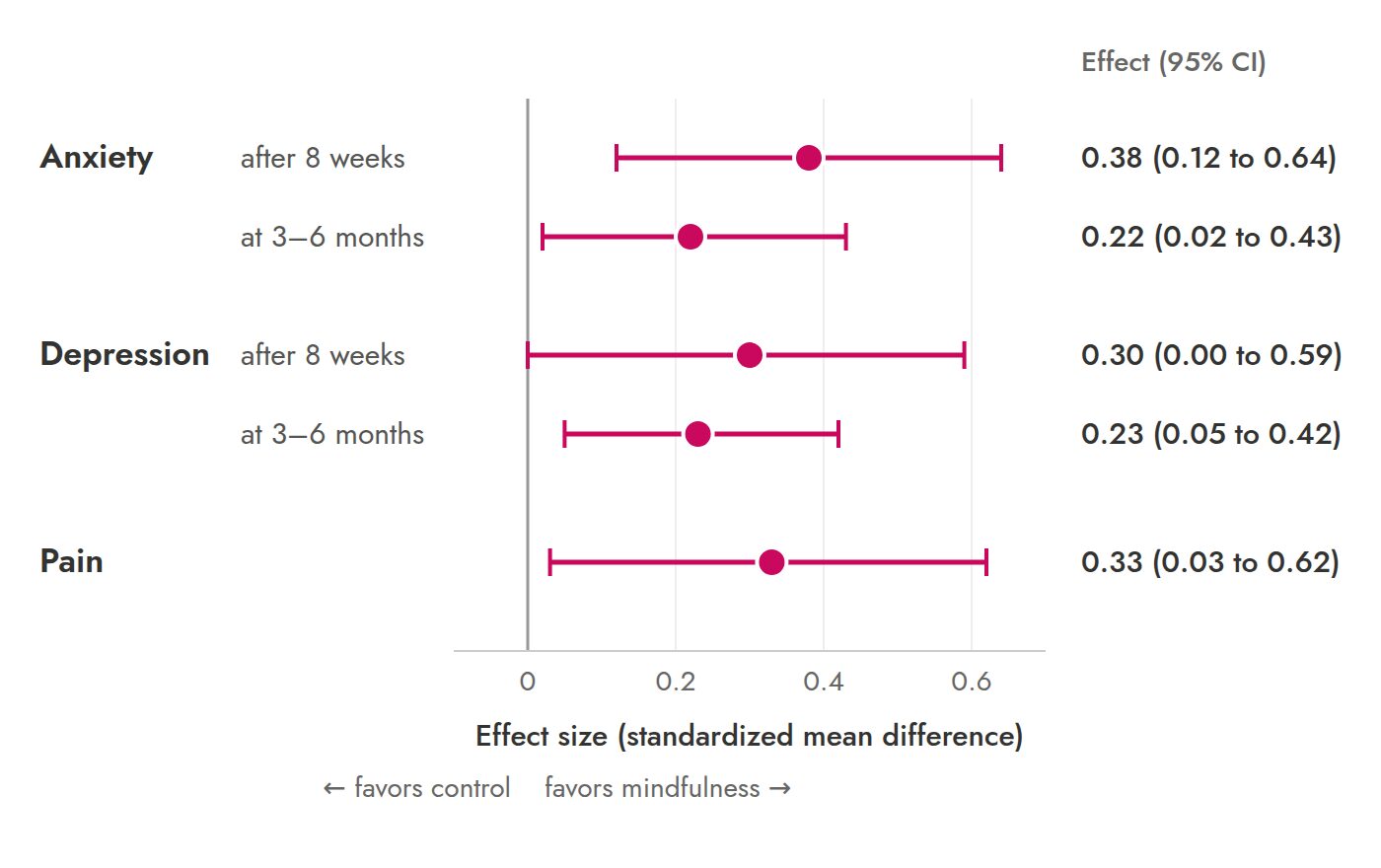
The authors call these effects small, and the confidence intervals show how uncertain they are. For depression after 8 weeks, the interval runs from 0.00 to 0.59, so the data can’t rule out no effect at all. Still, the signal pointed the same way across anxiety, depression and stress. Combining these, the authors saw “a small and consistent signal” that mindfulness programs improve negative mood across a broad range of clinical conditions.
To put the size in context, they compared it with antidepressants:
These small effects are comparable with what would be expected from the use of an antidepressant in a primary care population, without the associated toxicities.
They base this on an analysis of patient data from earlier drug trials, which found effect sizes against placebo of 0.11 for antidepressants in mild to moderate depression and 0.17 in severe depression. That figure comes from different studies, people and measures, so the comparison is a rough benchmark, not a head-to-head test. Nor does it show that meditation can replace antidepressants.
Miscellaneous Interesting Takeaways
Most Outcomes Had Weak or Missing Evidence
The review set out to look at much more than negative mood. For positive mood, attention, sleep and weight, the authors found either low evidence of no effect or insufficient evidence of any effect. For behaviors that stress can drive, such as substance use and eating, the evidence was insufficient. No outcome, positive or null, reached a high grade. The authors summarize:
Despite our focus on RCTs using active controls, we were unable to detect a specific effect of meditation on most outcomes, with the majority of our evidence grades being insufficient or low.
“Insufficient” doesn’t mean meditation fails to help with these things. It means the trials that existed were too few, too small or too inconsistent to say. Sleep is an example: a later meta-analysis of 18 trials in people with sleep problems found that mindfulness improved sleep quality more than matched programs.
Mantra Meditation Showed No Clear Benefit
Mantra programs, including TM, did not improve any of the outcomes examined, but the evidence for this was graded only low to insufficient. Very few mantra trials met the criteria, and three of the TM trials enrolled heart patients, who may not have had much anxiety or distress to reduce in the first place.
Meditation Was No Better Than Exercise, Relaxation or Therapy
Against established treatments such as exercise, progressive muscle relaxation, cognitive behavioral group therapy and drugs, the review found, for every outcome, either low evidence of no effect or insufficient evidence that meditation did better. That is not the same as showing meditation works as well. The trials averaged only 37 people per group, and none appeared large enough to show that meditation is equivalent to, or no worse than, the other treatment.
The Pain Effect Varied by Condition
Nine trials measured pain, and the pooled effect of 0.33 came from four of them: two in people with musculoskeletal pain, one in people with irritable bowel syndrome and one in people who were not recruited for pain. The benefit was uneven. Visceral pain, the kind felt in irritable bowel syndrome, improved by a statistically significant relative 30%, while musculoskeletal pain improved by only 5–8%, which was not statistically significant.
Short Courses, Weak Trials and Thin Reporting
Some trials predated modern standards for clinical trials, and many did not report enough to judge their quality fully. The most common problems were outcome assessors who knew which group people were in, high dropout, poorly concealed group assignment and analyses that left out people who dropped out. Only five trials reported how much meditation experience their teachers had. Only nine reported on possible harms, and none of those found any, which says little given how rarely harms were asked about (a later study that asked in detail found unpleasant effects were common). The team also found nine registered trials whose results they could not find published, and five that hadn’t published all their planned outcomes, so some results may be missing from the published record.
The authors suggest the short courses may themselves limit what trials can show. Meditation traditionally is a skill built over a lifetime, and an 8-week course of about 2.5 hours a week is a small dose. As they put it, participants “likely did not achieve a level of expertise needed to improve outcomes that depend on mastery of mental and emotional processes.”
Final Reflection
This review is valuable mainly for its strictness. By keeping only trials with a comparison program that matched meditation for time, attention and expectations, it asked whether meditation does anything beyond the general benefit of joining a class. For anxiety, depression and pain, the answer was a qualified yes: mindfulness programs helped a little more, with moderate-strength evidence. For stress, the evidence was weaker, and for positive mood, attention, sleep, eating, substance use and weight it was too thin to say.
The authors conclude that clinicians “should be prepared to talk with their patients about the role that a meditation program could have in addressing psychological stress.” That is a measured recommendation, and it fits the data. Mindfulness programs look like a reasonable option for easing anxiety and low mood. But the effects are small, they have not been shown to beat other active treatments, and the questions the review left open called for larger, better-reported trials.
Citation
Goyal, M., Singh, S., Sibinga, E. M. S., Gould, N. F., Rowland-Seymour, A., Sharma, R., Berger, Z., Sleicher, D., Maron, D. D., Shihab, H. M., Ranasinghe, P. D., Linn, S., Saha, S., Bass, E. B., & Haythornthwaite, J. A. (2014). Meditation programs for psychological stress and well-being: A systematic review and meta-analysis. JAMA Internal Medicine, 174(3), 357–368. 10.1001/jamainternmed.2013.13018
Get the next summary by email
One or two new paper summaries every couple of weeks, sent to your inbox when they go up.
No spam, and you can unsubscribe at any time. Prefer a feed reader? Use the RSS feed.