
Background Information
Good feelings don’t last. Joy, gratitude or contentment typically fade within minutes, and they tend to be milder and less attention-grabbing than fear or anger. Yet people who often feel positive emotions tend to do better in life, with stronger friendships, better health and even longer lives. How could passing moods add up to lasting benefits?
Psychologist Barbara Fredrickson, this paper’s first author, proposed the
broaden-and-build theory
The broaden-and-build theory, proposed by psychologist Barbara Fredrickson in 1998, holds that positive emotions such as joy, interest and love briefly widen the range of thoughts and actions that come to mind. Over time, that broadened outlook is said to help people build lasting personal resources, such as skills, relationships, resilience and health, that serve them well later.
More on Wikipedia
Read more in the glossary
as one answer. Positive emotions, it says, briefly widen attention and thinking, and over time that wider outlook helps people build lasting “personal resources,” such as close relationships, a sense of purpose, resilience and good health. In the authors’ words:
Put simply, the broaden-and-build theory states that positive emotions widen people’s outlooks in ways that, little by little, reshape who they are.
The “broaden” half of the theory had been tested in many lab experiments. The “build” half was harder to test, because it needs positive emotions to be raised again and again over weeks. Lab methods such as film clips or small gifts work once, but the authors expected them to stop working if repeated daily, as people get used to them, a pattern known as the
hedonic treadmill
The hedonic treadmill (or hedonic adaptation) is the tendency for people to get used to good and bad changes in their lives and drift back toward their usual level of happiness. A raise, a new purchase or a pleasant routine may lift mood at first, but the lift tends to fade as it becomes familiar.
More on Wikipedia
Read more in the glossary
.
Fredrickson and her colleagues bet that meditation could keep working where a film clip would wear off, because it is a skill people can practice, adjust and carry into daily life. They chose
loving-kindness meditation
Loving-kindness meditation (mettā in Pali) is a Buddhist practice of deliberately cultivating warm, unconditional goodwill. Practitioners silently repeat wishes such as “may you be happy” or picture a person, usually starting with themselves or someone close and then extending the wishes to acquaintances, strangers, difficult people and all beings. It is one of the four brahmaviharas.
More on Wikipedia
Read more in the glossary
, which deliberately cultivates warm feelings toward oneself and others, rather than the more widely studied
mindfulness
Mindfulness is the psychological process of purposely bringing one’s attention to experiences occurring in the present moment without judgment. It involves maintaining awareness of thoughts, feelings, bodily sensations, and surrounding environment with an attitude of curiosity and acceptance. In meditation contexts, mindfulness practices typically involve focusing attention on the breath or body sensations as anchors to the present moment while acknowledging and releasing distracting thoughts.
More on Wikipedia
Read more in the glossary
meditation. Their question was not mainly whether meditation is good for people. It was whether positive emotions, raised by meditation, build resources that make people more satisfied with their lives.
What They Did
The study took place at the Detroit headquarters of Compuware, a large software and IT services company, as part of a workplace wellness program. All of the roughly 1,800 full-time employees with a company email address were invited to a study of “the benefits of meditation… [to] reduce stress.” Of the 202 who enrolled and completed a first survey, 102 were randomly assigned to a meditation workshop and 100 to a
wait-list control group
A wait-list control group is a comparison group that receives the program being studied only after the study period, so participants who are waiting can be compared with those already taking part. It controls for the passage of time and repeated testing, but not for the attention, expectations and setting that come with taking part in any program, which an active control group can address.
More on Wikipedia
Read more in the glossary
, who were offered the same workshop once the study was over.
The workshop had six 60-minute group sessions spread over seven weeks (because of religious holidays), with 20 to 30 people per group, held during work hours. All were led by a stress-management specialist with long experience of the practice, who is one of the paper’s authors. Each session included a 15- to 20-minute group meditation, time for questions, and a short talk on bringing the practice into daily life. Participants were asked to meditate at home at least five days a week with a CD of guided meditations, which grew from 15 to 22 minutes. In the first week, they directed love and compassion toward themselves. Over the following weeks, they widened the circle to loved ones, acquaintances, strangers and finally all living beings.
For about nine weeks, starting a week before the workshop and ending a week after it, everyone in both groups filled in a short online report each day. They rated how strongly they had felt each of 19 emotions in the past day, from 0 (not at all) to 4 (extremely), and said how much time they had spent in “meditation, prayer, or solo spiritual activity.” The researchers combined nine of the emotions (amusement, awe, contentment, joy, gratitude, hope, interest, love and pride) into a weekly positive-emotion score.
Before the workshop and about two weeks after it ended, participants also filled in questionnaires on 18 personal resources, which the authors grouped into four kinds:
- Cognitive: mindfulness, two kinds of hopeful thinking (believing you can reach your goals, and seeing many ways to reach them), and savoring good experiences past, present and future.
- Psychological: optimism, resilience, personal growth, a sense of mastery over daily life, autonomy, self-acceptance and purpose in life.
- Social: support given to others, support received, and positive relations with others.
- Physical: how often they had illness symptoms such as headaches or congestion, and how many hours they slept.
They also rated their life satisfaction and their depressive symptoms. At the end, they reconstructed the morning of the day they filled in the final survey, episode by episode, rating their emotions in each.
Participants were paid up to $101 for the surveys and daily reports, and the company gave them paid time off work to attend. The researchers dropped 63 people from the main analysis, roughly equally from both groups: 7 who didn’t keep to their random assignment, 27 who didn’t complete the final survey, 5 meditators who attended fewer than three classes and 24 who filled in fewer than 30 of the 61 daily reports. That left 139 people, 67 meditators and 72 on the wait-list. About two-thirds were women, their average age was 41, about three-quarters were white, and most had a bachelor’s or master’s degree.
One Big Result: Positive Emotions Rose Slowly in the Meditation Group, Not in the Wait-List Group
The meditators did meditate. In the week before the workshop, both groups spent about 12 to 13 minutes a week in meditation, prayer or solo spiritual activity. During the workshop, the meditation group averaged about 80 minutes a week, falling to about 60 minutes after the classes ended.
Over the nine weeks of daily reports, the meditation group’s positive emotions climbed, while the wait-list group’s didn’t change. The difference between the groups’ trends was statistically significant (p = .0004). It was also gradual: positive emotions rose by about 0.03 points a week on the 0-to-4 scale, and the authors note they did not rise significantly until the third week. Each of the nine positive emotions followed the same pattern, so the rise wasn’t driven by love or contentment alone. Negative emotions such as anger, sadness and fear did not change.
The authors acknowledge that the effect was modest:
These shifts in positive emotions took time to appear and were not large in magnitude, but over the course of 9 weeks, they were linked to increases in a variety of personal resources, including mindful attention, self-acceptance, positive relations with others, and good physical health.
Practice seemed to get more effective with time. Among the meditators, an hour of practice in the second week went with 0.06 points more positive emotion, a link that fell short of significance (p = .06). By the seventh week, an hour of practice went with 0.17 points more, about three times as much, and in the week after the classes ended the link stayed about as strong (0.18). The authors read this as people building “a dependable skill for self-generating positive emotions” rather than growing bored with it. Since people chose how much to practice, though, these are links between practice and mood, not proof that practice caused the change.
Miscellaneous Interesting Takeaways
People Whose Positive Emotions Rose Most Reported More Resources
To test the build idea, the researchers estimated how fast each person’s positive emotions rose over the nine weeks and checked whether that rise predicted changes in each resource, and whether changes in the resource in turn predicted changes in life satisfaction. They ran this
mediation analysis
Mediation analysis is a statistical method that tests whether a third variable helps explain the link between a cause and an effect, for example whether a brain change helps explain why a training program altered a health marker. It estimates how much of the overall effect runs through that variable. A significant result is consistent with a causal pathway but does not prove one on its own.
More on Wikipedia
Read more in the glossary
separately for each of the 18 resources.
For 9 of the 18, both links held: people whose positive emotions rose more reported bigger gains in mindfulness, seeing many ways to reach their goals, looking forward to good things (savoring the future), mastery of daily life, self-acceptance, purpose in life, support received, and positive relations with others, and fewer illness symptoms. Those gains, in turn, went with rising life satisfaction. Resilience rose with positive emotions, but its link to life satisfaction fell short of significance.
The other resources did not rise significantly with positive emotions: optimism, personal growth, autonomy, the other kind of hopeful thinking, savoring the past and present, support given to others, and hours of sleep. Six of these still went with changes in life satisfaction.
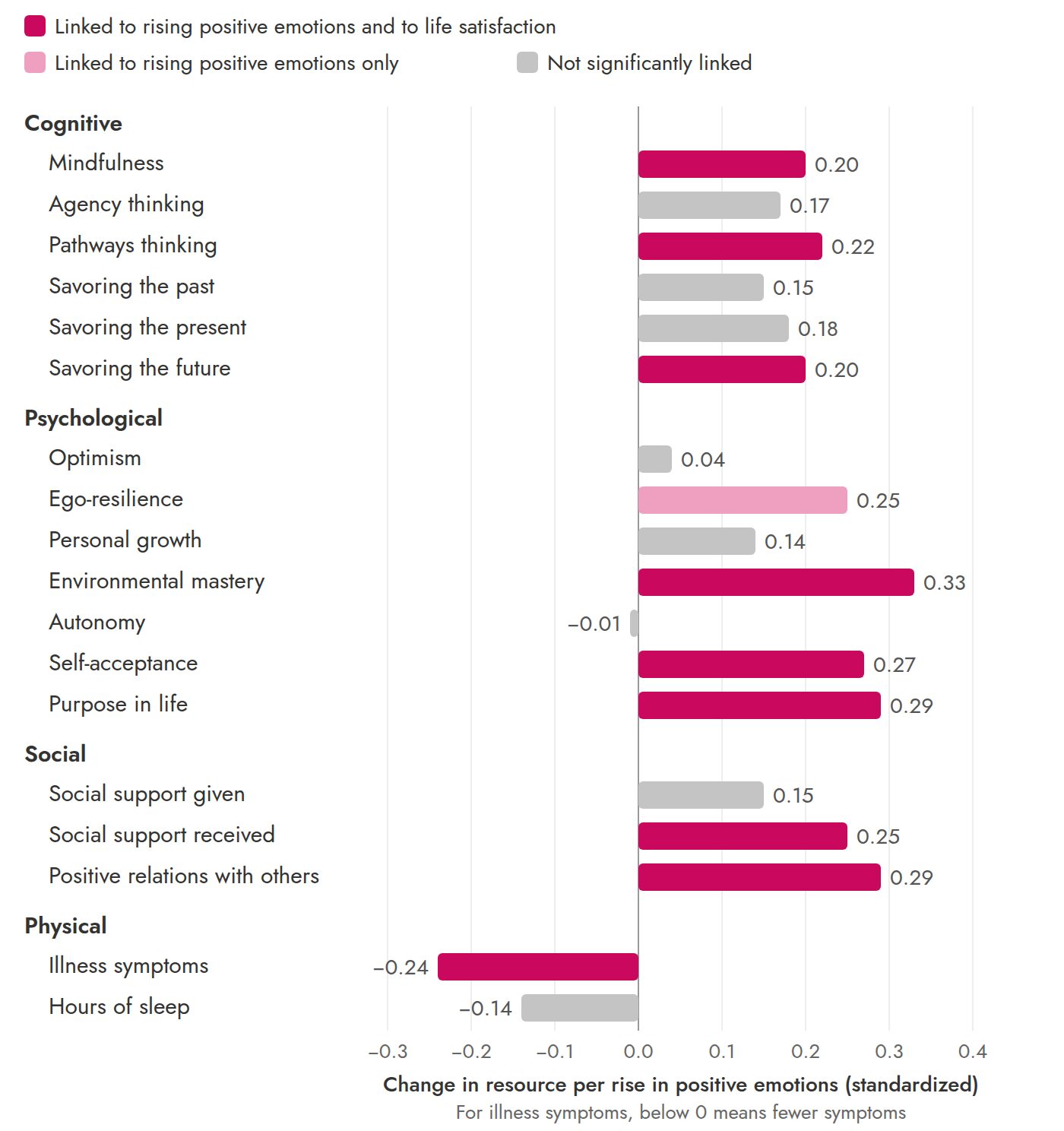
The links were modest. The models accounted for 5–10% of the variation in how much each of those nine resources changed. In these models, positive emotions were linked to life satisfaction only through the resources, which the authors take to mean that people feel more satisfied with life not simply because they feel good more often, but because those feelings help them build a better life.
When depressive symptoms replaced life satisfaction as the outcome, the same nine resources showed the same pattern (eight of them once a direct link was allowed). Here, though, rising positive emotions were also linked directly to falling depressive symptoms, beyond what the resources explained.
What the Models Can and Can’t Show
It’s important to be clear about what was randomized. Random assignment means the meditation workshop can be credited with the rise in positive emotions, at least among the people who completed the study. The later steps, from emotions to resources to life satisfaction, compare people within the study who happened to change more or less. Those are correlations. Resources and life satisfaction were measured only twice, before and after, so the models can’t show that resources grew before life satisfaction did, or rule out that the arrows run another way, or that something else drove all three. Running 18 separate models, with no correction described for
multiple comparisons
The multiple comparisons problem arises when researchers run many statistical tests at once. Each test has a small chance of a false positive, so across thousands of tests, such as one for every point in a brain scan, some “significant” results will turn up by chance alone. Corrections raise the bar for significance to keep the overall false-positive rate down, at the cost of making small real effects harder to detect.
More on Wikipedia
Read more in the glossary
, also raises the chance that a few links appear by luck.
The paper also doesn’t report the simplest comparison: whether the meditation group gained more resources, life satisfaction or freedom from depression than the wait-list group. Across both groups together, life satisfaction rose from 4.10 to 4.50 on a 7-point scale and depression scores fell from 15.9 to 12.8, but those figures aren’t split by group. When the researchers added direct paths from being in the workshop to each resource, these were “generally nonsignificant,” which they interpret as the workshop working through positive emotions.
Counting Everyone Weakened the Main Result
Only 139 of the 202 people who started were in the main analysis. When the researchers repeated the analysis with everyone who was successfully randomized (195 people, an
intention-to-treat analysis
An intention-to-treat analysis counts every randomized participant in the group they were assigned to, whether or not they completed or even started the treatment. It keeps the benefit of randomization, since dropping people who didn’t follow their plan can leave groups that differ in other ways, and it estimates what happens when a treatment is offered in practice rather than when it is taken exactly as intended.
More on Wikipedia
Read more in the glossary
), the difference between the groups’ positive-emotion trends was no longer significant (p = .17), nor was it in a “per-protocol” sample of 175 who received at least three classes or were on the wait-list (p = .11). The link between time spent meditating and positive emotions held up, and so did most of the links to resources. The authors drew a cautious conclusion:
However, these analyses suggest that conclusions about the efficacy of LKM may need to be restricted to individuals who invest adequate effort in training and practice (approximately 70% in this sample).
Here LKM is loving-kindness meditation.
No Rise in Compassion, and Some Uneven Starts
Oddly for a practice built on warmth toward others, the daily compassion rating didn’t change significantly. The authors suspect their single question, which asked about “sympathy, concern or compassion,” pointed people toward responses to others’ suffering, which may not come up every day. The meditation group also started the study with somewhat lower positive emotions than the wait-list group, significantly so for interest, which the authors liken to the hard first weeks of any new habit. Even in the week before classes began, people who spent more time in meditation, prayer or solo spiritual activity reported more positive emotions, a reminder that people who practice more may differ from those who practice less.
More Positive Emotion on an Ordinary Morning, Especially With Other People
The reconstructed morning, about two weeks after the classes ended, gave a closer look at everyday life. Being in the meditation group did not by itself predict more positive emotion that morning. What did was the total time a person had spent meditating over the previous nine weeks. That link held even after accounting for the nine people who had meditated that morning, and it was stronger during episodes spent interacting with other people. In this kind of meditation, the authors suggest, the warm feelings may carry over into social life.
Checks on Expectation and a “Rosy Glow”
A wait-list group doesn’t attend classes, meet a caring instructor or get paid time off, so it can’t rule out that expectations or the setting raised people’s mood. The authors offer several arguments against this. Placebo-like effects usually appear quickly, while positive emotions here rose only from the third week. Positive emotions weren’t higher on class days or the day after. And time spent meditating predicted positive emotions even after accounting for which group a person was in. They also checked whether a good mood on the day of the final survey made people rate their resources more highly, and found that it didn’t explain the changes. These checks help, but a comparison with another active program, such as a different kind of class, would settle the question better, as the authors acknowledge.
Final Reflection
This study was an early and ambitious attempt to show that loving-kindness meditation can do something a film clip probably can’t: lift everyday positive emotions week after week. Among working adults who kept up with the program, it did, slowly and modestly, with no change in negative emotions. And the people whose positive emotions rose most also reported the biggest gains in things like purpose, self-acceptance and relationships, along with more satisfaction with life.
The study’s limits matter, though. The firm, randomized result is the gradual rise in positive emotions among the 139 completers, and even that wasn’t significant when everyone who started was counted. The claim that those emotions built the resources, which then raised life satisfaction, rests on correlations between changes measured over the same weeks, all reported by the participants themselves. The sample was motivated, well-educated office workers who were paid, given time off and followed for about ten weeks.
Later work on this site points in a similar direction with different methods. Two weeks of compassion training made people more generous toward a stranger in a lab game, and in six weeks of compassion meditation the students who practiced more had smaller stress responses, though the groups as a whole didn’t differ. Long-term loving-kindness practitioners showed hints of a smaller brain bias toward their own face. Like this study, these suggest that practicing warmth toward others may change people, but that how much they practice matters, and that firm proof of lasting change in daily life is still to come.
Citation
Fredrickson, B. L., Cohn, M. A., Coffey, K. A., Pek, J., & Finkel, S. M. (2008). Open hearts build lives: Positive emotions, induced through loving-kindness meditation, build consequential personal resources. Journal of Personality and Social Psychology, 95(5), 1045–1062. 10.1037/a0013262
Get the next summary by email
One or two new paper summaries every couple of weeks, sent to your inbox when they go up.
No spam, and you can unsubscribe at any time. Prefer a feed reader? Use the RSS feed.