
Background Information
By 2010, studies of experienced meditators and of people on long retreats had linked mindfulness practice to better attention, and 8-week programs such as
Mindfulness-Based Stress Reduction (MBSR)
Mindfulness-Based Stress Reduction (MBSR) is a program designed to help individuals cope with stress, pain, and illness. Developed by Jon Kabat-Zinn in the 1970s, it combines meditation and yoga to promote awareness and stress management. The eight-week program teaches participants to focus on the present moment non-judgmentally, enhancing their ability to manage difficulties.
More on Wikipedia
Read more in the glossary
to better mood. But those programs take a lot of time, and most people will never sit a three-month retreat. The authors wanted to know whether a much briefer dose could produce some of the same benefits in complete beginners.
Earlier work had hinted that it might. In a randomized trial by Tang and colleagues, five days of 20-minute integrative body–mind training improved attention and mood in Chinese undergraduates. That method mixes several techniques, though, including mindfulness, imagery and music, so it was hard to tell which one did the work. This team had also found that three days of mindfulness training reduced pain ratings and anxiety. Here they set out to test plain breath-focused mindfulness against cognitive tasks that make different demands on
working memory
Working memory is the small, short-lived mental workspace that holds information while you use it, such as a phone number you are about to dial or the running total of a sum done in your head. It holds only a few items at once and depends on attention, so a distraction or a wandering mind can quickly empty it. Psychologists measure it with tasks such as digit span and the n-back.
More on Wikipedia
Read more in the glossary
, sustained attention and verbal skills.
What They Did
Sixty-three students at the University of North Carolina, Charlotte volunteered to fulfill a requirement of their General Psychology course. All were interested in learning meditation and had never meditated. Assignment was by week rather than by person: the two programs were randomly assigned to weeks, and each student got whichever program ran in the week they signed up for. Seven people in each group did not finish, leaving 24 in the meditation group and 25 in the control group. The two groups did not differ at the start in age, gender, ethnicity, or any of the questionnaires or cognitive tests.
Each group met four times, on four days, for 20 minutes, in small groups. The meditation training was based on basic
Shamatha
Shamatha (Pali samatha, “calm abiding”) is a Buddhist family of concentration practices that train attention to settle and stay on a chosen object, such as the sensations of the breath. Practitioners notice when the mind has wandered and bring it back, aiming for attention that is both stable and vivid. It is often paired with vipassana, or insight, practice.
More on Wikipedia
Read more in the glossary
skills and led by a facilitator with 10 years’ experience teaching mindfulness. In the first session, groups of three to five people learned to relax with their eyes closed and focus on the breath at the tip of the nose. When a thought came up, they were to notice it, let it go and bring their attention back to the breath. In sessions 2 and 3 they followed the whole breath, from the nostrils to the abdomen and back, and noticed sensations in the body, and session 4 left more time for silent practice. After each session, every meditator was asked “Did you feel that you were truly meditating?”, and they consistently said they had.
The
active control group
An active control group is a comparison group that takes part in a different program designed to be just as engaging as the one being tested. In meditation research, it might involve exercise, music, or education classes with the same time commitment, teachers, and expectations of benefit. Comparing against an active control helps separate the effects of meditation itself from the general effects of joining a course.
More on Wikipedia
Read more in the glossary
listened to J.R.R. Tolkien’s The Hobbit on CD, in small groups, picking up the story where it left off each time. They were asked to silence their phones and sit quietly, and a research assistant sat with them to check that they were paying attention.
Before the first session and after the fourth, everyone took four kinds of cognitive test:
- Symbol Digit Modalities Test: using a key that pairs numbers with geometric symbols, match as many as possible in 90 seconds. The authors describe it as a test of complex visual tracking and working memory.
- Verbal fluency: say as many words as possible beginning with given letters (F, A and S, or C, F and L).
- Digit span: repeat back strings of digits, forwards and then backwards.
- An adaptive
2-back task
The n-back task is a working memory test in which people watch a stream of items, such as letters, and say whether each one matches the item a set number of steps back (two steps in a 2-back task). Doing it well means constantly updating what you hold in mind while letting go of older items, so it demands steady attention.
More on Wikipedia
Read more in the glossary : watch a stream of letters and say whether each one matches the letter two before it. The program speeds up or slows down to hold each person’s accuracy at a set level, then records how fast they could go and the “extended hit rate,” a count of runs of correct answers.
Alternate versions were used the second time for every test except the symbol-coding one. Everyone also filled in questionnaires on mindfulness (the Freiburg Mindfulness Inventory), mood (the
Profile of Mood States
The Profile of Mood States (POMS) is a questionnaire in which people rate how strongly they have felt a list of moods. It gives scores on six scales: tension–anxiety, depression–dejection, anger–hostility, fatigue–inertia, confusion–bewilderment and vigor–activity, the only positive one. Researchers use it to track short-term changes in mood, for example before and after a training program.
More on Wikipedia
Read more in the glossary
) and depression (the CES-D) at the start and end, and rated their anxiety on the
State Anxiety Inventory
The State Anxiety Inventory is the half of the State-Trait Anxiety Inventory (STAI) that asks how anxious someone feels right now, rather than how anxious they tend to be in general. People rate 20 statements such as “I feel worried” from 1 (not at all) to 4 (very much so), giving a score from 20 to 80. Because it captures the moment, researchers can give it just before and just after a single session.
More on Wikipedia
Read more in the glossary
before and after every session.
One Big Result: Meditators Improved More on Three of the Six Cognitive Scores
Both groups did better the second time on most tests, as people usually do when they repeat a test. The question was whether the meditators improved more. A combined test across all six cognitive scores found that the groups changed differently, though only just (p = .05). Looking at each score:
- Symbol-coding test: the meditation group improved significantly and the audiobook group did not (difference in change: p = .01).
- Verbal fluency: the same pattern (p = .03).
- 2-back task, runs of correct answers: the meditation group had more runs of correct answers after training than the audiobook group (p = .01).
- 2-back task, speed: no change in either group.
- Digit span, forwards and backwards: both groups improved, and the meditators did not improve significantly more. Across everyone, forward span went from 10.85 to 12.02 and backward span from 6.60 to 7.10.
The
effect sizes
Effect size is a statistical concept that quantifies the magnitude or strength of a relationship, difference, or intervention outcome. Unlike p-values which only indicate statistical significance, effect sizes measure how meaningful a result is in practical terms. Common measures include Cohen’s d (standardized mean difference), correlation coefficients (r), and odds ratios. In meditation research, effect sizes help quantify the practical impact of different meditation practices on psychological or physiological outcomes.
More on Wikipedia
Read more in the glossary
for these three differences (η² = .10 to .13) are moderate by common conventions. The paper shows the groups’ scores after training only in a chart, without the numbers, so it isn’t possible to say from its text how many more symbols the meditators coded or words they found.
The authors read the 2-back result strongly:
Our findings provide robust evidence that brief MM training enhances sustained attention.
(MM stands for mindfulness meditation.) The study did not include a dedicated test of sustained attention, however. That conclusion rests on interpreting longer runs of correct answers on the 2-back task as steadier attention, in one small study, and the abstract’s claim that the training improved working memory sits alongside the digit-span results, where the meditators did no better than the audiobook listeners.
Miscellaneous Interesting Takeaways
Both Groups Felt Better, but Only Meditation Calmed People on the Spot
Mood improved in both groups. Total scores on the Profile of Mood States and depression scores on the CES-D fell from the first session to the fourth, with no difference between the groups. The authors suggest that listening to The Hobbit may itself have been relaxing.
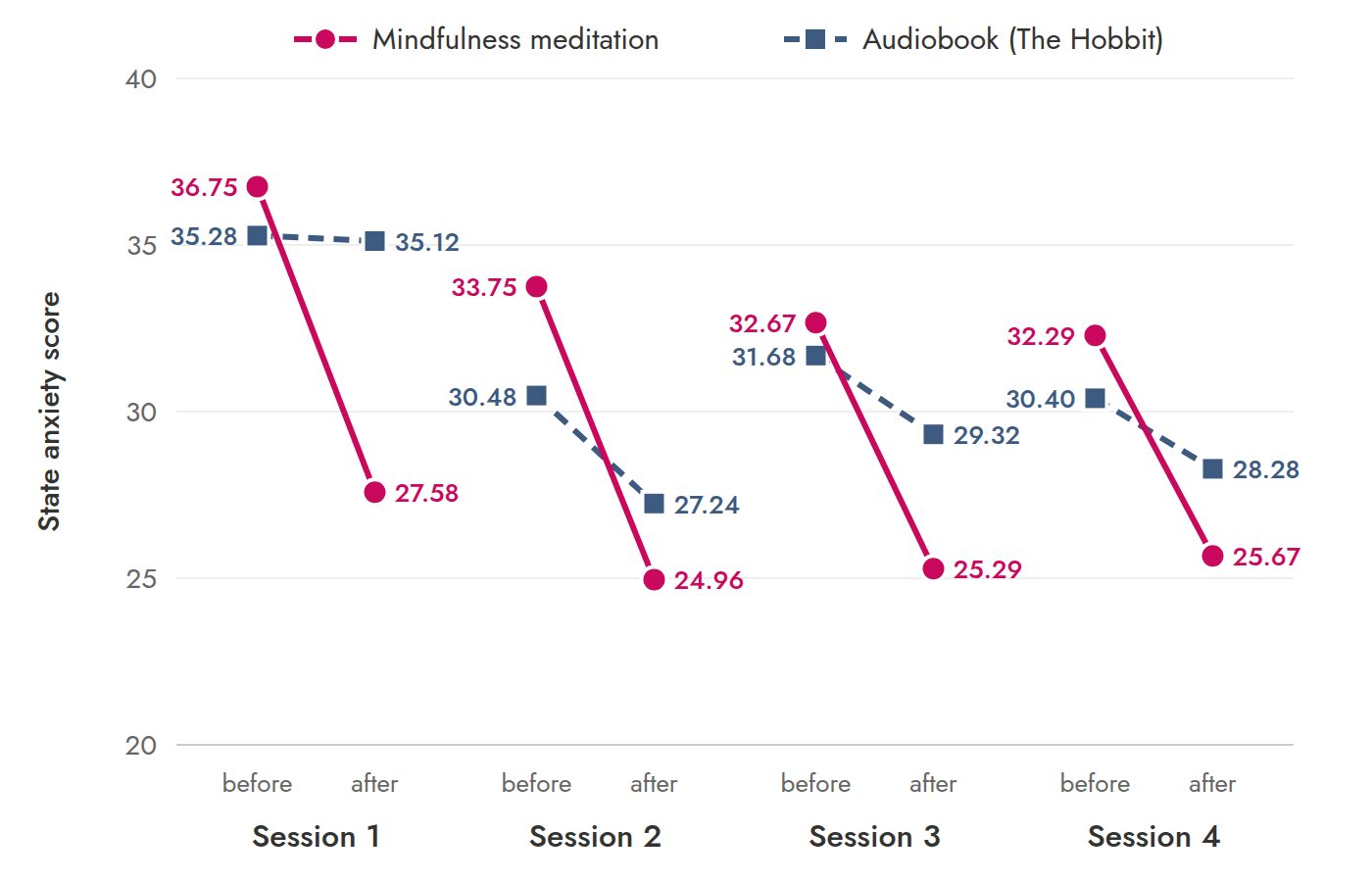
Anxiety told a different story within each session. Meditators’ anxiety dropped sharply from just before each session to just after it, by 6.6 to 9.2 points, while the audiobook listeners’ barely moved in the first session and fell by 2 to 3 points in the others. On average across the four sessions, meditators went from 33.86 to 25.88 and listeners from 31.96 to 29.99, a highly significant difference between the groups (p < .001). Anxiety also declined over the four sessions in both groups, at a similar rate, so this was an immediate calming effect of each session rather than a difference that grew with practice.
Less Fatigue and More Mindfulness, With a Caveat
On the mindfulness questionnaire, the meditation group’s scores rose from 43.33 to 49.96 while the audiobook group’s barely changed (47.00 to 48.36), a significant difference (p = .02). The meditators started a little lower, though not significantly so.
Fatigue on the mood questionnaire fell in the meditation group (from 5.54 to 1.71) and stayed flat in the audiobook group (4.84 to 4.80). The authors themselves urge caution here: the combined test across all six mood scales only approached significance (p = .06), and none of the other mood scales differed between the groups.
Was It Training, or Just Having Meditated?
The second round of tests came straight after the fourth session. So the meditators were tested minutes after 20 minutes of meditation, when they were also much less anxious, while the control group had just listened to an audiobook. The authors acknowledge this:
Additionally, the improvements exhibited by the meditation group may be due to direct effects of just having meditated in session four.
The design can’t separate a skill built over four days from a short-lived state left by the last session. There was no later follow-up to see whether any difference lasted.
Mind Wandering Was the Proposed Mechanism, Not a Measurement
In their discussion, the authors propose that the training helped people notice when their attention drifted, so that less
mind wandering
Mind wandering is the spontaneous shift of attention away from a current task or external environment to internally generated thoughts, memories, or fantasies. This common cognitive process is associated with default mode network activation and has been extensively studied in relation to meditation practices, which often aim to reduce mind wandering.
More on Wikipedia
Read more in the glossary
disrupted the tasks, and that better mood may also have reduced it. That idea fits the instructions the meditators were given, but the study didn’t measure mind wandering, so it remains a hypothesis.
What the Design Can and Can’t Show
- Assignment by week. The programs were randomly assigned to weeks, but students chose which week to sign up for. The paper doesn’t say how many weeks were involved, so it’s unclear how close this came to randomizing individuals.
- A disappointed control group? Everyone volunteered because they were interested in learning meditation, and half of them were given an audiobook instead. That makes the audiobook a reasonable control for sitting quietly in a group, but not for expectations of benefit, which weren’t measured.
- Many tests, no correction. The authors ran an overall test before looking at individual scores, a common safeguard against chance findings, but the overall cognitive test only just reached significance, and the follow-up tests weren’t adjusted for
multiple comparisons
The multiple comparisons problem arises when researchers run many statistical tests at once. Each test has a small chance of a false positive, so across thousands of tests, such as one for every point in a brain scan, some “significant” results will turn up by chance alone. Corrections raise the bar for significance to keep the overall false-positive rate down, at the cost of making small real effects harder to detect.
More on Wikipedia
Read more in the glossary . - Small and specific. About two dozen students per group, all at one university, as the authors note when they say the findings can’t be generalized to older adults.
- Reporting. The paper doesn’t say whether the people giving and scoring the tests knew who was in which group, and it reports exactly the same statistics for the overall improvement on the symbol-coding test and on the 2-back runs, which may be a copying error.
Final Reflection
This study is a useful early test of a question many beginners care about: does even a small amount of practice do anything you can measure? Four 20-minute sessions of breath-focused mindfulness, 80 minutes in all, left a group of students calmer straight after each session and doing better than audiobook listeners on three of six cognitive scores. The authors were careful in one respect:
We do not suggest that brief mental training is as effective as extensive training regimens.
Their title, “Mindfulness meditation improves cognition,” and their talk of “robust evidence” claim more than one small study can support. The improvements were confined to some tasks, were measured right after a meditation session, and rest on statistics that only just cleared the usual bar. Later evidence gives a mixed picture: a meta-analysis of 111 randomized trials found small-to-moderate gains in attention and working memory after mindfulness training, but none in verbal fluency, one of the three measures that improved here.
The study’s lasting contribution is less any single number than its design: an active control that matched the time, the group setting and the quiet sitting, and a dose small enough to fit into anyone’s week. Read with that in mind, it suggests that a few short sessions can change how people feel and perform right afterward, and leaves open how much of that lasts.
Citation
Zeidan, F., Johnson, S. K., Diamond, B. J., David, Z., & Goolkasian, P. (2010). Mindfulness meditation improves cognition: Evidence of brief mental training. Consciousness and Cognition, 19(2), 597–605. 10.1016/j.concog.2010.03.014
Get the next summary by email
One or two new paper summaries every couple of weeks, sent to your inbox when they go up.
No spam, and you can unsubscribe at any time. Prefer a feed reader? Use the RSS feed.