
Background Information
Most diets work for a while and then fade. One reason, the authors argue, is that diet and exercise programs mostly ask people to track and restrict what they eat, without touching the habit that keeps pulling them back: eating because of a craving. Overweight and obese people report more frequent and more intense cravings for very tasty food than people of normal weight, and craving-related eating is a commonly reported reason for falling off an eating plan.
The authors frame this habit in terms of
operant conditioning
Operant conditioning is learning from the consequences of behavior. An action followed by something pleasant (positive reinforcement) or by relief from something unpleasant (negative reinforcement) becomes more likely to be repeated, so that over time a cue such as a sight, a place or a mood can set off the habit almost automatically.
More on Wikipedia
Read more in the glossary
. Eating something sweet or rich feels good, or brings relief from stress or boredom, and that reward teaches the brain to reach for food the next time the same cue appears, whether or not the body needs it. Over time, sights, places and moods can set off eating almost automatically.
The senior author, Judson Brewer, had earlier tested
mindfulness
Mindfulness is the psychological process of purposely bringing one’s attention to experiences occurring in the present moment without judgment. It involves maintaining awareness of thoughts, feelings, bodily sensations, and surrounding environment with an attitude of curiosity and acceptance. In meditation contexts, mindfulness practices typically involve focusing attention on the breath or body sensations as anchors to the present moment while acknowledging and releasing distracting thoughts.
More on Wikipedia
Read more in the glossary
training for smoking, where (the paper reports) it doubled quit rates and weakened the link between craving a cigarette and smoking one. A large meta-analysis later found that smoking was the one condition where mindfulness programs beat established treatments. The program tested here applies the same approach to food, in three steps: notice the habit and its triggers; look closely at what eating on a craving actually feels like afterwards, so its perceived reward is updated; and learn to stay with a craving until it passes. On the third step, the authors write:
The third step is learning to exist with, rather than distract oneself from, the experience of craving.
Delivering this through a phone app, rather than weekly classes, had two attractions: people can use the tools at the moment a craving strikes, and everyone gets exactly the same content.
What They Did
This was an early, “proof-of-concept” test: a single-arm trial, meaning everyone got the app and there was no comparison group. Its stated aims were to see whether women would sign up for and finish the program, whether craving-related eating would go down, and whether any drop would go along with weight loss.
The researchers advertised on Facebook and Google, in University of California, San Francisco (UCSF) email digests and in letters to UCSF patients who had agreed to be contacted about research. Of 1,651 people who filled in the online screener, 719 qualified. To take part, women had to have a
BMI
Body mass index (BMI) is a person’s weight in kilograms divided by the square of their height in meters. Adults with a BMI of 25 to 29.9 are classed as overweight and 30 or more as obese. It is a quick screening measure that does not distinguish fat from muscle.
More on Wikipedia
Read more in the glossary
of 25 or more (overweight or obese), no diabetes, a smartphone, food cravings most days of the week, and be able to attend in-person visits in the San Francisco Bay Area. They also had to pass a trial week of text messages: answer at least 7 of 9 and report at least 3 instances of craving-related eating. In the end 104 women enrolled. Their average age was 46 and their average BMI 31; 68% were white.
The app offered 28 lessons of 5 to 10 minutes. A new one unlocked each day, but only once the previous one was done, so it took at least 28 days to finish. Each lesson had a short video with animations and a practice to try, typically a meditation or mindful eating exercise. Early lessons covered setting goals, how habits form, a
body scan
The body scan is a meditation practice in which attention is moved slowly through the body, part by part, noticing whatever sensations are present without trying to change them. It is a core exercise in mindfulness programs such as MBSR.
More on Wikipedia
Read more in the glossary
, and which foods tend to drive cravings. Later ones taught noting hunger, craving and fullness while eating, telling stress-driven eating from physical hunger,
loving-kindness
Loving-kindness meditation (mettā in Pali) is a Buddhist practice of deliberately cultivating warm, unconditional goodwill. Practitioners silently repeat wishes such as “may you be happy” or picture a person, usually starting with themselves or someone close and then extending the wishes to acquaintances, strangers, difficult people and all beings. It is one of the four brahmaviharas.
More on Wikipedia
Read more in the glossary
and kindness toward oneself after a slip.
Between lessons, users could turn to in-the-moment tools. A “Stress Test” asked them to check in with their body and suggested whether what they felt was more like stress, habit or real hunger. A “Want-O-Meter” button walked them through a craving as it happened, leading to exercises such as RAIN: Recognize, Accept, Investigate and Note what the craving feels like as it rises and passes. Users could also choose to eat the craved food, but slowly and with attention.
The main measure used
ecological momentary assessment
Ecological momentary assessment (EMA), also called experience sampling, asks people to report what they are feeling or doing several times a day, in the moment and in their everyday surroundings, usually through short surveys sent to their phones at set or random times. Because answers are given on the spot rather than recalled later, they are less colored by memory than questionnaires about the past week or month, and they can show how experiences rise and fall through the day.
More on Wikipedia
Read more in the glossary
. Before starting, and again one month after finishing, each woman got text messages at 11:30 am, 4:30 pm and 9 pm on three days in a week (two weekdays and a weekend day). Each asked whether she had eaten or drunk something because of a craving in the last hour, and she replied yes or no. At the same two points she filled in questionnaires on trait food craving (how often she is preoccupied with food, loses control around it or craves it when emotional), reward-driven eating, and her motives for eating tasty food, and she was weighed in person.
The main analyses included the 78 women who finished the app within the study’s 7-month window, with a second set for the 64 who finished within 3 months.
One Big Result: Eating on Cravings Fell by 40%, but Weight Barely Moved
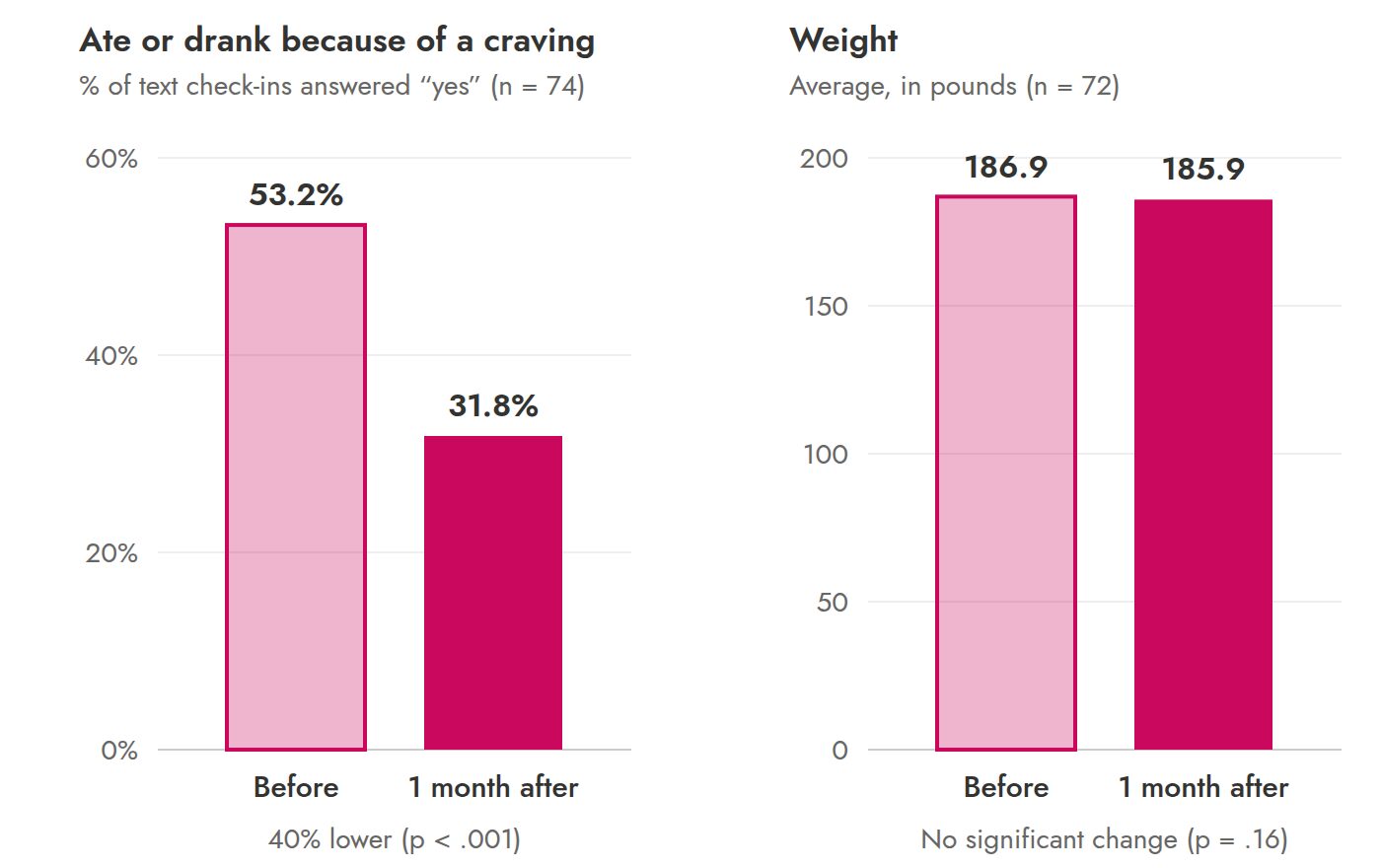
Among those who finished, the share of text check-ins in which women said they had eaten or drunk something because of a craving fell from 53.2% before the app to 31.8% one month after it (74 women), a relative drop of 40%. The women who finished within 3 months showed almost the same change, from 52.9% to 33.7%. The researchers had planned their study expecting a drop of about 30%.
The questionnaires told the same story. Trait food craving fell by about a quarter (from 61.8 to 46.6 on a scale running from 15 to 90), reward-driven eating by about 29%, and eating tasty food to cope with emotions by about a third. Eating for pleasure, for social reasons and to fit in with others also fell. All of these changes were statistically significant. The drops in craving-related eating and trait food craving also held up after the researchers accounted for missed text messages and for how long each woman took to finish.
Weight was another matter. Across everyone who finished, average weight went from 186.9 to 185.9 pounds, a 1-pound (about 0.5 kg) change that was not statistically significant. The women who finished within 3 months lost 1.8 pounds (about 0.8 kg) on average, which was significant. Weight was the clinical outcome the program ultimately aims at, but the authors caution that they did not weigh people at a set time of day, so these numbers “should be interpreted with caution.”
The authors’ conclusion is measured:
The results suggest that this intervention is feasible, engaging, and may reduce craving-related eating over time.
Miscellaneous Interesting Takeaways
Most Women Finished, at Their Own Pace
Three-quarters of the women who enrolled (78 of 104) finished all 28 lessons within the study window, and 64 (62%) did so within 3 months. Six withdrew because of major life events, such as a death in the family or surgery. Although the app could be finished in 28 days, it took 58 days on average (median 48, range 29 to 139). On average the women opened the app about twice a day and used it for about 12 minutes a day. Counting everyone who enrolled, they completed an average of 23 of the 28 lessons, and there was no particular lesson after which people tended to give up. How long a woman took to finish was not linked to how much her craving-related eating fell.
Less Craving Went With More Weight Loss, Modestly
Women whose trait food craving fell more tended to lose more weight. The correlation was r = .33 (p = .010) among those who finished within 3 months, and r = .23 among everyone who finished, which just missed statistical significance (p = .052). The abstract reports slightly different figures for the same tests (r = .30 and r = .22), so the exact values are uncertain, but the pattern is the same. The drop in craving-related eating measured by text message was not linked to weight change. The authors suggest this is partly a measurement problem: each woman’s yes-or-no answers were boiled down to a single before-and-after difference.
What a Single-Arm Trial Can’t Tell Us
Without a control group, there is no way to know how much of the change the app itself caused. The authors are clear about this:
Future designs should add an active control group, as these analyses are unable to account for factors such as interaction with one’s smartphone (which may, for example, increase self-monitoring behavior), goals setting, motivation, and the fact that participants were aware of their participation in a study focused on food cravings.
Apart from weight, every outcome was self-reported by women who knew the study was about food cravings, which leaves room for
demand characteristics
Demand characteristics are cues in an experiment that hint at what the researchers expect, which can lead participants to behave the way they think they are supposed to rather than how they normally would. Researchers reduce them by disguising the study’s purpose, measuring behavior unobtrusively, or using comparison conditions that seem just as plausible.
More on Wikipedia
Read more in the glossary
. The analyses also covered only the women who finished; the 26 who didn’t were left out, rather than counted as in an
intention-to-treat analysis
An intention-to-treat analysis counts every randomized participant in the group they were assigned to, whether or not they completed or even started the treatment. It keeps the benefit of randomization, since dropping people who didn’t follow their plan can leave groups that differ in other ways, and it estimates what happens when a treatment is offered in practice rather than when it is taken exactly as intended.
More on Wikipedia
Read more in the glossary
.
The authors are careful about weight, which they say “should be interpreted with caution” because participants weren’t weighed at a set time of day, and they say the next step is a trial with an active control group and more consistent measurements.
Who Took Part, and Who Made the App
The participants were women only, without diabetes, living near San Francisco and able to attend in-person visits, so the results may not apply more widely. The authors note that the sample was somewhat more diverse than in most app studies for weight loss, which have often been at least 80% white. They also point out that 493 of the 719 women who qualified on the screener didn’t complete the baseline survey, so those who went on to enroll may have been unusually motivated.
The paper calls the program simply “the app.” Its conflict-of-interest statement says Brewer, who principally developed it, “owns stock in Claritas MindSciences, the company that produced the app”; the other three authors declared no conflicts. The study’s listed funding came from the US National Institutes of Health and university funds. Still, as with a Headspace trial run by the company’s own staff, independent tests would carry more weight.
Final Reflection
This study shows that a short, self-guided mindful eating course on a phone is something many women with frequent food cravings will sign up for and finish, and that those who finished reported eating on cravings much less often afterwards. That makes it a reasonable candidate for a proper trial. It doesn’t yet show that the app caused the change, or that it helps with weight: the average weight loss was about a pound, measured loosely, one month after the course.
The idea behind it is still appealing. Rather than fighting cravings with willpower or calorie counting, the program asks people to get curious about what a craving feels like and what eating on it actually gives them, and to let the craving rise and fall without acting on it. Whether it works better than simply paying more attention to one’s eating, or than the motivation that comes with joining a study, is the question a controlled trial would need to answer.
Citation
Mason, A. E., Jhaveri, K., Cohn, M., & Brewer, J. A. (2018). Testing a mobile mindful eating intervention targeting craving-related eating: Feasibility and proof of concept. Journal of Behavioral Medicine, 41(2), 160–173. 10.1007/s10865-017-9884-5
Get the next summary by email
One or two new paper summaries every couple of weeks, sent to your inbox when they go up.
No spam, and you can unsubscribe at any time. Prefer a feed reader? Use the RSS feed.